30 Day Trading Psychology Plan for Beginners: Rules and Templates
Beginner traders should build rule-based systems, not try to force better discipline through sheer willpower. The first move: write down your maximum risk per trade and a daily loss limit before you place another order. Everything else, including the templates and 30-day starter plan below, exists to make those two numbers automatic.
TL;DR:
- Limiting risk per trade to 1% and setting a daily loss cap of 3% helps prevent large, panic-inducing losses for beginners.
- Following a strict pre-trade checklist and grading setups reduces impulsive decisions driven by fear, greed, or FOMO.
- Tracking discipline scores through journaling and practicing rule adherence during a 30-day plan accelerates the development of consistent habits.
- Moving from paper trading to live micro-size trades ensures adherence to stop-loss rules and consolidates disciplined behavior before scaling up.
- Building a structured routine, including pre-session habits and post-trade reviews, minimizes emotional reactions and reinforces objective decision-making.
Table of Contents
- What Is Trading Psychology for Beginners?
- What Emotional Traps Wreck Beginner Accounts?
- How Do You Build a Trading Plan That Removes In-the-Moment Choices?
- What Risk Management Rules Actually Reduce Stress?
- What Pre-Session Habits Prevent Impulsive Trading?
- How Do You Measure Progress With Journaling and Practice?
- What Does a 30-Day Starter Plan Look Like?
- Final Takeaways and a Realistic Timeline
- Kai’s Perspective: Habits Beat Motivation
- Put the 30-Day Starter Into Action
- Sources
- FAQ
What Is Trading Psychology for Beginners?
Trading psychology is the set of emotional and behavioral patterns that shape decisions once real money is on the line. It’s not about being calm by nature. It’s about what you actually do when a trade moves against you at 2 p.m. with your rent payment sitting in that account.
For beginners, consistency in following rules matters more than finding a clever edge. A mediocre strategy executed the same way 100 times beats a great strategy abandoned halfway through a losing streak. Two names come up constantly for good reason: Dr. Alexander Elder, whose framework treats discipline as a trainable system, and Mark Douglas, whose work on trader mindset shaped how the industry talks about emotional control. Both point to the same behavioral reality that Britannica’s overview of trading psychology confirms: fear and greed hijack decision-making unless something else is steering.
What actually separates disciplined traders from everyone else:
- They follow a written plan even when a trade “feels” wrong to skip.
- They measure process (did I follow my rules?) separately from outcome (did I make money?).
- They treat losing streaks as data, not personal failure.
What Emotional Traps Wreck Beginner Accounts?
Every beginner hits the same five walls. Naming them early speeds up how fast you stop repeating them.
- Fear. You exit a winning trade too early because you’re scared of losing the gain. Defense: set your target before entry and let the trade run to it, full stop.
- Greed. You hold a winner past your target hoping for more. Defense: when price hits your planned exit, you’re done, no negotiating with yourself.
- FOMO. You jump into a trade because it’s already moving and you don’t want to miss out. Defense: if you didn’t plan the entry before the move started, you don’t take it.
- Revenge trading. You try to win back a loss immediately with a bigger, sloppier position. Defense: after any loss that breaks your rules, step away from the screen for at least ten minutes.
- Overconfidence. A winning streak convinces you the rules no longer apply to you. Defense: your position size stays fixed regardless of your last three outcomes.
Investopedia’s breakdown of trading psychology frames these as cognitive and emotional biases, loss aversion and overconfidence chief among them, and the fix is always structural, never a pep talk. For a deeper look at one of the most damaging patterns, see how to spot and stop revenge trading.
How Do You Build a Trading Plan That Removes In-the-Moment Choices?
A trading plan only works if it makes decisions before you’re staring at a live chart with adrenaline running. Write it when you’re calm, then treat it as non-negotiable during market hours.
Your plan needs:
- Entry conditions specific enough that two different days would trigger the same trade.
- A stop-loss level set before entry, not adjusted after.
- A profit target and position size calculated in advance.
- A daily loss limit that shuts down trading for the day once hit.
Add a setup grading system: rate every trade idea A, B, or C before entering. A-grade setups meet every criterion in your plan. B-grade setups miss one. C-grade setups are guesses dressed up as trades, and the rule is simple: you only take A’s, maybe B’s, never C’s. Pair that with a short pre-trade checklist you run through out loud, five items max, before clicking buy or sell.
Pro Tip: Print your checklist and tape it to your monitor. The physical friction of glancing at paper instead of clicking straight to the order ticket buys you the half-second most impulsive trades die in.

A ready-made version of this structure is available in the trading plan template, built to fill in once and reuse every session.
What Risk Management Rules Actually Reduce Stress?
Small, controlled losses don’t trigger panic. Big, unplanned ones do, so risk management is a psychology tool as much as a safety net.
Position sizing works backward from two numbers: how much you’re willing to risk in dollars, and how far away your stop is in price. If you have a $2,000 account and risk 1% per trade, that’s $20 at stake. If your stop is $0.50 away from your entry, you can buy 40 shares ($20 divided by $0.50). Change the stop distance and the position size changes with it, automatically, no guessing.
Starter defaults worth testing for your first month:
- Risk 1% of account value per trade, never more.
- Set your daily loss limit at 3%, and when you hit it, you’re done for the day.
- Place your stop the moment you enter, not after you’ve watched the trade breathe.
The risk management rules guide covers sizing formulas and stop placement in more detail if you want to build this out further.
What Pre-Session Habits Prevent Impulsive Trading?
Most bad trades happen because a trader is tired, distracted, or reacting instead of planning. A short routine before the market opens closes that gap.
- Rate your mental state, honestly, one to ten. Below a five, you sit out or cut your position size in half.
- Set a maximum number of trades for the session, three is a reasonable cap for beginners.
- Check the economic calendar for news events that could spike volatility during your session.
- Mark your key price levels ahead of time so you’re not drawing lines while a trade is already moving.
Build in pauses too: after two losses in a row, stop for the day. After a big win, take five minutes before the next trade, euphoria is just as dangerous as panic.
Pro Tip: Hide your running profit-and-loss number on screen if your platform allows it. Watching the number bounce in real time pulls attention away from your setup and straight into your emotions.
How Do You Measure Progress With Journaling and Practice?
You can’t fix what you don’t track, and “I felt disciplined today” isn’t data.
Keep a trading journal that logs two things separately: what you did and how you felt doing it. Note whether you followed your entry rule, your stop, your position size, and your daily limit, plus a one-line note on your emotional state during the trade.
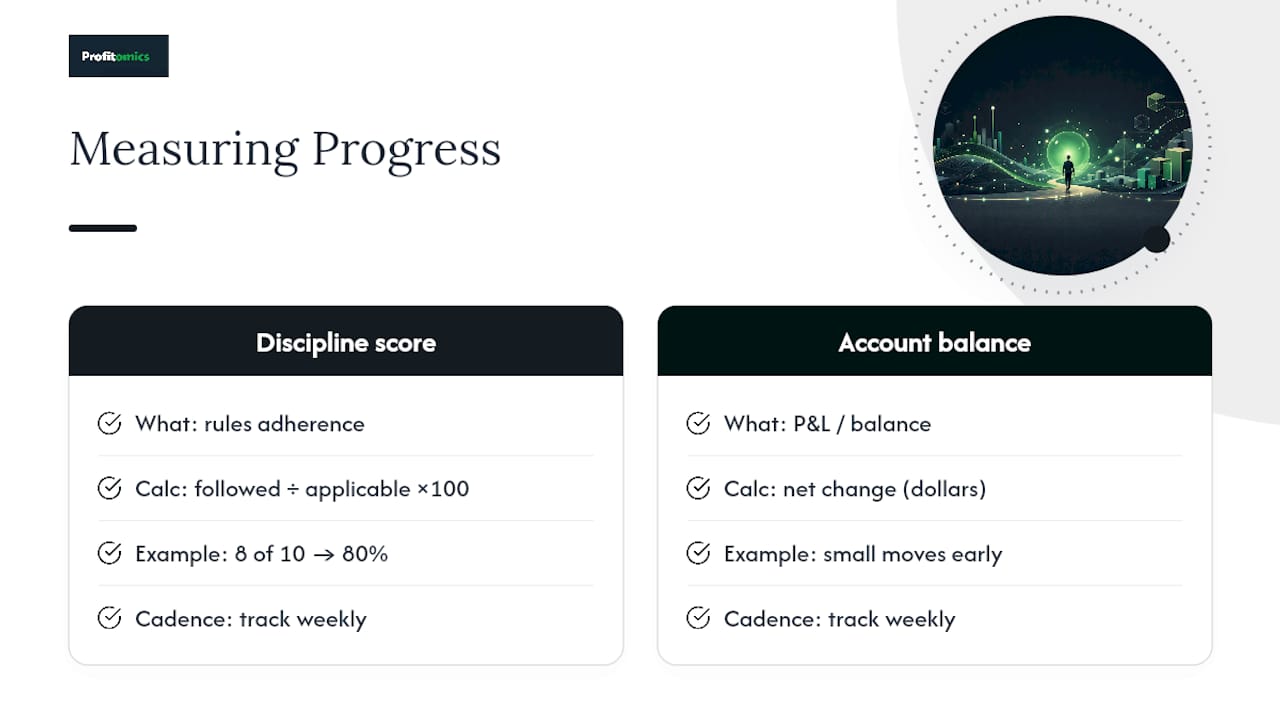
From that log, calculate a discipline score: rules followed divided by rules that applied, times 100. A trader who followed 8 of 10 applicable rules across a week scores 80%. That number, tracked weekly, tells you far more about your progress than your account balance does in the first month.
Paper trading, and a focused 30-day stretch of it, builds the automaticity that makes rule-following feel less like effort and more like habit. A simple, repeatable format is laid out in the trading journal template, and the same structured-practice logic shows up in resources like the No Spend Reset Challenge Workbook, built around the same idea: habits stick when you track them daily, not when you hope for the best.
What Does a 30-Day Starter Plan Look Like?
Here’s a compact schedule that turns everything above into something you actually do, week by week.
- Week 1: Write your trading plan, build your five-item checklist, and log baseline journal entries even if you’re not trading live yet.
- Week 2: Paper trade only. Grade every setup A, B, or C before entry and calculate your discipline score at week’s end.
- Week 3: Move to live trades at micro size, a fraction of your normal position, with your stop enforced without exception.
- Week 4: Run a full weekly review, adjust whichever rule you broke most, and repeat the cycle at slightly larger size.
| Week | Focus | What you’re measuring |
|---|---|---|
| 1 | Plan and checklist setup | Journal entries completed |
| 2 | Paper trading | Discipline score, setup grade accuracy |
| 3 | Live micro-size trades | Stop-loss adherence |
| 4 | Review and iterate | Weekly discipline score trend |
After 30 days, expect a measurable discipline score, not a bigger account. That number, not your P&L, tells you whether the system is working.
Final Takeaways and a Realistic Timeline
Design your rules once, then let them run the show instead of your mood. Expect real improvement in discipline over four to eight weeks of consistent tracking, not overnight. Start with the trading journal template and build from there.
Kai’s Perspective: Habits Beat Motivation
Templates work because they remove the moment where willpower is supposed to save you, and it usually doesn’t. Beginners who track a discipline score improve faster than those chasing perfect trades. Start with one rule today.
— Kai
Put the 30-Day Starter Into Action
Profitomics built Stock Market Mastery specifically for readers who want the templates, checklists, and journal structure from this guide in one place instead of scattered across bookmarks. The ebook maps directly onto the risk sizing, setup grading, and pre-trade checklist covered above, so instead of building your own spreadsheet from scratch, you fill in a system that’s already structured for a beginner’s first month of live trading.
If your focus leans more toward long-term income building than active stock trading, Passive Income Blueprint applies the same templates-first approach to building income streams outside a trading account. Either way, the starting point is the same: open the checklist, fill in your risk numbers, and run week one of the 30-day plan this week, not next month.
Sources
- Trading psychology: Mastering your emotions and instincts for successful trading (Britannica)
- Trading psychology: Definition, examples, importance (Investopedia)
- The New Trading for a Living (Alexander Elder) - Wiley
This article is general information, not a substitute for advice from a qualified financial advisor. Consult a qualified financial professional about your own circumstances before acting on anything here.
FAQ
What Is Trading Psychology in Simple Terms?
Trading psychology refers to the emotional and behavioral patterns, like fear, greed, and overconfidence, that shape trading decisions once real money is at risk. Managing it well usually means building rules and routines that reduce how often emotion drives a decision, as Investopedia explains.
What Are the Best Trading Psychology Books for Beginners?
The New Trading for a Living by Alexander Elder and Trading in the Zone by Mark Douglas are the two most commonly recommended trading mindset books for beginners. Both focus on building disciplined systems rather than relying on natural confidence or gut feel.
How Do I Stop Making Emotional Trading Mistakes?
Write specific entry, stop, and position-sizing rules before you trade, then follow them regardless of how a trade feels in the moment. Tracking a discipline score, the percentage of rules you actually followed each week, exposes emotional slippage faster than watching your account balance alone.
What’s a Realistic Way to Practice Trading Psychology as a Beginner?
Paper trading for a focused stretch, ideally around 30 days, lets you practice rule-following without financial stakes attached. Grading each setup before entry and journaling both your actions and your emotional state builds the habit faster than jumping straight into live trading.
Does Profitomics Offer Tools for Trading Psychology and Discipline?
Yes. Stock Market Mastery is priced at $47 and includes templates, checklists, and journal structures built around the same rule-based approach covered in this guide.