Trading Plan Template: Fill It Today and Paper Trade for 30–90 Days

This article includes a complete, fillable trading plan template covering instrument selection, strategy rules, risk limits, a pre-market checklist, and a weekly review log. Copy the sections below into a document now, fill in your risk percentage and one strategy first, and you have a working plan before your next session.
TL;DR:
- Trading plans must specify clear instrument liquidity, spreads, and trading hours to avoid traps like wide spreads and illiquid markets.
- Precise entry rules based on exact signals and disqualifiers are essential; vague instructions increase the risk of subjective judgment errors.
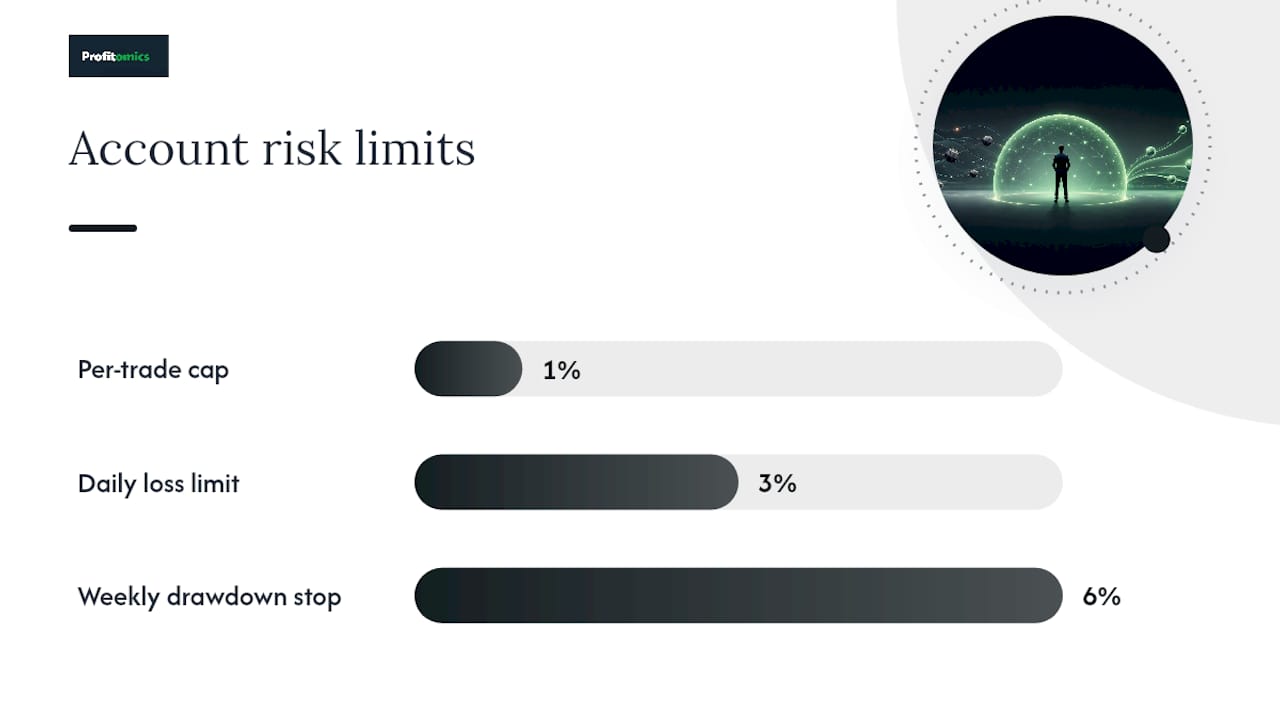
- Hard risk limits, such as a 1% per-trade cap and a 3% daily loss stop, outperform soft guidelines by preventing emotional decision-making during drawdowns.
- A well-structured journal tracking risk multiple, rule adherence, emotions, and mistakes reveals weak habits faster and guides plan adjustments.
- Paper trading for 30 to 90 days with the same rules and journal is necessary to confirm the plan’s effectiveness before risking real capital.
Table of Contents
- What’s Inside The Trading Plan Template
- How Do You Choose Which Markets To Trade?
- How Do You Write Entry Rules Someone Else Could Follow?
- What Risk Limits Should Your Plan Set?
- What Belongs On Your Entry And Exit Checklist?
- What Should Your Pre-Market Routine Look Like?
- How Should You Review Your Trades Each Week?
- How Do You Actually Fill Out The Template?
- One-Page Plan Or Full Playbook?
- Why Profitomics Built These Templates This Way
- A Realistic Note On What A Plan Can And Can’t Do
- Get The Fully Worked Template And Worksheets
- Sources
- FAQ
What’s Inside The Trading Plan Template
A trading plan template only earns its place on your desk if it answers five things: what you trade, how much you risk, where your stop goes, where your target sits, and when you stop trading for the day. That’s the backbone TradersSecondBrain recommends, and it maps directly onto the sections below.
- Identity and goals — your account size, weekly time commitment, and what “success” means in dollars or R.
- Market and instrument list — the specific stocks, pairs, or contracts you trade, and what you refuse to touch.
- Strategy rules — entry conditions, confirmation signals, and disqualifiers for each setup you trade.
- Risk rules — per-trade risk, daily loss limit, and weekly drawdown stop.
- Pre-market routine — a checklist you run before the bell or before your session opens.
- Entry/exit checklist — order type, stop placement, and scaling rules for every trade.
- Journal and review — what you log after each trade and what you calculate every week.
Day traders lean hardest on the pre-market routine and entry/exit checklist. Swing traders get more value from the strategy rules and weekly review. Options traders need an extra line item for expiration and implied volatility under market selection. The template works as a fillable PDF, a copyable Google Doc, or a spreadsheet format designed for trading journals.
How Do You Choose Which Markets To Trade?
Every instrument on your list should earn its spot on three criteria: liquidity, typical spread, and whether it trades during hours you can actually watch it.
Write specific lines, not categories. Instead of “large-cap tech stocks,” write:
- SPY and QQQ, 9:30 to 11:00 AM ET only, spread under 2 cents
- EUR/USD, London/New York overlap, spread under 1 pip
- AAPL, MSFT, NVDA, avoid first 5 minutes after open
Your “do not trade” list matters just as much as your watchlist. List instruments with wide spreads relative to your average stop, low average volume for the position size you need, or overlapping earnings and Fed announcements you don’t have an edge trading through.
Pro Tip: Keep a running “graveyard list” of tickers or pairs that burned you and why. Reviewing it monthly stops you from re-adding the same trap under a different setup.
How Do You Write Entry Rules Someone Else Could Follow?
A strategy definition fails the moment it needs your gut feeling to execute. If another trader couldn’t take the same trade from your written rules alone, the rule isn’t finished yet. FTMO’s guide to developing a trading plan frames this as writing entry criteria precise enough to remove interpretation, and that standard is worth holding yourself to.
Structure each strategy with four fields:
- Name and timeframe — “Pullback to 20 EMA, 15 minute chart, trending stocks only.”
- Setup conditions — the market state that must exist before you even look for an entry (e.g., price above the 50 EMA on the daily chart, ADX above 20).
- Entry trigger — the exact candle or price action that fires the trade (e.g., “bullish engulfing candle closes above the 20 EMA on rising volume”).
- Confirmation signal — a second, independent check that must agree, like RSI turning up from below 40 or a higher timeframe trend still intact.
Disqualifiers matter as much as triggers. Any of these should void the setup regardless of how clean the chart looks.
If you trade more than two setups, give each one its own playbook page rather than cramming them into one paragraph. A trend-following strategy and a mean-reversion setup have almost nothing in common in terms of entry logic, and blending their rules on one page is how traders talk themselves into bad trades using the wrong playbook.
What Risk Limits Should Your Plan Set?
Position sizing isn’t a feeling. Two formulas cover most retail accounts. The fixed-percentage method risks a flat share of your account per trade, commonly 0.5% to 1% for accounts under $50,000. The R-based method defines one “R” as your dollar risk per trade (entry minus stop, times shares), then measures every win or loss as a multiple of that R, which makes your journal and your position size speak the same language.
Set hard numbers, not vague intentions:
- Per-trade risk: cap at 1% of account equity on any single position.
- Daily loss limit: stop trading for the day after losing 3% of account equity.
- Weekly drawdown stop: close the platform for the week after a 6% pullback and review before resuming.
- Correlated exposure: treat two positions in the same sector or two currency pairs sharing the dollar as one combined risk unit, not two separate 1% bets.
FTMO’s research on plan structure notes that hard circuit-breakers outperform soft guidelines because they remove the decision from you at the exact moment you’re least equipped to make it, three losses deep and frustrated. A soft rule like “be careful after two losses” gets negotiated away in real time. A hard rule that locks the platform doesn’t.
If you’re trading a small account, your percentage math needs even more discipline since a single oversized loss eats a much bigger share of available capital. Growing a small account without blowing it up usually comes down to sizing smaller than feels necessary, not finding a better setup.
What Belongs On Your Entry And Exit Checklist?
Your entry and exit rules turn a strategy idea into a mechanical process you execute the same way every time, win or lose. Vague plans die here, not in the strategy section.
- Confirm the setup matches your written entry trigger exactly, not “close enough.”
- Place your stop at a structural level, below the last swing low for longs, above the last swing high for shorts, never at a round number just because it’s round.
- Size the position using your R value before you enter, not after.
- Use limit orders on entries where slippage matters; use market orders only when speed matters more than price.
- Scale out one third of the position at 1R, move the stop to breakeven on the remainder.
- Trail the stop behind each new swing point once the trade reaches 2R.
- Set a time-based exit for any position that hasn’t moved in your favor within your strategy’s typical holding period.
- Log the exit reason immediately: target hit, stop hit, time exit, or manual override.
Pro Tip: Write your breakeven and trailing rules as prices, not percentages, before you enter. “Move stop to $42.10 at 1R” beats “move stop up a bit” every time your position is actually moving.
What Should Your Pre-Market Routine Look Like?
A plan only works if you run it before your fingers touch the keyboard. TradersSecondBrain’s format guidance emphasizes keeping this list short enough that you’ll actually read it every single session, not just the first week.
Before the session:
- Check the economic calendar for releases in your trading window.
- Scan your watchlist for gaps over 2% and note the reason.
- Mark key levels: prior day high/low, premarket high/low, and any level from your strategy’s timeframe.
- Confirm your daily loss limit and how many trades you’ll allow yourself today.
During the session, cap concurrent positions at a number you set in advance, usually two to three for a beginner, and treat any urge to check unrelated news or social media mid-trade as a signal to step away from the screen.
Immediately after closing a trade, jot three things while they’re fresh: the exit reason, one word for how you felt entering, and whether you followed every rule. That thirty-second habit is what makes your weekly review worth running at all.
How Should You Review Your Trades Each Week?
Your journal is only useful if it captures the fields that explain why a trade won or lost, not just that it did. TradeOrbit’s trading journal template recommends tracking result in R, whether you followed your rules, an emotion tag, a mistake tag, and a screenshot link for every entry.
- R multiple — the standardized win or loss size, so a $40 win on a small position and a $400 win on a large one are comparable.
- Rule followed — a simple yes/no; this single column reveals more than your win rate ever will.
- Emotion tag — calm, rushed, revenge, bored, whatever fits; patterns show up fast once you have four weeks of data.
- Mistake tag — late entry, moved stop, oversized, chased.
- Screenshot — the chart at entry, so you can grade your own read later without memory bias.
Run a 30 to 60 minute weekly review every Sunday: total R, win rate, average R per winner versus average R per loser, and the percentage of trades where you followed every rule. Pick one change to test the following week, never three. Logging R with tagged mistakes speeds up how fast you can tell a losing strategy from a strategy going through a normal drawdown.
Revise your actual rules on a quarterly calibration schedule, not after a bad Tuesday. An emotional reaction to one rough week is exactly what a written plan is supposed to protect you from.
How Do You Actually Fill Out The Template?
Fill order matters more than most guides admit. Start with identity and risk rules first, since every other section depends on knowing your account size and per-trade risk cap. FTMO’s step-by-step approach to building the plan recommends this exact sequence:
- Identity, goals, and account size.
- Risk rules: per-trade, daily, and weekly limits.
- One strategy, fully written with entry, confirmation, and disqualifiers.
- Pre-market routine and session checklist.
Once the plan is written, don’t skip straight to live money. Run it in paper trading for 30 to 90 days, tracking the same journal fields you’ll use live. If your rule-followed percentage stays above roughly 90% and your R expectancy is positive across at least 30 trades, you have enough signal to size up gradually with real capital.
Print or pin your one-page session checklist somewhere you’ll see it before every single trade, not buried in a folder you open once a month.
One-Page Plan Or Full Playbook?
A one-page plan should fit: your market list, risk percentage, a two-line summary of your primary strategy, three entry/exit bullets, and your session checklist. That’s the version you read daily.
Expand to a full playbook once you’re running more than one strategy or trading instruments with meaningfully different rules, say, stocks and forex, where session times and spread tolerances don’t overlap.
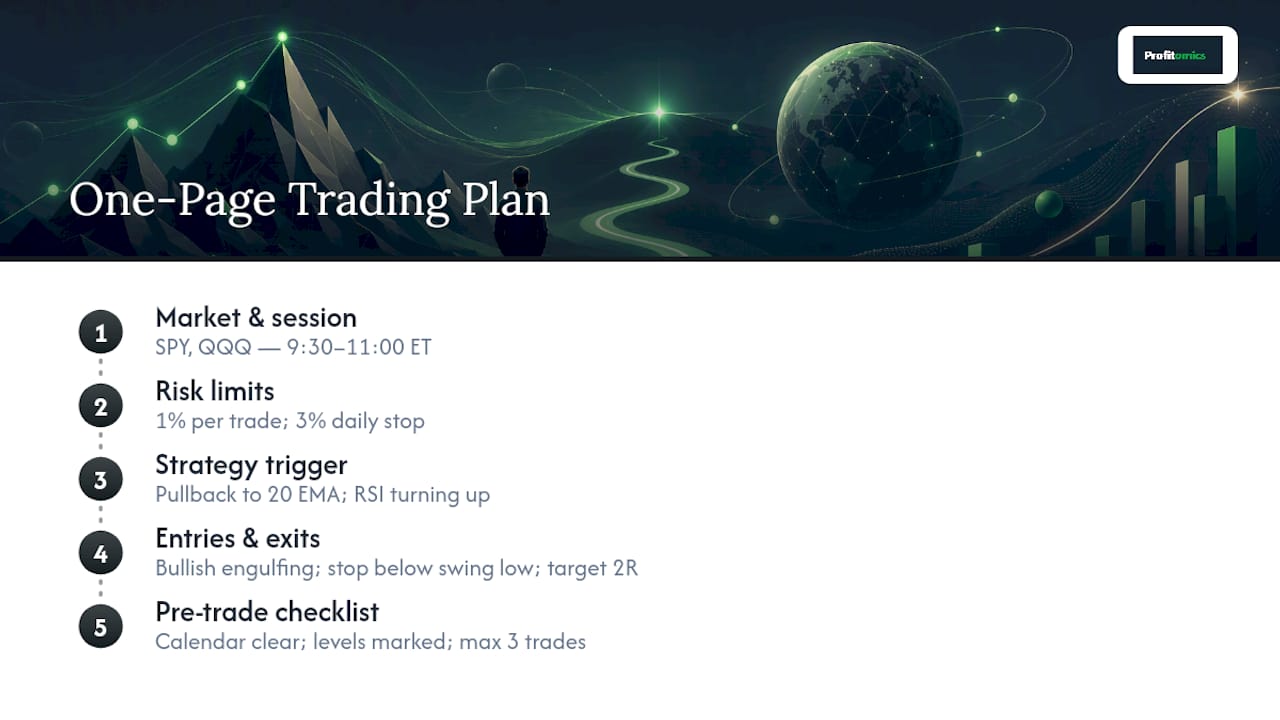
A copy-ready one-page layout:
Market: SPY, QQQ, 9:30 to 11 AM ET. Risk: 1% per trade, 3% daily stop. Strategy: Pullback to 20 EMA on rising volume, confirmed by RSI turning up. Entries: Bullish engulfing candle, stop below swing low, target 2R. Checklist: Calendar clear, levels marked, max 3 trades today.
Why Profitomics Built These Templates This Way
The templates are designed around one rule: a plan you actually use beats a plan that sits in a folder. Every template pairs the fill-in fields above with a companion checklist so setup takes one sitting, not a weekend. This article was written by Kai, drawing on the fill-order and calibration guidance published by FTMO Academy and TradersSecondBrain, and applying it to a format traders can copy and use the same day.
A Realistic Note On What A Plan Can And Can’t Do
A written plan doesn’t manufacture an edge. It just makes the edge you already have (or don’t) visible faster, because every rule break shows up in the journal instead of hiding behind a good week. Expect the template to expose weak habits before it produces a single extra dollar.
Run the weekly review even when you don’t want to, especially after a losing week. That’s the session where the plan actually earns its keep.
— Kai
Get The Fully Worked Template And Worksheets
The template above gets you started. If you want the filled-out version, complete with example strategies, position-sizing worksheets, and a journal spreadsheet formatted with R and rule-followed columns, these can be found as ready-to-use packages instead of blank forms you have to design yourself.

The Stock Market Mastery ebook includes a complete swing-trading playbook with filled example plans you can adapt line by line, so you’re editing a working template instead of staring at empty fields. If crypto is more your market, the Crypto Profit System applies the same risk-first structure to volatile assets where position sizing matters even more. Both are instant digital downloads. Visit Profitomics to pick the version that matches how you trade and start filling in your plan tonight.
Sources
- Developing a Trading Plan: Comprehensive Guide — FTMO Academy
- Trading Plan Template: The Only Format That Works (2026) — TradersSecondBrain
- Trading Journal Template (Free): Track R, Win Rate, and Mistakes - TradeOrbit
FAQ
Can I Make $1,000 A Day Day Trading?
Not consistently, and not with a small account. Daily targets that large require either significant capital or outsized risk per trade, which conflicts with the daily loss limits any sound trading plan template sets to protect your account.
What Is The 3-5-7 Rule In Trading?
Treat it as one starting framework, not a fixed law. Your own plan’s risk section should set the specific numbers that fit your account size.
Is $100 Enough For Day Trading?
Paper trading your plan first, as outlined above, makes far more sense than trading live with that little capital.
How Do I Make $200 A Day Trading?
There’s no reliable formula for a fixed daily dollar target, since results depend on account size, volatility, and how closely you follow your own rules. A trading plan template built around consistent risk per trade and a tracked R multiple gives you a realistic path to steady growth instead of chasing a specific number.