Growing a Small Trading Account Without Blowing It Up

Yes, small account trading works, but only if you treat capital preservation as the goal, not a side effect. The move that actually matters is picking one cost-efficient market, capping risk at 1% per trade, and logging every trade from day one. Everything else, the setups, the broker, the scaling plan, gets built on top of that foundation.
TL;DR:
- Small traders should prioritize using one cost-efficient market, such as micro futures or fractional shares, and limit risk per trade to 1% of the account to preserve capital.
- Cash accounts, micro futures, and forex micro lots are the best options for under $2,000, avoiding pattern day trader restrictions and reducing fees on small trades.
- Traders must set and record a stop loss before entering a trade, and avoid risking more than 1% to 2% of the account, with a strict daily loss limit to prevent ruin.
- Focus on high conviction setups like swing breakouts, sector ETFs, and micro futures scalps, aiming for modest risk reward ratios and avoiding volume-driven strategies that increase fees and slippage.
- Choosing brokers with zero commissions, fractional share support, low per-contract fees, and reliable execution is essential to maintain profitability on small accounts.
Table of Contents
- What Markets Work Best for Small Account Trading?
- How Much Should You Risk Per Trade?
- What Setups Actually Fit a Small Account?
- Which Broker Features Matter Most for Small Accounts?
- How Do You Know When to Add More Capital?
- Turning the Rules Into a Daily System
- What Small Account Traders Get Wrong Most Often
- Sources
- FAQ
What Markets Work Best for Small Account Trading?
Your account size decides which markets are even worth touching, and the Pattern Day Trader rule is usually the first wall small traders hit. FINRA flags any margin account that makes four or more day trades within five business days, and once flagged, you need $25,000 in equity to keep trading that way. Most people starting small don’t have that, so the workaround isn’t breaking the rule. It’s picking instruments where the rule barely applies.
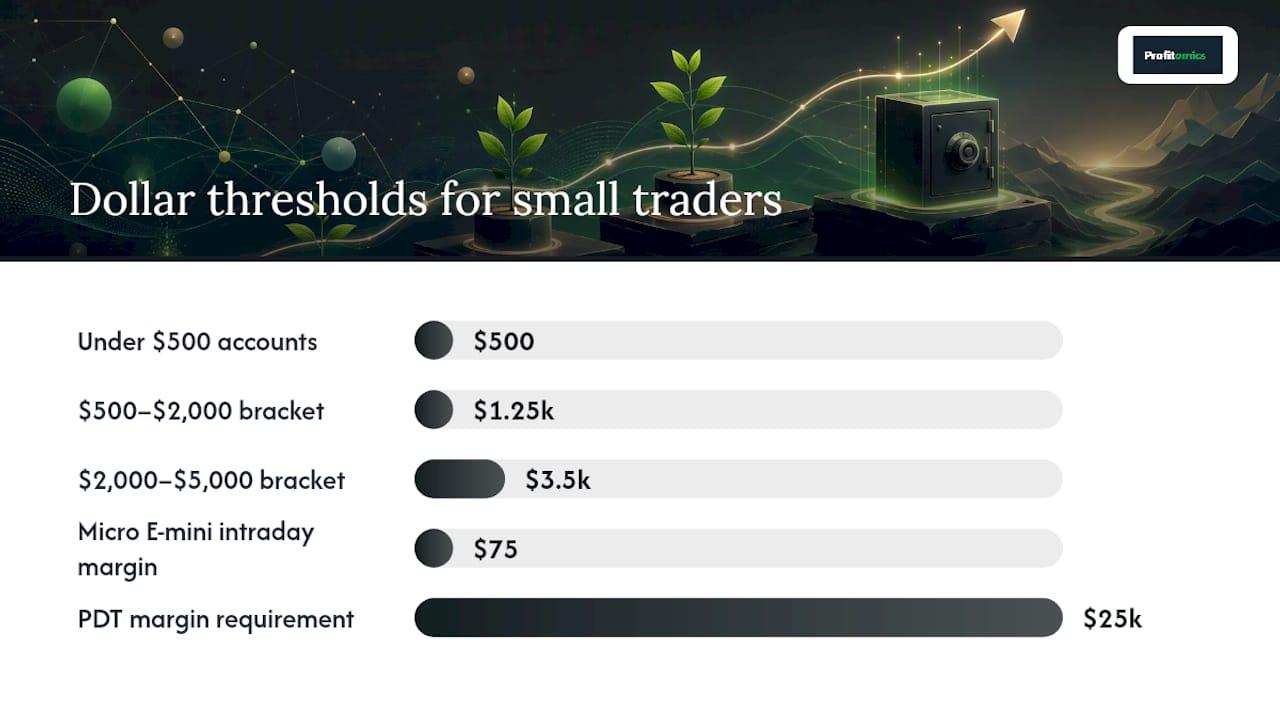
Cash accounts sidestep PDT entirely since the restriction only governs margin accounts, though you trade with settled funds only. Micro futures and forex micro lots dodge it too, since they’re regulated differently than equities. Micro E-mini contracts can require intraday margin as low as $50 to $100 at some brokers, which puts index exposure within reach of an account that couldn’t touch a standard futures contract.
Options and fractional shares round out the toolkit. Fractional shares let you own a slice of an expensive stock without needing the full share price, and defined-risk option structures cap your downside at the premium paid. Short-dated weekly options are a different story: theta decay eats them fast, and TradeAlgo notes they function more like lottery tickets than trades.
Here’s how the bracket usually breaks down:
- Under $500: Stick to a cash account with fractional shares or forex micro lots. Avoid anything requiring margin.
- $500 to $2,000: Micro futures become viable, and you can start layering in defined-risk options on liquid names.
- $2,000 to $5,000: You have room for a small margin cushion, but PDT still looms if you’re trading equities actively. Consider futures or forex as your primary vehicle instead.
How Much Should You Risk Per Trade?
The math here is non-negotiable, and it’s simpler than most beginners expect. Fixed fractional risk means you risk a set percentage of your account, usually 1%, on any single trade. Practical guides on small account strategy consistently point to that 1% figure, sometimes stretching to 2% for more experienced traders, as the number that keeps a losing streak from becoming a account-ending event.
Here’s the formula and three examples:
- $500 account, 1% risk: You risk $5 per trade. If your stop is $0.25 away from entry on a stock, you can buy 20 shares.
- $1,000 account, 1% risk: You risk $10 per trade. A $0.50 stop allows a 20 share position.
- $2,000 account, 1% risk: You risk $20 per trade. A $1.00 stop allows a 20 share position.
Notice the pattern: your stop distance determines your position size, not the other way around. Decide where the trade is wrong first, then work backward to figure out how many shares or contracts fit inside your risk budget. Traders who size first and place stops second almost always end up either oversized or forced to accept a stop that doesn’t match the chart.
Beyond the single trade, set a daily loss cutoff. A modest daily loss limit should be set to preserve capital; small consecutive losses under proper risk management are typically recoverable. Ignoring your cutoff and revenge trading is how that 3% becomes 15%.

Pro Tip: Write your stop loss price down before you enter the trade, not after. If you catch yourself calculating position size before deciding where you’re wrong, you’re sizing backward.
What Setups Actually Fit a Small Account?
Not every strategy translates to limited capital, and chasing volume is usually the fastest way to shrink an account through fees and slippage alone. A better target is one to three high-conviction trades a week rather than a dozen mediocre ones.
A handful of setups tend to hold up well:
- Swing breakouts on liquid stocks: Enter on a confirmed break above resistance with volume, stop below the breakout candle’s low, and target a 2R to 3R move before trimming.
- Momentum on liquid ETFs: Trade sector or index ETFs during the first hour after the open, using a tight stop just under the pullback low, and scale out at predetermined levels.
- Micro futures scalps: Use micro index contracts for short, defined moves during high-liquidity windows, keeping stops tight given the lower margin requirements that make these contracts accessible in the first place.
- Defined-risk options spreads: Debit spreads on liquid underlyings cap your maximum loss at entry, useful when you want directional exposure without theta destroying a naked option position.
Target realistic R-multiples rather than home runs. A small account risking a fixed percentage per trade that nets a modest positive risk reward ratio across multiple trades can achieve meaningful gains over time. That’s a legitimate outcome for a small account. It’s not fast money, but it compounds if you keep doing it.
Pro Tip: Backtest one setup in a simulator before risking real capital on it. Reducing decision fatigue on entries frees up your discipline for the part that actually matters, which is exiting on plan.
Which Broker Features Matter Most for Small Accounts?
Fees hit small accounts disproportionately hard. A $5 commission on a $500 account eats 1% of your capital before the trade even moves, and TradeAlgo’s small-account analysis makes the point directly: fixed costs that seem trivial on a large account can quietly wreck a small one.
Run through this checklist before opening an account:
- Zero or near-zero commissions on stock and ETF trades.
- Fractional share support, so you’re not locked out of expensive names.
- Low per-contract fees on futures and options, since those add up fast with frequent trading.
- Tight, reliable execution, meaning minimal slippage between the price you see and the price you get filled at.
Cash accounts introduce a settlement wrinkle worth planning around. Stock and ETF trades settle T+1, so funds from a closed position aren’t available to redeploy the same day. A common workaround is splitting your capital into two or three tranches, trading with one while the others settle, so you’re never sitting fully in cash waiting for a trade to clear.
PDT violations almost always come from carelessness rather than an actual strategy choice. Track your day trade count over any rolling five-day window, and if you’re on a margin account approaching four, either switch to swing trades or hold your positions overnight instead of closing them same day.
How Do You Know When to Add More Capital?
Scaling a small account is a discipline exercise, not a reward for a lucky week. A useful proving period runs three to six months, with a documented sample of at least 100 trades before you touch your risk settings. TradingSim’s research on small-account strategy suggests targeting around 20% net growth across that sample with positive expectancy before scaling meaningfully.
A rule-based path looks like this:
- Trade your defined setups for 3 to 6 months, journaling every entry, exit, and reason for both.
- Confirm positive expectancy across the sample, meaning your average win times win rate outweighs your average loss times loss rate.
- Increase position size in 50% to 100% increments, never doubling risk overnight even after a strong stretch.
- Withdraw partial gains periodically to lock in progress, so a rough month doesn’t erase months of compounding.
If your edge holds after that proving period, consider whether a funding program or a shift to a higher-liquidity instrument class makes sense for your next stage. Academic work on day-trading outcomes is blunt about this: most individual day traders lose money over time, and the ones who don’t are the ones treating process as the product, not the profit.
Turning the Rules Into a Daily System
Rules only work if you actually apply them on the same trade, every time, which is why a template beats a mental checklist. Profitomics builds risk-first templates specifically for this gap: a trade-risk calculator, a structured trade journal, and a scaling checklist that tells you exactly when you’ve earned the right to size up.
That’s the whole calculation, done before you click buy.
- Trade-risk template: locks in position size before entry, every single time.
- Trade journal: forces you to record the setup, the reasoning, and the outcome.
- Scaling checklist: keeps you from increasing size on a hot streak alone.
Try one setup in a simulator this week, run it live with a 90-day journal, then evaluate against the proving benchmarks above. The Stock Market Mastery guide walks through the swing and compounding mechanics behind this process in more depth.
What Small Account Traders Get Wrong Most Often
The conventional advice treats small account trading as a capital problem. It isn’t. It’s a behavior problem wearing a capital costume. Give most traders $50,000 instead of $500 and they’ll find a way to lose it just as fast, because the sizing math and the discipline gap don’t change, only the zeros do.
What gets underestimated is how much fees and instrument choice do the damage before a single bad trade even happens. A trader paying $5 to $7 in round-trip commissions on a $500 account is fighting a headwind that a $50,000 account never feels. That’s why instrument selection, cash accounts, micro futures, fractional ETFs, isn’t a workaround. It’s the actual strategy.
Where I’d push back hardest on the standard advice: most guides tell you to “find your edge” before they tell you to control your losses. Flip that order. A trader with no edge but perfect risk control survives long enough to develop one. A trader with a great setup and no size discipline doesn’t get a second chance to find out if it worked. Prioritize the stop and the sizing formula first. The setup matters, but it’s the second decision, not the first.
— Kai
This article is general information, not a substitute for advice from a qualified financial advisor. Consult a qualified financial professional about your own circumstances before acting on anything here.
Sources
- Intraday margin requirements — FINRA
- Day Trading Skill — Terrance Odean & co.
- Micro futures overview — Optimus Futures
FAQ
Can I Make $1,000 a Day Day Trading?
Not consistently on a small account. A $1,000 daily gain typically requires either large capital or outsized risk that violates the 1% rule, and most traders who chase it end up in the losing majority documented by academic research on day-trading outcomes.
Is $20 Enough to Start Trading?
Technically you can open positions with very small amounts using fractional shares or a micro forex account, but Investopedia’s guidance on minimum starting capital points toward demo accounts first, since extremely low capital leaves almost no room for even one losing trade under proper risk sizing.
How Do I Make $500 a Day With Day Trading?
A more realistic goal for a small account is consistent 1R to 2R gains across a handful of high-conviction trades weekly.
What Is the Pattern Day Trader Rule?
The PDT rule flags margin accounts making four or more day trades within five business days, requiring $25,000 in equity to keep trading that way, per FINRA. Cash accounts, futures, and forex trading fall outside this restriction.
Recommended
- Make Money Online — Ebooks on Passive Income, Stocks & Crypto | Profitomics
- Stock Market Mastery — Swing trading and long-term compounding strategies | Profitomics
- Side Hustle to Six Figures — Turn any skill or idea into a $100K+ income stream | Profitomics
- Crypto Profit System — A risk-first framework for building consistent crypto returns | Profitomics