Revenge Trading: How to Spot It and Stop It

Revenge trading means entering a trade to recover a recent loss rather than because your setup is valid. The single most effective thing you can do right after a loss is stop trading for a mandatory cooldown period before placing another order.
- What it is: A motivation-driven trade triggered by a loss, not by a signal
- Why it’s dangerous: Stress hormones impair judgment exactly when you think you’re thinking clearly
- Immediate action: Close your platform and enforce a minimum 10-minute pause after any losing trade
That pause isn’t a suggestion. It’s the structural intervention that separates disciplined traders from ones who blow up their accounts chasing losses.
Key Takeaways
Revenge trading is a predictable, measurable pattern driven by loss aversion and cortisol-impaired judgment, and a pre-committed rule set eliminates it more reliably than willpower ever will.
| Point | Details |
|---|---|
| Define it by motivation | Revenge trading is any entry made to recover a loss rather than because a valid setup exists. |
| The data is stark | Entries placed within 15 minutes of a loss showed a win rate of approximately 22% in a documented case study. |
| Cooldown tiers work | A 10-minute pause after 1 loss, 30 minutes after 2, and a full stop after 3 is a tested protocol that reduces revenge-trade frequency. |
| Tag every trade | Labeling trades as Planned, Opportunistic, or Revenge lets you calculate your personal revenge-trading cost and track improvement weekly. |
| Profitomics templates | Stock Market Mastery includes sizing spreadsheets, pre-trade checklists, and a trade-journal template to implement this protocol immediately. |
Table of Contents
- What revenge trading actually looks like in practice
- Why revenge trading happens: the psychology and physiology behind it
- Red flags you can check in 60 seconds before placing a trade
- The real costs of revenge trading: financial and beyond
- A rule-based system to stop revenge trading for good
- Tools, order types, and templates that enforce discipline automatically
- A 7-step recovery and prevention checklist
- What actually changed my trading: a perspective on durable habits
- Profitomics gives you the templates to make these rules stick
- Sources
What revenge trading actually looks like in practice
The textbook version is obvious: you lose $500, you immediately re-enter the same trade trying to win it back. But most revenge trading is subtler than that, and that’s what makes it dangerous.
Common forms include:
- Immediate re-entry: Jumping back into the same ticker within minutes of a loss, often with no new setup
- Sizing up: Doubling or tripling position size after a loss to “make it back faster”
- Revenge averaging: Adding to a losing position to lower your cost basis, not because the thesis changed
- Instrument switching: Moving from stocks to options or futures mid-session to access more leverage after a loss
- Plan abandonment: Skipping your entry checklist because you “know” this one will work
A few quick scenarios show how fast this escalates. A trader gets stopped out of a EUR/USD long at 9:45 AM. By 9:52 AM they’re in a new position, twice the size, in a different currency pair they don’t usually trade. Another trader takes a $300 loss on a tech stock, then buys a weekly call option on the same name with no defined exit, reasoning that the stock “has to bounce.” Neither trade was in their plan.
The defining trait isn’t whether the trade loses. It’s the motivation: entering to get even rather than because the setup is genuinely there.
Pro Tip: Ask yourself before every entry: “Would I take this trade if my last trade was a winner?” If the honest answer is no, you’re looking at a revenge impulse, not a signal.
Why revenge trading happens: the psychology and physiology behind it
Treating revenge trading as a character flaw is the wrong frame entirely. It’s a predictable output of specific cognitive biases and measurable physiological changes. Understanding the mechanism is what lets you design around it.
The core biases at work:
- Loss aversion: Losses feel roughly twice as painful as equivalent gains, a finding from prospect theory. That asymmetry creates intense pressure to recover immediately.
- Sunk-cost bias: The money already lost feels like it “should” be recoverable from the same market that took it.
- Recency bias: The most recent loss dominates your mental model of what the market is doing right now.
- Disposition effect: Traders hold losers too long and cut winners too fast, compounding the emotional weight of each loss.
- Reflection effect: Under loss conditions, people shift toward risk-seeking behavior, the opposite of what sound trading requires.
- FOMO: After a loss, the fear of missing a recovery move pushes traders into low-quality entries.
The physiology piece matters more than most traders admit. A loss triggers a cortisol spike. Research summarized by TrailingStopLoss notes that chronic cortisol exposure can substantially reduce risk-premium tolerance, impairing the prefrontal decision-making that your trading plan depends on. You’re not just emotionally rattled after a loss. Your brain is chemically less capable of evaluating risk accurately for a window of time afterward.
| Mechanism | Effect on trading behavior | Implication |
|---|---|---|
| Loss aversion (~2× pain of loss vs. gain) | Urgency to recover immediately | Drives impulsive re-entry |
| Cortisol spike post-loss | Reduced prefrontal control | Skews risk assessment toward overconfidence |
| Recency bias | Overweights last outcome | Distorts setup evaluation |
| Reflection effect | Shifts to risk-seeking under loss | Increases position size and leverage |
| Revenge trades (entries within 15 min of loss) | ~22% win rate in documented case study | Measurable performance drag |
A documented case study identified revenge trades as entries placed within 15 minutes of a loss and found those trades carried a win rate of approximately 22%, with a significant monthly cost for the trader involved.
Most traders’ base win rates sit well above that. The act of revenge trading doesn’t just fail to recover losses; it actively destroys the edge you’ve built.
Willpower alone fails here because it’s deployed after the cortisol spike has already hit. Pre-committed rules, by contrast, are designed before emotion enters the picture. That’s the structural advantage of a written protocol over in-the-moment discipline.
Red flags you can check in 60 seconds before placing a trade
The goal of this checklist is to catch a revenge impulse before it becomes an order. Run through it after any loss and before any new entry.
Red-flag checklist:
- Less than 10 minutes have passed since your last losing trade
- You’re considering a larger position size than your plan specifies
- You skipped one or more steps in your entry verification process
- You’re focused on your P&L rather than on the setup itself
- The trade is outside your defined instruments, timeframes, or session hours
- You feel urgency, irritation, or a need to “fix” the last trade
- You’re rationalizing an entry you’d normally pass on
The 60-second self-check:
- Check the clock: how many minutes since your last loss?
- Check your size: does it match your standard position-sizing formula?
- Check your reason: can you state a specific, plan-based entry reason in one sentence?
- Check your state: rate your emotional calm on a 1–5 scale. Below 3, stop.
- Check your plan: is this instrument and setup type in your trading plan?
If you hit three or more red flags, the trade doesn’t happen. That’s not a rule you negotiate with yourself in the moment.
Pro Tip: Set a physical or digital timer for 10 minutes the moment you close a losing trade. Don’t touch your platform until it goes off. The timer removes the in-the-moment decision entirely.
The real costs of revenge trading: financial and beyond
The financial damage is the most visible part, but it’s not the whole picture.
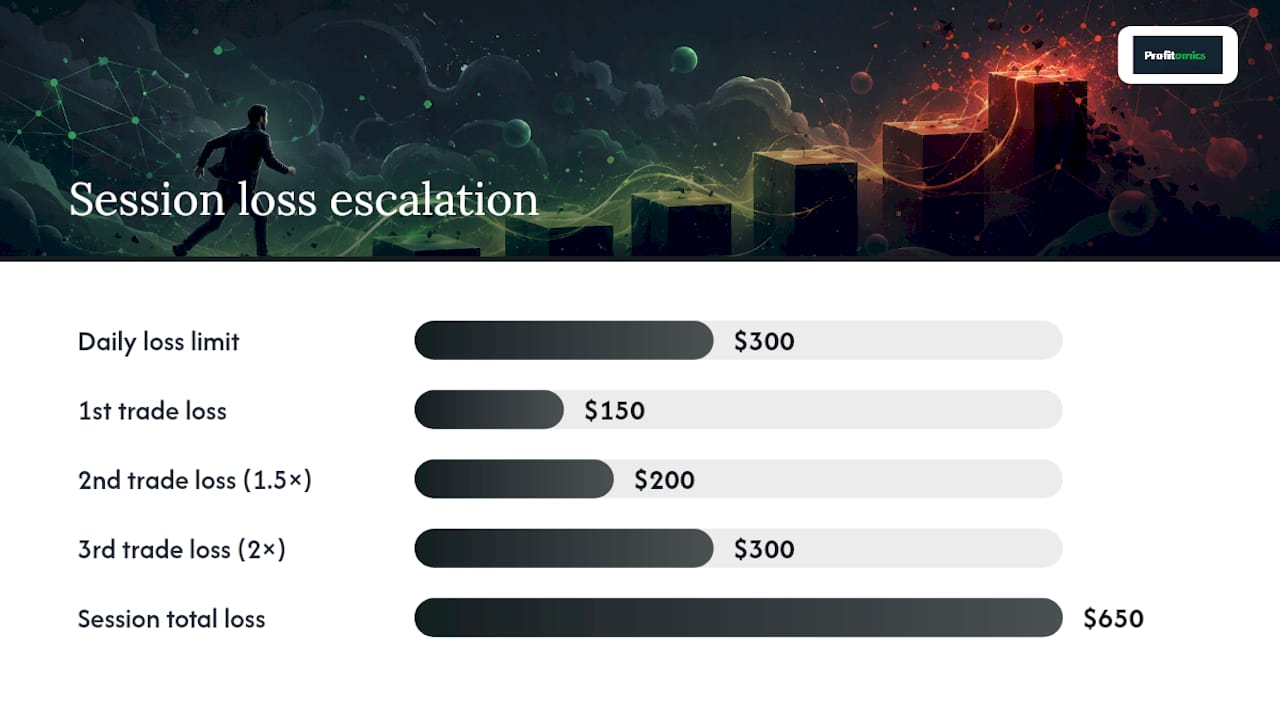
Here’s how the numbers compound in a single session. Suppose your trading plan allows a maximum daily loss of $300. You take a $150 loss on your first trade, a planned stop-out. Instead of pausing, you immediately re-enter at 1.5× size. That trade loses another $200. Now you’re at $350, already past your daily limit, and emotionally committed to recovering. A third trade at 2× size loses $300 more. You’ve turned a $150 planned loss into a $650 session loss in under an hour, none of it part of your plan.
Non-financial consequences are just as real:
- Confidence erosion: Each revenge loss reinforces a narrative that you “can’t trade,” which distorts future decision-making
- Plan abandonment: Once you’ve broken your rules once, the psychological barrier to breaking them again drops sharply
- Margin calls: Oversized revenge positions in leveraged accounts can trigger forced liquidation
- Account blowout: Funded account traders face hard daily loss caps; prop-style daily loss rules exist precisely because emotional mistakes destroy accounts
- Decision fatigue: Revenge trading sessions leave traders mentally depleted, degrading performance for days afterward
TradesViz’s analysis shows that tagging trades and measuring time-since-last-loss allows traders to calculate their personal revenge-trading cost and materially reduce it once they can see it as a number.
The moment you can quantify what revenge trading costs you per month, it stops feeling like an emotional problem and starts looking like a fixable operational one.
A rule-based system to stop revenge trading for good
Rules work where willpower fails because they’re set before the cortisol spike, not during it. Here’s a sequential protocol you can implement today.
Step 1: Set your cooldown tiers
Follow the graduated structure validated by TradersSecondBrain’s protocol:
- After 1 losing trade: mandatory 10-minute cooldown, platform closed
- After 2 consecutive losses: mandatory 30-minute break, step away from screens
- After 3 losses or daily max-loss hit: done for the day, no exceptions
Step 2: Define your daily max-loss before the session opens
Write a specific dollar amount. Once that number is hit, trading stops. This is non-negotiable and set in advance, not recalculated mid-session.
Step 3: Lock in your position-sizing formula
Calculate this before the session. Any trade that requires a larger size than the formula allows is automatically rejected.
Step 4: Complete a pre-trade verification after every cooldown
Before re-entering after a loss, answer these questions in writing:
- What is the specific entry reason? (Name the setup, not a feeling)
- What is the risk-to-reward ratio? (Minimum 1:1.5 for most strategies)
- Would you take this trade if your last trade had been a winner?
- Is the position size within your formula?
- Is this instrument and session in your plan?
If any answer is “no” or “I’m not sure,” the trade doesn’t happen.
Step 5: Automate enforcement wherever possible
- Use bracket orders or OCO (one-cancels-other) orders so your stop-loss and target are placed the moment you enter
- Set platform-level daily loss alerts or hard stops if your broker supports them
- Use a physical checklist printed and placed next to your keyboard
Pro Tip: Tell one person, a trading partner, coach, or accountability group, your daily max-loss number. External commitment layers work because they create a social cost for breaking the rule, which is a stronger deterrent than private resolve alone. Prop-style evaluation rules use this same principle at the account level.
Tools, order types, and templates that enforce discipline automatically
The best prevention system doesn’t rely on remembering to be disciplined. It builds discipline into the mechanics of how you trade.
Order types that protect you from yourself:
- Bracket orders: Set your stop-loss and profit target simultaneously at entry. The trade manages itself once you’re in, removing the temptation to move stops under pressure.
- OCO orders (one-cancels-other): Pair a stop-loss with a take-profit. When one fills, the other cancels automatically, preventing you from holding a loser “just a little longer.”
- Limit orders vs. market orders: Requiring yourself to use limit orders slows down impulsive entries. A market order placed in anger executes instantly; a limit order forces you to name a price.
- Trailing stops: Lock in gains as a trade moves in your favor, reducing the emotional weight of watching a winner turn into a loser.
Position-sizing and risk-calculator templates:
A simple spreadsheet with three inputs, account equity, risk percentage, and stop-loss distance in points, calculates your exact share or contract size before you touch the order ticket. Profitomics’ Stock Market Mastery includes ready-built sizing templates and risk frameworks you can plug your own numbers into immediately.

Trade tagging and journaling:
TradesViz recommends tagging every trade as one of three types: Planned, Opportunistic, or Revenge. That single tag converts an emotional pattern into a measurable metric. At the end of each week, filter your journal by tag and calculate the P&L for each category. Most traders are surprised by how much of their total loss comes from a small number of Revenge-tagged trades.
Your journal entry for each trade should capture: entry time, time since last loss, position size vs. plan, emotional state at entry (1–5 scale), and outcome. That data set, built over four to six weeks, tells you exactly when and how revenge trading costs you money.
A 7-step recovery and prevention checklist
Use this after any losing trade and before returning to the market.
Post-loss recovery checklist:
- Stop the clock. Note the exact time of the loss and start your cooldown timer (10 minutes minimum).
- Close or minimize your platform. Remove the visual stimulus of the chart and P&L.
- Record the trade immediately. Log entry reason, exit reason, emotional state (1–5), and whether the trade was Planned, Opportunistic, or Revenge.
- Run the 60-second self-check from the red-flag section above before considering any new entry.
- Verify your daily loss position. Are you within your pre-set daily max-loss? If not, the session ends here.
- Complete the pre-trade verification (entry reason, R:R, size check, plan alignment) in writing before placing any new order.
- End-of-session review. Tag all trades, note total Revenge P&L, and write one sentence on what triggered the impulse.
Journal prompts for each revenge-trade entry:
- How many minutes passed between the loss and this entry?
- Did I increase my position size? By how much?
- What was my emotional state on a 1–5 scale?
- What was the P&L impact of this trade?
- What rule did I break, and what would following it have cost or saved me?
Sample accountability message to a trading partner or coach:
Tracking that number weekly, the combined P&L of Revenge-tagged trades, is the single most motivating data point for changing behavior. Once you can see what it costs, the protocol stops feeling like a restriction and starts feeling like protection.
What actually changed my trading: a perspective on durable habits
The conventional advice on revenge trading is to “stay disciplined” and “control your emotions.” That framing is almost useless. Emotions don’t respond to instructions. What actually works is removing the decision from the moment of peak emotion entirely.
The habit that produces durable change is a forced daily stop-loss combined with a weekly journal review, not a mental note. A written number, set before the session, that ends trading automatically when hit. Paired with a Sunday review where you filter your journal by trade tag and calculate Revenge P&L for the week.
What makes this work, anchored in the psychology covered earlier, is that it operates before the cortisol spike and after the session when you’re calm enough to learn from the data. The cooldown timer and the daily stop-loss don’t require you to feel disciplined in the moment. They require you to have been disciplined once, when you wrote the rules down. That’s a much easier ask.
The traders who stop revenge trading aren’t the ones with the most willpower. They’re the ones who stopped relying on willpower and built a system instead.
Profitomics gives you the templates to make these rules stick
Most traders understand the protocol intellectually long before they follow it consistently. The gap isn’t knowledge; it’s having the right tools in front of you at the right moment.
Profitomics’ Stock Market Mastery includes the position-sizing spreadsheets, pre-trade verification checklists, and trade-journal templates that map directly to the prevention protocol in this article. You get a ready-built risk calculator, a trade-tagging framework (Planned / Opportunistic / Revenge), and a weekly review template, all as instant PDF downloads with companion spreadsheets.
What’s included:
- Position-sizing formula spreadsheet (plug in equity, risk %, and stop distance)
- Pre-trade verification checklist (printable, one per session)
- Trade journal template with Planned / Opportunistic / Revenge tagging
- Weekly P&L review framework by trade category
- Daily max-loss tracker
If you want a broader system for building income streams that don’t depend on split-second intraday decisions, the Profitomics library covers passive income, crypto risk frameworks, and swing trading strategies alongside the trading discipline tools. Pick up the Stock Market Mastery guide and run the protocol from day one.
Sources
- The Science of Revenge Trading: Why Your Brain Sabotages You After a Loss (and What the Data Actually Says) - TrailingStopLoss
- Stop Revenge Trading: A Data-Driven Protocol (2026)
- Revenge Trading: Why It Happens & How to Stop | TradesViz
- 10 Emotional Trading Mistakes and How to Avoid Them in 2026 — Goat Funded Trader
This article is general information, not a substitute for advice from a qualified financial advisor. Consult a qualified financial professional about your own circumstances before acting on anything here.