Swing Trading vs Day Trading: Which Fits Your Life?

If you have a full-time job and less than $25,000 to trade with, swing trading is almost certainly your starting point. If you can dedicate four to six hours a day to watching charts, have a margin account funded well above the $25,000 mark, and don’t flinch at rapid losses, day trading becomes a real option. Most beginners, regardless of income or ambition, learn faster and lose less money starting with swing trading first.
Here’s the tradeoff in plain terms:
- Time: Day trading demands your full attention during market hours; swing trading takes 30 to 60 minutes a day to manage positions.
- Capital: Frequent day trading in a margin account triggers the Pattern Day Trader rule, which requires $25,000 in equity. Swing trading has no such threshold.
- Overnight risk: Swing traders hold positions through news events and market gaps. Day traders close everything before the closing bell and sleep with zero exposure.
If you’re not sure which camp you fall into, start by paper trading swing setups for 30 days before risking real capital on anything faster.
Key Takeaways
Swing trading suits most beginners and part-time traders because it avoids the $25,000 PDT threshold and demands far less daily screen time than day trading requires.
| Point | Details |
|---|---|
| Match style to lifestyle first | Choose based on available hours and capital, not on which style promises faster profits. |
| Capital dictates feasibility | Active day trading in a margin account requires $25,000 in equity under the PDT rule. |
| Risk the same percentage every trade | Apply the 2% rule to position sizing regardless of which style you choose. |
| Start with simulation | Paper trade for 30 days before risking real capital in either style. |
| Use structured templates | Profitomics’s Stock Market Mastery provides the journal and position-sizing spreadsheets referenced in the starter plan. |
Table of Contents
- Swing Trading vs Day Trading at a Glance
- What Counts as a Day Trade vs a Swing Trade?
- How Do Time, Capital, and Tools Actually Differ?
- Which Strategies and Risk Rules Does Each Style Use?
- Weighing the Pros, Cons, and Personality Fit
- How Do I Decide Between the Two?
- Getting Started the Right Way
- A One-Month Starter Plan You Can Actually Follow
- What I’d Tell a Beginner Choosing Between These Two
- Get the Templates That Take the Guesswork Out of Your First Trades
- Sources
- FAQ
Swing Trading vs Day Trading at a Glance
The fastest way to see where these two styles diverge is to look at them side by side across the factors that actually determine whether you’ll stick with a strategy or burn out on it in three weeks.
| Dimension | Day Trading | Swing Trading |
|---|---|---|
| Time horizon | Minutes to hours, closed same day | Days to several weeks |
| Trades per day/week | Multiple trades daily | A few trades per week |
| Capital requirement | $25,000+ recommended (PDT rule in margin accounts) | No regulatory minimum; often started with a few thousand dollars |
| Tools & tech | Level 2 quotes, hotkeys, low-latency platform | Standard broker platform, end-of-day scanners |
| Typical costs | Higher due to trade volume and spread exposure | Lower; fewer trades mean less commission drag |
| Stress/time commitment | High, constant screen time during market hours | Moderate, checked once or twice daily |
| Tax/recordkeeping | Complex; frequent short-term gains, detailed trade logs | Simpler; still short-term gains but far fewer transactions to track |
A few things jump out once you see it laid out this way. The capital row favors swing trading heavily. Unless you’re funding a margin account with at least $25,000, FINRA’s Pattern Day Trader rule locks you out of frequent day trading entirely. The tools row favors day trading only if you’re willing to pay for Level 2 data and a fast execution platform. And the tax row is a wash in one sense: both styles typically generate short-term gains taxed at your ordinary income rate, but day trading’s sheer trade count makes recordkeeping a genuine chore.
One caveat for each: day trading’s cost structure can quietly eat your profits if you’re not tracking commissions and spread per trade. Swing trading’s caveat is patience. It’s the psychological ability to hold a position through a red day without panic-selling.
What Counts as a Day Trade vs a Swing Trade?
Day trading means opening and closing a position within the same trading session, using intraday charts, typically the 1 minute, 5 minute, or 15 minute timeframe. No position gets held overnight. A typical day trade might involve buying a stock at market open on a momentum breakout, watching it for 20 minutes, and selling by 10:15 a.m. Investopedia’s overview of day trading confirms this same-day close is the defining feature, along with the demand for fast execution and constant screen time.
Swing trading means holding a position for several days to a few weeks, reading daily and 4 hour charts instead of 1 minute ones. According to Investopedia’s guide to swing trading, this style typically requires only 30 to 60 minutes of daily attention since you’re not glued to a live feed all session.
The examples aren’t guarantees. Different rhythms, different math, same goal: more wins than losses, sized so the losses don’t sink you.
How Do Time, Capital, and Tools Actually Differ?
Timeframe and frequency. Day trading is a full-time occupation in practice, even if you don’t call it a job. Positions open and close within hours, sometimes minutes, which means you’re watching a screen from market open to close, or at least during the volatile first and last hours of the session. Swing trading works around a day job. You scan charts in the evening, place orders before bed or before work, and check in once during the trading day if you’re near a stop or target.
Capital and regulation. This is where the U.S. regulatory framework draws a hard line. The Pattern Day Trader rule applies to margin accounts and kicks in once you execute four or more day trades within five business days. Cross that threshold without $25,000 in account equity, and your broker will restrict your trading. That single rule pushes most beginners toward swing trading by default, since a swing account can start with a few thousand dollars and never bump into the restriction.
Tools and execution. Day traders typically need Level 2 order book data, hotkeys for rapid order entry, and a platform built for low latency. That infrastructure costs money, often $100 or more a month in data and platform fees before you’ve placed a single trade. Swing traders can operate on a standard broker app with an end-of-day scanner and a watchlist. No hotkeys required.
Costs and friction. TradingSim’s comparison points out that day trading generates far more trades per day than swing trading generates per week, and every one of those trades carries a spread cost and, depending on your broker, a commission. That friction compounds fast. A trader making 15 round-trip trades a day pays that cost 15 times; a swing trader making three trades a week pays it three times.
Skillset and psychology. Day trading rewards fast decision-making under pressure. You’re reading price action in real time and making calls in seconds. Swing trading rewards patience and a tolerance for not knowing exactly what will happen overnight. Neither is easier. They’re just different muscles.
Statistic Callout: Executing four or more day trades within five business days in a margin account triggers FINRA’s Pattern Day Trader designation, which requires maintaining $25,000 in account equity to keep trading actively. Source: FINRA
Pro Tip: Before you place a single live day trade, calculate your break-even win rate after commissions and spread. Most new day traders never run this math, and it’s why they blow up faster than they expect.
Which Strategies and Risk Rules Does Each Style Use?
Day traders lean on setups built for speed: VWAP bounces and fades, momentum breakouts off pre-market highs, and scalp trades around key support and resistance levels identified on intraday charts. The entry, stop, and target are often just cents apart, so precision execution matters more than the setup itself.
Swing traders lean on setups built for trend persistence: moving-average crossovers (the 20 and 50 day are common), breakout trades above resistance with volume confirmation, and pullback entries within an established trend. Because daily candles aggregate a full session’s worth of order flow, swing setups tend to produce fewer false signals than the same pattern would on a 5-minute chart.
The reward-to-risk math differs too. A day trader might target a 1:1 or 1.5:1 reward-to-risk ratio because the moves are small and fast. A swing trader typically aims for 2:1 or 3:1, since a multi-week hold gives the trade more room to develop into a larger move.
Risk management, though, follows the same core rule regardless of style: never risk more than a small, fixed percentage of your account on a single trade. The 2% rule is the standard benchmark. On a $10,000 account, that means capping your loss at $200 per trade, sized by adjusting your position based on the distance to your stop-loss, not by guessing.
- Position sizing: Calculate share count based on your stop distance and 2% risk limit, not on how confident you feel about the trade.
- Stop-loss placement: Day traders often place stops just below a recent intraday low; swing traders place them below a recent swing low or key moving average.
- Overnight risk: Swing traders can’t control what happens after the close, so many reduce position size on trades held through earnings announcements or major economic reports.
- Scaling out: Both styles benefit from taking partial profits at a first target and letting the remainder run.
Weighing the Pros, Cons, and Personality Fit
Day trading pays off for people who thrive on fast feedback and can treat trading like a job, showing up at the same time every day with the same discipline. It punishes people who can’t sit still through a slow session or who trade to relieve boredom rather than to execute a plan.
Day trading pros: no overnight risk, fast feedback loop for learning, ability to profit in both trending and choppy markets.
Day trading cons: requires $25,000+ for consistent activity under PDT rules, demands full attention during market hours, higher cumulative transaction costs, steep emotional toll from rapid win/loss cycles.
Swing trading pros: works around a day job, lower capital barrier to entry, fewer trades mean lower cumulative costs, more reliable chart patterns on daily timeframes.
Swing trading cons: exposed to overnight and weekend gap risk, slower feedback makes it harder to learn quickly, requires patience through drawdowns that can last days.
Run through this quick checklist to see where you land:
- Do you have four or more uninterrupted hours during market hours, five days a week? Day trading leans your way.
- Is your trading capital under $25,000? Swing trading avoids the PDT wall entirely.
- Do you check your phone anxiously if a position moves against you overnight? Day trading removes that discomfort by closing everything daily.
- Do you learn best through repetition and fast feedback, or through patient observation over days? Match the style to your learning pace, not your ambition.
How Do I Decide Between the Two?
Match the style to your life first, then to your capital, and never the other way around. Most people who succeed at either style are the ones who picked the approach they could execute consistently, week after week, rather than the one promising the fastest returns.
Run through this sequence:
- Count your available hours. If you can’t watch a screen during the first and last hour of the trading session most days, day trading isn’t realistic yet.
- Check your account balance. Below $25,000 in a margin account, active day trading runs into the PDT rule almost immediately.
- Assess your tolerance for overnight risk. If a stock gapping down 8% overnight would ruin your week, you’re better suited to day trading’s clean nightly slate, or you need to size swing positions much smaller.
- Match your learning pace. Fast learners who want rapid feedback often gravitate toward day trading; patient learners who prefer to study setups over days do better with swing trading.
- Set a realistic income target. Someone hoping to replace a full-time salary within months is chasing an unrealistic timeline in either style. Both take months of paper trading and small-size live testing before they generate real, dependable income.
Red flags that should delay day trading: an account under $25,000, a full-time job you can’t step away from during market hours, no experience reading Level 2 order flow.
Red flags that should delay swing trading: zero tolerance for holding any position overnight, a need to see daily account gains to stay motivated, discomfort with multi-day drawdowns.
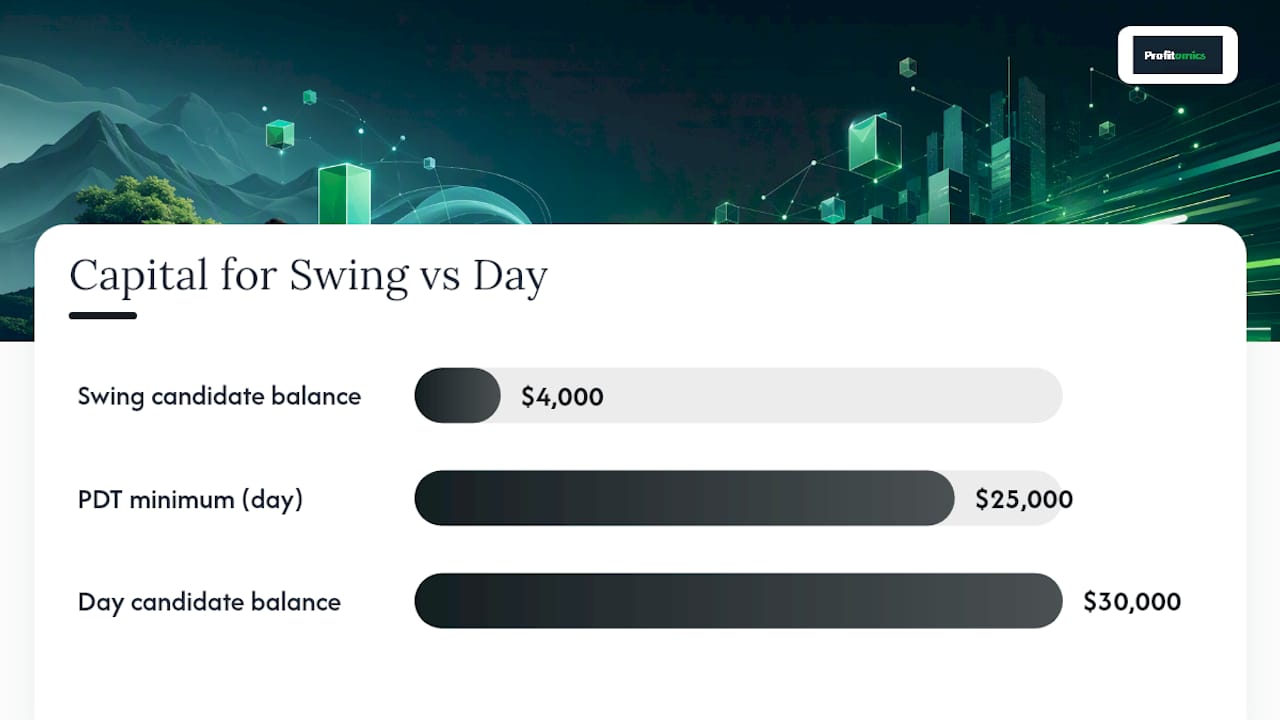
Two quick examples: a warehouse supervisor with $4,000 saved and a 6 a.m. to 2 p.m. shift is a clear swing trading candidate; the schedule and capital both point that direction. A remote consultant with a flexible calendar and $30,000 sitting in a brokerage account, comfortable with fast decisions, is a reasonable day trading candidate, assuming they start small and paper trade first.
Getting Started the Right Way
Whichever style you land on, the mistakes that wreck new traders are almost always avoidable: undersized accounts pushed into high-frequency trading, no stop-loss discipline, and skipping the practice phase entirely.
If you’re starting with day trading:
- Paper trade for at least 30 days using a simulator before risking real money.
- Choose a platform with Level 2 data and reliable hotkey support.
- Build and memorize a small set of hotkeys for entry, exit, and stop adjustment.
- Start live trading with the smallest position size your broker allows.
- Journal every trade, including the setup, entry, exit, and emotional state at the time.
If you’re starting with swing trading:
- Build a daily or weekly scanning routine to identify setups on higher timeframes.
- Create a watchlist of 10 to 20 stocks you understand well and follow consistently.
- Size each position using the 2% rule based on your stop distance.
- Plan for overnight and weekend risk before entering, not after.
- Review your trades weekly, not daily, to avoid overreacting to short-term noise.
A One-Month Starter Plan You Can Actually Follow
Structure beats motivation. A four-week plan with specific, measurable checkpoints will teach you more than months of unfocused chart-watching.
- Week 1: Spend time studying charts daily and run at least 50 simulated trades in a paper account, focusing on recognizing your chosen setup (a moving-average pullback for swing, a VWAP bounce for day trading) without risking real capital.
- Week 2: Narrow down to two setups that produced your best simulated results and refine your entry and stop rules until they’re mechanical, not emotional.
- Week 3: Move to live trading with the smallest position size available, focusing on execution discipline rather than profit.
- Week 4: Review every trade from the month, calculate your win rate and average reward-to-risk, and decide whether to scale position size or keep refining.
Tracking the right numbers matters more than tracking every number. Here’s what to log each session:
| Metric | What It Tells You |
|---|---|
| Win rate | Percentage of trades closed profitably; useful only alongside reward-to-risk |
| Average reward-to-risk | Ratio of average win size to average loss size across your trades |
| Max drawdown | Largest peak-to-trough decline in your account during the period |
| Time per session | Minutes or hours spent actively managing trades, useful for gauging sustainability |
Pro Tip: *Don’t judge your first month by profit and loss alone.
What I’d Tell a Beginner Choosing Between These Two
Most people who ask me whether to day trade or swing trade are really asking a different question: how fast can I make this work? I get why. But speed is exactly the wrong metric to optimize for when you’re new. Swing trading tends to be the more sustainable starting point for most beginners, not because day trading doesn’t work, but because the learning curve punishes mistakes less severely when your trades unfold over days instead of minutes.
The retail traders who burn out fastest are usually the ones who jumped straight into high-frequency day trading on a small account, got squeezed by commissions and slippage, and never gave a single setup enough repetitions to actually learn it. Swing trading’s slower pace forces you to sit with a decision, watch it play out, and learn from the outcome without a dozen other trades muddying the lesson. That’s not a knock on day trading. It’s a case for sequencing: learn the discipline on a slower clock, then decide if you want to speed it up.
The templates and checklists in Profitomics’s practical guides exist for exactly this reason: to give you a structure to follow during that first month instead of guessing your way through it.
Get the Templates That Take the Guesswork Out of Your First Trades
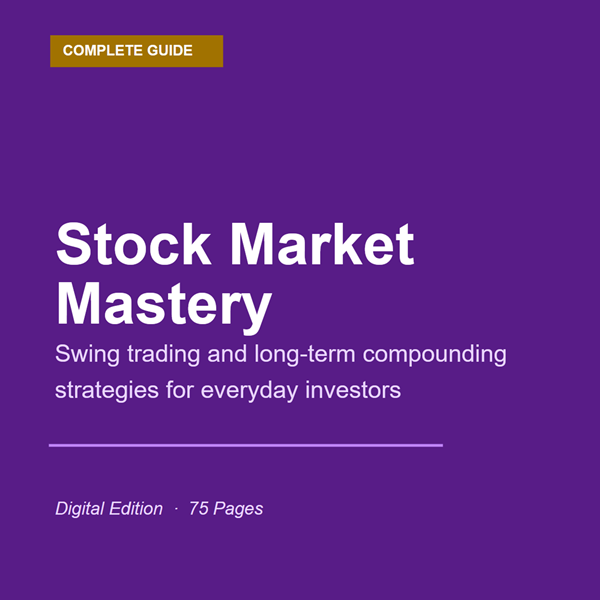
The starter plan above works better with the actual spreadsheets and checklists in hand instead of building them from scratch. Stock Market Mastery from Profitomics is built specifically around swing trading and long-term compounding strategies, and it comes with the position-sizing spreadsheet, trade journal template, and setup checklists referenced throughout this article.
It’s built for exactly the reader profile most of this article describes: someone with a job, a modest account, and a plan to grow it methodically rather than gamble on it. Profitomics can’t promise you’ll be profitable. No education product can. What it does provide is a system you can follow instead of piecing one together from forum posts and guesswork. Get Stock Market Mastery and start applying the framework to your own watchlist this week.
Sources
Use the Investopedia and TradingSim guides for deeper strategy mechanics, check FINRA directly before opening a margin account for day trading, and confirm your broker’s protections through SIPC before funding any account.
This article is general information, not a substitute for advice from a qualified financial advisor. Consult a qualified financial professional about your own circumstances before acting on anything here.
FAQ
Which is better, swing trading or day trading?
Neither is universally better. Day trading suits people with $25,000 or more in capital, flexible full-time hours, and a fast decision-making style, while swing trading suits part-time traders with smaller accounts who prefer a slower pace.
What is the 2% rule in swing trading?
Is swing trading still profitable?
Swing trading remains a viable approach when paired with disciplined risk management and realistic reward-to-risk targets, though profitability depends on execution and market conditions rather than the style itself.
How much money do I need to start day trading?
You technically need less to start, but the Pattern Day Trader rule requires $25,000 in equity to place four or more day trades within five business days in a margin account.
Can I combine swing trading and day trading?
Many experienced traders eventually blend both styles once they’ve built enough capital and skill, using swing trades for core positions and occasional day trades for shorter-term opportunities.
Recommended
- Stock Market Mastery — Swing trading and long-term compounding strategies | Profitomics
- Make Money Online — Ebooks on Passive Income, Stocks & Crypto | Profitomics
- Side Hustle to Six Figures — Turn any skill or idea into a $100K+ income stream | Profitomics
- The Passive Income Blueprint — Build income streams that pay you while you sleep | Profitomics