Make Trading Discipline Mechanical Using a Discipline Score
Trading discipline comes from system design: pre-commitment rules written before the market opens, guardrails that make the wrong choice harder than the right one, and a way to measure whether you followed your own plan. Start this week with three things: a five-item pre-session checklist, a hard daily loss limit enforced at the platform level, and a discipline score that tracks rule adherence separately from profit and loss. Everything else in trading psychology is a variation on those three moves.
TL;DR:
- Building trading discipline depends on system design, including pre-commitment rules, platform-enforced guardrails, discipline measurement, and recovery plans.
- A five-minute pre-session checklist, small watchlist, and specific implementation intentions significantly reduce impulsive decisions during trading sessions.
- Mechanical tools such as hard loss limits, position caps, and auto-shutdown features are more effective than psychological willpower alone.
- Tracking a discipline score weekly, focusing on rule adherence rather than profit, helps traders identify patterns and build consistent habits over about two to three months.
- Most common failures—overtrading, revenge trading, moving stops, FOMO entries—have specific fixable countermeasures, emphasizing system design over character flaws.
Table of Contents
- Why Trading Discipline Is an Engineering Problem, Not a Willpower Problem
- Pre-Session Systems: Checklists, Watchlists, and If-Then Rules
- In-Session Guardrails: Make the Disciplined Choice the Easy One
- Measuring Process: Build a Discipline Score and Run Weekly Reviews
- How Long Discipline Actually Takes to Build, and How to Recover From a Miss
- Common Discipline Failures and the Exact Fix for Each
- Profitomics Templates and Kai’s Guidance for Putting This Into Practice
- What Actually Changes a Trader’s Behavior
- Turn These Systems Into a 12-Week Program With Profitomics
- Sources
- FAQ
Why Trading Discipline Is an Engineering Problem, Not a Willpower Problem
Most traders treat a blown rule as a character failure. It’s usually a design failure. Discipline isn’t a fixed reserve of willpower you either have or burn through by 10 a.m. It’s better understood as a cost-benefit calculation your brain runs in real time, and that calculation shifts the moment stress, fatigue, or a string of losses changes what feels urgent. The Wall Street Coach frames this as a motivated recalculation rather than a moral lapse, and that reframing matters because it points you toward fixes that actually work: change the inputs to the calculation, not the person doing the calculating.
This connects directly to a concept the poker player and decision writer Annie Duke calls “resulting”: judging a decision by its outcome instead of its process. A trader who breaks a stop-loss rule and gets bailed out by a lucky reversal learns exactly the wrong lesson. A trader who follows every rule and still loses money on a well-executed setup learns to distrust a system that was actually working. Grading yourself on process instead of P&L, an approach Traders Second Brain documents in detail, breaks that feedback loop.
Durable trading discipline rests on four components, and skipping any one of them is why most “just be more disciplined” advice fails within a week:
- Pre-commitment: rules written and locked in before you have skin in the game.
- Enforcement: guardrails, ideally mechanical ones, that don’t ask your permission in the moment.
- Measurement: a number that tells you whether you actually followed the plan.
- Recovery: a defined way to get back on track after a miss, without a spiral.
Traders who build all four tend to plateau at a much higher level of consistency than traders relying on motivation alone, because motivation is the one input in that list you can’t control on a bad day.
Pre-Session Systems: Checklists, Watchlists, and If-Then Rules
The highest-leverage discipline tool most traders never build is a five-minute routine completed before the first trade. Coaching resources consistently rank the pre-session checklist as the single highest-impact discipline intervention, mainly because it moves decisions out of the moment when adrenaline is running the show.
Run through these five checks before every session:
- Confirm your daily loss limit in dollars, not percent, so there’s no mental math when you’re already rattled.
- Set your maximum trade count for the day and write it somewhere you’ll see it, not just in your head.
- Rate your mental state on a 1 to 5 scale. Below a 3, size down or sit out.
- Check the economic calendar for scheduled releases that could spike volatility outside your edge.
- Mark key levels on your chart, support, resistance, and prior day’s range, before price starts moving.
Pair the checklist with a watchlist you deliberately keep small, three to five tickers with a pre-defined entry trigger and an invalidation point written next to each one. A big watchlist invites you to hunt for action; a small one forces you to wait for your setup.
The real unlock is writing implementation intentions, simple if-then statements for your most common triggers. Research from Gollwitzer and Sheeran on implementation intentions found that people who plan a specific response to a specific cue follow through far more often than people relying on general intent. In trading terms: “If I hit my daily loss limit, then I close the platform for the day” beats “I’ll try to stop trading if things go badly” every time.
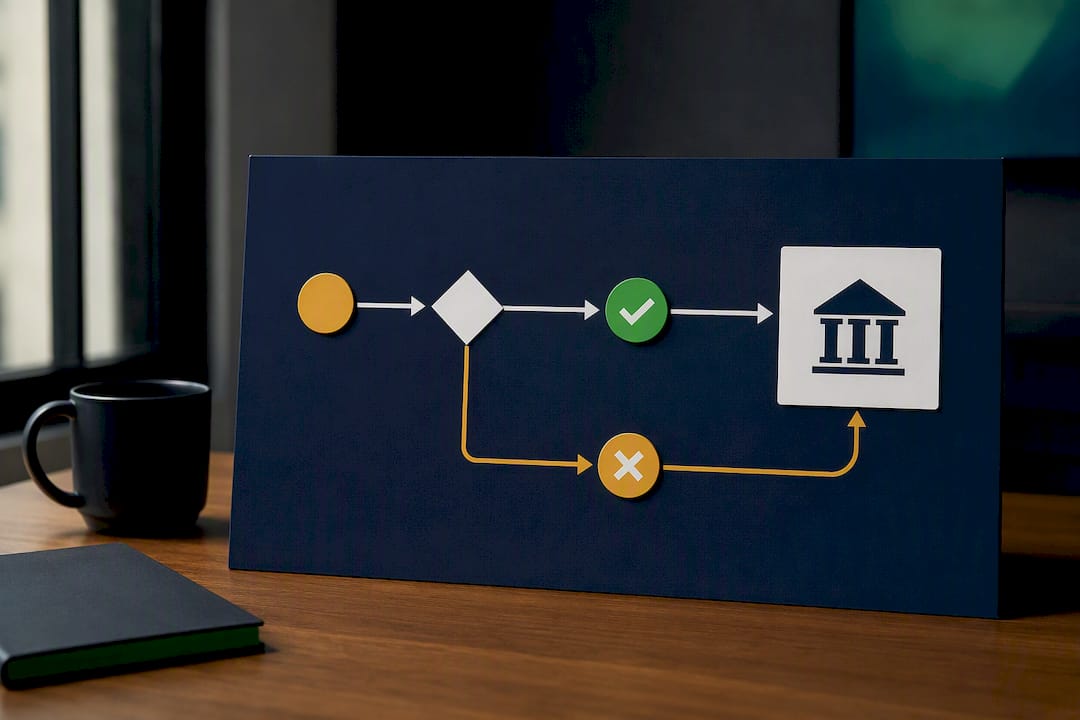
Pro Tip: Write your if-then rules on a sticky note on your monitor, not buried in a note app. The friction of opening an app is exactly enough friction to let you talk yourself out of following it.
Building this routine around a fixed trading plan template keeps the checklist consistent from session to session instead of reinventing it under pressure.
In-Session Guardrails: Make the Disciplined Choice the Easy One
The most effective discipline tools aren’t psychological at all. They’re mechanical. NexusFi’s analysis of rule-following in active trading points to broker- and platform-enforced limits as the single most effective category of discipline tool, because they remove the moment of discretion entirely.
Set these guardrails at the platform or broker level, not just in your notes:
- A hard daily loss limit that locks you out of new orders. Most platforms let you set a maximum daily loss that triggers an automatic trading halt, not just an alert you can dismiss.
- Position-size caps enforced by the platform, so a bigger size requires deliberately changing a setting, not just clicking a bigger number in the heat of the moment.
- OCO (one-cancels-the-other) or bracket orders on every entry. Set your stop and target at the same time you place the trade, and treat moving a stop after entry as a rule violation, full stop.
- A time-based auto-shutdown that closes your platform after your defined session window, so “just one more trade” isn’t an option after hours.
- Hide your live, running P&L during the session if you can. Watching an unrealized number swing is one of the fastest ways to trigger an emotional exit.
- Strip your charts down to the indicators your setup actually uses. Extra charts invite improvised trades that weren’t on your plan.
Detailed sizing math and stop placement rules are covered in Profitomics’s risk management guide, which pairs well with the guardrails above once you’re ready to formalize position sizing.
Measuring Process: Build a Discipline Score and Run Weekly Reviews
You can’t improve what you don’t measure, and most traders measure the wrong thing. P&L tells you what happened. A discipline score tells you why. Calculate it after every session with a simple formula:
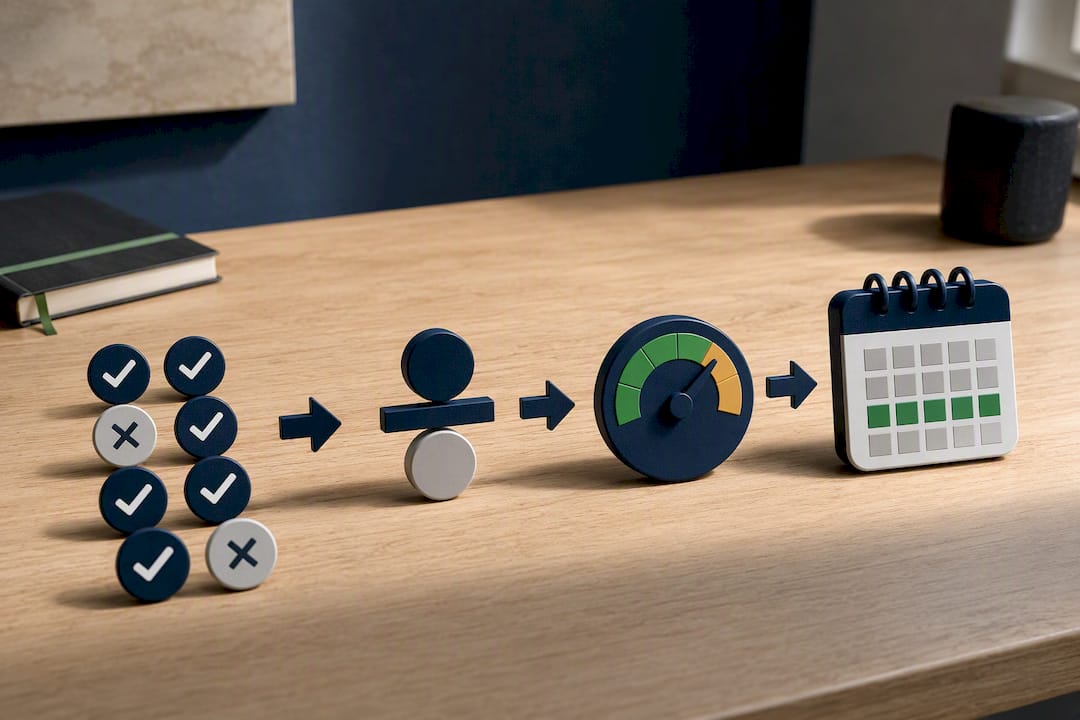
Discipline score = (rules followed ÷ total applicable rules) × 100
Tracking this separately from outcomes is the core recommendation in Traders Second Brain’s framework, and it’s backed by a broader pattern in behavioral research: a 2007 Dominican University study on goal-setting found that people who wrote down goals and reported progress to someone else completed significantly more of them than people who didn’t.
Log the following for every trade, not just the losers:
- Which specific rule tags applied (entry trigger, stop rule, size rule, time-of-day rule).
- Your emotional state rating at entry and exit.
- Whether each applicable rule was followed, yes or no.
- The P&L attributable specifically to any rule violation, isolated from the rest of the trade.
A weekly review turns that log into action. Keep the template tight:
| Metric | This week | Fix for next week |
|---|---|---|
| Average discipline score | e.g. 78% | One rule to prioritize |
| Number of violations | e.g. 4 | Which rule broke most often |
| Violation P&L | e.g. $180 lost | Guardrail to escalate |
| Best-graded setup win rate | e.g. A-setups only | Whether to grade tighter |
Pick exactly one fix per week. Trying to correct five habits simultaneously is how discipline programs collapse by week three. A structured trading journal template makes this weekly tally take minutes instead of an evening.
How Long Discipline Actually Takes to Build, and How to Recover From a Miss
Forget the “21 days to build a habit” line. It’s not supported by the research it’s usually attributed to. A UCL study led by Lally and colleagues found that the median time for a behavior to become automatic is around two months, with individual results varying widely depending on the person and the habit. Set your own expectation at three months, not three weeks, and you’ll stop quitting a working system right before it clicks.
When you miss a session or blow a rule, the wrong move is a full reset of your streak count and a spiral of guilt. The right sequence is shorter: acknowledge the miss, identify the specific trigger, adjust one guardrail, and trade the next session as scheduled. Missing a day of physical therapy doesn’t undo the healing; missing a session of rule-following doesn’t erase the 40 sessions you got right before it.
A practical 12-week single-rule plan looks like this:
- Weeks 1 to 2: pick one rule, usually the daily loss limit, and enforce it mechanically.
- Weeks 3 to 6: hold that rule while journaling every violation and its trigger.
- Weeks 7 to 9: add a second rule only once the first one holds above a 90% discipline score.
- Weeks 10 to 12: run weekly reviews and escalate any guardrail that’s still leaking.
Common Discipline Failures and the Exact Fix for Each
Four failure patterns account for most of the damage traders do to their own accounts, and each one has a specific, testable countermeasure rather than a vague “stay calm” instruction.
- FOMO entries. You see a move already happening and jump in without your setup. Fix: trade only limit orders at your pre-defined entry price, never market orders chasing a candle, and treat every missed trade as a cost of doing business, not a mistake.
- Revenge trading. A loss triggers an oversized trade meant to “get it back” immediately. Fix: a hard daily loss cutoff that locks the platform, plus a time-based shutdown after any two-loss streak in a session.
- Moving stops. You widen a stop-loss mid-trade hoping for a reversal. Fix: mandatory OCO orders placed at entry, with partial profit-taking rules defined in advance so there’s no discretionary decision to make while the trade is live.
- Overtrading. You take marginal setups just to stay active. Fix: a strict max-trade-count per session and a setup grading system (A, B, C) where only A-graded setups get full size. Setup grading is associated with meaningfully higher win rates than trading every signal that appears.
Pro Tip: Track violations by category, not just by trade. If four of your last five rule breaks are the same rule, you don’t have a discipline problem, you have a design problem with that one rule.
Professional trading rule lists consistently circle back to these same four categories, which is a strong signal they’re the ones worth fixing first. Profitomics’s overtrading guide breaks the fourth pattern down further if trade-count creep is your specific issue.
Profitomics Templates and Kai’s Guidance for Putting This Into Practice
Every system above works better with a template instead of a blank page. Profitomics’s trading journal template already includes fields for rule tags and violation P&L, so your discipline score calculates itself. The trading plan template maps directly to the pre-session checklist. Kai’s posts on overtrading and risk management go deeper on two of the failure modes above. When adapting any template, prioritize the fields for daily loss limit and rule-followed yes/no first. Those two drive most of the discipline score.
What Actually Changes a Trader’s Behavior
System design compounds in a way willpower never does. A weekly review is a small habit, but stacked over a few months it surfaces patterns no single trading session ever reveals on its own. I’d rather see a trader with a mediocre strategy and a strict discipline score than a brilliant strategy with no measurement at all, because the second trader has no way of knowing which of their trades were skill and which were luck.
Pick one metric, probably your discipline score or your daily loss limit compliance, and track it for 30 days before you touch anything else. Report your results to yourself in writing every Sunday. Process adherence, not this week’s P&L, is what actually predicts whether you’re still trading profitably a year from now.
— Kai
Turn These Systems Into a 12-Week Program With Profitomics
You’ve got the framework: checklist, guardrails, discipline score, weekly review. What most traders lack isn’t the concept, it’s a done-for-you structure that removes the setup time between reading about discipline and actually running it. Stock Market Mastery is built around exactly this gap, giving you step-by-step systems and ready-to-use templates instead of theory you have to translate into your own spreadsheet from scratch.

Some ebooks pair practical trading systems with checklists that can be used immediately, emphasizing pre-commitment to remove friction before the market opens rather than during it. If you’re also building income streams outside trading, Side Hustle to Six Figures applies the same template-first approach to online business. Get Stock Market Mastery today and start your first 12-week discipline cycle this week instead of after another string of inconsistent sessions.
Sources
The systems in this article draw on a mix of trading-specific coaching material and broader behavioral research. For deeper reading:
- 20 Rules Followed by Professional Traders — Investopedia
- Trading Discipline: The System-Based Framework That Works — The Wall Street Coach
- Trading Discipline and Rule Following: System Design Over Willpower — NexusFi Academy
- Trading discipline: Follow your rules every session — Traders Second Brain
For automated trade logging beyond a manual spreadsheet, Betlog offers a record-keeping approach worth comparing against a DIY journal.
FAQ
Can I Make $1,000 a Day Day Trading?
It’s possible on some days with enough capital and volatility, but it isn’t a repeatable baseline you can plan around. Consistent traders think in terms of percentage return and risk per trade, not a fixed dollar target, because a fixed daily goal pressures you into overtrading on slow days to hit the number.
What Is the 3-5-7 Rule in Trading?
It’s a risk-management guideline where you risk no more than 3% of your account on any single trade, cap total exposure across open positions at 5%, and aim for a risk-reward ratio of at least 1:7 or a similar high multiple on your best setups. Versions of this ratio vary across sources, so treat it as a starting framework to adapt inside your own trading plan rather than a fixed law.
Why Do 90% of Day Traders Lose Money?
The most common causes are exactly the failure modes covered above: overtrading, moving stops, revenge trading after a loss, and no measurable way to know whether they’re following their own rules. Traders who track a discipline score and enforce guardrails at the platform level, rather than relying on willpower alone, tend to break that pattern.
What Is the 90% Rule in Trading?
It refers to the informal but widely repeated claim that roughly 90% of new traders lose most or all of their starting capital, often within their first months. The specific percentage varies by source and isn’t tied to a single rigorous study, but the underlying message, that undisciplined trading fails at a high rate, lines up with why systems like a pre-session checklist and a hard daily loss limit matter so much.
How Do I Build Trading Discipline if I Keep Breaking My Own Rules?
Move the rule from something you enforce mentally to something the platform enforces mechanically, a hard daily loss lockout instead of a note to yourself. Pair that with a discipline score tracked weekly, since measuring rule adherence separately from P&L is what turns an intention into an actual habit over the roughly two-to-three-month timeline most behavior change requires.