Overtrading: How to Spot It and Stop It Fast
Overtrading is buying and selling more often than your strategy, capital, or emotional state can support, and it quietly drains accounts through fees, taxes, and bad decisions made in sequence. If you’ve placed multiple trades in the last hour without a written reason for each one, close the platform now. The SEC and FINRA regulate broker misconduct like churning, but they won’t stop you from overtrading yourself. That job is yours, and Profitomics built its trading ebooks around exactly this problem.
Do this in the next five minutes:
- Log out of your brokerage app or close the desktop platform.
- Write down your last five trades and the reason you entered each one.
- Set a hard stop: no new trades until tomorrow.
Key Takeaways
Overtrading damages returns primarily through compounding fees, tax inefficiency, and emotionally driven decisions, and mechanical rules stop it more reliably than willpower alone.
| Point | Details |
|---|---|
| Two meanings, one root cause | Trader-level overtrading is emotional excess; accounting overtrading is growth outpacing cash flow, but both mean activity beyond sustainable limits. |
| Audit your last 30–90 trades | Check trades per day, costs as a share of gains, and win rate immediately after losses to spot the pattern. |
| Know the $25,000 rule | Four or more day trades in five business days in a margin account triggers pattern day trader status and a $25,000 minimum equity requirement. |
| Rules beat feelings | Set a daily trade cap, a daily loss limit (commonly 2% of equity), and a mandatory cooldown after losses. |
| Use templates to apply it fast | Profitomics’s Stock Market Mastery ebook provides position-sizing and trade-quality templates you can start using the same day. |
Table of Contents
- What Does Overtrading Mean, Exactly?
- How Do You Know If You’re Overtrading?
- Why Do Traders Fall Into Overtrading?
- What Does Overtrading Actually Cost You?
- How Do You Stop Overtrading Starting Today?
- What Should You Track to Stay Disciplined?
- How Do You Recover From a Pattern of Overtrading?
- Trading Is a Performance Discipline, Not a Willpower Test
- Want a Structured Way to Stop Overtrading for Good?
- Sources
- FAQ
What Does Overtrading Mean, Exactly?
The word covers two different problems, and mixing them up leads to bad advice. At the individual level, overtrading means placing trades driven by emotion or boredom rather than a tested method, like buying a stock because it’s spiking on social media, not because it fits your plan. At the company level, accounting overtrading means a business grows sales faster than its working capital can support, running out of cash even while revenue climbs.
Both versions share the same root problem: activity that outpaces what the underlying resource, capital, discipline, or cash flow, can actually sustain.
How Do You Know If You’re Overtrading?
Pull your last 30 to 90 trades and run the numbers before you trust your gut. Overtrading rarely feels like a problem in the moment. It feels like activity, and activity feels like progress.
Watch for these signals:
- A sudden jump in trades per day compared to your usual pace.
- Commission and spread costs eating a rising share of your gains.
- Multiple trades classified as short-term, triggering higher tax rates than long-term capital gains.
- Four or more day trades in five business days, which flags you as a pattern day trader and can trigger a $25,000 minimum equity requirement in a margin account.
- A cluster of trades placed within 30 minutes of a loss.
Export the data, calculate trades per day, and check your win rate specifically on trades that followed a loss. If that win rate drops sharply, you’ve found your pattern.
Why Do Traders Fall Into Overtrading?
Overtrading is a decision-quality problem before it’s a frequency problem, and it usually traces back to one of a handful of triggers.
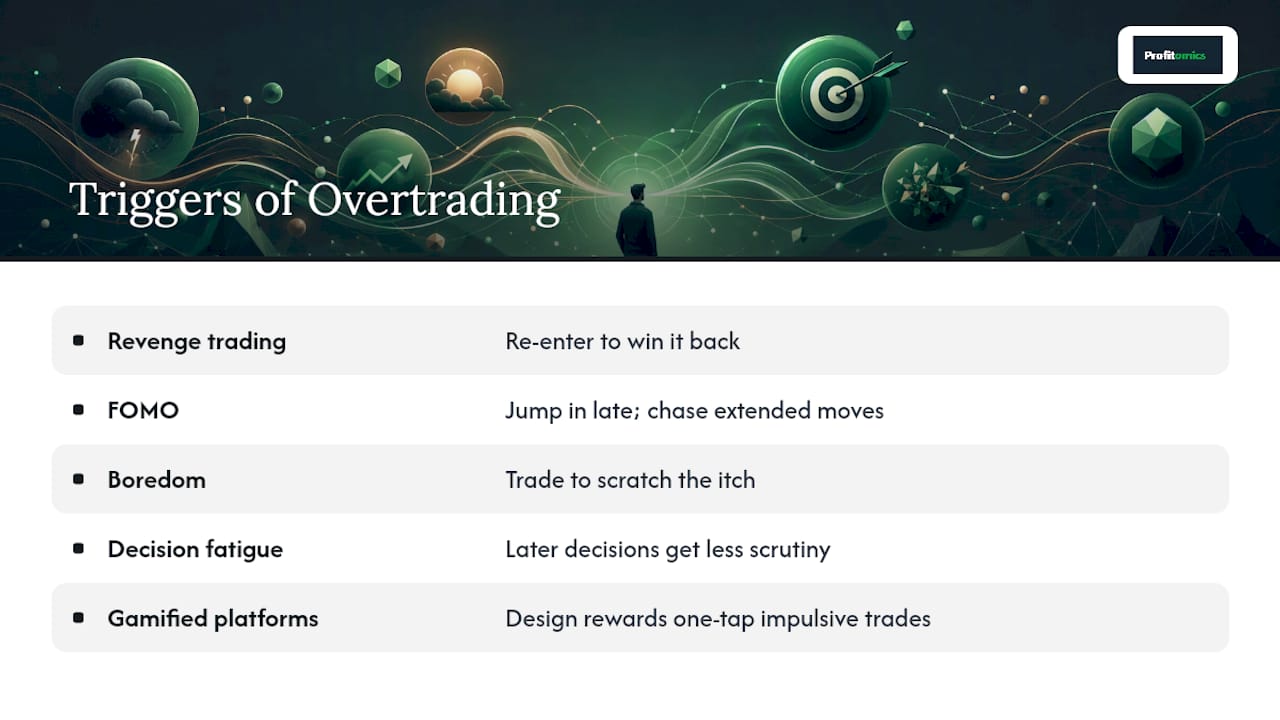
Revenge trading shows up right after a loss, when you re-enter the market to “win it back” instead of waiting for a real setup. FOMO hits when a stock is moving without you and you jump in late, chasing a trade that’s already extended. Boredom drives trades on slow days simply because the itch to do something overrides the plan. Decision fatigue sets in after hours of screen time, when your tenth trade decision that day gets far less scrutiny than your first. Gamified platforms, with real-time price alerts and one-tap execution, are built to reward frequency, and that design measurably increases impulsive trading. Underneath most of these is a simple structural gap: no written rules for position size, entry criteria, or daily limits.
What Does Overtrading Actually Cost You?
The damage compounds quietly across several fronts at once:
- Transaction fees that multiply with every extra trade.
- Bid-ask spreads that eat into small, frequent positions harder than large, infrequent ones.
- Slippage on fast-moving entries and exits.
- Short-term capital gains taxed at higher rates than long-term holdings.
- Opportunity cost from capital tied up in low-conviction trades.
- Reduced diversification as position sizes shrink to fit more trades in.
Academic research on retail trading behavior has repeatedly found that high-frequency traders underperform after costs, often by a wide margin compared to less active investors.
On the regulatory side, it helps to know what’s actually covered. Churning, a broker excessively trading a client’s account to generate commissions, is a securities law violation the SEC and FINRA can act on. But that protection applies to broker misconduct, not to your own self-directed decisions. If you’re managing your own account, no regulator is coming to save you from yourself. The pattern day trader rule is the closest thing to a built-in guardrail, and it exists to limit leverage risk, not to protect your judgment. Before your next tax season, check whether your recent trades were classified short-term. That single number often explains more of your underperformance than any single bad pick.
How Do You Stop Overtrading Starting Today?
Mechanical rules beat willpower, because willpower runs out by your fifth decision of the day and rules don’t.
- Set a daily trade limit. Cap yourself at a fixed number, three is a common starting point, and treat hitting it as a hard stop, not a suggestion.
- Set a daily loss limit. A common benchmark is 2% of account equity; once you hit it, you’re done for the day regardless of how convinced you are the next trade will work.
- Add a mandatory cooldown after losses. No new trade for at least 30 minutes after a losing position closes.
- Build in a trade-approval delay. Force a 10-minute wait between spotting a setup and executing it.
- Cap your session time. Trading for eight straight hours guarantees fatigue-driven mistakes late in the day.
- Size positions by rule, not by feel. Fixed percentage risk per trade removes the temptation to go bigger after a win or a loss.
Automate what you can. Many platforms let you set trade alerts or daily loss circuit breakers, and the simplest kill switch is still closing the app. Tell a trusted contact, a coach, or a trading partner your daily limits so someone besides you is watching.
Pro Tip: Write your daily limits on a sticky note next to your monitor. The friction of physically seeing the rule outperforms any app notification, because it interrupts the autopilot moment before you click “buy.”
What Should You Track to Stay Disciplined?
A short checklist beats a long one you’ll abandon by week two.
Before every session: Confirm your daily trade limit and loss limit out loud. Check that you’re not trading on fewer than six hours of sleep. Review your open positions before looking for new ones.
Before every trade: Does this match a setup in your written plan? Have I already hit today’s trade or loss limit? Am I entering because of a signal, or because of a feeling?
After every session: Log every trade, win or lose, planned or impulsive.
A simple spreadsheet works better than memory. Track date and time, trade sequence number for the day, whether it was planned or impulsive, your entry reason in one line, profit and loss, running drawdown, and an emotional tag (calm, anxious, angry, bored).

Pro Tip: Traders are mental athletes whether they think of themselves that way or not. Protecting sleep, taking a real midday break away from the screen, and staying hydrated measurably reduces the impulsive decisions that come from a tired, depleted brain.
How Do You Recover From a Pattern of Overtrading?
Recovery works in stages, not all at once.
- Immediate triage (today): Close the platform, set a hard daily loss limit, and stop trading until tomorrow.
- Days 1 to 7: Journal every trade and enforce your new limits without exception, even on strong-feeling days.
- Days 8 to 30: Run weekly reviews and score each trade for quality, not just outcome. Aim for a maximum of three trades per day as a working ceiling.
- Days 31 to 90: Refine your actual edge using the trade log data, then carefully re-test whether your limits can loosen without your quality score dropping.
If a review of your account shows your broker, not you, is driving the excess activity, that’s a different problem entirely. Excessive trading initiated by a broker for commissions is churning, and it’s worth escalating to FINRA or the SEC rather than trying to self-correct.
Trading Is a Performance Discipline, Not a Willpower Test
Treating overtrading as a moral failing, a lack of discipline you should simply try harder to fix, misses what’s actually happening. It’s a cognitive performance problem, closer to what an athlete manages before a competition than a habit you break through sheer resolve. The traders who fix it don’t rely on motivation. They rely on mechanical limits that don’t care how confident they feel in the moment.
Small, boring changes, a daily trade cap, a cooldown timer, a logged reason for every entry, compound into something that looks a lot like skill after a few months. Start with the checklist above today.
Want a Structured Way to Stop Overtrading for Good?
Rules only work if you actually write them down and apply them the same way every session, and that’s the gap most traders never close on their own. Profitomics builds its ebooks around exactly that gap: ready-to-use templates and spreadsheets instead of vague advice to “trade with discipline.”
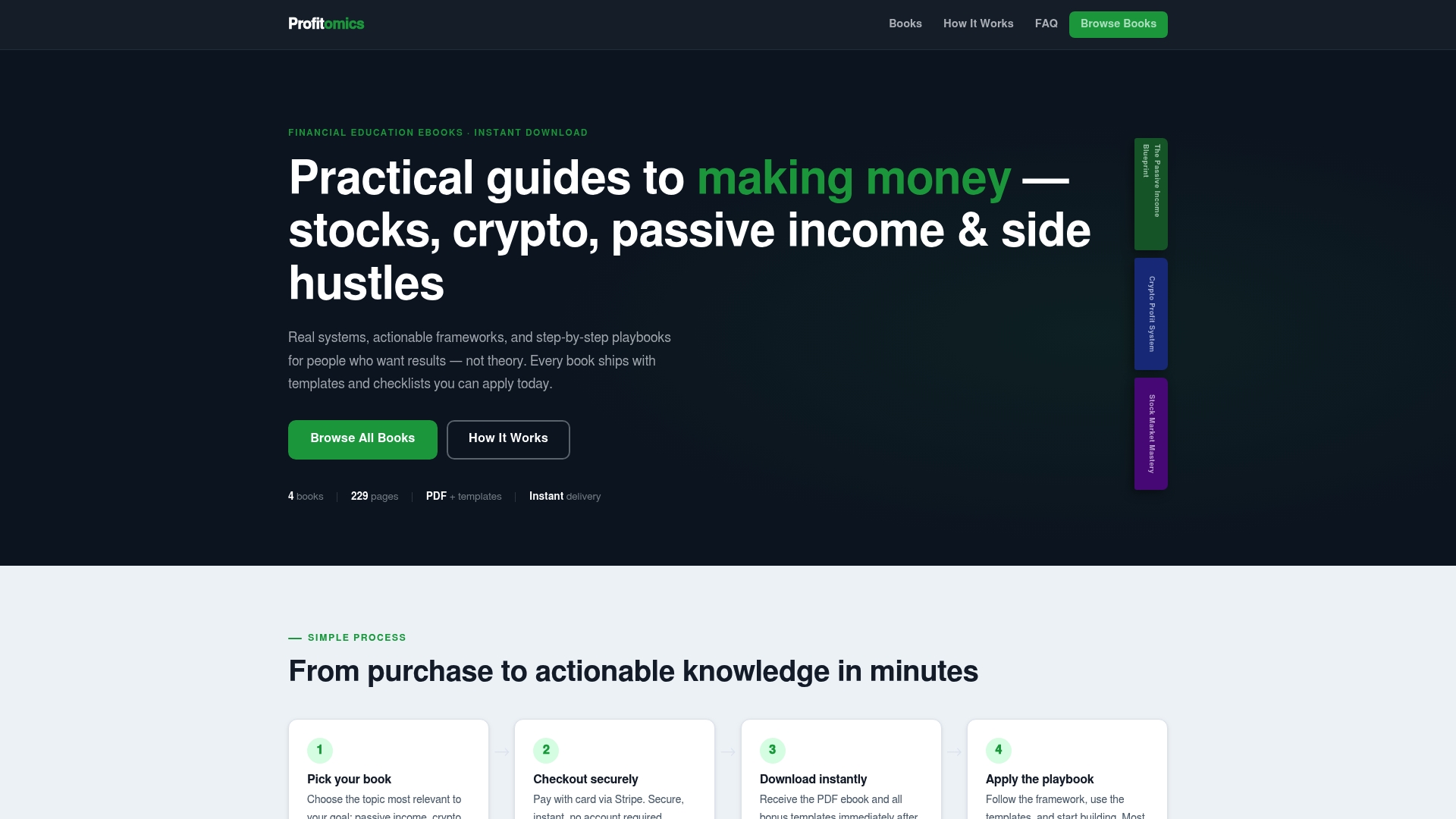
The Stock Market Mastery ebook walks through position-sizing rules and setup criteria so you can define, in writing, what counts as a valid trade before you ever place one. It pairs three things active traders consistently struggle to build alone:
- Templates for daily trade limits, loss limits, and cooldown rules you can apply the same day you download them.
- A trade-quality scoring framework so you’re measuring decisions, not just outcomes.
- Instant access, meaning you can start applying the system in your next trading session instead of waiting weeks for a course.
If crypto is where your overtrading tends to spike, the Crypto Profit System ebook applies the same risk-first framework to that market’s extra volatility. Either way, the next step is the same: pick up the Stock Market Mastery ebook and build your written rule set before your next session, not after your next drawdown.
Sources
- Overtrading: Definition, examples and how to make sure you don’t do it — Chase
- Churning — Legal Information Institute, Cornell Law
- Overtrading — AccountingTools
Use self-help tools like journaling and trade limits for your own behavior; contact FINRA or the SEC only when you suspect broker-driven churning, not personal overtrading.
This article is general information, not a substitute for advice from a qualified financial advisor. Consult a qualified financial professional about your own circumstances before acting on anything here.
FAQ
How Do You Stop Overtrading?
Set a written daily trade limit and loss limit, add a mandatory cooldown after losses, and log every trade with your reason for entering it before you place it.
What Counts as Overtrading?
Any pattern of trades driven by emotion rather than a written strategy counts, including revenge trades after a loss, chasing a moving stock out of FOMO, or exceeding four day trades in five business days.
What Does Overtrading Mean in Accounting?
In accounting, overtrading happens when a business grows sales or production faster than its working capital can support, leading to cash shortages despite rising revenue.
Is Overtrading Illegal?
Overtrading by an individual isn’t illegal, but churning, a broker excessively trading a client’s account to generate commissions, is a securities law violation regulators can act on.
Recommended
- Stock Market Mastery — Swing trading and long-term compounding strategies | Profitomics
- Make Money Online — Ebooks on Passive Income, Stocks & Crypto | Profitomics
- Crypto Profit System — A risk-first framework for building consistent crypto returns | Profitomics
- Side Hustle to Six Figures — Turn any skill or idea into a $100K+ income stream | Profitomics