Start in 30 Minutes: Step by Step Plan for Beginners with Templates
Open a brokerage account or IRA right now, and set up a $25 to $50 automatic monthly investment into a broad-market ETF. That single move makes you an investor today, no matter your balance. Everything else in step by step investing, from picking an account type to choosing your first fund, just fills in the details around that one action.
TL;DR:
- Investing as little as $25 to $50 monthly into a broad-market ETF is enough to start building wealth immediately, regardless of your balance.
- Choosing the right account type depends on your goals: prioritize a 401(k) for employer match, then consider Roth or traditional IRA based on income expectations; a taxable account suits medium-term and leftovers.
- Automating recurring contributions and rebalancing annually eliminates the need for constant oversight, making long-term investing manageable for beginners.
- The first purchase should be a simple, broad-market ETF or target-date fund, avoiding individual stocks or crypto unless you understand the business or can tolerate loss.
- Always verify brokers through official channels before funding, and keep trading costs low by favoring commission-free trades and low expense ratio funds.
Table of Contents
- Your Step By Step Investing Checklist For This Afternoon
- Step 1: What Are Your Financial Goals and Timeline?
- Step 2: Which Account Type Fits Your Goals?
- Step 3: How Do You Open and Fund the Account?
- Step 4: What Should You Buy First?
- Step 5: How Do You Actually Place the Order?
- Step 6: How Do You Automate and Maintain the Plan?
- What Mistakes and Fraud Red Flags Should You Watch For?
- What Should You Know About Fees, Taxes, and Performance?
- Kai’s Take: Templates Beat Willpower
- Where Should Beginners Go for Guided Templates?
- Where Can You Verify Brokers and Learn About Fraud Protection?
- Sources
- FAQ
Your Step By Step Investing Checklist For This Afternoon
You don’t need a financial degree to start. You need about 30 minutes and this sequence.
- Open the account. Enable your workplace 401(k) or open an IRA or taxable brokerage account online.
- Fund it. Link your bank, make an initial deposit, and schedule an automatic monthly transfer.
- Buy something broad. Put the money into a low-cost, broad-market ETF or an all-in-one target-date fund.
- Turn on dividend reinvestment. Set it and forget it so every payout buys more shares automatically.
- Set a 12-month reminder. Check your allocation once a year, not once a week.
That’s the whole skeleton. The rest of this guide fills in the “why” and the “how” behind each step, because the mechanics matter less than most people think, and the habits matter more.
Step 1: What Are Your Financial Goals and Timeline?
Money needs a job before it gets invested. A goal three months away and a goal thirty years away should never sit in the same account, let alone the same fund.
Start by sorting your goals into three buckets:
- Short-term (under 3 years): a house down payment, a wedding, an emergency fund. This money stays in cash or a high-yield savings account, never in the stock market.
- Medium-term (3 to 7 years): a car replacement fund, a career break, a kid’s braces. Conservative, low-volatility investments only.
- Long-term (7-plus years): retirement, financial independence, a kid’s college fund started early. This is where stock-heavy portfolios belong.
Investing cash you’ll need next spring is the single fastest way to turn a good plan into a bad outcome, because a market downturn doesn’t care about your timeline. Keep three to six months of expenses in cash before you invest a dollar beyond your employer match.
Speaking of match: if your employer offers one on a 401(k), that’s the first dollar that goes to work, before an IRA, before a brokerage account, before anything else. It’s an immediate, guaranteed return that nothing else on this list can match.
From there, industry guidance points toward a long-term target of roughly 15% of your pre-tax income going toward retirement, employer match included. You don’t need to hit that on day one.
Step 2: Which Account Type Fits Your Goals?
The account you choose determines your tax bill years before you ever pick an investment. Get this wrong and you’ll pay for it later, sometimes literally.
Here’s the beginner’s decision tree:
- 401(k) first, up to the match. If your employer matches contributions, capture the full match before funding anything else. It’s free money that a taxable account can never replicate.
- Roth IRA if you expect to earn more later. You pay taxes now, at what’s probably your lowest lifetime tax rate, and withdrawals in retirement are tax-free.
- Traditional IRA if you’re in a high tax bracket now and expect a lower one in retirement. You get a deduction today and pay taxes on withdrawals later.
- Taxable brokerage account for anything else. No contribution limits, no early-withdrawal penalties, and full access to your money. Use it for medium-term goals or once you’ve maxed your retirement accounts.
A rough rule of thumb: if you’re early in your career and in a lower tax bracket than you expect to be in later, Roth usually wins. If you’re at your peak earning years, a traditional IRA’s upfront deduction often carries more weight. Neither choice is permanent. You can hold both a Roth and a traditional IRA, and plenty of people do.
Step 3: How Do You Open and Fund the Account?
Opening an account online takes less time than ordering takeout. You’ll need your Social Security number, a government ID, your employer’s name and address, and your bank’s routing and account numbers.
A few practical notes on timing and mechanics:
- ACH transfers typically take one to three business days to move money from your bank into your new account, though some brokers show available cash instantly and settle behind the scenes.
- Trades settle on a T+1 basis, meaning a stock or ETF purchase finalizes one business day after the trade date. It rarely matters for buy-and-hold investing, but it explains why your account might briefly show a “pending” status after a trade.
- Start small with fractional shares if your first deposit is modest. Most major brokers now let you buy a dollar amount of a stock or ETF instead of a whole share, which means $50 can buy a slice of a $400 ETF instead of sitting in cash waiting for a full share price.
- Set up the recurring transfer during account opening, not as an afterthought. Most platforms let you schedule it in the same flow where you fund the account the first time.
Once the money lands and clears, you’re ready to buy.
Step 4: What Should You Buy First?
Your first purchase should be boring. Boring, in investing, is a compliment.
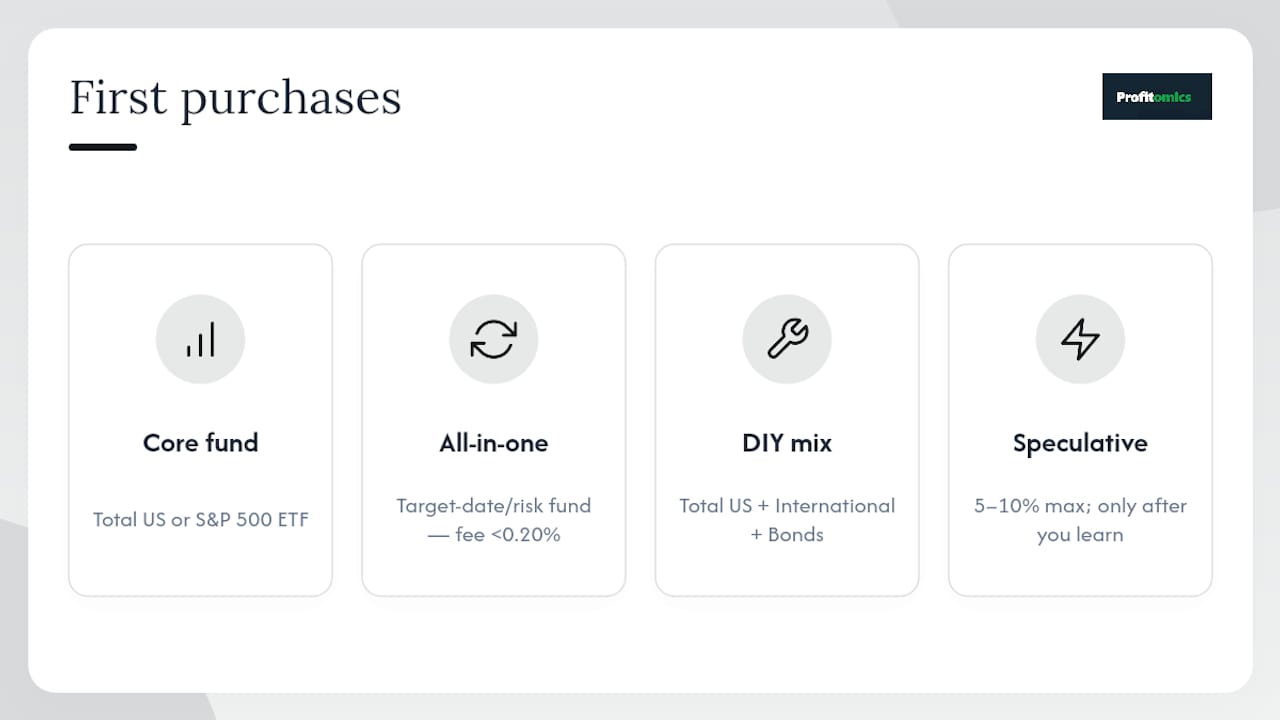
For most beginners, a broad-market index fund or ETF should form the core of the portfolio, something that tracks the total U.S. stock market or the S&P 500. Fractional-share access has made these funds the simplest realistic first purchase for anyone starting with a small balance, since you no longer need thousands of dollars just to clear a mutual fund’s minimum investment.
If you want even less decision-making, an all-in-one target-date fund or a target-risk fund does the diversification and rebalancing for you inside a single ticker. You pick a fund labeled for your approximate retirement year, and the fund manager gradually shifts the mix from stock-heavy to bond-heavy as that date approaches. It costs slightly more than a bare-bones ETF, usually still under 0.20%, but it removes an entire category of ongoing decisions.
Building your own simple two- or three-fund mix, say a total U.S. market fund, an international fund, and a bond fund, gives you more control over your exact allocation. It also asks more of you: you have to decide the percentages and remember to rebalance them.
Individual stocks and cryptocurrency belong in a small, separate bucket, if at all, and only after you understand what you’re buying. Think 5% to 10% of your portfolio at most, money you could genuinely afford to lose without changing your plans.
Pro Tip: Before buying a single stock, ask yourself if you could explain the company’s business model in one sentence to a friend. If you can’t, you’re not investing yet. You’re guessing.
For readers who want a fuller walkthrough on fund selection, Profitomics’ ETF investing guide breaks down how to compare expense ratios and pick between similar funds.
Step 5: How Do You Actually Place the Order?
The order ticket looks intimidating the first time. It’s four decisions, not forty.
- Choose market or limit. A market order executes immediately at the current price, which is fine for a stable, high-volume ETF. A limit order lets you set the maximum price you’re willing to pay, which matters more for a volatile individual stock where prices can swing sharply in seconds.
- Pick dollars or shares. Most brokers now let you enter a dollar amount instead of a share count, so a $100 buy order gets you exactly $100 of the ETF, fractional shares included.
- Review the confirmation screen. It shows the estimated cost, any commission (usually $0 on major platforms for stocks and ETFs), and the order type before you submit.
- Confirm and check your holdings. The trade settles within one business day, and your position shows up in your account almost immediately, even while the trade is technically still settling behind the scenes.
For a first-time buyer, a market order on a broad ETF is usually the simplest, safest choice. Save limit orders for later, once you’re buying something less liquid or more prone to sudden price jumps.
Step 6: How Do You Automate and Maintain the Plan?
The best investing plan is the one you don’t have to think about. Automating your contributions, a practice known as dollar-cost averaging, means you invest a fixed amount on a fixed schedule regardless of what the market is doing that day. It removes the temptation to time the market, which even professional fund managers routinely fail to do consistently.
Set it up once, inside your brokerage or 401(k) dashboard:
- Schedule a monthly transfer tied to payday, not to a date you have to remember.
- Rebalance once a year, or whenever any single holding drifts more than 5% to 10% from your target allocation.
- At your annual check-in, confirm your contribution amount still matches your income, your goals haven’t shifted, and your fund choices still fit your timeline.
That’s the entire maintenance routine. No daily price checks, no reacting to headlines. Readers who want a longer-range framework once this habit sticks can look at Profitomics’ guide to a long-term investing strategy for the next layer of planning.
What Mistakes and Fraud Red Flags Should You Watch For?
Most beginner losses aren’t caused by bad investments. They’re caused by bad behavior around otherwise fine investments.
The recurring behavioral traps:
- Panic selling during a downturn, locking in a loss that would have recovered had you stayed invested.
- Overtrading, treating a long-term account like a video game and racking up fees and short-term tax bills.
- Chasing hot tips, jumping into whatever a friend or forum is hyping without understanding it.
On the fraud side, Investor.gov flags a consistent pattern across scams: promises of high returns with little or no risk, pressure to act immediately, fake testimonials, and requests for payment through unusual methods like gift cards or cryptocurrency transfers to an unknown wallet. If you’re evaluating a broker or advisor, FINRA’s BrokerCheck lets you verify their registration and disciplinary history in a few minutes, free. It’s a step almost nobody takes, and it’s the single fastest way to filter out bad actors before you hand anyone your money.
What Should You Know About Fees, Taxes, and Performance?
Fees are the one guaranteed cost in investing, and they’re often invisible unless you go looking. Check the expense ratio on every fund before you buy it, and favor commission-free trades, which most major brokers now offer on stocks and ETFs.
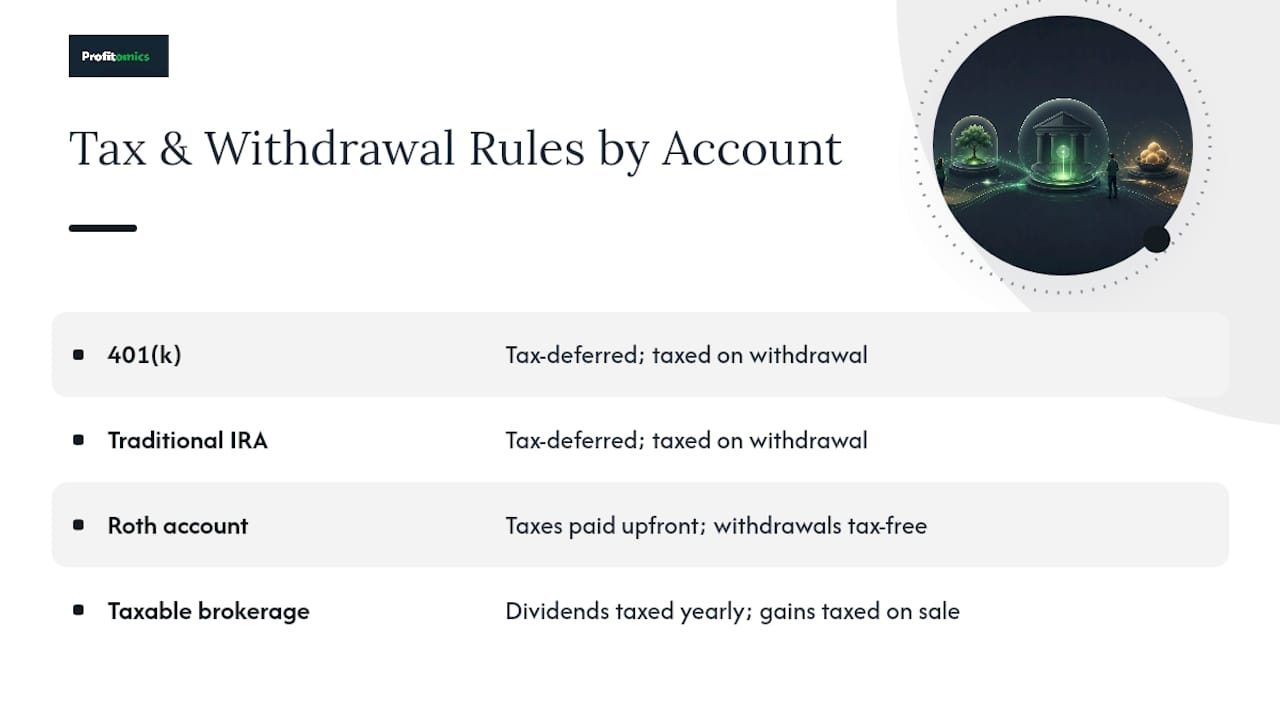
Taxes depend entirely on the account type. Money inside a 401(k) or traditional IRA grows tax-deferred, meaning you pay taxes when you withdraw it in retirement. A Roth account flips that: you pay taxes upfront and withdraw tax-free later. A taxable brokerage account taxes you each year on dividends and on any gains you realize when you sell, with lower rates for investments held longer than a year.
Evaluating performance isn’t about checking your balance daily. Compare your portfolio’s return against a relevant benchmark, like the S&P 500 for a U.S. stock fund, over periods of a year or longer. A single bad month means almost nothing. A pattern across several years tells you whether your allocation still makes sense.
Kai’s Take: Templates Beat Willpower
Most people don’t fail at step by step investing because they lack information. They fail because the plan lives only in their head, and life gets in the way of memory. A written plan, even a one-page one, outperforms a mental one almost every time.
That’s the gap Profitomics tries to close. Profitomics’ beginner investing guide and its companion checklists take the six steps above and turn them into a document you fill in once: your account type, your fund picks, your monthly contribution date, your rebalancing trigger. If you’re starting with a small amount, Profitomics’ plan for investing your first $1,000 walks through the exact allocation decisions in a worksheet format rather than a wall of text.
The goal isn’t to read another article about investing. It’s to have something in front of you on a Sunday afternoon that tells you exactly what to click next.
— Kai
Where Should Beginners Go for Guided Templates?
Reading a guide gets you the map. Executing on it, consistently, for years, is a different skill, and it’s the one most beginners underestimate. If you’ve made it this far and you’re still not sure exactly what percentage to put where, or which fund fits your specific timeline, that’s the gap a structured guide is built to close.
Profitomics’ Stock Market Mastery eBook takes the six steps in this article and expands them into a full worksheet-based system: account setup checklists, fund comparison sheets, and a rebalancing schedule you fill in with your own numbers. It’s built for someone who wants the decisions made simple rather than researched from scratch. If your goal leans more toward building income streams outside a single paycheck, the Passive Income Blueprint covers a wider set of income-generating assets beyond core stock investing.
Free resources like this article can absolutely get you started, and the checklist above works without spending a dollar. A paid guide earns its price when you want the decisions pre-organized into templates instead of pieced together from a dozen open browser tabs. Either path gets you invested. The templates just get you there faster.
Where Can You Verify Brokers and Learn About Fraud Protection?
Before you fund any account, confirm the firm and any advisor are properly registered. Investor.gov covers fraud red flags and general investor education, FINRA’s BrokerCheck lets you look up a specific broker or advisor’s registration and history, and SIPC explains what protections apply if your brokerage fails, and what they don’t cover, like market losses. For readers thinking about diversifying beyond domestic stock funds down the road, this overview of international diversification risks is worth a look before you expand outside core index funds.
This article is general information, not a substitute for advice from a qualified financial advisor. Consult a qualified financial professional about your own circumstances before acting on anything here.
Sources
- What is dollar-cost averaging? — U.S. Bank
- Fractional shares and stock slices — Charles Schwab
- Investor
- SIPC — Securities Investor Protection Corporation
FAQ
How Much Money Do I Need to Start Investing?
You can start with as little as $1 to $25 thanks to fractional-share investing, which lets you buy a dollar amount of a stock or ETF instead of a full share. The bigger factor than your starting amount is consistency: a small automatic monthly contribution beats a large one-time deposit that never repeats.
What Is the Difference Between a Market Order and a Limit Order?
A market order buys or sells immediately at the current price, while a limit order lets you set the exact maximum or minimum price you’re willing to accept. Beginners buying a stable, broad-market ETF usually do fine with a market order; limit orders matter more for volatile individual stocks.
How Much of My Income Should Go Toward Investing?
Industry guidance points toward a long-term target of about 15% of pre-tax income, including any employer match, though beginners can start at 5% and increase gradually. Capturing a full 401(k) match first should always come before other contributions, since it’s an immediate return no other account offers.
Is My Money Safe in a Brokerage Account?
SIPC protects brokerage customers if their firm fails financially, covering the return of missing cash and securities up to program limits, but it does not protect against normal market losses. Checking a broker’s registration through FINRA’s BrokerCheck before you open an account adds another layer of confidence.
Does Profitomics Offer a Guide for Complete Beginners?
Yes. Stock Market Mastery is priced at $27 and includes a step-by-step plan, spreadsheets, and templates built for readers starting from zero. The Passive Income Blueprint is priced at $27 as well, and covers a broader set of income-generating strategies beyond core stock investing.