Investing for Beginners: A Step-by-Step Plan to Start

Here’s the sequence that matters more than any stock pick: build a small cushion, grab your full employer 401(k) match, open the right account, buy a low-cost index fund or target-date fund, then automate the whole thing so you never have to think about it again. That’s it. That’s the plan.
You do not need a large sum or a finance degree to start. Fractional shares and low-minimum ETFs mean $100 is enough to begin, and consistency beats a lump sum almost every time. For unbiased ground rules, Investor is the SEC’s own resource, built with no product to sell you. Profitomics exists to turn that guidance into templates you can actually fill out this weekend.
This week’s checklist:
- Confirm you have (or are building toward) a starter emergency fund.
- Log into your workplace portal and set your 401(k) contribution to at least the match threshold.
- Open a Roth IRA or brokerage account if you don’t already have one.
- Pick one low-cost index fund or target-date fund and buy your first shares.
- Turn on automatic contributions so this becomes a habit, not a decision.
Key Takeaways
Investing for beginners works best as a fixed sequence: emergency fund, employer match, the right account, a low-cost diversified fund, then automation.
| Point | Details |
|---|---|
| Match before market | Capture your full employer 401(k) match before contributing elsewhere; it’s an immediate return. |
| Small amounts count | Fractional shares and low minimums mean $100 is a legitimate starting point, not a placeholder. |
| Fewer funds, less fuss | A single target-date fund or a two-fund split beats picking individual stocks for most beginners. |
| Automate the habit | Recurring payroll deferrals and scheduled transfers do more for long-term results than willpower. |
| Templates speed setup | Profitomics ebooks like Stock Market Mastery turn each checklist step into a fillable worksheet. |
Table of Contents
- Your First 90 Days of Investing for Beginners
- Which Investment Account Should You Open First?
- What Should a Beginner Actually Invest In?
- How Much Should You Invest, and How Do You Automate It?
- How Much Risk Should a Beginner Take On?
- Turning This Guide Into an Afternoon of Action
- Why I’d Rather You Automate Than Actively Trade
- Ready-Made Templates to Skip the Guesswork
- Where to Verify What You’ve Read
- Sources
- FAQ
Your First 90 Days of Investing for Beginners
A beginner investing guide only works if it breaks down into dates on a calendar. Here’s what that looks like in practice.
- Week 1: Write down one or two goals (retirement, a house down payment, general wealth building) and a rough timeline. Check your bank balance against your monthly expenses. If you don’t have at least a small cushion saved, that’s your first priority.
- Week 1, part two: Log into your employer’s benefits portal and set your 401(k) contribution to capture the full match. If your employer doesn’t offer a 401(k), open an IRA instead.
- Weeks 2 to 4: Automate a recurring transfer into that account, even if it’s small. Choose one fund (a target-date fund is the simplest option) and place your first purchase.
- Month 2 to 3: Confirm your beneficiary designations are filled in correctly. This is the single most skipped piece of paperwork in new accounts.
Pro Tip: If you’re carrying credit card debt above 15% interest, pause new investing contributions beyond the employer match and attack that debt first. No index fund reliably outruns that math.
Once high-cost debt is gone and your cushion is funded, that’s your signal to accelerate contributions rather than hold back.
Which Investment Account Should You Open First?
Order matters here, and skipping the sequence costs real money.
- Employer 401(k) up to the match. If your company offers a dollar-for-dollar match up to a percent of your salary, that’s an immediate, guaranteed return before your investments even grow a cent. Investor.gov calls this one of the clearest wins in personal finance, and it’s the first box to check.
- Roth IRA. Contributions grow tax-free, and withdrawals in retirement owe nothing to the IRS, assuming you meet the holding rules. It’s a strong second stop for most people under the income limits.
- Traditional IRA. This can make more sense if you expect your tax rate to drop significantly in retirement, or if your income puts you outside Roth eligibility.
- Taxable brokerage account. No contribution caps and no withdrawal penalties, which makes it the flexible option once you’ve maxed out tax-advantaged space or want money for a goal before retirement age.
Opening any of these takes a driver’s license, your Social Security number, and a bank account for funding. Fifteen minutes, most of the time.
What Should a Beginner Actually Invest In?
Skip individual stock picking at the start. Low-cost index funds and ETFs spread your money across hundreds or thousands of companies at once, and their fees run a fraction of what actively managed funds charge. Over 20 or 30 years, that fee gap compounds into a real difference in your account balance.
Three starter templates cover almost every beginner’s needs, according to a practical breakdown from Britannica:
- Single target-date fund. Pick the fund labeled closest to your expected retirement year, and it automatically adjusts your stock-to-bond mix as you age. One fund, zero rebalancing required.
- Two-fund portfolio. A total US stock market index fund paired with a total bond market index fund, split according to your risk tolerance.
- Three-fund portfolio. Add a total international stock index fund to the two-fund mix for global diversification. Slightly more setup, slightly more diversification.
If you want room to learn stock-picking or experiment with individual names, cap that at 5% to 10% of your portfolio. Treat it as tuition money, not your retirement plan.
Fractional shares mean $100 gets you a real stake in expensive stocks or diversified ETFs instead of waiting to afford a full share.
Pro Tip: Resist the urge to make your “fun money” allocation your core holding just because it had a good month. High-risk instruments belong on the edges of your portfolio, not the center.
How Much Should You Invest, and How Do You Automate It?
Automation is what separates people who stick with investing from people who quit after two months. Set up your 401(k) deferral through payroll, schedule a recurring transfer into your IRA or brokerage account, and set standing orders to buy your chosen fund on the same day each month.
A workable contribution ramp, based on Investor.gov’s escalation guidance:
- Start at a small percentage of income if that’s all your budget allows right now.
- Increase it gradually over several months.
- Aim to raise contributions further over the next few years, ideally tied to raises so your take-home pay never actually drops.
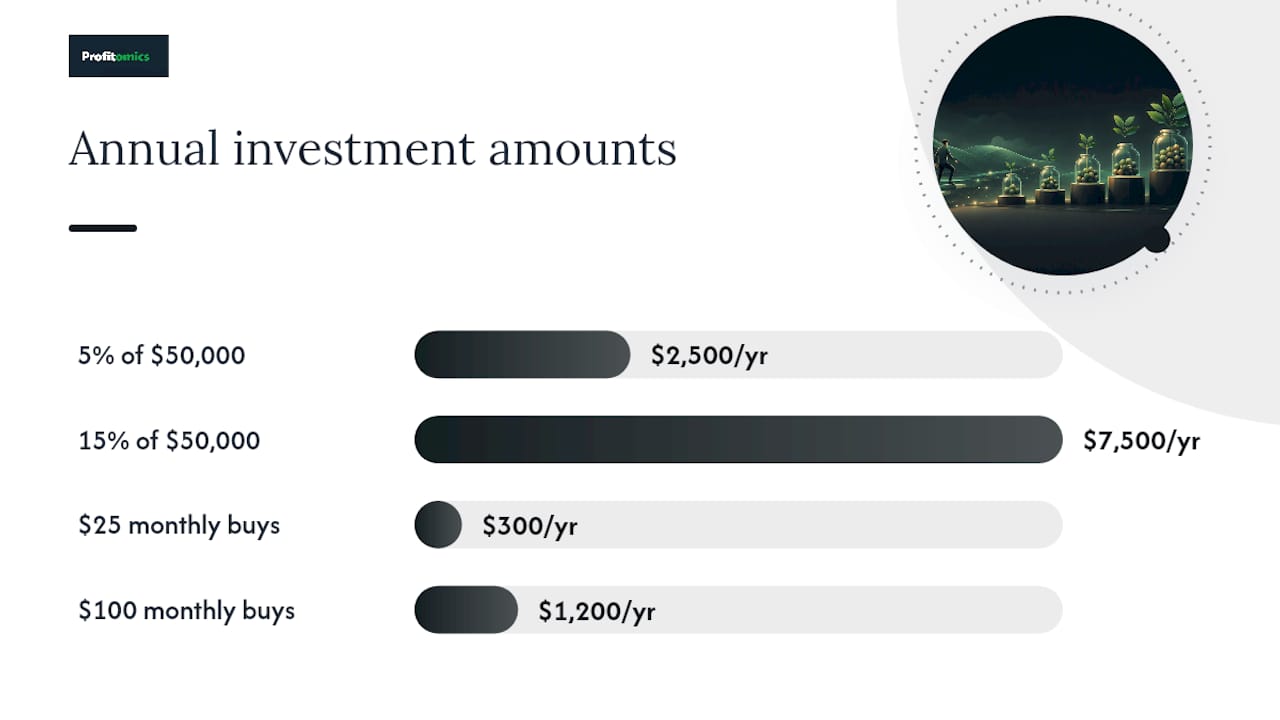
On a $50,000 salary, moving from 5% to 15% is the difference between $2,500 and $7,500 invested a year, without ever feeling like a pay cut if you time the increase to a raise. Round-up apps and recurring $25 to $100 buys work well for closing the gap in between.
How Much Risk Should a Beginner Take On?
Your time horizon does most of the work in deciding your allocation. Money you need in the next two or three years belongs in cash or bonds, not stocks. Money you won’t touch for 20 or 30 years can afford to sit mostly in stocks, riding out the dips.
- International stocks give you exposure outside a single country’s economic cycles. Most beginner portfolios use somewhere in the 20% to 40% range of their total stock allocation for that piece.
- Bonds dampen volatility. Even a small bond allocation smooths out the ride when the stock market drops 15% in a month.
- Rebalancing once a year, or whenever an allocation drifts more than five percentage points from your target, keeps your portfolio honest without turning you into a day trader.
Pro Tip: Set a calendar reminder for the same week every year, ideally near your birthday or a tax deadline you already remember, to check and rebalance. Frequent tinkering usually hurts returns more than it helps.
Turning This Guide Into an Afternoon of Action
Reading about investing basics for beginners and actually opening the accounts are two different things, which is exactly the gap Profitomics ebooks are built to close. Instead of researching account types and fund tickers from scratch, a Profitomics template hands you the checklist, the worksheet, and the exact fields to fill in.
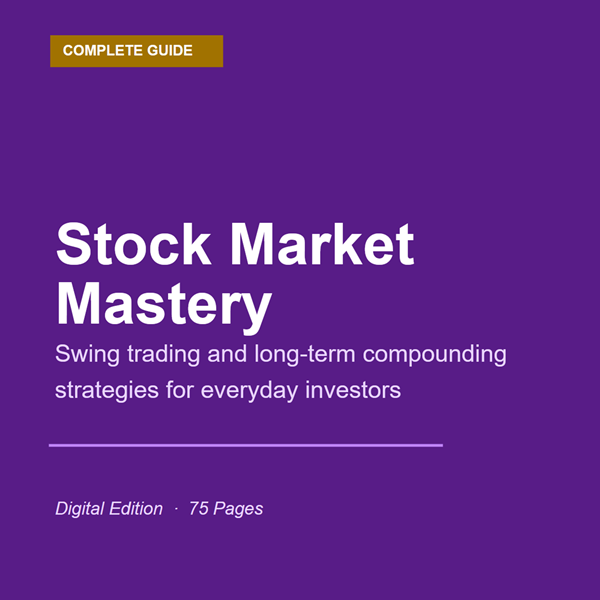
- Stock Market Mastery includes allocation worksheets for building a two-fund or three-fund portfolio without guessing at percentages.
- The Passive Income Blueprint maps out account setup and automation steps for readers whose main goal is hands-off income over time.
- Crypto Profit System applies the same structured, checklist-first approach to a much higher-risk asset class, for readers who want that exposure capped and controlled rather than open-ended.
Author Kai built these around one idea: a checklist you complete in one sitting beats a strategy you keep meaning to start.
Why I’d Rather You Automate Than Actively Trade
The beginners who succeed at this aren’t the ones checking stock prices every morning. They’re the ones who set up their contributions once, picked a diversified fund, and forgot about it for a decade. Active trading feels like control, but for most people it’s just more chances to sell low out of panic.
Learn the mechanics of individual stocks later, with money you’ve already labeled as your learning budget. Early on, patience and automation do more heavy lifting than any strategy you’ll read about.
— Kai
Ready-Made Templates to Skip the Guesswork
You’ve got the checklist. The harder part is usually turning “open a Roth IRA” and “pick a fund” into filled-in forms instead of another open browser tab. That’s the gap Profitomics ebooks close: instead of piecing together account rules and allocation math from a dozen sources, you get worksheets that walk through each decision once and let you move on.
If your main goal is building a solid stock and fund allocation, Stock Market Mastery gives you the worksheets to set target percentages and pick funds without second-guessing every choice. If passive income is the bigger draw, The Passive Income Blueprint lays out the account and automation sequence in the same checklist format. Either way, start with a single template, fill it out this weekend, and use it to open your account and set your first automated contribution. Browse the full library at Profitomics and pick the one that matches where you’re starting from.
Where to Verify What You’ve Read
Cross-check any investing claim, including this article’s, against sources with no product to sell.
- Investor offers the SEC’s own primer on investing basics, free of sales pitches.
- SIPC explains what happens to your investments if your brokerage fails.
- FINRA’s BrokerCheck tool lets you verify a broker’s licensing and disciplinary history before you hand over your money.
This article is general information, not a substitute for advice from a qualified financial advisor. Consult a qualified financial professional about your own circumstances before acting on anything here.
Sources
FAQ
What should I invest in as a beginner?
Start with a low-cost, diversified option like a target-date fund or a total stock market index fund rather than individual stocks. Investor.gov’s own framework recommends this exact order: build a foundation, choose the right account, then pick diversified, low-fee investments.
Is $100 too little to invest?
No. Fractional shares and low-minimum ETFs mean $100 is enough to open a position in a diversified fund, and consistent small contributions typically outperform waiting to save a larger amount.
Do I need an emergency fund before I start investing?
Yes. Most guidance recommends three to six months of expenses saved before investing significant sums, so you’re not forced to sell investments during a downturn to cover an unexpected bill.
What’s the biggest mistake beginner investors make?
Skipping the employer 401(k) match and trying to pick individual stocks before building a diversified, automated foundation. Both mistakes cost more in missed compounding than most people realize until years later.
Recommended
- Make Money Online — Ebooks on Passive Income, Stocks & Crypto | Profitomics
- The Passive Income Blueprint — Build income streams that pay you while you sleep | Profitomics
- Stock Market Mastery — Swing trading and long-term compounding strategies | Profitomics
- Side Hustle to Six Figures — Turn any skill or idea into a $100K+ income stream | Profitomics