Four Steps to a Long Term Investing Strategy: Week One Checklist
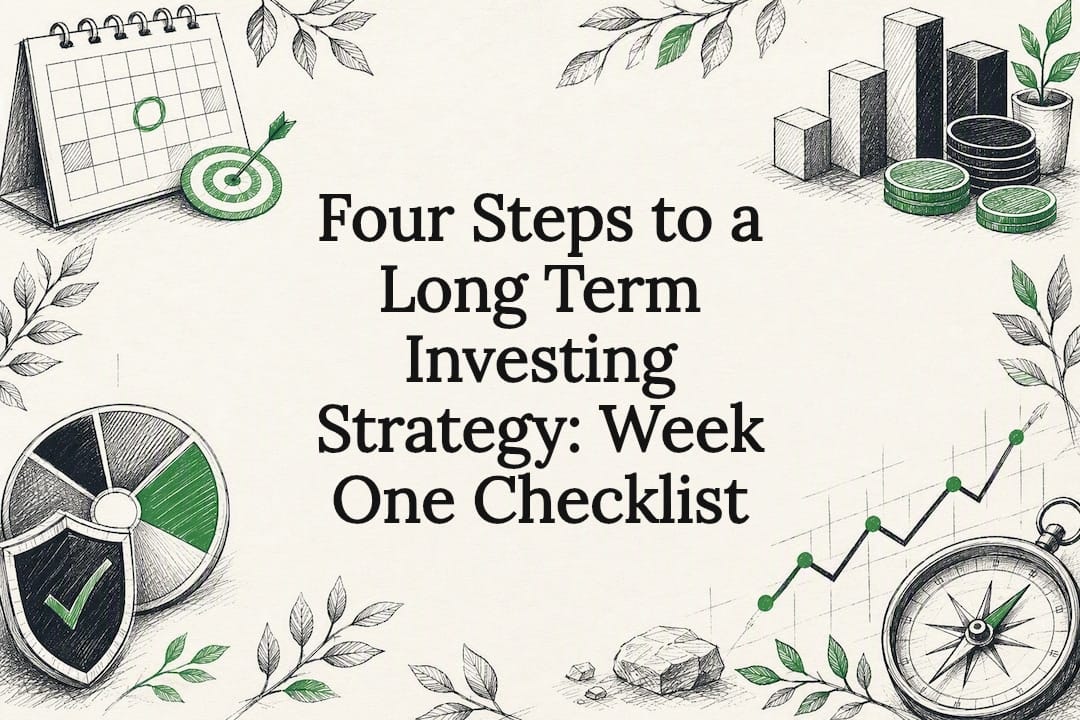
Set clear goals, put your money in a broadly diversified, low-cost portfolio, automate contributions through tax-advantaged accounts, and rebalance a couple of times a year. That’s it. The single best move you can make in the next ten minutes: open your bank app and schedule a recurring transfer into a diversified index fund or ETF. Give it years, ignore the noise, and let time do the heavy lifting.
TL;DR:
- Diversify across asset classes and regions, and base your allocation on time-to-goal rather than your age or a fixed formula.
- Maximize tax-advantaged accounts by capturing employer matching first, then contributing to IRAs before using taxable accounts, with asset location tailored to tax efficiency.
- Automate contributions and rebalancing to avoid emotional decision-making, scaling contributions as income increases and rebalancing annually or after excess drift.
- Use broad-market index funds and ETFs with low costs, focusing on patience and consistency rather than attempting to beat the market with frequent trades.
- Adjust your portfolio gradually as retirement approaches, shifting toward stability, and utilize buckets or target-date funds for income security and smooth withdrawals.
Table of Contents
- What’s the Best Long-Term Investing Strategy? Setting Goals and Time Horizon First
- How Should You Build Asset Allocation and Diversification?
- Which Accounts Should You Use, and How Does Tax-Smart Placement Work?
- How Do You Implement This Plan Without Overthinking It?
- How Do You Manage Risk, Emotions, and Life Changes Over Time?
- Your Week-One Action Plan: Templates and Checklists That Speed Things Up
- What Does Inflation Do to Long-Term Investments?
- How Should Your Strategy Change as Retirement Gets Closer?
- What Role Do Stocks, Bonds, Real Estate, and Commodities Play in Your Portfolio?
- What Are the Biggest Mistakes People Make in Long-Term Investing?
- A Straight Answer on What Actually Moves the Needle
- How Profitomics Turns This Strategy Into a Week-One Plan
- Sources
- FAQ
What’s the Best Long-Term Investing Strategy? Setting Goals and Time Horizon First
You can’t build a portfolio before you know what it’s for. A down payment in three years and a retirement 30 years out are two entirely different math problems, and treating them the same is the most common planning mistake beginners make.
Start by mapping each goal to a rough deadline and dollar target: retirement, a home, a kid’s education. The nearer the deadline, the less room you have to recover from a bad market year, so short-term goals belong in cash or short-term bonds, not stocks.
Before any of that, two things come first. Build an emergency fund covering three to six months of expenses, and pay down high-interest debt. Investor is blunt about this order: get the emergency fund and debt handled, then invest a portion of every paycheck.
Risk capacity (how much risk your finances can absorb) and risk tolerance (how much risk you can stomach emotionally) aren’t the same thing, and confusing them causes people to pick allocations they abandon during the first real downturn.
Try this exercise before choosing a single number:
- List each goal with its target date and rough cost.
- Rank goals by urgency, not by how exciting they are.
- Pick a contribution range, not a fixed percentage. A moderate portion of income is a realistic starting range for most people building toward retirement.
- Revisit the range every time income or expenses shift meaningfully.
How Should You Build Asset Allocation and Diversification?
Allocation, not stock picking, is what actually moves your long-term results. Vanguard’s research on model portfolios treats how you split money across asset classes as the primary driver of long-term portfolio variability, well ahead of which individual securities you own.
That’s good news for a beginner. You don’t need to beat the market by guessing winners. You need to pick a sensible mix and leave it alone.
Three frameworks cover almost every situation:
- Target-date approach: a single fund that automatically shifts from stock-heavy to bond-heavy as your target year approaches. Best for hands-off investors who want one decision, made once.
- Three-fund portfolio: a U.S. total stock market fund, an international stock fund, and a total bond fund, weighted to your risk band. Best for people who want a little more control without picking individual stocks.
- Risk-banded allocation: conservative (roughly 30-40% stocks), moderate (roughly 60% stocks), and aggressive (roughly 80-90% stocks) bands, chosen by goal rather than a rigid formula.
Diversification also means spreading across regions and company sizes, not just asset types. stocks are still concentrated risk, even if it feels diversified because it holds fifty different companies.
Pro Tip: Pick your allocation based on time-to-goal, not your age. A 45-year-old saving for a goal 25 years out can reasonably hold more stock than the classic “110 minus your age” rule of thumb suggests, because the timeline, not the birthday, determines how much volatility you can absorb.
Small tilts toward income-generating assets make sense as a goal gets closer, but the core allocation should stay boring by design.
Which Accounts Should You Use, and How Does Tax-Smart Placement Work?
The order you fund accounts matters almost as much as what you buy inside them. Get this sequence wrong and you leave free money on the table or pay taxes you didn’t need to pay.
- Capture the full employer 401(k) match first. It’s an immediate, guaranteed return that nothing else on this list can match.
- Consider an IRA next, either traditional or Roth depending on your current versus expected future tax bracket.
- Once tax-advantaged space is used up, move to a taxable brokerage account for additional long-term investing.
- Inside each account type, apply asset location: put tax-inefficient holdings like taxable bonds and REITs inside tax-advantaged accounts, and keep broad, tax-efficient equity ETFs in the taxable account.
Tax-smart execution isn’t a rounding error. Practitioner analysis on asset location and tax-loss harvesting suggests where you hold an asset can matter almost as much as which asset you choose, because tax drag compounds against you every year, the same way returns compound for you.
Tax-loss harvesting, selling a losing position in a taxable account to offset gains elsewhere, is a legitimate technique worth learning, but it has wash-sale rules and edge cases that justify a conversation with a tax advisor once your taxable account grows large enough to matter.
Before moving on, confirm four things: accounts are open, beneficiaries are named, contributions are automated, and your employer match is actually being captured (people forget to check this more often than you’d expect).
How Do You Implement This Plan Without Overthinking It?
Low-cost index funds and broad-market ETFs are the default recommendation for a reason: costs are one of the only variables you fully control, and a lower expense ratio compounds in your favor every single year you hold the fund. Buy-and-hold approaches that avoid frequent trading also tend to simplify taxes and outperform active trading after costs over long stretches, largely because trading less means paying less in taxes and fees along the way.
The implementation patterns from the earlier allocation section apply here directly: a target-date fund, a three-fund portfolio, or a simple bucket strategy that separates near-term cash needs from long-term growth money. None of these require you to compare vendors or chase performance rankings. Our ETF investing guide walks through how to structure this if you’re starting from zero.
Automation is what actually makes the plan durable:
- Set a recurring transfer tied to payday, not to how you feel about the market that week.
- Turn on automatic dividend reinvestment so payouts buy more shares instead of sitting in cash.
- Use a percent-of-paycheck rule so contributions scale automatically as your income grows.
Pro Tip: Rebalance by directing new contributions into whatever asset class has drifted below target, instead of selling winners. It gets your allocation back in line without triggering a taxable event in a brokerage account.
For the calendar itself, pick one rule and stick with it: rebalance once a year on a fixed date, or rebalance whenever an asset class drifts more than 5 percentage points from target. Both work. Switching between them mid-year is what causes trouble.
How Do You Manage Risk, Emotions, and Life Changes Over Time?
Behavioral mistakes cost investors more than market crashes do. Trying to time entries and exits is a losing habit for almost everyone. Missing even a handful of the market’s best days can meaningfully drag down long-term returns, and those best days routinely land right after the worst ones, when panic makes selling feel rational.
The countermeasures are unglamorous but effective:
- Set a rule requiring a 90-day cooling-off period before making any allocation change after a market shock.
- Automate contributions so you’re buying consistently through both downturns and rallies, not just when you feel confident.
- Check your portfolio on a schedule (quarterly is plenty) instead of every time the market moves.
Not every life event calls for a portfolio overhaul, but some genuinely do: a new dependent, a job loss, a windfall, or a goal moving from “someday” to “next year.” A goal shifting from decades away to a few years away is the clearest signal to shift that specific bucket toward cash or short-term bonds, even if the rest of your portfolio stays put.
Keep an emergency fund sized to your actual job stability, not a generic number, and ladder short-term bonds or cash equivalents for any goal within three years of its deadline. Track three numbers over time: your contribution rate, how far your allocation has drifted from target, and how your results compare to a simple benchmark index. If those three stay healthy, the rest tends to take care of itself.
Your Week-One Action Plan: Templates and Checklists That Speed Things Up
Reading about a strategy and running one are different skills. Here’s the sequence for week one:
- Fund or top off your emergency account.
- Open the account type that matches your situation (401(k) enrollment, IRA, or taxable brokerage).
- Set up automated contributions on a schedule tied to payday.
- Choose one simple allocation and stop tweaking it.
Profitomics builds templates specifically to shorten that sequence: a contribution calculator that turns your income and goals into a specific dollar figure, a rebalancing checklist that tells you exactly when to act, and an asset-location map for splitting holdings across account types correctly the first time.
- A contribution calculator to set your recurring transfer amount.
- A rebalancing checklist for calendar or threshold-based rebalancing.
- An asset-location map to decide what goes where.
Measuring progress doesn’t require complicated metrics. At 30 days, confirm every automation is actually running. At 90 days, check whether your allocation has drifted. At 180 days, compare your contribution rate against the range you set in your goals exercise, and adjust it up if income allowed for it.
What Does Inflation Do to Long-Term Investments?
Inflation quietly erodes purchasing power every year it runs, which means a portfolio that isn’t growing faster than inflation is technically losing money even while the account balance rises. That gap is easy to miss because the number on your statement keeps climbing.
Cash and low-yield savings accounts are the most exposed to this problem. Money sitting in a checking account earning near-zero interest loses real value every single year inflation runs above that rate, which is exactly why long-term goals shouldn’t sit entirely in cash.
Stocks have historically outpaced inflation over long periods, because company revenues and earnings tend to rise alongside prices, even though the ride is bumpier year to year than it is with cash. Bonds are more exposed, particularly long-term fixed-rate bonds, since their fixed payments get worth less in real terms as prices climb. This is one reason diversified allocations lean on stocks for the growth engine over a multi-decade horizon rather than parking everything in fixed income for perceived safety.
Real assets, real estate and certain commodities among them, often provide a partial hedge because their prices tend to move with, rather than against, rising costs. That’s not a reason to overload a portfolio with them, but it’s a reasonable argument for including a modest allocation, especially in the years leading into retirement when the portfolio has less time to recover from an extended inflationary stretch. Profitomics covers this in more detail in a guide on investing during inflationary periods for readers who want asset-specific detail.
How Should Your Strategy Change as Retirement Gets Closer?
The core shift as retirement approaches is gradual, not sudden: moving from a growth-heavy allocation toward one with more stability, without abandoning stocks altogether. Retirement can last 20 to 30 years, so a portfolio that’s too conservative too early risks running out of growth before it runs out of need.
Target-date funds automate this glide path, gradually shifting the mix as the target year nears, which is exactly why they work well for investors who don’t want to manage the transition by hand. If you’re using a three-fund or risk-banded approach instead, plan a deliberate shift in your bond allocation over the five to ten years before your planned retirement date, rather than making one large change all at once.
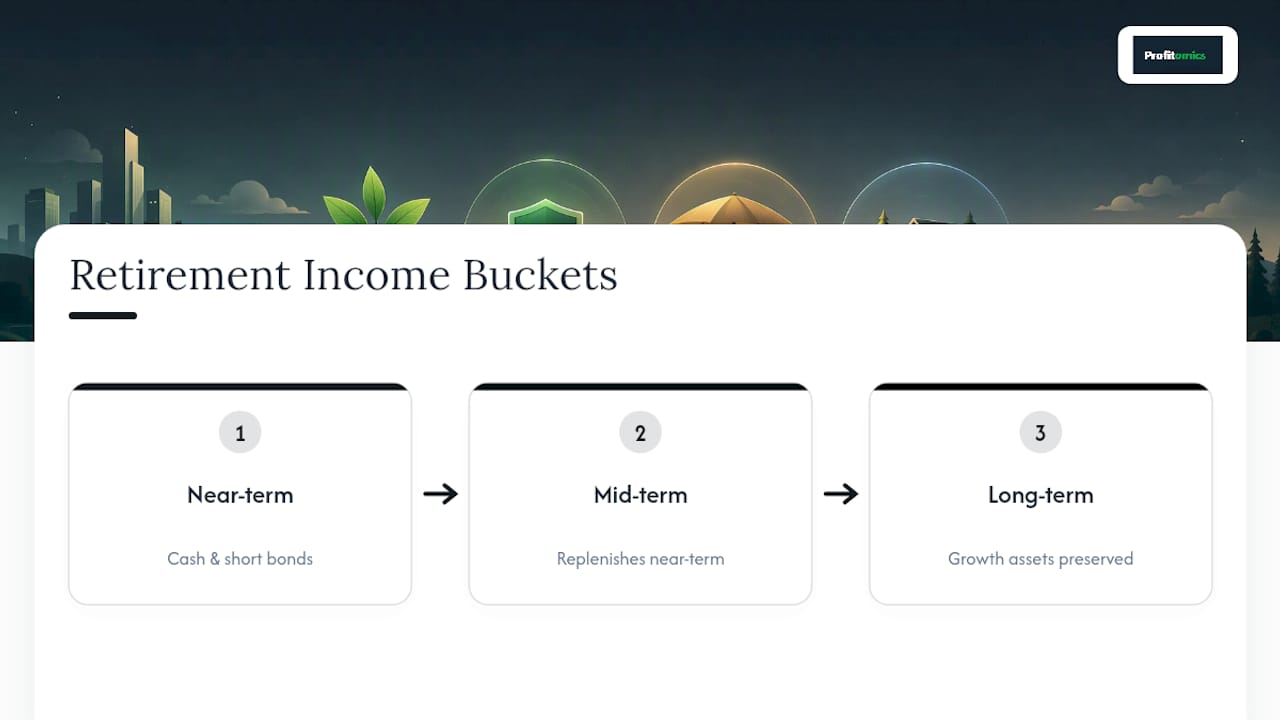
Bucket strategies become genuinely useful here. Splitting savings into a near-term bucket (cash and short-term bonds covering the first few years of withdrawals), a mid-term bucket, and a long-term growth bucket lets you draw income without being forced to sell stocks during a downturn.
Fidelity’s framework for building an investment strategy points out that this is also the stage where professional guidance tends to add the most value, since decisions around withdrawal sequencing, required distributions, and tax bracket management get more complex than a simple accumulation-phase plan. If your situation includes multiple account types, a pension, or Social Security timing decisions, that’s a reasonable point to bring in a financial professional rather than solving it alone.
What Role Do Stocks, Bonds, Real Estate, and Commodities Play in Your Portfolio?
Each asset class does a different job, and the mistake beginners make is expecting one asset to do all the jobs at once.
Stocks are the growth engine. They carry the most short-term volatility but have historically delivered the strongest long-term returns, which is why they dominate the allocation for any goal more than a decade away.
Bonds provide ballast. They smooth out the ride during stock market downturns and generate income, which matters more as a goal or retirement date approaches and preserving what you’ve built takes priority over growing it aggressively.
Real estate, whether through direct ownership or a real estate investment trust inside a portfolio, adds a return stream that doesn’t always move in lockstep with stocks and bonds, plus a partial inflation hedge through rents and property values that tend to rise with prices.
Commodities play a smaller, more situational role. A modest allocation can help during specific inflationary stretches, but commodities don’t generate income and can sit flat or negative for long periods, which is why they’re typically a minor slice of a long-term portfolio rather than a core holding.
The mix that makes sense depends entirely on the goals and time horizon established earlier. A three-fund portfolio already captures stocks and bonds efficiently; adding real estate or commodities is an optional refinement, not a requirement, for most long-term investors.
What Are the Biggest Mistakes People Make in Long-Term Investing?
Most long-term investing failures trace back to a handful of repeatable errors, not bad luck.
Chasing performance, moving money into whatever fund or sector just had a great year, tends to buy in near the top and sell near the bottom, since yesterday’s winner rarely repeats. Trying to time the market has the same problem: it requires being right twice, on the way out and the way back in, and even professional fund managers struggle to do that consistently.
Ignoring fees is a quieter mistake with a bigger long-term cost. A fund charging 1% more in expense ratio than a comparable index fund doesn’t feel dramatic in year one, but that gap compounds against you every year you hold it, eventually adding up to a meaningful chunk of your total return.
Checking the portfolio too often invites emotional decisions. Daily price-watching turns a decades-long plan into a series of short-term reactions, and short-term reactions are exactly what a long-term strategy is designed to avoid.
Skipping the emergency fund is the mistake that undoes everything else, because a forced sale during a market downturn to cover an unexpected expense locks in a loss that patience would otherwise have recovered.
And under-diversifying, often by holding too much employer stock or too few asset classes, concentrates risk in ways that don’t show up until something goes wrong. Each of these has a straightforward fix: automate contributions, pick low-cost funds, check in on a schedule rather than constantly, fund the emergency account first, and diversify deliberately rather than by accident.
A Straight Answer on What Actually Moves the Needle
Most of what gets marketed as investing wisdom is noise dressed up as insight. The strategy that actually works is almost boringly simple: broad diversification, low costs, automation, and enough patience to let compounding do what it does. People don’t fail at long-term investing because they picked the wrong fund. They fail because they stopped contributing during a downturn, or started tinkering with an allocation that was working fine.
The single habit that prevents most beginner mistakes is automation you can’t easily override on impulse. If your contribution happens before you see the money, you never get the chance to talk yourself out of it. Pick one template this week, whether it’s a contribution calculator or a rebalancing checklist, and put it to use instead of researching a tenth different approach.
— Kai
How Profitomics Turns This Strategy Into a Week-One Plan
Reading about diversification and automation is one thing. Actually setting up accounts, choosing an allocation, and building a rebalancing habit is where most people stall out. Profitomics builds ebooks specifically to close that gap, with the templates and checklists this article referenced built right in.
If your focus is long-term stock market compounding, Stock Market Mastery walks through swing trading and long-term allocation templates side by side, so you can see exactly how a diversified stock portfolio should be structured for a decade-plus horizon. If you’re diversifying into digital assets as a smaller satellite allocation, the Crypto Profit System gives you a risk-first framework instead of a hype-driven one. And if the goal is building income streams alongside your core portfolio, The Passive Income Blueprint lays out the systems for that.
Every Profitomics ebook arrives as an instant PDF download with companion spreadsheets, so there’s no waiting and no guessing about the next step. Start on the Profitomics home page and pick the guide that matches the goal you mapped out earlier this week.
Sources
For rules, protections, and filings, Sec is the primary regulatory source. For a practical savings checklist, see Investor.gov. For allocation frameworks, Vanguard’s model portfolios are a solid reference, alongside Fidelity’s six-step planning framework.
This article is general information, not a substitute for advice from a qualified financial advisor. Consult a qualified financial professional about your own circumstances before acting on anything here.
- Investor
- Investment portfolios: Asset allocation models | Vanguard
- 6 steps to building an investment strategy | Fidelity
- The 70-20-10 rule / tax-smart investing considerations | Smead Capital Management
FAQ
What’s the Best Long-Term Investing Strategy?
Set clear goals, build a diversified low-cost portfolio, automate regular contributions through tax-advantaged accounts, and rebalance annually or when allocation drifts by 5% or more. Consistency and low costs matter more than picking individual winning stocks.
What Is Warren Buffett’s 70/30 Rule?
Treat it as a rough starting point rather than a fixed formula since the right split depends on your own goals and time horizon.
How Do You Turn $10,000 Into $100,000 in a Year?
There’s no reliable, low-risk strategy that quickly multiplies a small amount into a very large sum in a short time. Attempting such growth typically requires taking on extreme risk with a high chance of significant loss, which runs counter to the diversification and patience that long-term investing depends on.
What Is the 70-20-10 Investment Strategy?
Definitions vary, but a common version allocates roughly 70% to core diversified investments like stocks and bonds, 20% to higher-risk or opportunistic investments, and 10% to cash or speculative positions. It’s a rough guideline for structuring risk, not a rule with fixed, universal percentages.
How Much of My Income Should I Invest for Retirement?
Increasing that rate as income grows tends to matter more than getting the exact starting number right.