ETF Investing for Beginners: A Simple Starting Guide

For most beginners, low-cost broad-market ETFs plus automatic recurring buys are the simplest, highest-probability way to start investing. The next step is concrete: open a brokerage account today and set up a recurring buy into a broad-market fund, then leave it alone.
Before you click anything, know three terms: expense ratio (the annual fee a fund charges), prospectus (the legal document describing what a fund actually holds and how it behaves), and dollar-cost averaging (buying on a fixed schedule regardless of price). Profitomics builds its guidance around exactly this kind of action first, jargon second approach.
- Open a brokerage account and fund it
- Choose one broad-market ETF with a low expense ratio
- Automate a weekly or monthly purchase
- Leave it alone for at least a year
Key Takeaways
Beginners succeed with ETFs by combining a low-cost, broad-market fund with automatic recurring purchases and the discipline to leave the position alone for years.
| Point | Details |
|---|---|
| Start with one broad ETF | A low-cost, broad-market index ETF gives instant diversification without picking individual winners. |
| Automate your purchases | Recurring buys remove timing decisions and build the habit of consistent investing. |
| Check fees and liquidity | Confirm the expense ratio, fund size, and average daily volume before buying any fund. |
| Read the prospectus first | Use SEC EDGAR filings to verify holdings, risks, and issuer reputation before committing money. |
| Use guided templates | Profitomics’ ebooks pair checklists and spreadsheets with these fundamentals for hands-on implementation. |
This article is general information, not a substitute for advice from a qualified financial advisor. Consult a qualified financial professional about your own circumstances before acting on anything here.
Table of Contents
- What Is ETF Investing for Beginners, and How Does It Work?
- How Do ETFs Differ From Mutual Funds and Stocks?
- How Do You Buy Your First ETF?
- What ETF Strategies Work Best for Beginners?
- How Much Do ETF Fees and Liquidity Really Cost You?
- What Should You Check Before Buying Any ETF?
- What Do Beginner Starter Portfolios Actually Look Like?
- How Are ETF Dividends and Capital Gains Taxed?
- Should You Hold ETFs in a Retirement Account or a Taxable Account?
- What Order Types Should Beginners Know Beyond Market and Limit?
- What Mistakes Do Most ETF Beginners Make?
- What Actually Matters Most for New ETF Investors
- Sources
- FAQ
What Is ETF Investing for Beginners, and How Does It Work?
An ETF, or exchange-traded fund, is a basket of stocks, bonds, or other assets that trades on an exchange the same way a single stock does. You can buy or sell shares any time the market is open, at whatever price buyers and sellers agree on that second.
That price moves throughout the day and is called the intraday price. It usually tracks closely to the fund’s net asset value (NAV), the actual value of the underlying holdings, but the two can drift apart for a few minutes or longer, creating a small premium or discount. Large market makers use a process called creation and redemption to keep that gap tight, and that same mechanism is part of why ETFs often carry a tax advantage over mutual funds.
A few things worth knowing before your first trade:
- Fund holdings are published daily, so you can see exactly what you own
- The prospectus spells out the fund’s strategy, risks, and fees
- NAV updates constantly during market hours based on underlying asset prices
Major index ETFs often have very low expense ratios, making their annual fees minimal compared to many actively managed funds, as explained in Investopedia’s breakdown of ETF costs. That’s a fraction of what many actively managed funds charge.
How Do ETFs Differ From Mutual Funds and Stocks?
The biggest functional difference is timing. ETFs trade throughout the day at fluctuating prices; mutual funds price once, after the market closes. A single stock, meanwhile, gives you ownership of one company instead of a basket of many.
- ETFs: intraday trading, typically lower fees, tax-efficient structure, no minimum investment beyond one share (or a fraction of one)
- Mutual funds: priced once daily, sometimes higher fees, occasionally required minimum investments, but can suit automatic payroll-deduction retirement plans
- Individual stocks: full transparency into one company, but zero built-in diversification
Mutual funds still make sense inside certain employer retirement plans where ETFs aren’t offered. Individual stocks make sense once you understand a specific company well enough to accept its risk. For nearly everyone starting out, though, a broad ETF gives you diversification and lower cost in a single trade.
How Do You Buy Your First ETF?
Opening an account and placing your first trade takes less time than most people expect.
- Open and fund a brokerage account. This usually takes 10 to 15 minutes online, and most brokers ask only for your Social Security number, address, and employment info. Before you commit, check the broker’s standing through SIPC or FINRA’s BrokerCheck tool.
- Search for the ETF by its ticker symbol, not its full name, since tickers are the fastest way to confirm you’re looking at the right fund.
- Choose your order type. A market order fills immediately at the current price. A limit order lets you set the maximum price you’ll pay, which matters more for thinly traded funds.
- Use fractional shares if the fund’s price is more than you want to commit. Many brokers now let you buy a slice of a share for $5 or $10.
- Set up a recurring automatic purchase so you’re buying on a schedule rather than trying to time the market.
- Consider a small test trade first — a token amount just to confirm the mechanics work the way you expect.
If you want zero financial risk while you learn, practicing with a simulated trading account for two to three months is a legitimate way to get comfortable with order types before real money is on the line.
Pro Tip: Set your first automatic purchase for the day after payday. You’re far less likely to skip it or second-guess it if the money moves before you have a chance to spend it elsewhere.
What ETF Strategies Work Best for Beginners?
You don’t need five strategies. You need one that matches your timeline and temperament, executed consistently.
Buy-and-hold with a broad-market index ETF is the default for a reason: it requires almost no maintenance and captures market-wide returns without trying to pick winners. A fund tracking a total-market or S&P 500 style index gives you exposure to hundreds of companies in one purchase.
From there, allocation is mostly about risk tolerance:
- Conservative: heavier bond ETF weighting, smaller equity slice
- Balanced: roughly even split between stock and bond ETFs
- Growth: mostly equity ETFs, minimal bonds, longer time horizon
If picking and rebalancing funds yourself feels like too much, all-in-one target-date ETFs and robo-advisors are a legitimate hands-off option that automatically adjusts allocation as you age.
Once you’ve got a core broad-market ETF in place, some investors add a small “satellite” position, maybe a sector or thematic fund, around that core. Keep the satellite small. The core is what does the compounding work.
Pro Tip: If you’re not sure which strategy fits, default to balanced. It’s easier to get more aggressive later once you’ve watched a market dip and know how you actually react, versus how you think you’ll react.
How Much Do ETF Fees and Liquidity Really Cost You?
Fees look tiny in isolation and add up over decades. The expense ratio is deducted automatically from fund assets, so you’ll never see a bill, but a 0.5% fee versus a 0.03% fee compounds into a meaningfully different balance over 20 or 30 years.
- Check the expense ratio before anything else; many large index ETFs sit near 0.03%
- Check the bid-ask spread and average daily volume; wider spreads mean you lose more on entry and exit
- Avoid thinly traded ETFs where a single large order can move the price against you
ETFs also tend to generate fewer taxable capital gains distributions than mutual funds, a byproduct of the creation and redemption process FINRA describes. That’s a general tendency, not a guarantee for every fund in every year, so read the prospectus and talk to a tax professional about your specific situation before assuming any fund is fully tax-free.
What Should You Check Before Buying Any ETF?
Run through this before you commit money to any fund:
- Confirm the index or strategy. Know exactly what the fund is trying to track and whether that matches your goal.
- Check the expense ratio. Lower is usually better, all else equal.
- Check fund size and average daily trading volume. Bigger, more liquid funds typically mean tighter spreads and easier execution.
- Look at tracking error, meaning how closely the fund’s actual performance matches its benchmark index.
- Read the prospectus and check SEC filings on EDGAR for the fund’s holdings, risks, and issuer details, exactly as the SEC recommends for both mutual funds and ETFs.
- Verify the issuer’s reputation. Established issuers with large fund families tend to offer more stable, liquid products.
What Do Beginner Starter Portfolios Actually Look Like?
Three shapes cover most beginners’ needs. Adjust the percentages to your actual timeline and comfort with volatility.
- Conservative: roughly 70% bond ETFs, 30% broad equity ETFs. Suited to shorter time horizons or low risk tolerance.
- Balanced: roughly 60% equity ETFs, 40% bond ETFs. A common middle-ground allocation for medium-term goals.
- Growth: roughly 90% equity ETFs, 10% bonds. Suited to longer horizons where you can ride out downturns.
Rebalancing keeps your allocation from drifting as one asset class outperforms another. Two simple triggers work well: rebalance once a year on a set date, or rebalance whenever an allocation drifts more than 5 percentage points from your target. Either method beats no plan at all.
Why Trust This Guide: Profitomics’ Practical Resources
This guide leans on the same standard regulators point to: read the prospectus, check the expense ratio, favor broad diversification.
- Profitomics’ ebook library builds on these fundamentals with step-by-step checklists and templates
- Downloadable spreadsheets let you plug in real allocation numbers instead of just reading about them
- Author: Kai (credentials detailed in the byline)
How Are ETF Dividends and Capital Gains Taxed?
Most ETFs pass along dividends and, occasionally, capital gains distributions to shareholders, and both are generally taxable events in a standard brokerage account.
Qualified dividends, meaning payouts from stocks you or the fund has held long enough to meet IRS holding-period rules, are usually taxed at lower long-term capital gains rates. Non-qualified dividends get taxed as ordinary income, which is a meaningfully higher rate for most earners.
Capital gains distributions happen when a fund manager sells holdings inside the fund at a profit, and that gain gets passed to shareholders whether or not you personally sold anything. This is one area where ETFs tend to have an edge: the creation and redemption structure that lets ETFs trade intraday also tends to reduce how often they distribute taxable capital gains compared to many actively managed mutual funds.
None of this is guaranteed fund by fund. Some ETFs, especially those holding bonds or making frequent internal trades, still distribute meaningful taxable income. Check a fund’s distribution history before assuming it will be tax-quiet, and treat any tax strategy decision as a conversation for a licensed tax professional who knows your full financial picture, not a blanket rule from an article.
Should You Hold ETFs in a Retirement Account or a Taxable Account?
The account type changes almost nothing about how the ETF itself works, but it changes a lot about what happens to your returns.
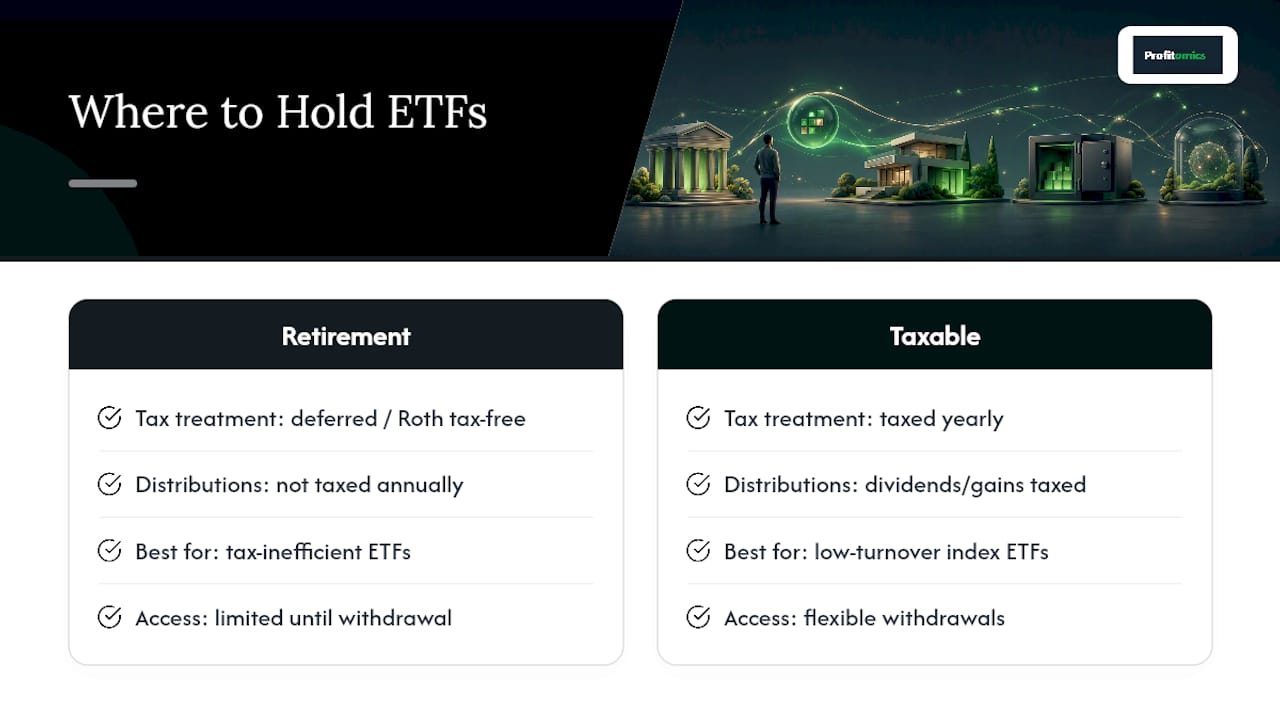
Inside a retirement account like a 401(k) or IRA, dividends and capital gains distributions aren’t taxed the year they happen. Traditional accounts defer taxes until withdrawal; Roth accounts can let qualified withdrawals come out tax-free entirely. That tax shelter makes retirement accounts a logical home for ETFs that generate frequent distributions, since you’re not managing a tax bill every year on money you don’t plan to touch for decades.
Taxable brokerage accounts don’t offer that shelter. Every dividend and capital gain distribution is a taxable event in the year it happens, whether you reinvest it or not. That doesn’t make taxable accounts a bad choice. They offer withdrawal flexibility retirement accounts don’t, and they’re the only option once you’ve maxed out retirement contribution limits for the year.
A practical split many beginners use: keep tax-inefficient or frequently distributing funds inside retirement accounts, and hold broad, low-turnover index ETFs, which already tend to be more tax-efficient, in a taxable account if you need one. There’s no single right answer here independent of your income, timeline, and how much you’ve already saved in each account type.
What Order Types Should Beginners Know Beyond Market and Limit?
Market and limit orders cover most trades, but a couple of additional order types give you more control once you’re comfortable with the basics.
A stop-loss order triggers a sale automatically once a fund’s price drops to a level you set in advance. If you own a fund at $50 and set a stop-loss at $45, the order becomes a market sell once the price hits $45, protecting you from a deeper decline while you’re not watching the market.
A trailing stop works similarly but moves with the price. Instead of a fixed dollar trigger, you set a percentage or dollar gap that trails the fund’s high point. If a fund climbs from $50 to $60 and you’ve set a 10% trailing stop, your sell trigger rises to $54, locking in some gains while still giving the position room to keep growing.
Both order types carry a real limitation worth understanding before you use them: they don’t guarantee your exact exit price, only that a market sell order gets triggered once the stop price hits. In a fast-moving or thinly traded market, the actual fill price can land below your stop level. For most beginners running a buy-and-hold strategy, these order types matter far less than they do for active traders, but knowing they exist means you’re not caught off guard when a broker’s order screen offers them as options.
What Mistakes Do Most ETF Beginners Make?
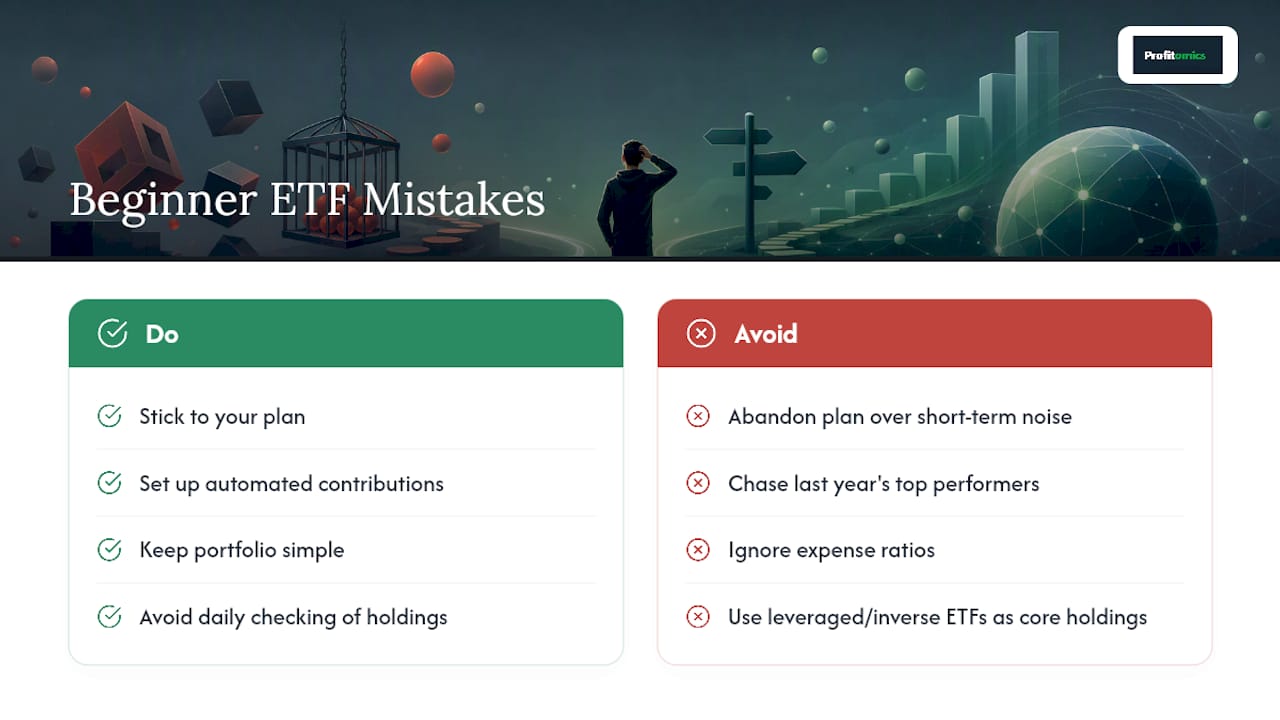
The biggest mistake isn’t picking a bad fund. It’s abandoning a reasonable plan halfway through because of short-term noise.
Checking your portfolio daily trains your brain to react to normal market fluctuation as if it were a crisis. NerdWallet’s research on beginner investing habits points to consistent, automated contributions as more valuable early on than trying to time entries perfectly.
Chasing last year’s top-performing sector ETF is a close second. A fund that returned 40% last year has no obligation to repeat that, and beginners who rotate into whatever just went up tend to buy near the top and sell near the bottom.
Ignoring fees because they look small costs real money over time; a 1% difference in expense ratio compounds into thousands of dollars lost over a few decades on even a modest portfolio.
Overcomplicating the portfolio with a dozen overlapping funds is another common trap. Owning five different broad-market ETFs that all track similar indexes isn’t diversification, it’s redundancy with extra paperwork.
Skipping leveraged and inverse ETFs is worth flagging directly, since these products are built for short-term trading and carry risks that make them generally unsuitable for beginners building a core portfolio. Save the exploration for after you’ve built real experience with simpler funds.
What Actually Matters Most for New ETF Investors
The conventional advice on ETF investing tends to overload beginners with comparisons: this fund versus that fund, this ratio versus that ratio. Most of that noise matters less than one unglamorous habit: buying consistently, and not touching the account for years.
Where the standard advice falls short is treating fee comparison and fund selection as the hard part. It isn’t. The hard part is psychological: staying invested through a 20% drop without selling, and not chasing whatever sector is hot this quarter.
If you’re starting from zero, prioritize the automatic buy over the perfect allocation. A slightly suboptimal portfolio you actually stick with for ten years beats a perfectly optimized one you abandon after eight months. Read the prospectus once, pick a broad index ETF, automate the purchase, and check in once a year to rebalance. That’s the entire system, and resisting the urge to make it more complicated is the actual skill.
Turn This Guide Into a Portfolio You’ll Actually Stick With
Reading about ETFs and building a portfolio you trust enough to leave alone for a decade are two different skills. Profitomics closes that gap with ebooks built around the same step-by-step checklists and templates referenced throughout this guide, not theory you have to translate into action yourself.
Stock Market Mastery walks through portfolio construction, order types, and long-term compounding strategy with worksheets you fill in as you go, rather than concepts you have to figure out how to apply on your own. The Passive Income Blueprint takes a similar template-driven approach for readers whose main goal is building income streams that run in the background of a regular income.
Both arrive as instant digital downloads, so you’re working from the checklist the same day you buy it. Start at the Profitomics library and pick the guide that matches whether you’re focused on building a portfolio or building income streams beyond it.
Sources
- Finra
- SEC guide to mutual funds and ETFs
- The Best ETFs and How to Start Investing - NerdWallet
- How to Invest in ETFs for Beginners | Kiplinger
FAQ
What is the best ETF for a complete beginner?
There’s no single “best” fund, but a broad-market, low-cost index ETF tracking a total-market or S&P 500 style index is the common starting choice financial writers recommend for beginners.
How much money do I need to start investing in ETFs?
Many brokers now offer fractional shares and no account minimums, so you can start with as little as $5 or $10.
Are ETFs safer than individual stocks?
ETFs spread your money across many holdings instead of one company, which reduces the impact of any single company’s collapse, though the fund still carries the market risk of whatever it tracks.
How often should I rebalance my ETF portfolio?
Once a year on a fixed date, or whenever an allocation drifts more than about 5 percentage points from your target, both work as simple rebalancing triggers.
Do ETFs pay dividends?
Many ETFs pay dividends from the underlying stocks or bonds they hold, and those payouts are generally taxable in a standard brokerage account unless held in a retirement account.
Can Profitomics help me build my first ETF portfolio?
Profitomics’ ebooks, including Stock Market Mastery, include templates and checklists designed to help readers apply core-portfolio and allocation concepts like the ones covered in this guide.