Set Financial Goals in One Weekend With SMART Templates

Set one measurable financial target and fund it using the SMART method: specific dollar amount, clear deadline, and a monthly contribution you calculate by dividing the target by the number of months you have. Start today. Write one short term goal and one long term goal, then automate a transfer or set a calendar reminder so the plan runs itself instead of relying on willpower.
TL;DR:
- Setting clear, measurable goals with specific dollar amounts and deadlines ensures meaningful progress rather than vague hopes.
- Prioritizing an emergency fund and high-interest debt payoff before long-term savings maximizes financial stability.
- Automating transfers and reviewing progress monthly significantly increases the likelihood of goal achievement without extra effort.
- Long-term goals benefit from breaking into 90-day milestones, helping maintain motivation and realistic pacing.
- Adjusting goals in response to life changes, rather than abandoning them, keeps progress aligned with current circumstances.
Table of Contents
- How to Set Financial Goals With the SMART Method
- What Should You Fund First When Money Is Tight?
- Financial Goals Examples With Real Dollar Amounts
- How Do You Track Progress Without It Becoming a Chore?
- How Templates Can Turn This Into a Weekend Project
- Matching Your Goals to Your Values and Life Stage
- The Mistakes That Quietly Kill Financial Goals
- Adjusting Financial Goals When Life Changes
- Pick One North Star and Build Small Habits Around It
- Sources
- FAQ
How to Set Financial Goals With the SMART Method
Wishes don’t get funded. Numbers do. That’s the whole difference between “I want to save more” and “I’m saving $3,000 for a car down payment by October 2026.” The second version tells your bank account exactly what to do.
The SMART framework, Specific, Measurable, Achievable, Relevant, Time-bound, turns a vague hope into an assignment with a due date. Here’s the actual mechanics of doing that.
1. Take inventory first. Before you write a single goal, list three things: your current account balances, your monthly net income (what actually lands after taxes), and your recurring fixed expenses. You can’t set a realistic goal without knowing what’s left over each month to fund it.
2. Apply SMART with real numbers. Every goal needs a dollar amount and a deadline attached. “Save for an emergency fund” becomes “Save $1,000 by December 2026.” Then run one calculation: target amount divided by months remaining equals your required monthly contribution.
3. Sort goals by timeframe. Short term goals (under two years) and long term goals (five, ten, twenty years out) need different homes in your budget and different accounts entirely, more on that below.
4. Assign each goal a budget bucket. Give every goal its own line item, not a vague “leftover money” category.
Here’s a worksheet structure you can rebuild in any spreadsheet or notebook in five minutes:
- Goal name and why it matters to you
- Dollar target
- Deadline (specific month and year)
- Months remaining
- Monthly contribution required (target ÷ months)
- Where the money lives (checking, high-yield savings, brokerage)
Keep a running checklist next to it:
- Balances and income logged
- Goal written with a number and a date
- Monthly contribution calculated
- Account assigned based on timeframe
- Automatic transfer scheduled
Writing the goal down isn’t a formality. People who put financial goals in writing complete them at meaningfully higher rates than people who just think about them.
What Should You Fund First When Money Is Tight?
Sequencing matters more than most people realize.
The order that holds up under most circumstances:
- A starter emergency fund first. Financial planning guidance commonly points to $500 to $1,000 as the starter cushion that keeps a flat tire or a broken laptop from landing on a credit card.
- High-interest debt second. Paying off a card charging 22% APR is a guaranteed 22% return on your money. Almost no other option beats that math, which is why Schwab and other planning resources recommend attacking high-cost debt before ramping up investing.
- Retirement and other goals third. Once the cushion exists and the expensive debt is gone, you can split contributions across retirement accounts, a house fund, or other priorities without one derailing the others.
If your budget only allows for $100 extra a month, don’t split it three ways into $33 pieces. Send it all to whichever goal is currently first in the sequence, finish that one, then move to the next. Partial progress on everything at once usually means slow progress on everything.
Pro Tip: If you’re on a genuinely tight budget, automate a micro-transfer of even $10 a week into your starter fund. It’s small enough not to disrupt your budget but consistent enough to hit $500 in under a year.
Financial Goals Examples With Real Dollar Amounts
Theory is easy. Here’s what these numbers look like when you actually run them for three different situations.
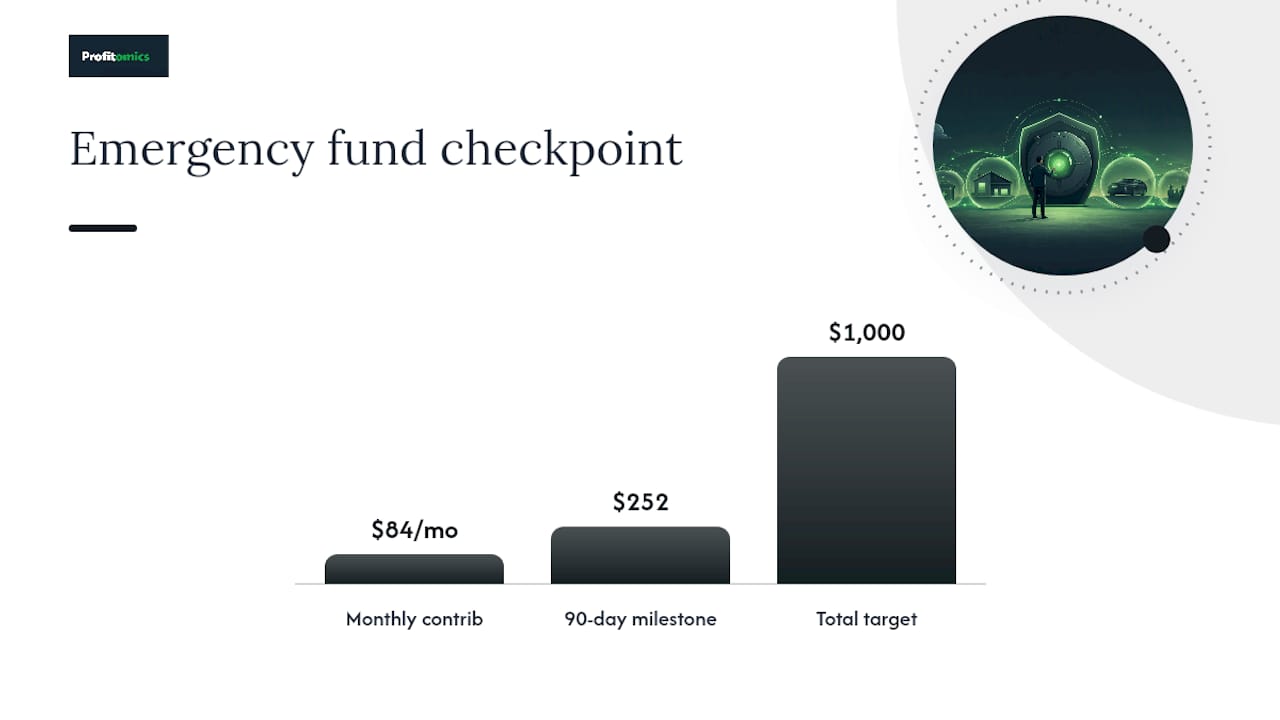
Early career, building the cushion. Target: $1,000 starter emergency fund. Timeline: 12 months. Monthly contribution: $1,000 ÷ 12 = about $84 a month. Break that into a 90-day milestone: $252 saved by day 90, roughly a quarter of the goal, which is a realistic checkpoint to hit before you reassess.
Mid career, killing high-interest debt. Target: pay off $4,200 in credit card debt. Timeline: 18 months. Monthly contribution: about $233. The 90-day milestone: $700 paid down, plus confirmation that no new charges have hit the card.
Home purchase, long term goal. Target: $30,000 down payment. Timeline: 5 years (60 months). Monthly contribution: $500. The 90-day milestone here isn’t about the dollar figure, it’s opening the dedicated high-yield savings account and confirming the automatic transfer actually processed three times in a row.
| Goal | Timeframe | Monthly Contribution |
|---|---|---|
| $1,000 starter emergency fund | 12 months | $84 |
| $4,200 credit card payoff | 18 months | $233 |
| $30,000 home down payment | 60 months | $500 |
Every long term goal on this list gets easier once it’s broken into a 90-day milestone instead of staying a distant five-year number. Ask yourself: what has to be true in 90 days for me to know I’m on pace? Then work backward into monthly and weekly actions.
How Do You Track Progress Without It Becoming a Chore?
Automation is the single biggest lever here. Setting up automatic transfers can raise savings success rates by roughly 30%, mostly because it removes the monthly decision of whether to save. The money moves before you get a chance to talk yourself out of it.
Setting it up takes ten minutes: log into your bank or a budgeting app, schedule a recurring transfer for the day after payday, and route it straight into the account tied to that specific goal.
Once it’s automated, checking in is light work:
- Weekly: a 60 second glance at account balances to confirm the transfer went through.
- Monthly: a proper review, comparing actual progress against your worksheet’s target.
- Quarterly: a milestone check, are you on pace for the 90-day marker you set?
For tracking tools, you don’t need anything complicated. A basic spreadsheet works fine, a visual savings thermometer works if you like seeing progress, and most budgeting apps will chart it automatically. If you want a low-pressure way to build the micro-savings habit while you’re getting your system running, tools like the No Spend Reset Challenge Workbook give you a structured short burst to jump-start momentum.
How Templates Can Turn This Into a Weekend Project
Reading about SMART goals is one thing. Sitting down and actually building the worksheet, the monthly math, and the 90-day plan is where most people stall out. That’s the gap templates are built to close.
A typical goal-setting bundle includes:
- A goal sheet for logging targets, deadlines, and required monthly contributions
- A monthly calculator that automates the target-divided-by-months math
- A 90-day milestone planner that breaks long term goals into checkpoints
- A progress tracker for your weekly and monthly reviews
With the template in hand, you can build your entire goal system, inventory, SMART goals, priority order, and milestones, more quickly rather than stretching the process out over weeks of procrastination. If you want to see the full range of templates and guides available, the ebook library is a reasonable place to start.
Matching Your Goals to Your Values and Life Stage
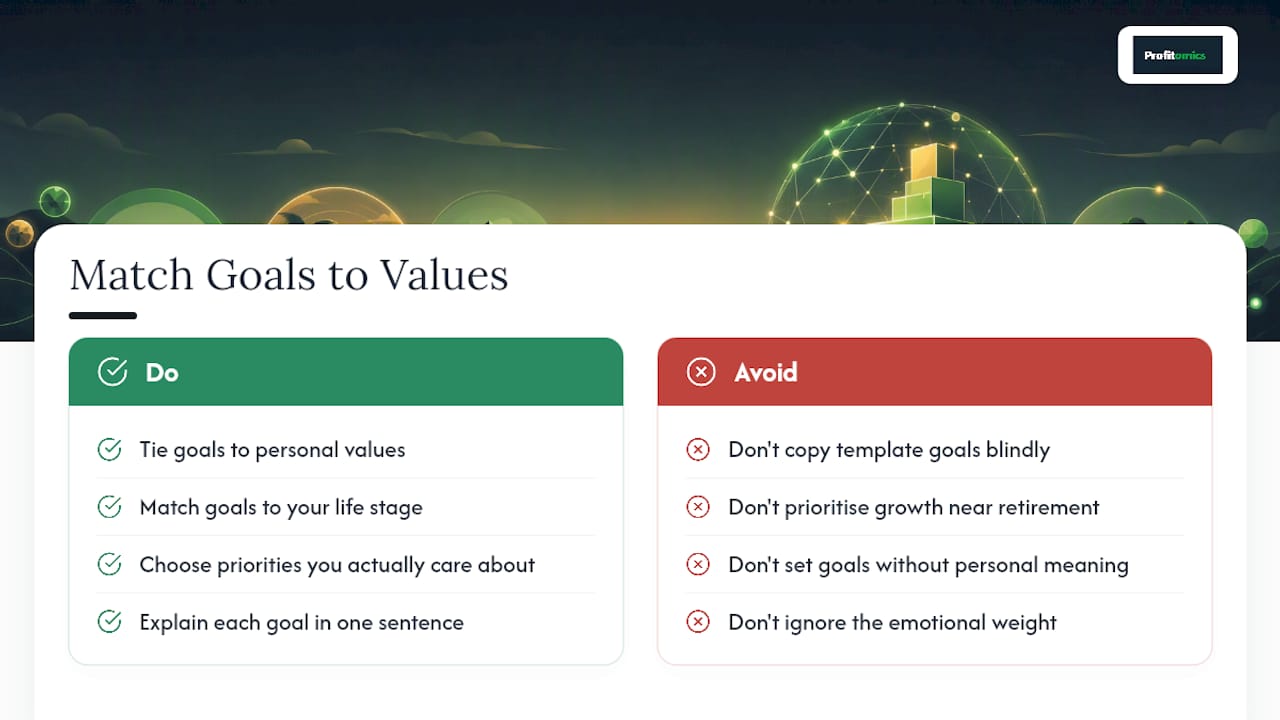
A goal that isn’t tied to something you actually care about tends to quietly die by month three. This is the “relevant” part of SMART, and it’s the one people skip most often.
Before locking in a number, ask what stage of life you’re actually in. Someone in their twenties paying off student loans has a completely different priority list than someone in their forties saving for a kid’s college fund or someone in their sixties shifting from growth to preservation. The math changes, but so does the emotional weight behind each goal.
If travel matters more to you than owning a house, don’t set a house down payment goal because it’s what a template suggests. Set the travel fund instead, and let the down payment wait. If your values center on family security, an emergency fund and life insurance review might outrank an aggressive stock portfolio, even if the portfolio has better theoretical returns.
Life stage also determines your investment goals. A 25 year old setting investing goals can lean into growth assets with a long runway to recover from downturns. Someone five years from retirement setting the same kind of goal needs a different investment plan entirely, one that protects what’s already been built rather than chasing higher returns.
The test is simple: if you can’t explain why a goal matters to you personally in one sentence, it probably isn’t the right goal to prioritize right now.
The Mistakes That Quietly Kill Financial Goals
Most failed financial goals don’t fail because of bad math. They fail because of a handful of repeatable mistakes.
Setting goals with no number attached. “Save more this year” isn’t a goal, it’s a mood. Every goal needs a dollar figure and a date, full stop.
Ignoring the timeframe mismatch. Putting a five-year house fund into a checking account earning nothing, or putting next month’s rent money into volatile stocks, are both timeframe errors. Match the account type to the goal’s horizon: near-term money stays stable, long-term money can absorb market swings.
Running too many goals at once. Splitting limited money across five priorities usually means none of them move fast enough to feel real, which kills motivation faster than slow progress on one goal ever would.
Skipping the review. A goal set in January and never checked again in June has quietly become a wish again. Monthly reviews are what keep a goal a goal.
Copying someone else’s numbers. A goal borrowed from a blog post or a friend’s situation, rather than built from your own income and expenses, rarely survives contact with your actual budget.
Every one of these is fixable with the same tool: a written goal, a real number, and a scheduled check-in. That’s most of the system right there.
Adjusting Financial Goals When Life Changes
A goal is a plan, not a promise. When your income drops, a medical bill hits, or you get a raise, the goal needs to move with you, not get abandoned entirely.
The fastest way to revise a goal is to rerun the same math you used to set it. If your $500 monthly contribution toward a house down payment suddenly isn’t feasible after a job loss, don’t quit the goal, extend the timeline. Recalculate: same target, more months, smaller monthly number. The goal survives; only the pace changes.
Unexpected windfalls deserve the same recalculation in reverse. A tax refund or bonus can shrink your timeline dramatically if you drop it straight into the goal instead of letting it disappear into general spending.
Major life events, a new baby, a marriage, a move, almost always mean your whole priority order needs a fresh look, not just a tweak to one number. Rerun the priority sequence: is the emergency fund still adequate for a bigger household? Did a merger of finances change what “high-interest debt” even means for the two of you now?
Treat every quarterly review as a chance to ask a blunt question: does this goal still make sense given where I actually am right now? If the answer is no, change the goal. Don’t force outdated numbers to fit a life that’s already moved on.
Pick One North Star and Build Small Habits Around It
If you take one thing from this, make it this: pick a single long term priority and let everything else orbit it. Trying to chase five goals with equal intensity is how people end up finishing none of them.
Two small habits do most of the heavy lifting: an automatic transfer that moves money before you can second-guess it, and a calendar reminder for a monthly five-minute review. Neither takes willpower once it’s set up.
Expect to adjust the numbers most months. That’s not failure, that’s the system working. Progress beats perfection every time.
— Kai
This article is general information, not a substitute for advice from a qualified financial advisor. Consult a qualified financial professional about your own circumstances before acting on anything here.
Sources
- How to Set Financial Goals That Stick (Free Worksheet) | SpendWiseCents
- Long-Term vs Short-Term Goals: Why You Need Both (And How to Connect Them) - LifeHack
- How to Set Financial Goals in 2026: 7 | MONEYlume
- How to Set Effective Financial Goals | Charles Schwab
FAQ
What Are Examples of Financial Goals?
Common examples include a $1,000 starter emergency fund, paying off a $4,200 credit card balance, saving $30,000 for a home down payment, or contributing a set percentage of income to a retirement account. Each becomes a real financial goal only once it has a dollar amount and a deadline attached.
How Do I Set My Financial Goals?
Take inventory of your income and expenses, apply the SMART framework to attach a specific dollar amount and deadline to each goal, then divide the target by the number of months remaining to find your required monthly contribution. Automate that contribution so it happens without relying on memory.
What Is the 7/7/7 Rule for Money?
There’s no single agreed-upon definition of what some call a “7/7/7 rule” in mainstream financial planning resources, so treat any version you see with caution rather than as an established standard. If you’ve encountered it somewhere, verify what specific numbers it refers to before applying it to your own budget.
What Is the 3/6/9 Rule in Finance?
This isn’t a standardized financial planning term either, definitions circulating online vary widely and aren’t consistent with established guidance. What is well supported is the recommendation to keep 3 to 6 months of expenses in an emergency fund, which may be where a similar-sounding rule originated.