Build an Investment Plan This Week: Best Investing Books and Templates
If you want a foundation in numbers, index investing, and market psychology, start with The Intelligent Investor and The Little Book of Common Sense Investing. If value investing pulls at you, add Common Stocks and Uncommon Profits. Together, these teach margin of safety, cost discipline, and how to size up a business like an owner. Pick the one closest to your goal and start today.
TL;DR:
- Reading classics like The Intelligent Investor and The Little Book of Common Sense Investing builds foundational judgment and cost awareness without prior finance experience.
- Value investing books such as Security Analysis teach detailed financial modeling and business valuation, suitable for readers comfortable with balance sheets.
- Traders benefit more from risk management and psychology-focused books like Market Wizards and Reminiscences of a Stock Operator than from specific technical setups.
- Matching the book choice to your skill level and goals ensures you focus on practical application rather than unnecessary complexity or theory.
- Applying concepts through templates and checklists accelerates decision-making; reading without action remains the main obstacle for most investors.
Table of Contents
- The Best Investing Books, Ranked by What They Actually Teach You
- Which Category Fits Your Investing Goal?
- How to Choose the Right Investing Book for Your Goals
- A Reading Order That Actually Builds on Itself
- How This List Was Compiled
- What the Best Investing Books Actually Get You (and What They Don’t)
- Turn What You Read Into a Plan You Can Follow This Week
- Sources
- FAQ
The Best Investing Books, Ranked by What They Actually Teach You
Every list of the best investing books draws from the same core canon, and for good reason. These titles have survived decades of market cycles, and professional investors still cite them when asked what shaped their thinking. CFA Institute’s Enterprising Investor found that working professionals repeatedly point beginners toward books that build numerical fluency and behavioral awareness before anything tactical. That’s the spine of this list.
1. The Intelligent Investor by Benjamin Graham. Warren Buffett called this one of the best books on investing ever written, and Books-A-Million’s edition page reflects why it still sells decades after its original 1949 printing. The core lesson: buy businesses with a margin of safety, and never confuse a stock’s price with its actual worth. Best for readers ready to think like an owner rather than a speculator. Seek the revised edition with commentary by Jason Zweig, which updates Graham’s numbers for modern markets.
2. A Random Walk Down Wall Street by Burton Malkiel. Malkiel, a Princeton economist, argues that beating the market consistently is far harder than most active traders admit, and that low-cost index funds win over time for most people. This is the book for skeptics who want the academic case for indexing laid out plainly. Look for the newest edition since Malkiel updates data and adds sections on newer asset classes like cryptocurrency.
3. The Essays of Warren Buffett, compiled by Lawrence Cunningham. This collects decades of Buffett’s Berkshire Hathaway shareholder letters into a single readable volume. The takeaway is less about formulas and more about temperament: patience, honesty about mistakes, and thinking in decades instead of quarters. Best for readers who already grasp basic investing and want the mindset behind long-term compounding.
4. One Up On Wall Street by Peter Lynch. Lynch ran Fidelity’s Magellan Fund and made the case that ordinary people can spot great stocks before Wall Street does, simply by paying attention to the businesses around them. The lesson: your everyday consumer experience is a research edge. Best for retail investors who enjoy picking individual stocks rather than funds.
5. Common Stocks and Uncommon Profits by Philip Fisher. Fisher’s “fifteen points to look for in a common stock” remains one of the more rigorous frameworks for evaluating a company’s growth potential and management quality. Forbes counts it among the enduring classics precisely because Fisher’s growth-investing lens complements Graham’s value lens. Best for readers with some accounting comfort who want to go deeper on qualitative analysis.
6. Security Analysis by Benjamin Graham and David Dodd. This is the textbook Graham and Dodd wrote before The Intelligent Investor distilled it for general readers. Dense, technical, and genuinely academic, it remains a reference-level work for serious students rather than a casual read. Best for readers who want to actually build financial models, not just understand the philosophy behind them.
7. The Little Book of Common Sense Investing by John Bogle. Bogle founded Vanguard and built this short book around one relentless point: costs compound against you just as returns compound for you. Target’s product listing shows the 10th anniversary edition, which is the one to buy since it includes updated performance data. Best for anyone building a retirement account who wants zero complexity.
8. Market Wizards by Jack Schwager. A series of interviews with elite traders across futures, options, and equities, this book shows there’s no single formula for trading success, only disciplined risk management repeated consistently. Best for active traders who want to see how different personalities approach the same markets.
9. Reminiscences of a Stock Operator by Edwin Lefèvre. A fictionalized biography of trader Jesse Livermore, originally published in 1923, and still assigned reading in trading desks nearly a century later. It teaches the emotional traps of trading: overconfidence, chasing losses, ignoring your own rules. Best for anyone who has already lost money trading and wants to understand why.
10. A Man for All Markets by Edward Thorp. Thorp beat blackjack with math before applying the same probabilistic thinking to markets as a hedge fund manager. The lesson is edge detection: find a repeatable statistical advantage, size your bets accordingly, and stay disciplined. Best for quantitatively minded readers curious about systematic strategies.
11. The Misbehavior of Markets by Benoit Mandelbrot. Mandelbrot, the mathematician who developed fractal geometry, argues markets are far more volatile and unpredictable than standard models assume. Dense reading, but it reshapes how you think about risk and “black swan” events. Best for readers who’ve finished the basics and want their assumptions challenged.
12. Fooled By Randomness by Nassim Nicholas Taleb. Taleb’s central argument: humans consistently mistake luck for skill, especially in markets, and that error costs real money. It’s less a how-to guide and more a warning label for overconfident investors. Best for anyone tempted to think a winning streak proves a strategy works.
13. Safe Haven by Mark Spitznagel. Spitznagel, a hedge fund manager known for tail-risk strategies, makes the case that protecting against rare, severe downturns actually improves long-term compounding, not just peace of mind. Best for intermediate investors ready to think seriously about portfolio insurance rather than just upside.
Which Category Fits Your Investing Goal?
Not every book on this list serves the same reader. Matching the category to your actual goal saves you from starting with a book that’s either too basic or too far over your head.
- Beginners: The Intelligent Investor and The Little Book of Common Sense Investing build the vocabulary and cost awareness everything else depends on. No prior finance background required, just patience with some math.
- Index and ETF investors: Bogle’s book is the whole category in one volume; pair it with A Random Walk Down Wall Street for the academic backing. You’ll learn why fees matter more than most people assume.
- Value investors: Security Analysis and Common Stocks and Uncommon Profits demand real time and comfort reading balance sheets, but they teach you to price a business independent of its stock chart.
- Traders: Market Wizards and Reminiscences of a Stock Operator focus on psychology and risk control over specific setups. Expect to learn discipline before you learn technique.
- Behavioral finance readers: Fooled By Randomness and The Misbehavior of Markets expose how your own brain and the market’s structure both work against clean predictions. Amazon’s best-seller data in investing shows growing demand for exactly this kind of book, alongside newer behavioral titles.
How to Choose the Right Investing Book for Your Goals
Picking from a long list gets easier once you know what you’re actually optimizing for. Run through this before you buy anything:
- Identify your skill level honestly. If you don’t know what a P/E ratio is, skip Fisher and Graham & Dodd for now and start with Bogle or Malkiel.
- Decide if you want tactics or worldview. Some books (Lynch, Schwager) hand you frameworks you can apply this week. Others (Buffett’s essays, Taleb) reshape how you think over months.
- Check whether you need spreadsheets and worked examples, or philosophy. Fisher and Graham & Dodd expect you to build models; Bogle and Buffett expect you to absorb principles.
- Match format to your habits. Audiobook editions exist for nearly every title here, and they work fine for narrative books like Reminiscences of a Stock Operator, but data-heavy books like Security Analysis read better in print or ebook where you can flip back to tables.
- Confirm the edition. For fast-moving topics like index fund performance or crypto commentary, an outdated edition can mislead you on numbers that have since changed.
Pro Tip: Avoid any investing book, new or old, that promises specific returns or a “guaranteed” system. The classics on this list all emphasize process and risk control over promises, which is exactly why they’re still recommended decades later.
Red flags to watch for: get-rich-quick language on the cover, no mention of risk or downside scenarios, and self-published titles with no track record behind the author’s claims.
A Reading Order That Actually Builds on Itself
Random reading works, but a sequence compounds faster. Three paths cover most readers:
- Beginner, passive path: Start with The Little Book of Common Sense Investing, then A Random Walk Down Wall Street. After each, open a brokerage account and build a mock index portfolio to see the concepts in action.
- Value investor path: The Intelligent Investor first, then Common Stocks and Uncommon Profits, then Security Analysis if you want the full technical grounding. Practice by picking three real companies and writing a one-page valuation after each book.
- Trader/active path: Reminiscences of a Stock Operator, then Market Wizards, then A Man for All Markets for the quantitative edge. Keep a trading journal from day one; the psychology lessons only stick when you can see your own mistakes on paper.
Pace yourself at one book per two to three weeks, and pair every book with a small hands-on exercise. Reading without application is where most people quit.
How This List Was Compiled
This ranking cross-references curator consensus across major outlets, professional investor recommendations, and each book’s staying power across multiple print editions. Forbes’ recurring list of top investing books overlaps heavily with other major rankings, which is a strong signal these titles have earned their spot rather than trending briefly.
Professionals surveyed by CFA Institute’s Enterprising Investor consistently pointed newer investors toward books that build numerical literacy and behavioral awareness before specialized tactics, rather than jumping straight to trading systems.
Author credentials matter here too. Graham taught at Columbia and mentored Buffett directly. Bogle founded Vanguard. Malkiel spent decades as a Princeton economist. These aren’t marketing credentials; they’re the actual track record behind the advice. For readers who finish a book and want a faster path from lesson to action, Profitomics builds templates and checklists around the same core strategies these authors describe.
What the Best Investing Books Actually Get You (and What They Don’t)
Here’s what the conventional advice glosses over: reading the classics builds judgment, but judgment alone doesn’t execute a trade, build a budget, or open an account. Graham teaches you to think about margin of safety. He does not hand you a spreadsheet to calculate it for your own portfolio this weekend. That gap between insight and action is where most self-taught investors stall out for months after finishing a great book.
The overrated advice you’ll hear constantly is “just read Graham and you’ll be fine.” Graham’s principles are sound, but 1949 accounting metrics and modern market structure don’t map perfectly. Pairing a classic with a modern, practical resource closes that gap faster than rereading the same chapter three times hoping it clicks.
My honest read: start with one canonical book for the worldview, then immediately look for a template or checklist that forces you to apply it to a real decision. Theory without application is just an expensive way to feel informed.
— Kai
Turn What You Read Into a Plan You Can Follow This Week
The books on this list will change how you think about markets. They won’t build your portfolio tracker, your position-sizing rules, or your first trade checklist for you. That’s the gap Profitomics fills: instant-download ebooks with the templates and spreadsheets these authors never included.
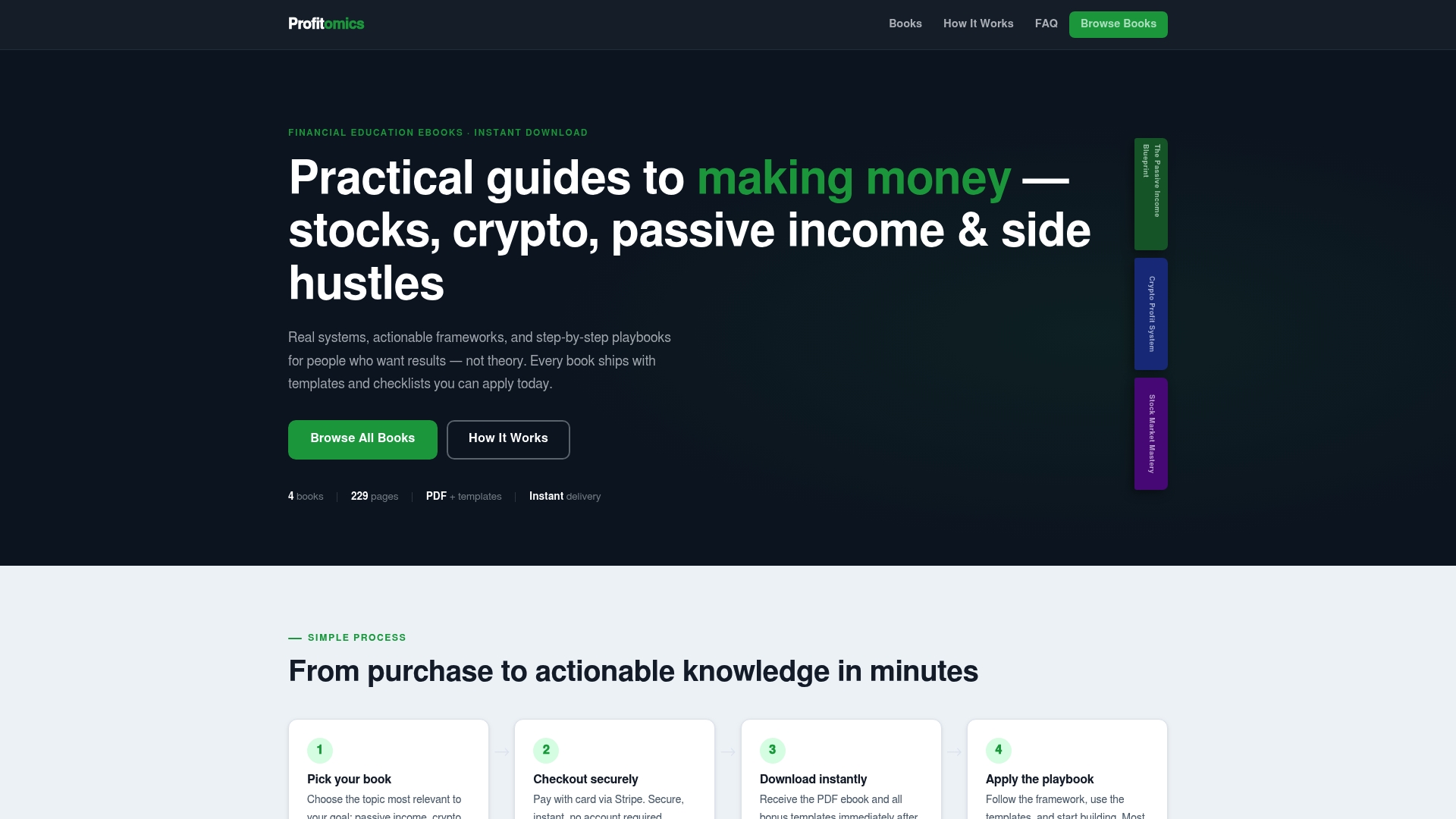
If Lynch and Schwager’s approach to picking and tracking individual stocks resonated with you, Stock Market Mastery hands you the swing trading and compounding frameworks in checklist form, ready to apply the same day you download it. If Bogle’s low-cost, income-focused philosophy is more your speed, The Passive Income Blueprint walks through building income streams step by step, with the spreadsheets already built. Readers curious about Thorp’s edge-detection approach applied to newer markets can check the Crypto Profit System for a risk-first framework instead of guesswork.
Every Profitomics ebook arrives as an instant PDF download with companion templates, so you skip the months of trial and error between finishing a book and actually using what it taught you. Browse the full catalog at Profitomics and pick the guide that matches the reading path you just chose.
Sources
- The Intelligent Investor — Books-A-Million
- The little book of common sense investing — Target product page
- What Successful Investors Read: Book Recommendations from Professionals — CFA Institute RPC
- 13 Of The Best Investing Books Of All Time — Forbes
This article is general information, not a substitute for advice from a qualified financial advisor. Consult a qualified financial professional about your own circumstances before acting on anything here.
FAQ
What are the top 10 books for investing?
Most curated lists converge on The Intelligent Investor, A Random Walk Down Wall Street, The Little Book of Common Sense Investing, One Up On Wall Street, Common Stocks and Uncommon Profits, Security Analysis, Market Wizards, Reminiscences of a Stock Operator, The Essays of Warren Buffett, and A Man for All Markets, based on overlapping recommendations across Forbes and other major outlets.
What is the 70/30 Buffett rule for investing?
This isn’t a rule Buffett has publicly described in his shareholder letters or in The Essays of Warren Buffett; definitions circulating online vary and aren’t traceable to a documented Buffett source, so treat any specific percentage split attributed to him with caution.
How can I turn $100 into $1,000,000 through investing?
No book on this list promises guaranteed large returns, and any resource that does should be treated as a red flag. The realistic path involves consistent contributions, low-cost index investing as Bogle describes, and time. Decades of compounding, not a single lump sum, does the heavy lifting.
How much do I need to invest to earn $1,000 a month?
This depends entirely on your expected return and the assets you hold, so there’s no single figure that applies to everyone. A dividend portfolio, a bond ladder, and a growth stock portfolio would each require very different amounts to generate the same monthly income, which is exactly why understanding valuation and cost drag, as Graham and Bogle both teach, matters before you set a target.
Where can I find these investing books for free or cheap?
Public libraries carry most titles on this list, and many, including The Intelligent Investor and Reminiscences of a Stock Operator, are available as audiobooks through library apps at no cost. Used bookstores and older paperback editions also cut costs significantly for the less data-sensitive titles like Lynch’s and Schwager’s.