Best Wealth Building Courses: 7 Options Compared for 2026

The best wealth building course is the one that matches your next step. If you need money basics, a free class from Khan Academy or the University of Michigan is a strong start. If you want to act on investing, passive income or a side business, a practical course with templates will get you moving faster. Below we compare seven options by what they teach, who they suit, what they cost and how fast you can use them.
TL;DR
- For free fundamentals (budgeting, credit, saving), start with Khan Academy’s Financial Literacy course or Finance for Everyone from the University of Michigan.
- For beginner market knowledge, Morningstar Investing Classroom is free and built from short lessons.
- For doing rather than studying, our Profitomics ebooks run from $27 to $47 each, with templates, checklists and spreadsheets included.
- No legitimate course can guarantee returns. Treat that promise as a red flag.
- Pick one course, finish it, and apply one thing from it in the first week.
Table of Contents
- What counts as a wealth building course
- The 7 options at a glance
- Free courses that build the foundation
- Practical courses that turn learning into action
- How to choose: five questions
- Check credentials and claims before you enroll
- Courses versus certificates versus advice
- A simple 30-day plan
- Our perspective
- Start with a plan you can use today
- FAQ
- Sources
What counts as a wealth building course
The phrase covers three very different things, and mixing them up is the most common mistake beginners make.
Financial literacy courses teach the foundations: budgeting, saving, credit, debt, taxes and basic investing. They are mostly free, run by universities, nonprofits and lenders.
Investing and income courses teach you how to put money to work: index funds and ETFs, stock analysis, crypto, side businesses, flipping assets. Quality ranges from excellent free lessons to expensive programs with big promises.
Professional certificates such as wealth management or family office programs prepare people to work in the industry or manage large estates. They are built for careers, not for a first $1,000 invested.
Several pages that rank for this search are of that third type. If you are an individual trying to build your own wealth, you probably want the first two. Ask yourself which gap is holding you back: knowledge of the basics, confidence to invest, or a system to follow.
The 7 options at a glance
| Course | Best for | Format | Cost |
|---|---|---|---|
| Khan Academy Financial Literacy | Money basics from zero | Self-paced lessons | Free |
| Finance for Everyone (University of Michigan) | Decision frameworks | Six-week self-paced course | See the provider page |
| Morningstar Investing Classroom | Beginner market knowledge | Short lessons with quizzes | Free |
| Coursera Introduction to Personal Finance | A quick one-week overview | Online course | See the provider page |
| Passive Income Blueprint (Profitomics) | Building multiple income streams | PDF ebook with bonus materials | $27 one-off |
| Stock Market Mastery (Profitomics) | A structured stock investing plan | PDF ebook with bonus materials | $47 one-off |
| Side Hustle to Six Figures (Profitomics) | Turning skills into income | PDF ebook with bonus materials | $29 one-off |
We have also covered the crypto and car-flipping routes below, since they suit specific readers.
Free courses that build the foundation
Khan Academy Financial Literacy
Khan Academy’s course, offered with Capital One, is self-paced and free. It is divided into units that cover budgeting, saving, credit, investments, insurance, taxes and scams. It is a good first stop if you have never written a budget or do not know how a credit score works.
Its limit is by design: it teaches concepts, not a personal plan. You will finish knowing the vocabulary, and you will still need to decide what to do on Monday.
Finance for Everyone (University of Michigan)
This course was developed to teach students frameworks for making good financial decisions. According to U.S. News, it is self-paced, with an estimated commitment of five to six hours per week over six weeks. That makes it a real study project, closer to a college class than a weekend read. It suits people who like thinking through trade-offs, such as paying down debt versus investing.
Coursera’s Introduction to Personal Finance
Experian’s guide to personal finance courses lists Coursera’s one-week Introduction to Personal Finance alongside Khan Academy and Finance for Everyone. It says online courses can help you learn the basics and gain confidence without enrolling in college. The one-week length makes it the lightest commitment of the university options. Check the provider page for current pricing and whether a certificate costs extra.
Morningstar Investing Classroom
Investopedia’s November 2026 investing course roundup names Morningstar Investing Classroom the best pick for beginners and general market knowledge. It is free, the lessons take about 10 minutes and include quizzes, and no certificate is offered. That suits a commuter or a lunch break well. You can build real understanding of how markets work without committing to a long program.
If you want a plain-language walk-through to pair with it, our guides to investing for beginners and ETF investing for beginners cover the same ground in an action-first order.
Practical courses that turn learning into action
Free courses explain. Many readers then stall, because explanation is not a plan. This is the gap our ebooks are built for. Each Profitomics title is a PDF delivered instantly, with companion materials such as templates, checklists and spreadsheets, so you can apply what you read the same day. We write them for beginners and for people frustrated by methods that were all theory.
Passive Income Blueprint ($27)
Passive Income Blueprint is designed to help readers set up multiple income streams within 14 days. It is the right fit if your question is how to start generating income outside a paycheck, and you want a sequence rather than a list of ideas. For the wider picture, our three-tier 90-day passive income plan shows how the streams fit together over time.
Stock Market Mastery ($47)
Stock Market Mastery is our structured guide to stock market investing, with frameworks and worksheets for beginners. It suits readers who finished a free class and now want a repeatable process. It is also the one to choose if emotional decisions are your weak point, since a written process gives you something to follow when markets move. If you want to rehearse first, our guide to paper trading for beginners lays out a start-up plan.
Side Hustle to Six Figures ($29)
Side Hustle to Six Figures is for people who already have a skill and want to convert it into income. It treats a side business as a system to build, not a hobby to hope about.
Crypto Profit System ($37) and The Car Flipping Playbook ($44)
Two more titles serve narrower goals. The Crypto Profit System is for readers who want a structured approach to cryptocurrency trading. The Car Flipping Playbook is for car enthusiasts who want a first-deal system: sourcing, inspecting and reselling cars for profit.
How to choose: five questions
- What is my starting point? If you cannot say what a budget surplus or an index fund is, take a foundation course first. If you already can, skip ahead to an applied one.
- Do I need credentials or results? A certificate matters for a career. For your own money, a finished plan matters more.
- How much time can I give? Michigan’s six weeks at five to six hours is a different commitment from a ten-minute lesson or a PDF you can work through in a weekend.
- Does it include tools? Templates, checklists and spreadsheets cut the distance between reading and doing.
- Does it promise outcomes it cannot control? Read the next section before you pay anyone.
We also compare the personal finance options in more depth in our guide to personal finance courses for beginners, and the trading options in stock trading courses that force practice.
Check credentials and claims before you enroll
Wealth building attracts exaggeration, so check a few things for any course, ours included in your own routine of due diligence for any purchase you make.
The SEC’s Office of Investor Education lists red flags of investment fraud, including promises of great wealth, guaranteed returns, risk-free opportunities and pressure to act right now. Use that list on every sales page. Education is not a security, but the same warning signs apply when a seller dangles outcomes.
Also look at who teaches the course and what they actually did. Real experience described in specifics is more useful than a headline income figure. And match the format to how you learn: video, quizzes, or a document you work through with a pen.
One more point on passive income. It is rarely effortless at the start. One personal finance writer explains that passive income usually needs front-loaded labor, capital or both, and that diversified index funds with reinvested dividends take a long time horizon rather than delivering quick results. For a realistic view of the upkeep side of online income, see this piece on making money online realistically. Planning for that effort is part of building income well, and it is why a step-by-step plan helps. Our comparison of passive versus active income explains how to use both while the passive side matures.
If your situation involves a large sum, a business sale or tax planning, a licensed financial advisor or CPA is the right person to consult. A course teaches you a method. An advisor looks at your whole situation.
Courses versus certificates versus advice
These three get confused, so here is the difference.
- A course teaches a skill or method for you to apply yourself. Cost ranges from free to the price of a book.
- A wealth management certificate trains someone to advise clients or run family wealth. Programs like these appear high in search results, but they target professionals.
- Personalized advice comes from a licensed professional who reviews your finances and is accountable for the recommendation.
For most beginners the sensible order is a course first, then advice once your finances are complex enough to need it.
A simple 30-day plan
Whichever course you pick, treat it as a project with a deadline.
Week 1: Take one foundation lesson set (for example the budgeting and saving units in Khan Academy) and write down your monthly surplus.

Week 2: Learn one investment vehicle properly. Index funds and ETFs are a common place to start.
Week 3: Choose one income action: a side hustle offer, a first listing, or a first small investment you can explain in two sentences.
Week 4: Review what happened, write down what you would change, and decide whether you need a deeper course.
If you want a shortcut for the setup steps, our step-by-step investing plan with templates is built to be started in 30 minutes.
Our perspective
We built Profitomics because many beginners do not fail from lack of information. They fail because information never turns into a first action.
That is why every guide we publish strips out unnecessary theory and gives you steps, templates, checklists and worksheets you can use right away. We draw on real-world experience and write for people who may have no prior background, whether the goal is evaluating a car-flipping opportunity, building an investment strategy or setting up online income.
Free courses are a great way to learn the vocabulary, and we encourage using them. Our ebooks are where we think the next step happens: you leave with a plan on paper and tools to run it. Pair the two and you cover both understanding and execution.
Kai
Start with a plan you can use today
If you have finished a free class, or you would rather skip straight to doing, a Profitomics ebook gives you a clear route. Passive Income Blueprint ($27) is our entry point for building income streams, and Stock Market Mastery ($47) is our deeper guide for stock investing. Each is a one-off purchase, delivered instantly as a PDF with companion materials.
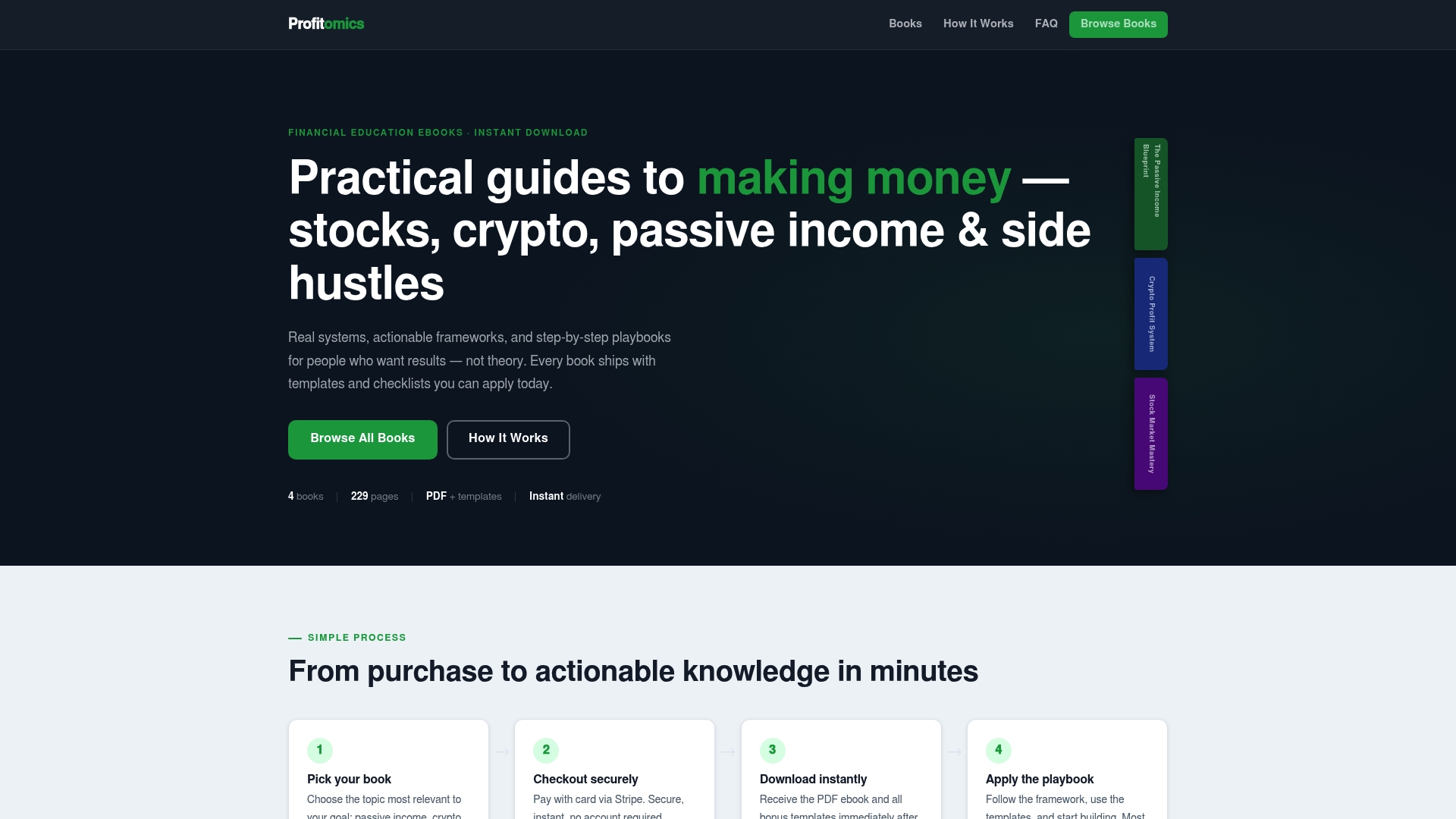
Browse every title on the Profitomics ebook page and pick the one that matches your goal.
FAQ
Which course is best for wealth management?
It depends on whether you mean managing your own money or working as a wealth manager. For your own money, a foundation course plus an applied guide is enough to start. For a career, look at professional certificate programs, which are built for that path.
What is the number one way to build wealth?
There is no single method, but the common thread is spending less than you earn and investing the difference consistently over a long period. Courses help you do that with more confidence and fewer mistakes. No one can promise a specific return.
Are free wealth building courses good enough?
For fundamentals, yes. Khan Academy and Morningstar are free and cover the basics well. Many readers add a paid, applied guide when they want templates and a step-by-step plan to follow.
How long does it take to finish a course?
It varies widely. Morningstar lessons take about 10 minutes each, Michigan’s Finance for Everyone is estimated at five to six hours a week for six weeks, and an ebook can be read in a weekend. Pick the length you will really finish.
Sources
- Best Investing Courses for November 2026, Investopedia
- 9 Personal Finance Courses to Help You Manage Your Money, Experian
- 11 Best Free Online Personal Finance Courses, U.S. News
- Khan Academy Financial Literacy Course, Capital One
- Red Flags of Investment Fraud Checklist, Investor.gov
- Passive Income: What’s Real, What’s Hype, Savvy Nickel
- Making Money Online: What Works, What Pays, What to Avoid