Passive Income vs Active Income: Using Both to Grow Your Money

Active income is what you earn by trading time for a paycheck: wages, salary, tips, commissions. Passive income is what you earn from ownership or systems that keep producing after the upfront work is done: rental property, dividends, royalties, digital products. The practical verdict is simple: lean on active income to cover your bills now, and use part of it to build one passive engine at a time so you’re not selling hours forever.
The two are also taxed differently in ways that matter more than most people realize. The IRS defines passive activity around whether you materially participate in the work, and that classification affects your tax bill, not just your paycheck.
- Active income = predictable, capped by your hours, taxed at ordinary rates.
- Passive income = scalable, slower to start, sometimes taxed at preferential rates.
- Most solid financial plans use both, in sequence, not as an either/or choice.
Key Takeaways
Active income pays the bills today; passive income, built through ownership or systems, is what eventually buys back your time and diversifies your tax exposure.
| Point | Details |
|---|---|
| Active income is capped | It’s tied directly to your hours, so raises and second jobs are the only ways to grow it. |
| Passive income needs upfront work | Rental, royalties, and digital products all require real effort before they run with less input. |
| Material participation drives taxes | The IRS uses tests like the 500-hour rule to decide if business income counts as active or passive. |
| NIIT can hit high earners | Investment and passive income above certain thresholds may face an added surtax on top of regular tax. |
| Stage your approach | Start with savings and a small dividend position, validate one passive idea, then scale what works. |
Table of Contents
- Passive Income vs Active Income: What Counts as Active?
- Passive Income vs Active Income: What Actually Counts as Passive?
- Major Differences: Time, Scalability, Risk, and Control
- Tax Implications: Material Participation, NIIT, and Preferential Rates
- Pros, Cons, and the Risks Nobody Mentions
- How to Build and Balance Both, Step by Step
- What Realistic Numbers Look Like
- Getting Started: Practical Next Steps
- Why the “Quit Your Job for Passive Income” Advice Misses the Point
- Sources
- FAQ
Passive Income vs Active Income: What Counts as Active?
Active income is money you receive in direct exchange for work performed, and the IRS ties this to material participation. If you’re clocking hours and getting paid for them, that’s active, whether you’re salaried, hourly, tipped, or self-employed and running the show yourself.
Common examples include:
- Salary or hourly wages from an employer
- Tips and commissions
- Freelance or contract work
- Self-employment income where you materially participate in the business
According to Investopedia’s definition of active income, the line between active and passive business income often involves a participation test based on several criteria, including hours worked, to determine if the IRS treats the income as active or passive.
Active income is reliable. You know roughly what you’ll earn each pay period, and lenders like that predictability when you apply for a mortgage. But it has a hard ceiling. There are only so many hours in a day, and unless you get a raise or a second job, your income stays flat until something external changes it.
Passive Income vs Active Income: What Actually Counts as Passive?
The IRS defines passive income narrowly: rental activities, plus business activities where you don’t materially participate. That’s a stricter bar than the internet’s version of “passive income,” which lumps in almost anything that isn’t a 9 to 5.
Real, U.S.-relevant passive income sources include:
- Dividend payments from stocks or ETFs
- Rental income from real estate (when you’re not materially participating)
- Royalties from books, music, or licensed content
- Revenue from digital products like templates, courses, or ebooks
Here’s the myth worth killing: passive doesn’t mean zero work. Practitioners who work with passive-income clients consistently note that most passive streams demand real upfront effort and ongoing maintenance before they run on their own. A rental property needs a lease renewed, a roof inspected, a tenant screened. A digital product needs updates and customer support. “Passive” usually means “less active,” not “no work at all.”
Pro Tip: Before you buy into any passive income idea, ask how many hours it needs in month one versus month twelve. If the answer doesn’t drop significantly, it’s not passive, it’s just a different job.
Major Differences: Time, Scalability, Risk, and Control
Four axes separate these two income types in ways that actually affect your decisions.
Time dependence and ceiling. Active income scales with hours worked, which means it’s capped by your schedule. Passive income, once built, keeps paying whether you work that day or not.
Scalability. A single ebook or course can sell to a thousand buyers overnight, something active income simply cannot do. A digital product’s reach isn’t limited by your calendar the way freelance hours are, which is why passive income compounds and active income doesn’t.

Upfront cost and time-to-first-dollar. Active income usually starts paying immediately (your first paycheck). Passive income almost always requires capital, time, or both before the first dollar arrives, sometimes months, sometimes years.
Risk and control. Active income risk is mostly job security. Passive income risk is different: market volatility for dividends, vacancy for rentals, platform dependency for digital products sold through a marketplace you don’t control. You trade a predictable paycheck for exposure to forces outside your job.
- Active income: fast cash, low complexity, hard ceiling.
- Passive income: slower start, higher ceiling, more moving parts to manage.
Tax Implications: Material Participation, NIIT, and Preferential Rates
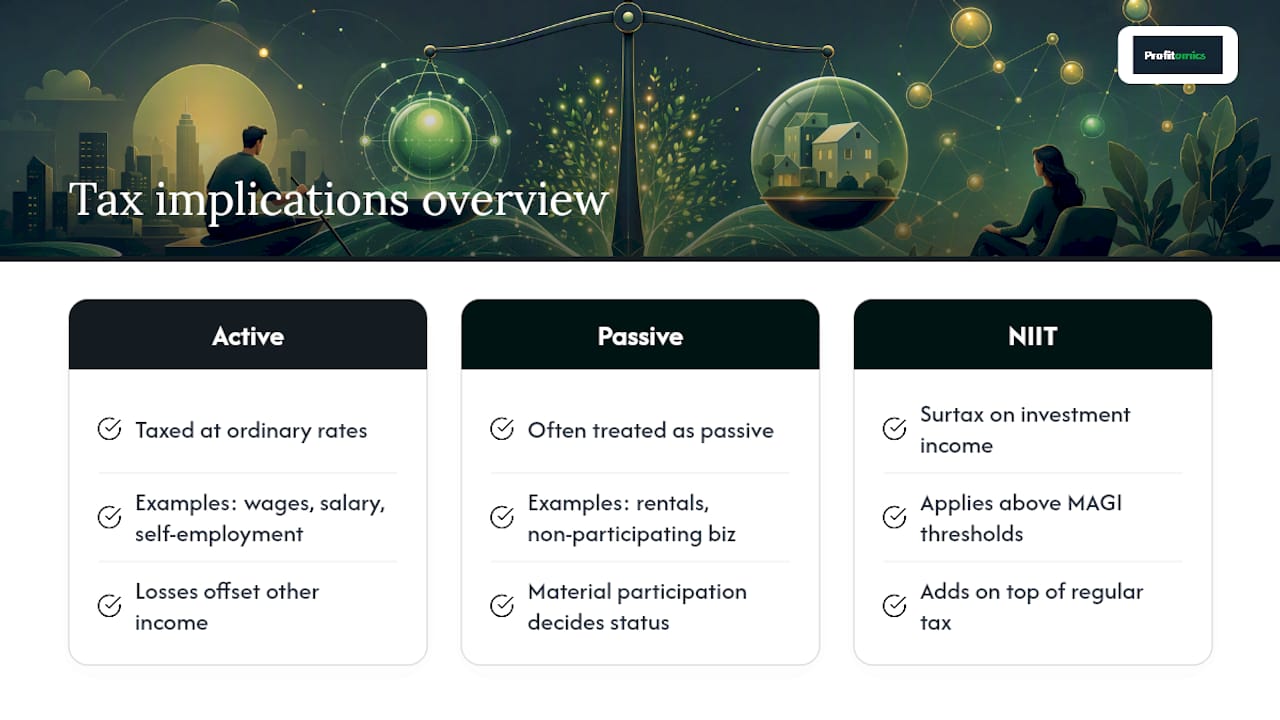
Taxes are where active and passive income really diverge, and it’s not just semantics. Ordinary active income, wages, salary, self-employment earnings, gets taxed at your marginal ordinary income rate. Qualified dividends and long-term capital gains, by contrast, can qualify for preferential tax rates lower than ordinary income brackets, though not every form of passive income gets that treatment.
Whether a rental or business activity counts as passive for tax purposes comes down to material participation, and the IRS spells out the tests in detail.
The IRS generally treats rental activities and businesses where you don’t materially participate as passive. Material participation is often measured using a roughly 500-hour threshold or by being the activity’s primary worker. Even hiring a property manager doesn’t automatically make rental income passive if you’re still heavily involved in decisions.
That distinction from Publication 925 determines whether losses from that activity can offset other income, which matters a lot if you’re renting out property at a loss in year one.
High earners face another layer: the Net Investment Income Tax can add a surtax on investment and passive income once your modified adjusted gross income crosses certain thresholds. NIIT applies on top of regular tax, not instead of it, so it’s easy to underestimate your total liability if you’re only budgeting for ordinary rates.
Tax preparers who handle passive activity income regularly flag recurring pitfalls around passive loss limitations and misclassified rental activity. If you’re generating meaningful passive income for the first time, a CPA who’s handled passive activity rules before is worth the fee. Misclassifying income costs more than the consultation.
Pros, Cons, and the Risks Nobody Mentions
Both income types have real trade-offs, and pretending one is strictly better ignores how they actually function in a financial plan.
- Active income pros: predictable, immediate, easier to qualify for loans against. Cons: capped by hours, vanishes if you stop working, fully taxed at ordinary rates.
- Passive income pros: scales without added hours, can continue through job loss or illness, sometimes taxed preferentially. Cons: slow to start, requires upfront capital or labor, less predictable month to month.
- Shared risks: misclassifying income for tax purposes, depending too heavily on one platform or tenant, and concentrating all your passive bets in a single asset class.
The biggest failure mode isn’t picking the wrong income type. It’s treating passive income as a replacement for active income before it’s actually replaced anything.
How to Build and Balance Both, Step by Step
Building passive income works better as a staged plan than a leap.
- Starter stage: Automate savings, build a cash buffer, and put a modest amount into a diversified dividend ETF. This gets money working without demanding new skills.
- Validation stage: Test a low-cost idea, an ebook, a template pack, a small rental, before committing serious capital or time. Treat it as an experiment with a defined budget.
- Scaling stage: Once something works, reinvest the proceeds. Buy a second rental, outsource the parts of the business you don’t need to touch personally, or expand a digital product line.
- Systemize: Set up bookkeeping, automate rent collection or royalty tracking, and check ROI quarterly so you know what’s actually working.
Pro Tip: Track time-to-breakeven for every passive experiment you run. If a rental or product hasn’t paid back its upfront cost within your projected window, that’s your signal to fix it or walk away, not to double down blindly.
What Realistic Numbers Look Like
Concrete math helps more than vague promises here.
- An investment in a dividend ETF can yield a modest amount annually, arriving quarterly, with essentially no ongoing work beyond monitoring.
- An ebook or digital template often requires dozens of hours to build well. First-year revenue can vary widely by niche and marketing effort.
- A turnkey rental property typically requires a down payment plus reserves for repairs, and cashflow may take substantial time to become reliably positive once vacancy and maintenance costs are factored in.
Meaningful passive cashflow rarely appears on day one. As Experian’s guidance on passive income taxation notes, scaling beyond a small dividend position usually takes either more capital, a product that reaches many buyers at once, or repeated reinvestment over time.
Getting Started: Practical Next Steps
You don’t need a perfect plan before you start, you need a first move that’s small enough to survive being wrong.
- Open a brokerage account and automate a modest monthly contribution to an index or dividend fund.
- Draft an outline for one digital product you could realistically finish in six to eight weeks.
- If you’re considering rental property, talk to a real estate professional and a CPA before you buy, not after.
- Use a structured system rather than guessing. Profitomics’s templates and checklists walk you through building a passive stream step by step, including the paperwork most beginners skip.
Hire a tax professional once you have passive activity income to report. The rules around material participation and passive losses are specific enough that a wrong guess can cost you real money.
Why the “Quit Your Job for Passive Income” Advice Misses the Point
Most content on this topic sells a fantasy: build passive income, fire your boss, live on autopilot. The research doesn’t support that timeline for most people, and frankly, it sets readers up to quit too early or take on risk they can’t afford.
What the evidence actually supports is sequencing. Active income funds your experiments. Passive income, done right, takes months or years to mature, and the tax rules reward patience over speed, especially once you understand how material participation and preferential capital gains rates interact. Conventional advice treats passive income like a switch you flip. It’s closer to a plant you have to water for a while before it feeds you.
Where I’d push back hardest: don’t wait for passive income to feel “ready” before starting. Buy the small dividend position now. Draft the ebook outline this week. The upfront work is the expensive part, and starting small while your active income covers you is the only version of this plan that doesn’t blow up.
This article is general information, not a substitute for advice from a qualified financial advisor. Consult a qualified financial professional about your own circumstances before acting on anything here.
Sources
- Publication 925 (Passive Activity and At-Risk Rules) — IRS
- How is passive income taxed? — Jackson Hewitt
- Active income — Investopedia
FAQ
Is Passive Income Actually Taxed Less Than Active Income?
Not always. Some passive income, like qualified dividends and long-term capital gains, can get preferential tax rates, but other passive income is still taxed at ordinary rates depending on the source and your situation.
What Is the IRS Material Participation Test?
The IRS uses several tests, including a roughly 500-hour threshold, to determine whether you’re materially participating in a business or rental activity, which decides if that income counts as active or passive.
Does the Net Investment Income Tax Apply to Everyone With Passive Income?
No. The NIIT only applies once your modified adjusted gross income crosses certain thresholds, and it’s an additional tax on top of regular income tax, not a replacement.
Can Rental Income Ever Count as Active Income?
Yes, if you materially participate in the rental activity or qualify as a real estate professional, the IRS may treat that income differently than standard passive rental income under Publication 925.
How Long Does It Take to Build Meaningful Passive Income?
It varies widely by method, but scaling beyond a small dividend position typically requires more capital, a product reaching many buyers, or repeated reinvestment, rarely an overnight result.
Recommended
- Make Money Online — Ebooks on Passive Income, Stocks & Crypto | Profitomics
- The Passive Income Blueprint — Build income streams that pay you while you sleep | Profitomics
- Side Hustle to Six Figures — Turn any skill or idea into a $100K+ income stream | Profitomics
- Stock Market Mastery — Swing trading and long-term compounding strategies | Profitomics