Best Dividend Investing Books for 2026: Our Picks

The best dividend investing book is the one you finish and then act on. For a first-time dividend investor, a beginner title such as G. R. Tiberius’s Dividend Investing for Beginners is the safest pick. Retirees who want a rules-based screen should read Stuart Chaussée’s Dividend Investing for Income and Growth. Most readers stall at the same point, which is turning chapters into a watchlist and a first purchase. That is why we pair each book below with a way to apply it, and why our own Stock Market Mastery guide ($47) comes with templates and checklists built for that step.
TL;DR
- Start with Dividend Investing for Beginners (Tiberius) if you are new. SmartAsset ranks it first on its 2026 list.
- Choose Chaussée’s Dividend Investing for Income and Growth if you want concrete screening numbers, such as a payout ratio of 65% or less and 10 or more years of dividend growth.
- Read Josh Peters, Lowell Miller or Charles Carlson for the long-term dividend-growth philosophy, and Nathan Winklepleck’s Dividend Growth Machine for retirement income.
- Dividend safety matters more than yield. Check payout ratio, balance sheet and competitive position before you buy anything.
- A book gives you the ideas. Worksheets and checklists turn them into a portfolio you actually build.
Table of Contents
- How we picked these books
- Dividend investing books at a glance
- The best books for beginners
- The best books for retirement income
- The classics: dividend growth as a long-term philosophy
- What every dividend book agrees on: safety first
- Yield is only part of the picture
- Our perspective
- Turn the book into a portfolio: a four-step routine
- Where our guides fit
- Which book should you buy first?
- FAQ
- Sources
How we picked these books
The query “best dividend investing books” mixes three different readers: the beginner who does not know what a payout ratio is, the pre-retiree who wants income, and the investor who already owns a few dividend stocks and wants a system. We judged each book on four things:
- Clarity for its audience. Can a newcomer follow it without a finance degree?
- Rules you can apply. Does it give screens, ratios and thresholds, or only philosophy?
- Portfolio construction. Does it cover diversification, reinvestment and when to sell?
- Age. Dividend principles last, but yields, tax rules and market levels change, so older books need current data alongside them.
The starting list comes from SmartAsset’s Top 10 Dividend Investing Books for 2026, which includes titles by Tiberius, Josh Peters, Brett Owens, Daniel Peris, Lowell Miller, Marc Lichtenfeld, Charles B. Carlson, Kelley Wright, Mark Lowe and Steve Rickard. We added books with primary-source pages that let us check the contents.
Dividend investing books at a glance
| Book | Author | Best for | Angle |
|---|---|---|---|
| Dividend Investing for Beginners | G. R. Tiberius | Absolute beginners | Basics, evaluation, diversification |
| The Ultimate Dividend Playbook | Josh Peters | Newcomers who want depth | Dividends as reliable income in a balanced portfolio |
| Dividend Investing for Income and Growth | Stuart Chaussée | Retirees and pre-retirees | Screening rules and portfolio monitoring |
| Dividend Growth Machine | Nathan Winklepleck | Retirement income builders | Dividend growth, case studies, compounding |
| The Single Best Investment | Lowell Miller | Long-term compounders | Dividend growth as a wealth engine |
| Get Rich with Dividends | Marc Lichtenfeld | Beginners moving to advanced | Basic through advanced topics |
| The Little Book of Big Dividends | Charles B. Carlson | Beginners wanting a short read | Beginner-friendly income focus |
| Dividends Still Don’t Lie | Kelley Wright | Value-minded investors | Building a portfolio of trusted payers |
| Investing in Dividends for Dummies | Lawrence Carrel | Readers who like reference style | General overview, 2023 edition |
The best books for beginners
Dividend Investing for Beginners by G. R. Tiberius
SmartAsset puts this book at number one and describes it as a guide that breaks complex financial ideas into pieces for new investors who want a steady income stream from dividends (SmartAsset, 2026). It covers dividend-stock basics, how to evaluate a company and how to diversify. If you have never opened a brokerage account, this is the cleanest place to begin.
The Ultimate Dividend Playbook by Josh Peters
Peters is the Morningstar analyst whose view on dividend safety we quote below. SmartAsset ranks his book second and describes it as a detailed look at how dividends can serve as a dependable income source within a well-rounded portfolio. It suits a reader who wants more than the basics but not an academic treatise.
The Little Book of Big Dividends by Charles B. Carlson
SmartAsset calls Carlson’s book beginner-friendly. The “little book” format means you can finish it in a weekend, which matters: a short book you complete beats a long one you abandon.
Investing in Dividends for Dummies by Lawrence Carrel
This one was published on August 29, 2023, runs 272 pages, and lists at $18.99 in the U.S. according to Chaucer’s Books. The reference-style layout is handy if you want to look up a term such as ex-dividend date and move on.
The best books for retirement income
Dividend Investing for Income and Growth by Stuart Chaussée
This is the most rule-driven title here. The book’s PDF, printed in the U.S. in 2015, has chapters on dividend-stock basics, yields and ratios, Dividend Growth Achievers, portfolio construction, ETFs, REITs, selling, risk control and withdrawals. It aims at supplemental income with moderate growth for investors near or in retirement.
Its screens are specific. Among other filters, it recommends a payout ratio of 65% or less, at least 10 consecutive years of dividend growth and a beta of 0.60 or less. These are the author’s philosophy, not individualized advice, but they give you something concrete to test against your own watchlist. Because the book dates from 2015, pair it with current yields and prices when you screen.

Dividend Growth Machine by Nathan Winklepleck
Subtitled The Intelligent Investor’s Guide to Creating Passive Income in Retirement, this book covers dividend-growth fundamentals, portfolio construction matched to income needs and risk tolerance, diversification, reinvestment and compounding, and real-life case studies, according to the author’s own page. It speaks to people approaching or already in retirement. The outcomes it describes are the author’s claims, not guaranteed results.
The classics: dividend growth as a long-term philosophy
The Single Best Investment by Lowell Miller
Miller argues for putting money in dividend-paying, moderate-growth companies rather than chasing the market, and the book gives simple rules for choosing stocks, reinvesting dividends, comparing stocks with bonds and building a portfolio, per its Google Books listing. The edition listed there is from 2006, so treat its statistics as history and its method as the lasting part.
Get Rich with Dividends by Marc Lichtenfeld
First published May 29, 2012, as a 224-page hardcover per Goodreads. SmartAsset describes it as spanning basic to advanced topics, which makes it a bridge book once you outgrow an introduction.
Dividends Still Don’t Lie by Kelley Wright
Wiley published it in 2010, as a follow-up to Geraldine Weiss’s Dividends Don’t Lie (1988), per a copy of the book’s front matter. SmartAsset describes it as guidance for building a portfolio of trusted dividend-paying companies. Its age is the reason to read it with a current valuation check in hand.
What every dividend book agrees on: safety first
A high yield is easy to find. A yield that survives a recession is harder. Josh Peters, writing for Morningstar, says dividend safety comes largely down to a company’s competitive advantage, its financial health including low leverage, and a balanced payout ratio (Morningstar). He also stresses that safety is never guaranteed, because it depends on the company’s long-term earning power and position in its industry.
That is the lens to bring to every book on this page. When an author names a stock or a threshold, ask three questions:
- Is the payout ratio comfortably below the company’s earnings?
- Is debt low enough that a bad year will not force a cut?
- Does the business have an edge that protects earnings over a decade?
Our walkthrough on dividend safety analysis puts these checks in step-by-step order.
Yield is only part of the picture
One useful counterpoint comes from Meb Faber of Cambria Investment Management. He argues that shareholder yield, meaning cash dividends plus net buybacks divided by market cap, has historically beaten any pure dividend strategy. He notes that the S&P 500’s dividend yield sits near 1.04%, close to an all-time low, and that buybacks have outpaced dividends every year since the late 1990s in the U.S. (Frazer Rice interview). It is a reason to read a dividend book for method and discipline while keeping an eye on total return.

If you want to compare dividend income with other income vehicles, a guide to high-income investment options shows the wider landscape, including tax considerations that interact with dividend income.
Our perspective
Every reader of a dividend book hits the same wall. The chapters make sense, the thresholds sound reasonable, and then nothing happens. No watchlist gets built, no ratio gets checked, no first share gets bought.
We design our guides around that wall. A Profitomics ebook is built from step-by-step instructions, templates, checklists and worksheets so you can move from reading to a first informed decision quickly, even with no prior experience. We cut theory that does not change what you do on Monday morning.
That is why we see the dividend book and a practical system as a pair. Read Tiberius or Chaussée for the concepts. Then use a structured guide such as Stock Market Mastery to organize the research, record your findings and decide, with the same checklist every time.
Kai
Turn the book into a portfolio: a four-step routine
Whichever title you pick, this routine converts reading into action.
- Pick one book and set a finish date. Two weeks is realistic for the short titles. Resist buying five at once.
- Write down the author’s screening rules. From Chaussée, for example, you would note the payout ratio, years of dividend growth and beta thresholds. Put them in a spreadsheet column each.
- Run 10 to 15 companies through the screen. Add the safety questions above. Our P/E ratio guide helps you add a valuation check so you do not overpay for a good dividend.
- Decide how much income you are aiming at. Our article on $1,000 a month from dividends shows how to calculate the portfolio size that income target needs.
If you are earlier in your journey, start with investing for beginners and the index fund investing guide. If you prefer funds over single stocks, ETF investing for beginners covers that route, and Chaussée’s book also has an ETF chapter. For a broader reading plan, see our piece on value investing books, which is built around practicing stock analysis over 6 to 12 weeks.
Where our guides fit
If you want a structured way to research stocks, Stock Market Mastery is a $47 one-time purchase, delivered instantly as a PDF with companion bonus materials, including templates, checklists and spreadsheets. If your goal is wider income-building, the Passive Income Blueprint costs $27 one-time. You can see the full range on the Profitomics homepage.
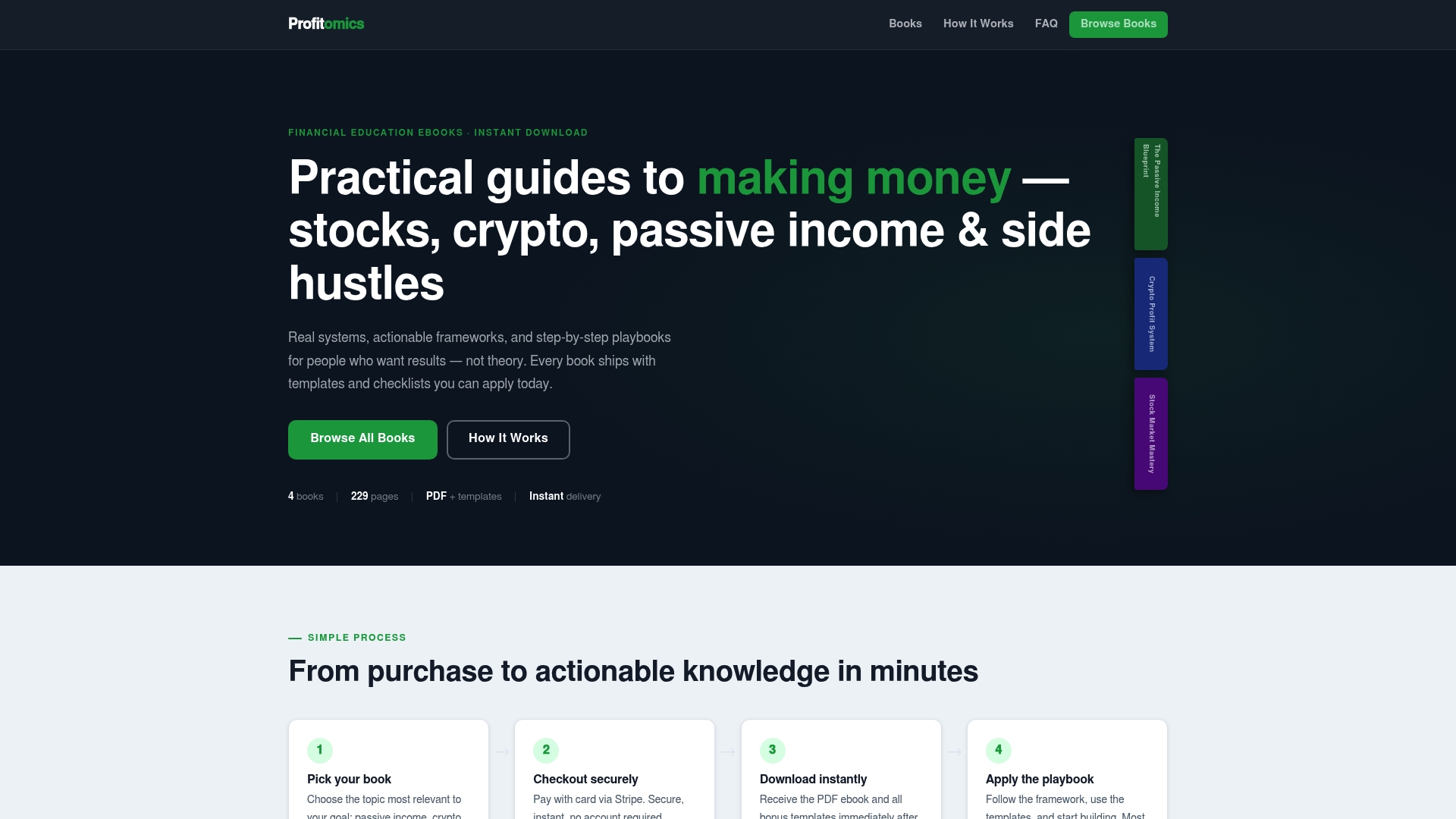
Both are written for beginners who want to apply what they learn right away.
Which book should you buy first?
- You have never bought a stock: Dividend Investing for Beginners by Tiberius.
- You want a short, friendly read: The Little Book of Big Dividends by Carlson.
- You are within ten years of retirement: Dividend Investing for Income and Growth by Chaussée, then Dividend Growth Machine by Winklepleck.
- You want the long-term compounding case: The Single Best Investment by Miller.
- You like reference books: Investing in Dividends for Dummies by Carrel.
- You want a bridge from beginner to advanced: Get Rich with Dividends by Lichtenfeld.
Dividends are never guaranteed and any company can cut its payout. For decisions about retirement accounts, withdrawals or taxes, talk to a licensed financial adviser or tax professional about your own situation.
FAQ
What is the best dividend investing book for beginners?
SmartAsset ranks Dividend Investing for Beginners by G. R. Tiberius first on its 2026 list and describes it as accessible to newcomers. It covers the basics, how to evaluate a dividend stock and how to diversify. Carlson’s The Little Book of Big Dividends is a shorter alternative.
Are older dividend books still worth reading?
Yes, for the method. Miller’s book is from 2006, Wright’s from 2010 and Chaussée’s from 2015, and the ideas of payout discipline, dividend growth and diversification still apply. Yields, prices and tax rules have changed, so use current market data when you apply the screens.
What payout ratio is considered safe for dividend stocks?
There is no universal number. Chaussée’s book recommends a payout ratio of 65% or less among its filters. Morningstar’s Josh Peters adds that a balanced payout ratio works alongside competitive advantage and low leverage in judging safety.
Do I need a dividend book if I buy index funds or ETFs?
Not strictly, but a book helps you understand what the funds hold and why income varies. Chaussée’s book includes chapters on ETFs and REITs. Our guides on index funds and ETFs cover the starting steps.
Sources
- Top 10 Dividend Investing Books for 2026, SmartAsset
- Dividend Investing for Income and Growth, Stuart Chaussée (PDF)
- Dividend Growth Machine, Nathan Winklepleck
- 3 Signs of a Safe Dividend, Morningstar
- 250 Years of American Compounding with Meb Faber, Frazer Rice
- Investing in Dividends for Dummies, Chaucer’s Books
- Dividends Still Don’t Lie, front matter
- Get Rich with Dividends, Goodreads
- The Single Best Investment, Google Books
- High-Income Investment Options: A 2026 Tax-Smart Guide