$1,000 a Month From Dividends: Calculate the Portfolio You Need
Dividend income is cash a company or fund pays you for owning its shares, and it can turn a portfolio into a paycheck. Most of it falls into two tax buckets: qualified dividends taxed at 0%, 15%, or 20%, and ordinary dividends taxed at your regular income rate. To size the portfolio you’d need, divide your target annual income by your assumed yield. The math and tax details live in the sections below.
TL;DR:
- Higher-yield strategies require less capital but carry increased risk, especially in sectors like utilities and energy prone to payout cuts.
- Understanding whether dividends are qualified or ordinary, and how they are reported on Form 1099-DIV, is crucial for accurate tax planning and maximizing after-tax income.
- Using a conservative yield assumption of 3% to 4% for planning ensures sustainable growth and better long-term income stability.
- Limiting individual holdings to a small percentage of the portfolio and diversifying across sectors reduces the impact of potential dividend cuts.
- Holding high-yield or REIT investments in tax-advantaged accounts like IRAs or Roths helps avoid immediate tax liabilities on dividends.
Table of Contents
- What Are Dividends, and Where Does Income From Dividends Actually Come From?
- How Is Dividend Income Taxed and Reported?
- How Do You Estimate Dividend Income? (The Math That Actually Matters)
- Building a Dividend Income Strategy That Fits Your Timeline
- Dividend Cuts, Yield Traps, and the Risks That Wreck an Income Plan
- Where You Hold Dividend Stocks Changes Your Tax Bill
- Tools for Tracking Dividend Income and Testing Your Assumptions
- Your Step-by-Step Checklist to Start Building Dividend Income
- A Practical Perspective on Making Dividend Income Actually Work
- Ready-Made Templates for Building Your Dividend Income Plan
- Sources
- FAQ
What Are Dividends, and Where Does Income From Dividends Actually Come From?
A dividend is a portion of a company’s profit paid out to shareholders, usually in cash, sometimes in additional stock. Companies don’t have to pay them. When they do, the payout follows a predictable sequence: the board announces a declaration date, the stock trades ex-dividend on a set date (buy after that date and you miss the payment), a record date locks in who’s entitled to the cash, and a payment date sends the money to your brokerage account. Investor: miss the ex-dividend date and the next check goes to whoever owned the shares before you did.
Not every distribution is a garden-variety cash dividend, and the differences matter for both your strategy and your tax return.
- Cash dividend: the standard payout, deposited directly or reinvested if you’ve elected a reinvestment plan.
- Stock dividend: additional shares instead of cash, which dilutes existing shares but doesn’t create immediate taxable income the way cash does.
- Return of capital: money paid back that isn’t classified as taxable income at all. It reduces your cost basis instead, which changes your capital gains math later.
- Capital-gain distribution: common with mutual funds and some REITs, this reflects gains the fund realized internally and passed through to you, taxed separately from ordinary dividend income.
Funds and REITs (real estate investment trusts) complicate the picture further. A REIT is legally required to distribute at least 90% of its taxable income to shareholders, which is why REIT yields often run higher than the average stock. But that structural quirk also means REIT dividends frequently get taxed as ordinary income rather than the lower qualified rate, since the REIT itself doesn’t pay corporate tax on the distributed portion. Mutual funds and ETFs pass through whatever mix of qualified dividends, ordinary income, and capital gains they generated internally. If you want a primer on how fund structure shapes the payouts you receive, Profitomics’s guide to ETF investing for beginners breaks down how expense ratios and fund composition affect what lands in your account.
How Is Dividend Income Taxed and Reported?
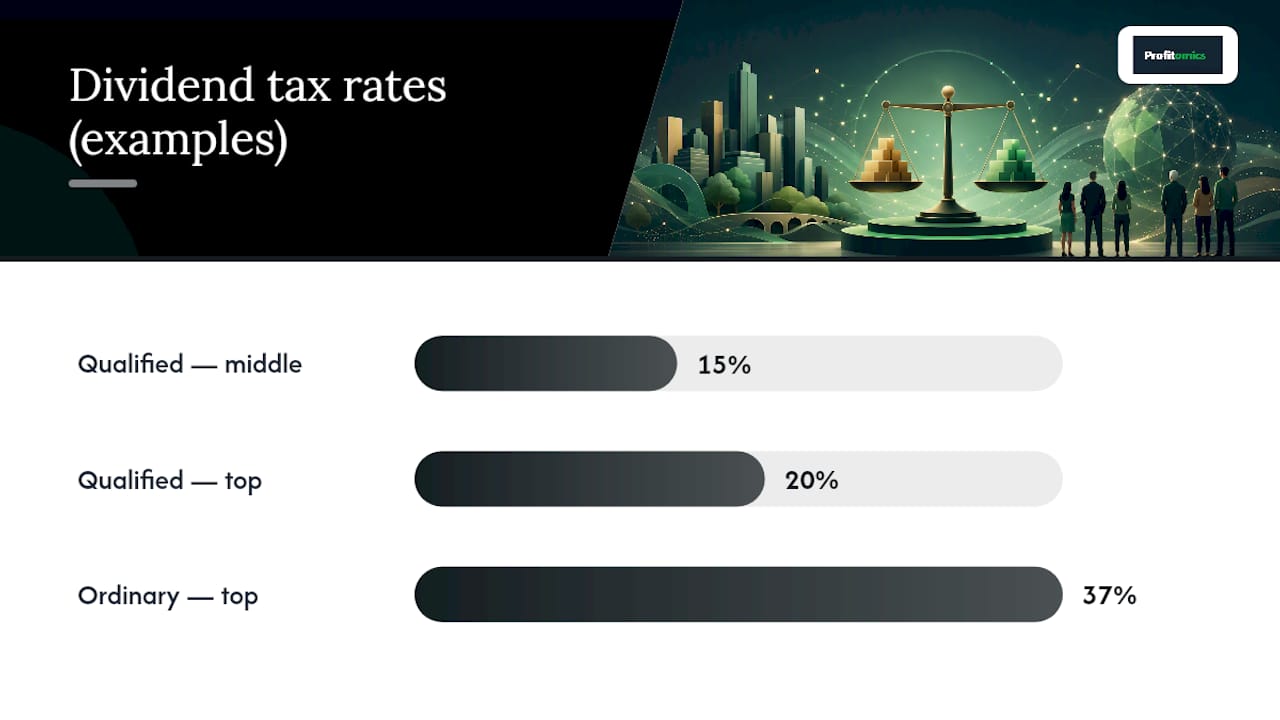
The single biggest factor in your after-tax dividend income is whether the payout counts as qualified or ordinary. The IRS treats qualified dividends as long-term capital gains for tax purposes, meaning they’re taxed at 0%, 15%, or 20% depending on your income bracket. Ordinary (nonqualified) dividends get taxed at your regular marginal income rate, which for many earners is meaningfully higher than the qualified rate.
To count as qualified, a dividend generally has to meet a holding-period test: you must have held the stock for more than 60 days during the 121-day period that starts 60 days before the ex-dividend date. Miss that window, even by a few days, and a dividend that looked qualified reverts to ordinary tax treatment. This trips up a surprising number of people who trade around ex-dividend dates trying to “catch” a payout.
Here’s roughly how the qualified dividend brackets break down:
- 0% rate: applies to taxpayers in the lower ordinary income brackets (roughly the 10% to 12% brackets).
- 15% rate: covers the bulk of middle income earners, spanning the 22% through 35% ordinary brackets.
- 20% rate: applies only at the top ordinary bracket, 37%.
Statistic Callout: Qualified dividends are taxed at 0%, 15%, or 20% depending on income bracket, while ordinary dividends are taxed at regular income rates that can run as high as 37%. Payers must issue Form 1099-DIV for any distribution of $10 or more.
That gap between 0% and 37% is why the qualified versus ordinary distinction deserves more attention than most beginner guides give it. A retiree in a low tax bracket holding qualified dividend payers might owe nothing at all on that income. Someone in a high bracket holding REITs or certain foreign stocks that don’t meet qualification rules could lose more than a third of the same dollar amount to taxes.
Form 1099-DIV is where all of this gets reported to you and to the IRS. The instructions for Form 1099-DIV lay out the specific boxes that matter:
- Box 1a: total ordinary dividends, the starting point for your tax calculation.
- Box 1b: the portion of box 1a that qualifies for the lower capital-gains rates.
- Box 2a and related boxes: capital-gain distributions, taxed separately from dividend income.
- Box 3: nondividend distributions, which is the IRS’s label for return of capital. This isn’t taxed as income; it reduces your cost basis in the stock, which affects your gain calculation whenever you eventually sell.
One practical filing note: don’t assume every number on your 1099-DIV is taxed the same way just because it arrived in one envelope. A single REIT or fund can generate ordinary dividends, qualified dividends, capital-gain distributions, and return-of-capital all in the same tax year, each landing in a different box with different treatment. Tax software handles this automatically if you enter the form correctly, but it’s worth understanding why the boxes exist before you assume your entire distribution got the friendly 15% rate.
There’s no such thing as a universal tax-free dividend allowance in a regular brokerage account. The IRS is explicit that dividends are only tax-deferred or tax-free inside qualified retirement accounts like IRAs and 401(k)s. Some readers ask “what amount of dividend income is tax-free,” expecting a specific dollar threshold. In a taxable account, that threshold effectively depends on your total income and which bracket you land in for the 0% qualified rate. Outside a retirement account, there’s no dollar amount that’s automatically exempt.
How Do You Estimate Dividend Income? (The Math That Actually Matters)
The formula behind every dividend income plan is simple: required portfolio value = desired annual income ÷ assumed portfolio yield. Financial planners use versions of this constantly, and the arithmetic scales cleanly whether you’re aiming for $200 a month or $10,000. One commonly cited example: $12,000 in desired annual income divided by a 3% yield equals $400,000 in required capital.
Say your goal is $1,000 a month, or $12,000 a year. Here’s what that target portfolio looks like at three different yield assumptions, before accounting for taxes:
Chasing a higher yield clearly shrinks the capital you need. It also usually means taking on more business risk, since abnormally high yields often signal a company under stress rather than a shareholder-friendly one. That tradeoff shows up again in the strategy section below.
Taxes change the picture further. The same $12,000 gross figure can leave you with meaningfully different take-home cash depending on how the payer classifies the distribution and which account holds the shares.
A few other numbers worth tracking as you plan:
- Dividend growth compounds your income even without adding new capital. A 3% starting yield growing at 8% annually roughly doubles the income stream in about nine years, turning a modest starting payout into a substantially larger one over a decade.
- Payment frequency creates timing gaps. Most stocks pay quarterly, some funds pay monthly. If you’re relying on dividends to cover monthly bills, a portfolio of quarterly payers can leave lumpy months unless you stagger ex-dividend dates across multiple holdings.
- Use conservative yield assumptions when planning, not the highest number you can find. A portfolio built around a sustainable 3% to 4% yield with growth potential tends to hold up better over decades than one chasing 8% or 9% yields that may not survive a downturn.
Building a Dividend Income Strategy That Fits Your Timeline
Two broad approaches dominate dividend investing, and they pull in different directions.
The tradeoff comes down to capital and patience. High-yield strategies need less starting capital to hit a given income target today, but they concentrate risk in sectors, like utilities, energy, and some REITs, that can cut payouts hard during a downturn. Dividend growth strategies need more capital upfront to generate the same income now, but a rising payout stream does more of the work over time, since growth compounding can double income roughly every nine years at reasonable growth rates.
How you implement either approach depends on your bandwidth for research:
- Individual dividend stocks give you control over exactly which companies you own and let you target specific tax treatment, but they require ongoing monitoring of each company’s financial health.
- ETFs and mutual funds spread risk across dozens or hundreds of holdings automatically, trading some upside for lower single-company risk. Profitomics’s beginner investing guide walks through how to evaluate fund options if you’re just starting out.
- REITs offer higher yields tied to real estate income but come with the tax quirks discussed earlier and more sensitivity to interest rate moves.
Building a mix usually depends on where you are in your investing life. During accumulation years, dividend growth stocks and broad-market ETFs with reinvestment turned on tend to build the largest long-term base. During withdrawal years, closer to or in retirement, a blend that leans more toward established payers and adds some higher-yield holdings for current cash flow, while still avoiding concentration in any single sector, tends to balance income needs against growth.
Before buying anything, run it through a basic screening checklist:
- Payout ratio: what percentage of earnings or free cash flow goes toward the dividend. A ratio consistently above 80% to 90% leaves little room for error.
- Free cash flow coverage: does actual cash generation, not just accounting earnings, support the payout?
- Leverage: heavily indebted companies are more likely to cut dividends when conditions tighten.
- Dividend history: a track record of raising or at least maintaining payouts through past downturns says more than any single year’s numbers.
Morningstar’s analysis on dividend investing makes a point worth internalizing: dividends are part of total return, not the whole story. Buybacks and capital appreciation matter too, and a portfolio obsessed with yield alone can quietly underperform one balanced across income and growth.
Pro Tip: Before buying a high-yield stock, check its payout ratio against free cash flow, not just reported earnings. Companies sometimes maintain a dividend using debt or asset sales even after cash flow no longer covers it, and that gap is usually the first sign of a coming cut.

Dividend Cuts, Yield Traps, and the Risks That Wreck an Income Plan
Dividend cuts rarely happen without warning signs. Companies often try to protect their dividend track record for as long as possible, since a cut signals distress to the market, which means the warning signs can build for a year or more before management finally pulls the trigger.
That delay is exactly what creates a yield trap: a stock whose price has fallen so much that its dividend yield looks unusually attractive, when in reality the market has already priced in an expected cut. It’s frequently a warning that the market doesn’t believe the current payout is sustainable. Morningstar’s own screening approach combines payout-ratio checks with forward-looking cash-flow analysis and a “distance to default” style metric that estimates how close a company is to financial distress, precisely to catch these situations before the cut happens.
A few practical guardrails reduce your exposure:
- Cap any single holding at a modest percentage of your dividend portfolio, so one cut doesn’t blow a hole in your monthly income.
- Diversify across sectors, since dividend cuts tend to cluster by industry during downturns (energy and financials during commodity or credit crunches, for example).
- Watch for yields that sit far above the sector average as a research prompt, not a buying signal.
- Track dividend growth rate alongside yield. A payout that hasn’t grown in five years, even if the yield looks fine today, is losing purchasing power every year inflation runs above 0%.
That last point deserves emphasis: inflation is a quiet risk that flat dividend payments don’t defend against. Dividend growth isn’t just about bigger checks; it’s the mechanism that keeps your income plan viable a decade or two out.
Where You Hold Dividend Stocks Changes Your Tax Bill
Account choice is one of the most underused levers in dividend income planning. Inside a traditional IRA or 401(k), dividends grow tax-deferred, meaning you don’t owe anything on them until you withdraw funds in retirement, at which point withdrawals are taxed as ordinary income regardless of whether the underlying dividends were originally qualified. Inside a Roth IRA, qualified withdrawals in retirement are tax-free entirely, which makes Roth accounts a natural home for higher-yield or REIT-heavy holdings that would otherwise generate ordinary income taxed at your full marginal rate. In a taxable brokerage account, you owe tax on dividends the year you receive them, whether you spend the cash or automatically reinvest it.
That last point catches new investors off guard constantly. Reinvested dividends through a dividend reinvestment plan (DRIP) still count as taxable income in a taxable account, even though you never see the cash in your bank account. The IRS doesn’t care that the money went straight back into buying more shares; it’s still a distribution the year it’s paid, and it still shows up on your 1099-DIV. What DRIPs do change is your cost basis: every reinvested dividend adds to your basis in that position, which reduces your taxable gain when you eventually sell.
Keeping clean records matters more with dividends than most investors expect:
- Save every 1099-DIV, and if you hold the same fund across multiple years, keep a running log of return-of-capital adjustments to your basis.
- Track reinvested shares separately from your original purchase, since each reinvestment creates a new basis lot with its own purchase date, which matters for the holding-period test on qualified dividends.
- Note any return-of-capital distributions immediately, since these reduce basis rather than generating current income, and missing this adjustment means overpaying tax when you sell.
If you’re weighing how fixed-income or annuity-style products inside a retirement account might complement a dividend allocation, this breakdown of annuities in a Roth IRA covers how those structures interact with tax-advantaged accounts.
Tools for Tracking Dividend Income and Testing Your Assumptions
A dividend calculator is only as useful as the inputs you feed it. Before trusting any projection, make sure the tool accounts for these four variables:
- Current yield, ideally based on the most recent quarterly or monthly payout annualized, not a trailing twelve-month average that might include a since-cut dividend.
- Assumed dividend growth rate, which should reflect the company or fund’s actual multi-year history rather than an optimistic guess.
- Tax status of the distribution, since a calculator that ignores the qualified versus ordinary split will overstate your real spendable income.
- Payout frequency, because monthly payers and quarterly payers produce very different month-to-month cash flow even at identical annual yields.
A basic spreadsheet tracker beats most free online calculators for one reason: you control every assumption. A workable template needs an inputs section (shares owned, cost basis, current yield, expected growth rate), an outputs section (annual income, yield on cost, monthly average), and a projection column that runs the numbers forward five or ten years under different growth assumptions.
Broker platforms and third-party trackers vary widely in what they surface. Prioritize tools that show dividend payment history over multiple years, upcoming ex-dividend dates so you can plan around them, and aggregate payout totals across your entire portfolio rather than position by position. This comparison of brokers for dividend investors breaks down which platforms handle these features best.
Ongoing tracking does more than satisfy curiosity. It’s the only way to test whether your dividend-growth thesis is actually holding up. If a holding you bought for its growth history stalls its payout for two years running, that’s a signal to revisit the position, not wait it out indefinitely.
Your Step-by-Step Checklist to Start Building Dividend Income
- Define your income need and time horizon. Are you supplementing current income, or building toward full retirement replacement 15 years out? The answer shapes every decision after this.
- Run the core formula. Divide your desired annual income by a conservative assumed yield (3% to 4% is a reasonable starting point) to find your target portfolio size.
- Choose your account type. Prioritize tax-advantaged space (401(k), traditional or Roth IRA) before building a large position in a taxable brokerage account, especially for higher-yield or REIT holdings.
- Pick your strategy mix. Decide roughly how much goes toward dividend growth stocks, income-focused ETFs, and higher-yield holdings like REITs based on your timeline from step 1.
- Screen every candidate holding. Check payout ratio, free cash flow coverage, leverage, and dividend history before buying anything.
- Size positions to limit concentration. No single stock should be able to meaningfully damage your monthly income if it cuts its dividend.
- Set up tracking immediately. Build your spreadsheet or connect a broker tool before you need it, not after your first surprise dividend cut.
- Schedule a quarterly review and a tax-season checklist. Confirm 1099-DIVs match your records, check for any return-of-capital adjustments to basis, and reassess any holding whose growth rate has stalled.
Pro Tip: Set a calendar reminder for the week before each ex-dividend date on your largest holdings. It takes five minutes and catches a surprisingly high number of upcoming cuts or special distributions before they show up as a shock in your account.
A Practical Perspective on Making Dividend Income Actually Work
Most dividend content either drowns you in ticker recommendations or buries the math so deep you never actually calculate what you need. Neither helps. The formula in this article, income divided by yield, is something you can do on a phone calculator in ten seconds, and it’s the single most useful number in this entire topic. Skipping it is why so many people either overshoot their required savings out of fear or undershoot it out of optimism about yields that won’t hold.
At Profitomics, the practical education approach means giving you the templates that turn this math into a habit rather than a one-time exercise. The step-by-step checklist above maps directly onto the worksheets and spreadsheet frameworks Profitomics builds into its stock market and passive income materials, designed so you fill in your own numbers instead of starting from a blank sheet. The goal isn’t to make you an expert overnight. It’s to make the quarterly review in step 8 something you’ll actually do.
— Kai
Ready-Made Templates for Building Your Dividend Income Plan
Doing the math by hand in this article gets you started, but rebuilding a spreadsheet from scratch every quarter is where most people quietly give up. Profitomics packages the exact framework covered here, income formulas, yield-on-cost tracking, and portfolio screening checklists, into ready-to-use templates so you spend your time picking holdings instead of building tools.

Stock Market Mastery includes spreadsheets built specifically for tracking dividend growth and payout sustainability over time, mapping directly onto the screening checklist in this guide. If your goal is a broader passive income plan that includes dividends alongside other income streams, The Passive Income Blueprint comes with worksheets for calculating your required portfolio size at different yield assumptions, the same math from the estimation section above, ready to fill in with your own numbers. Both are instant digital downloads, so you can start building your tracker today instead of waiting on a template you’d otherwise have to design yourself. Visit Profitomics to see the full library and find the format that matches where you’re starting from.
This article is general information, not a substitute for advice from a qualified financial advisor. Consult a qualified financial professional about your own circumstances before acting on anything here.
FAQ
How much money do I need to make $1,000 a month in dividends?
Higher yields reduce the required capital but usually come with more business risk.
Is income from dividends taxable?
Yes.
What does income from dividends mean?
It refers to cash or stock distributions paid to shareholders from a company’s profits, or passed through by a fund or REIT, that can serve as a recurring income stream separate from selling shares for capital gains.
What amount of dividend income is tax-free?
There’s no universal tax-free threshold in a taxable account.