Fractional Shares Investing: Start With Just $1

A fractional share is a slice of a stock or ETF that costs less than one full share, priced by the dollar amount you choose to invest rather than by a whole-share count. You can start with a small dollar amount at most major brokers.
To begin today:
- Open a brokerage account (most take five minutes)
- Fund it with a modest amount such as $25, $50, or $100
- Place a dollar-based order or set up a recurring buy
Quick take: Fractional shares open the door to expensive stocks and allow for tighter diversification, but they come with transfer and voting-rights limits worth knowing before you fund an account. The Investor bulletin confirms this dollar-based approach is now standard across many retail platforms.
Key Takeaways
Fractional shares investing lets you buy any stock or ETF by dollar amount, starting as low as $1, but broker policies on execution, transfers, and voting rights differ enough to shop around before you fund an account.
| Point | Details |
|---|---|
| Dollar-based buying | Enter a cash amount instead of a share count; the broker calculates your fractional quantity automatically. |
| Broker policies vary widely | Check eligibility, execution timing, minimums, and voting rights before funding any account. |
| Taxes apply normally | Dividends and capital gains on fractional shares are taxable and reported on your consolidated 1099. |
| Transfers can be tricky | Fractional positions often can’t move between brokers without being sold first. |
| Track your positions | Profitomics offers fillable templates to log ticker, dollar amount, cost basis, and dividends as you build your portfolio. |
Where to Verify Broker Policies and Protections
- FINRA’s guide to fractional shares for execution and transfer rules
- Investor for regulatory basics
- SIPC for what happens if your broker fails
- FDIC’s deposit insurance guide for what’s covered in cash sweep accounts
Look for a broker’s fractional policy page, its order-execution disclosure, and its fee schedule before opening an account.
This article is general information, not a substitute for advice from a qualified financial advisor. Consult a qualified financial professional about your own circumstances before acting on anything here.
Table of Contents
- How Does Fractional Shares Investing Actually Work?
- What Brokerage Differences Should You Check First?
- Which Brokers Offer the Best Fractional Share Options?
- What Are the Pros and Cons of Fractional Shares?
- How Do You Buy Your First Fractional Share?
- Do You Pay Taxes on Fractional Shares?
- What Risks Should You Confirm Before Funding an Account?
- Your Quick-Start Checklist for Fractional Investing
- Sources
- FAQ
How Does Fractional Shares Investing Actually Work?
Fractional shares investing means your money buys a percentage of a share instead of a full unit. For example, if a stock trades at a high price, putting in a smaller dollar amount lets you own a proportional fractional share.
Brokers create these slivers a few different ways: dollar-based orders where you specify a cash amount, share-based orders where you type in a decimal quantity like 0.5, dividend reinvestment plans (DRIPs) that reinvest cash dividends into partial shares, and stock splits that occasionally leave odd fractional remainders. Some platforms also pool small orders from many customers and execute them as one aggregated block, then divide the fill proportionally.
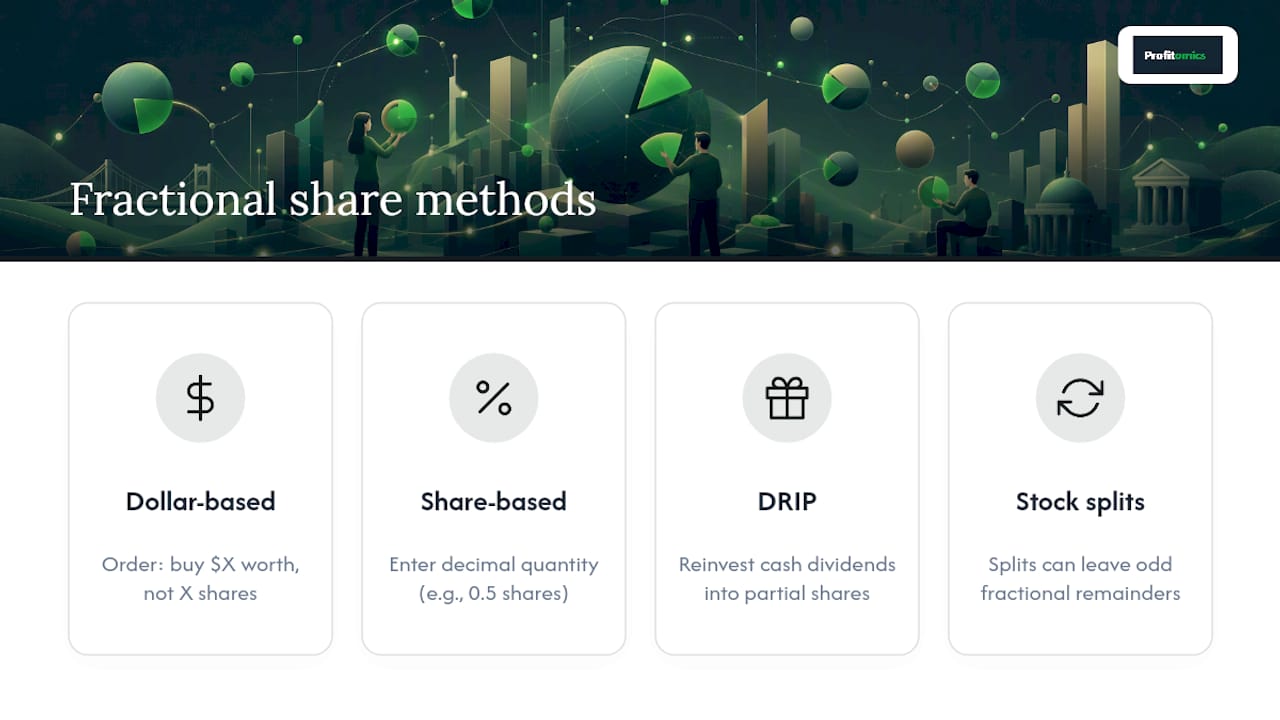
A few terms show up constantly. A dollar-based order tells the broker “buy $X worth,” not “buy X shares.” Aggregation or batching refers to bundling many small orders together before execution. Rounding determines whether your fractional quantity shows three decimal places or gets rounded to the nearest cent of value. And most fractional trading only happens during regular market hours, even if the broker supports extended-hours trading for whole shares.
According to Investor.gov, buying $100 of a $1,000 stock nets you exactly 0.1 shares, a clean illustration of how the math scales at any price point.
What Brokerage Differences Should You Check First?
Not every broker treats fractional shares the same way, and the differences affect your returns more than most beginners realize. Before funding an account, verify:
- Which stocks and ETFs are eligible for fractional trading (some brokers exclude thinly traded or low-priced securities)
- Whether you can enter orders by dollar amount, share quantity, or both
- Whether limit orders are supported, or only market orders
- The minimum order size, which ranges from $1 to $5 depending on the platform
- Whether fractional trades are allowed during extended hours
Execution models vary too. Some brokers fill your fractional order in real time, at or near the live market price the moment you click buy. Others batch orders throughout the day and execute one aggregated trade at set intervals, which means your actual fill price could differ slightly from the price you saw when you placed the order. FINRA notes that fractional-share handling varies meaningfully across firms, covering everything from execution timing to voting rights.
Pro Tip: Read your broker’s fractional-share policy and order-execution disclosure before you fund the account. It’s usually a short page, and it tells you exactly how your orders get filled and whether you’ll ever hold a fraction that can’t be transferred elsewhere.
Which Brokers Offer the Best Fractional Share Options?
Seven platforms dominate the fractional-investing conversation among U.S. retail investors, and each one leans into a different strength.
| Broker | Minimum Investment | Available Assets | Recurring/DRIP Support |
|---|---|---|---|
| Fidelity | $1 | Stocks, ETFs | Yes, automatic |
| Charles Schwab | $5 | S&P 500 stocks only | Yes, automatic |
| Robinhood | $1 | Stocks, ETFs | Yes |
| SoFi | $5 | Stocks, ETFs | Yes |
| M1 Finance | $1 | Stocks, ETFs (custom “pies”) | Yes, automatic |
| Webull | $5 | Stocks, ETFs | Limited |
| Navy Federal | Varies by fund | Limited selection | Yes |
- Fidelity: Broad eligibility and a $1 minimum make it one of the most flexible starting points, with clear rounding rules laid out on Fidelity’s own learning page.
- Charles Schwab: Its Schwab Stock Slices program limits you to S&P 500 companies, a tradeoff for simplicity if you only want blue-chip exposure.
- Robinhood: Built for mobile-first buying with instant execution and a $1 floor, appealing if you want to trade on the fly.
- SoFi: Bundles fractional trading with its broader banking and lending products, useful if you already bank there.
- M1 Finance: Lets you build custom “pies” of fractional holdings that rebalance automatically, a strong fit for hands-off diversification.
- Webull: Popular for active traders who want fractional access alongside charting tools, though DRIP support lags competitors.
- Navy Federal: Available only to credit union members, with a narrower fund lineup but familiar service for military families.
What Are the Pros and Cons of Fractional Shares?
The upside is straightforward. You get access to high-priced stocks with relatively small investment amounts. You can build a finely balanced portfolio across ten or twenty names instead of two or three. Every dollar goes to work instead of sitting as leftover cash, which makes consistent dollar-cost averaging genuinely painless, a point NerdWallet highlights as one of the format’s clearest practical benefits.
The downside matters too. Fractional positions often can’t move between brokers, you may lose proxy voting rights on the fractional portion, and execution prices can lag the live quote if your broker batches orders. If you want simple, one-ticket diversification without those wrinkles, a broad-market ETF or mutual fund can accomplish the same goal with fewer moving parts.
How Do You Buy Your First Fractional Share?
- Choose a broker based on the eligibility and minimums that matter most to you.
- Open the account online. Expect to verify your identity and answer a few risk-tolerance questions.
- Fund the account with a bank transfer. A modest funding amount is usually enough to place a real order.
- Pick your investment, a single stock or a diversified ETF.
- Enter a dollar amount instead of a share count, then confirm the order type (market or limit, if available).
- Set up recurring buys if your broker allows it, so contributions happen automatically each pay period.
Say you want to test the waters. Put $25 into a total-market ETF one week, then $50 into a single stock the next. Both trades settle the same way: you specify the dollar figure, the broker calculates the fractional quantity, and you own a piece of the company by the next trading session.
Pro Tip: Confirm whether your broker supports limit orders on fractional trades. If it only offers market orders, you’re accepting whatever price is live at execution, which is fine for small amounts but worth knowing upfront.
Do You Pay Taxes on Fractional Shares?
Yes. Fractional shares are taxed exactly like whole shares, just scaled down.
- Dividends get paid pro rata based on your fractional ownership, and they’re taxable in the year received.
- Selling a fraction for a gain or loss is a taxable event, reported the same way a whole-share sale would be.
- Cost basis for fractional positions shows up on your consolidated 1099 each year, so you don’t have to track it by hand.
If you transfer accounts, sell a fraction involuntarily, or receive a cash-in-lieu payment from a corporate action, the tax treatment can get less obvious. A tax professional is worth the conversation in those specific cases.
What Risks Should You Confirm Before Funding an Account?
A few edge cases deserve attention before you deposit money. Fractional positions typically can’t transfer in-kind between brokers, so FINRA notes you may need to sell them first, which can trigger an unplanned taxable event. Thinly traded securities can have liquidity quirks, voting rights on fractional shares are often restricted, and rounding plus execution slippage can create small discrepancies between the price you expected and the price you got.

Red flags to watch for: no clear policy on fractional transferability, aggregated execution with no disclosed timing, or fees that aren’t spelled out anywhere on the broker’s site. Corporate actions like mergers or spinoffs usually settle fractional positions with a cash-in-lieu payment rather than a matching fractional share of the new company, according to Investopedia.
Your Quick-Start Checklist for Fractional Investing
- Set a goal (retirement, a house fund, general wealth building).
- Choose a target allocation across a few stocks or ETFs.
- Pick a broker that matches your eligibility and minimum needs.
- Fund the account and place your first dollar-based buy.
- Set up a recurring investment plan.
- Track it: ticker, date, dollar amount, fractional quantity to three decimals, and dividends received in a simple spreadsheet.
Why Fractional Shares Changed the Math for New Investors
Fractional investing removed the biggest barrier I saw trip up beginners for years: needing hundreds of dollars just to own one share of a company worth owning. My honest take is that the bigger risk isn’t the math, it’s the mindset. Chasing one stock feels exciting; showing up with recurring $50 contributions across a handful of names is what actually builds wealth over a decade.
Get Fillable Templates to Track Your First Trades
Figuring out the mechanics is one thing. Actually tracking cost basis, dividends, and recurring contributions without losing track of a decimal point is another. Profitomics builds fillable checklists and order-tracking templates specifically for investors who are just getting started with small-dollar positions, so you’re not rebuilding a spreadsheet from scratch every time you add a new ticker.
If you want a structured, step-by-step framework that goes beyond your first trade, into building a long-term stock strategy with the same practical, template-driven approach, Stock Market Mastery walks through swing trading and long-term compounding strategies at your own pace. Start by browsing the full library of guides at Profitomics and download the one that matches where you are right now.
Sources
- Investor
- Investing in fractional shares | FINRA
- Fractional shares | Dollar-based investing | Fidelity
- Fractional share definition and guide | Investopedia
- Fractional shares: what they are and where to buy them | NerdWallet
FAQ
Is It a Good Idea to Buy Fractional Shares?
For most beginners, yes. Fractional shares let you diversify with small amounts of money instead of concentrating your entire balance in one or two stocks you can afford in whole units.
Does the S&P 500 Allow Fractional Shares?
You can’t buy a fraction of the index itself, but most brokers let you buy fractional shares of S&P 500 ETFs or individual S&P 500 companies, and Charles Schwab’s Stock Slices program is built specifically around that index.
Can You Make Money Off Fractional Shares?
Yes. Fractional shares grow or shrink in value exactly like whole shares, proportional to your ownership stake, so gains and losses work identically on a smaller scale.
Do You Pay Taxes on Fractional Shares?
Yes. Dividends are taxed pro rata in the year received, and selling a fractional position for a gain or loss is a reportable taxable event just like a whole-share sale.
Can You Transfer Fractional Shares Between Brokers?
Usually not directly. Most brokers require you to sell the fractional portion before an account transfer, which can trigger a taxable event, so check your broker’s policy in advance.
Recommended
- Make Money Online — Ebooks on Passive Income, Stocks & Crypto | Profitomics
- Stock Market Mastery — Swing trading and long-term compounding strategies | Profitomics
- Side Hustle to Six Figures — Turn any skill or idea into a $100K+ income stream | Profitomics
- The Passive Income Blueprint — Build income streams that pay you while you sleep | Profitomics