Protect Winners: Trailing Stop Loss Rules for Traders, 0.5–15%
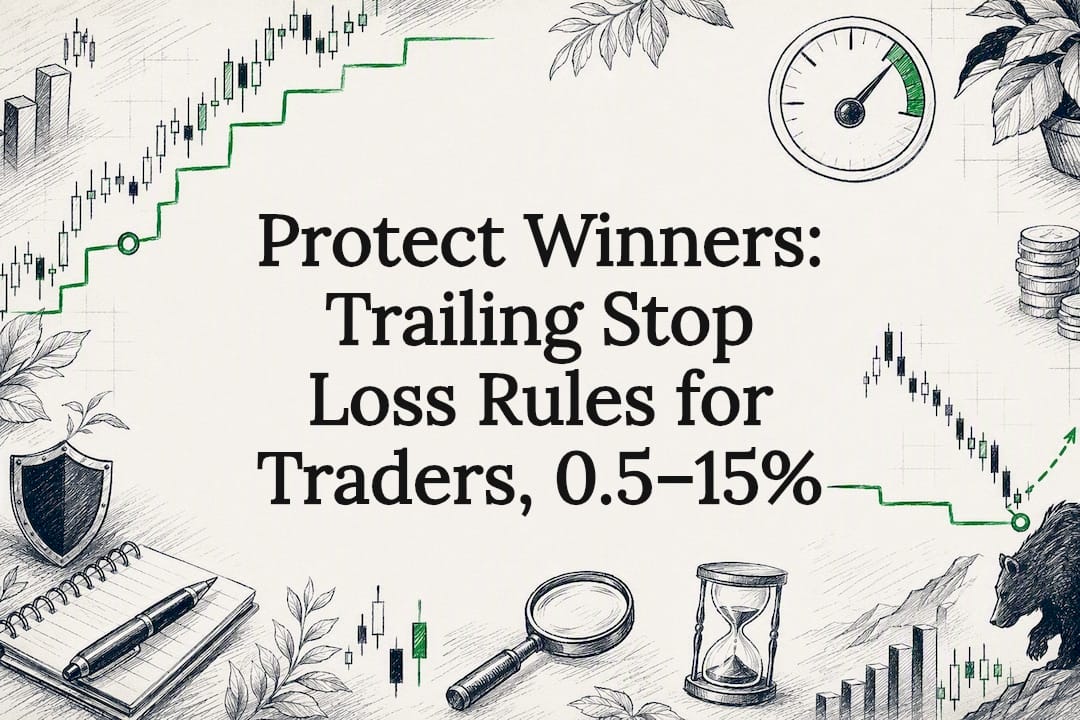
A trailing stop loss is a stop order that automatically moves with a winning trade, locking in gains while letting the position keep running. It adjusts only in your favor and never against you, which is what separates it from a fixed stop loss. The tradeoff: once triggered, it typically fills as a market order, so your exit price can slip from the trigger price during fast or thin trading.
TL;DR:
- Trailing stops adjust only in your favor, locking in gains as the stock rises, but can fill at a worse price during fast or thin markets.
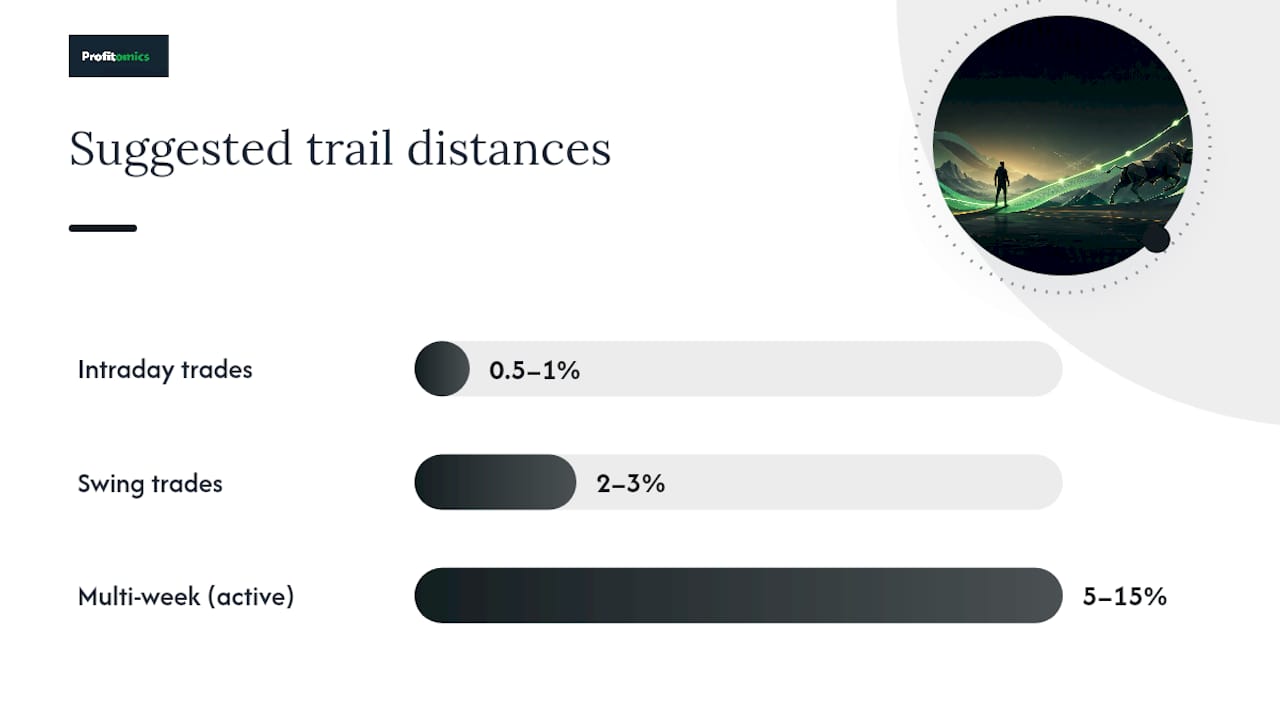
- The most common method is a percentage trail, typically 0.5-1% for intraday, 2-3% for swing trades, and 5-15% for longer-term holdings, depending on volatility.
- Using ATR-based or indicator-based methods can better adapt to market volatility, but require more setup and calculation.
- Whipsaw, slippage, and gaps are key risks, especially in choppy markets or after-hours trading, which can cause unexpected fills or losses.
- A clear pre-trade plan, including trail size, trigger settings, and post-trade review, improves the effectiveness and consistency of trailing stop use.
Table of Contents
- How Does a Trailing Stop Loss Work?
- Common Methods to Set a Trailing Stop
- How Do You Choose the Right Trail Distance?
- Setting a Trailing Stop: A Worked Example
- What Are the Risks of Trailing Stop Losses?
- When Should You Use a Trailing Stop Loss?
- Building a Trailing Stop Checklist You’ll Actually Use
- A Rules-First Take on Trailing Stops
- Practice Trailing Stops With Profitomics Templates
- Where to Verify Trailing Stop Mechanics
- Sources
- FAQ
How Does a Trailing Stop Loss Work?
A trailing stop tracks the highest price your position reaches (or the lowest, if you’re short) and holds a set distance behind it. That distance can be a percentage or a fixed dollar amount. If the stock climbs, the stop climbs with it. If the stock drops, the stop stays put. It never widens or moves backward against you, according to the SEC’s Investor Bulletin on trailing stop orders, which is the core mechanical guarantee that makes this order type useful.
Once the stop price is touched, most brokers convert it into a market order, meaning it fills at the next available price, not necessarily the price you set.
A few things vary by broker and matter more than most traders realize:
- Trigger source: some platforms trigger off the last traded sale, others off the bid or ask, which can fire your stop at slightly different moments during a volatile session.
- Monitoring hours: Fidelity’s conditional order documentation notes trailing stops are often watched only during regular market hours, leaving gaps overnight or in extended sessions.
- Order type on trigger: most convert to market orders, though some brokers offer a trailing stop-limit variant.
Common Methods to Set a Trailing Stop
There’s no single right way to size a trail. The method should match your instrument, your timeframe, and how that stock typically moves. Investopedia’s breakdown of trailing stop types covers the four approaches most traders actually use:
- Percentage-based: the most common method. A 10% trail on a $50 stock sits at $45 and rises as the stock does. Simple, but it ignores whether the stock is calm or wild.
- Fixed-dollar or point-based: useful for futures or options where price moves are measured in points rather than percent. A $2 trail on a $40 stock behaves very differently than the same $2 trail on a $150 stock.
- ATR-based (average true range): the stop distance scales with actual recent volatility instead of a flat number, so it adapts as the stock speeds up or calms down.
- Indicator-based: trailing behind a moving average (commonly the 20 or 50-day EMA), a Parabolic SAR line, or a recent swing low/support level.
Percentage trails are easiest to set and understand but can be too tight for volatile names and too loose for sleepy ones. ATR and indicator-based trails take more setup but flex with the market instead of fighting it.
How Do You Choose the Right Trail Distance?
Trail distance should track your timeframe and the stock’s actual volatility, not a number you picked because it felt safe. A day trader and a swing trader holding the same stock need completely different stops.
- Identify your holding period. Intraday trades need tight trails; multi-week swing trades need room to breathe.
- Pull the ATR (typically 14-period) for your timeframe and multiply it by a factor between 1.5 and 3, a range widely used among trend-following traders to size stops that adjust with volatility.
- Cross-check against percentage benchmarks: roughly 0.5 to 1% for intraday trades, 2 to 3% for swing trades, and 5% to 15% for many actively traded stocks held over weeks.
Statistic to watch: practitioner diagnostics suggest a win rate under roughly 30% often signals a trail that’s too tight, stopping you out on normal noise before the real move happens. On the flip side, giving back a large portion of your peak open profit on a regular basis points to a trail that’s too wide, letting winners round-trip back to breakeven.
Pro Tip: If you’re trading a stock that just doubled its average daily range on news, don’t reuse yesterday’s ATR multiplier. Recalculate it, or you’re trailing a calm-market stop through a storm.
Setting a Trailing Stop: A Worked Example
Setting one up is straightforward once you’ve picked a method. Here’s the process, start to finish.
- Choose your method and calculate the initial trail using a tool like What did your currency lose against the dollar? | Fiatmap to understand percentage and dollar value changes accurately. Say you buy a stock at $100. Using a 10% percentage trail, your initial stop sits at $90. Using ATR instead, if the 14-day ATR is $3 and you apply a 2x multiplier, your trail distance is $6, putting your stop at $94.
- Enter the order with your broker. Look for “trailing stop” or “trailing stop percent/amount” in the order type menu, then enter either the percentage or the dollar trail value, plus any time-in-force setting.
- Watch it ratchet as price rises. If the stock climbs to $110, a 10% trail moves the stop to $99. If it keeps climbing to $130, the stop rises to $117, locking in $17 of profit even before you sell.
- Let the market do the rest. If the stock reverses and hits $117, the order triggers and (usually) fills close to that level, though not guaranteed exactly at it.
Before running this live, test the sizing in a simulator. Paper trading first lets you see how a given trail behaves across a handful of real chart patterns before any real money is on the line.
What Are the Risks of Trailing Stop Losses?
Trailing stops solve one problem (letting winners run while protecting gains) and introduce a few others. Know these before you rely on one.
- Whipsaw: a stock chopping sideways can tag a tight trail repeatedly, kicking you out right before it resumes the move you wanted to catch.
- Slippage: because the order becomes a market order once triggered, the fill price can differ from the trigger price, especially during fast drops or thin after-hours trading.
- Gaps: if a stock gaps down below your stop overnight on bad news, your trail doesn’t protect you from the gap. It fills wherever the market opens next.
- Broker inconsistency: trigger source (last sale versus bid/ask) and monitoring windows differ by platform, so the same trail can behave differently at two different brokers.
Widening the trail, switching to ATR-based sizing, or using a trailing stop-limit order (where available) can soften these problems, though a stop-limit risks not filling at all if price blows through your limit.
When Should You Use a Trailing Stop Loss?
Trailing stops earn their keep in trending markets. A stock in a clean uptrend rewards a trail that lets it climb while quietly raising your floor underneath it. That’s the whole appeal for trend-following strategies and multi-week swing trades.
They struggle in rangebound or choppy markets, where price oscillates without going anywhere and a tight trail just bleeds you with repeated small stop-outs.
A trailing stop loss is not a substitute for position sizing or a broader trading plan. It’s one tool inside that plan, not the plan itself.
Building a Trailing Stop Checklist You’ll Actually Use
Most traders set a trailing stop once and never revisit whether it’s actually working. A short checklist fixes that.
Before the trade: confirm your timeframe, pick percent or ATR as your method, calculate the specific trail value, and decide how much slippage you’ll tolerate if the market gaps against you.
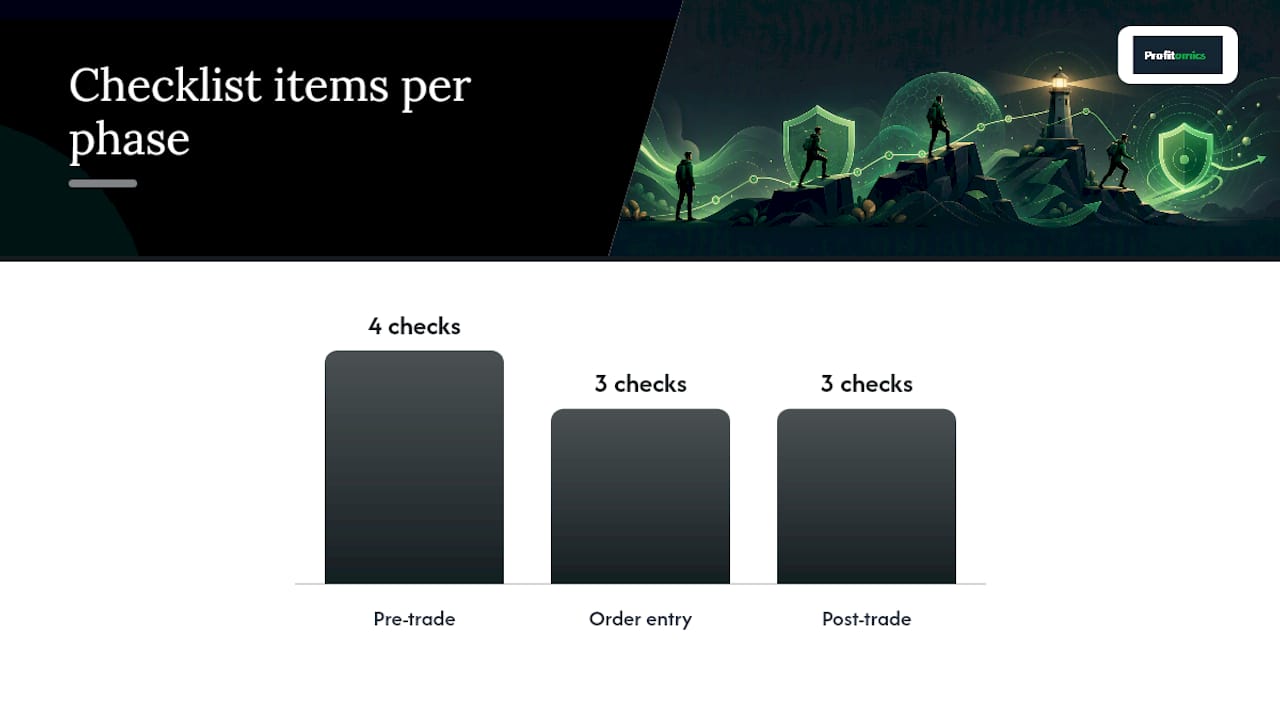
At order entry: check your broker’s trigger setting (last sale vs. bid/ask), confirm whether the order converts to market or limit, and double-check the trail value before submitting.
After the trade closes: log what percent of your peak open profit you actually kept, note whether you got whipsawed, and adjust your trail sizing for next time.
- Pre-trade: timeframe, method, trail value, slippage tolerance
- Order entry: trigger source, market vs. limit, trail value confirmed
- Post-trade: percent of peak profit kept, whipsaw count, sizing adjustment
Pro Tip: Keep a simple spreadsheet log of every trailing stop you set and how it played out. After 20 trades, you’ll see your own patterns faster than any strategy article can tell you what to do.
A Rules-First Take on Trailing Stops
Trailing stops work best as a rule you follow automatically, not a decision you re-litigate every time a stock wobbles… The traders who struggle with trailing stops usually aren’t miscalculating the ATR. They’re second-guessing the stop after it’s already set, which is the same emotional pattern behind revenge trading. A trail you trust removes that decision from a moment when you’re least equipped to make it well.
— Kai
Practice Trailing Stops With Profitomics Templates
Reading about trail distances is one thing. Actually calculating them, entering them correctly, and reviewing what happened afterward is another, and that’s the gap detailed practical guides are designed to close. Some educational materials include worksheets and worked examples for swing trading setups, walking through percent and ATR calculations step by step instead of leaving you to reverse-engineer the math from a blog post.
It’s built to sit alongside paper trading, not replace it: run the numbers with the templates, then test them in a simulator before committing real capital. If you’re ready to put trailing stop rules into an actual trading routine, start with Stock Market Mastery and work through the swing trading templates at your own pace.
Where to Verify Trailing Stop Mechanics
For primary references, check the SEC’s Investor Bulletin on stop and trailing stop orders, Investopedia’s trailing stop explainer, and your own broker’s conditional order documentation, since trigger rules differ by platform. Before choosing a broker, it’s also worth confirming their standing through SIPC.
Sources
- Investor
- Trailing Stops: What They Are, How to Use Them in Trading | Investopedia
- Trailing Stop Loss Order: How to Set It (2026 Guide) | TradingSim
FAQ
How Does a Trailing Stop Loss Work?
It sets a stop price that follows your position’s price in the favorable direction only, by a fixed percentage or dollar amount, and triggers a market order once the price reverses by that distance.
What Are the Disadvantages of Trailing Stop Losses?
The main drawbacks are whipsaw in choppy markets, slippage since triggered orders usually fill as market orders, and inconsistent behavior across brokers depending on trigger source and monitoring hours.
What Is a Good Trailing Stop Percentage?
There’s no universal number, but common starting points are 0.5% to 1% for intraday trades, 2% to 3% for swing trades, and 5% to 15% for many actively traded stocks held over several weeks, adjusted for each stock’s own volatility.