How to Stop FOMO Trading Before It Wrecks Your Account

FOMO trading is the impulse to buy an asset because others appear to be profiting, not because your own criteria say it’s a good trade. The single most effective way to stop it isn’t willpower. It’s pre-commitment: a written rule you set before the urge hits, combined with a mandatory cooling-off period that puts time between the emotion and the order button.
If you feel the pull right now, do these three things before you touch your platform:
- Pause for 10 seconds. Close the chart or social feed. Breathe. Your amygdala is firing; your prefrontal cortex needs a moment to catch up.
- Ask three questions: Is this trade in my written plan? Do I know my exact stop-loss level? Is my risk per trade within my limit?
- If any answer is “no,” set a 24–48-hour wait. Write down why you want the trade. If the rationale still holds tomorrow, revisit it then.
The rest of this guide builds the longer systems, including an Investment Policy Statement, automation, and a trade journal, that make those three steps automatic.
Key Takeaways
FOMO trading is a systems problem, not a willpower problem. Pre-commitment tools like an IPS, automated contributions, and a trade journal remove in-the-moment decision pressure before the emotion can reach your account.
| Point | Details |
|---|---|
| Use the 3-gate check | Before any trade, confirm it’s on your watchlist, matches your criteria, and fits your risk limit. |
| Write an IPS when calm | A one-to-two-page document with allocation bands and forbidden actions governs decisions made under pressure. |
| Journal every impulse | Log FOMO urges whether you act or not; weekly reviews show patterns your memory won’t. |
| Add friction, not willpower | Separate funding accounts, limit orders, and two-strike circuit breakers make impulsive trades harder than planned ones. |
| Profitomics templates | Stock Market Mastery and Crypto Profit System provide ready-to-use checklists and frameworks for beginner accounts. |
Table of Contents
- What is FOMO trading and why does it hurt beginners?
- How to use a cooling-off protocol in the moment
- Build systems that prevent FOMO before it starts
- How to use a trade journal to externalize your thinking
- Daily habits that lower FOMO pressure
- When FOMO becomes a serious problem
- Copyable templates you can use right now
- What actually changes when you use these systems
- Profitomics makes the templates-first approach practical
- Sources
What is FOMO trading and why does it hurt beginners?
FOMO trading, the informal term for fear of missing out investing, happens when urgency and social signals replace pre-defined criteria as the reason to enter a position.
The psychology behind it is well-documented in behavioral finance. Loss aversion, the tendency to feel losses roughly twice as sharply as equivalent gains, combines with avoidant regret: the specific pain of imagining yourself watching a trade you skipped go to the moon. That combination activates the amygdala, the brain’s threat-detection center, and produces a sense of urgency that bypasses the prefrontal cortex, where deliberate reasoning lives. Systemic cooling-off routines are effective precisely because they restore executive control before capital moves.
The math punishes late entries hard. By the time a meme stock or crypto pump is visible on social media, the early buyers are already sitting on gains and looking for an exit. You’re buying their liquidity. Investor against making investment decisions based on influencer recommendations or social-media hype, recommending diversification and long-term planning as the practical defense.
How to use a cooling-off protocol in the moment
When the urge to chase a trade hits, run this sequence before placing any order:
- Stop and name it. Say out loud or write: “I feel FOMO right now.” Naming the emotion activates the prefrontal cortex and creates a small but real pause.
- Check the three gates. Is this ticker on my pre-approved watchlist? Does the setup match my written entry criteria? Is my position size within my maximum risk per trade?
- Calculate risk-reward. Where is the logical stop-loss? Where is the realistic target? If the ratio is worse than 1:2, the trade fails on math alone.
- Set a 24–48-hour hold. Write the trade idea in your journal with a timestamp. If it still looks valid the next day, you can consider it. If the move is already over, you have your answer.
- If you already placed the trade: Check immediately whether a stop-loss is set. If not, set one now. Take a 10-minute break away from screens, then journal what happened.
Tactics like the 10-second pause, a watchlist-only rule, and two-strike circuit breakers are consistently cited as effective moment-of-trade tools for preventing impulsive entries.
Build systems that prevent FOMO before it starts
One-off willpower fixes don’t last. The traders who manage fear of missing out trading over the long run do it with systems that remove in-the-moment decision pressure entirely.
Investment Policy Statement
An Investment Policy Statement (IPS) is a one-to-two-page document you write when you’re calm that governs every trading decision you make when you’re not. It specifies your target asset allocation (e.g., 60% equities, 20% bonds, 20% crypto), your rebalancing cadence, a list of forbidden actions (no leveraged products, no buying after a 30%+ weekly run), and your maximum risk per trade. Pre-commitment strategies like an IPS and mandatory waiting periods reduce emotional trading by removing the need to decide under pressure.
Automation and friction
Scheduled contributions via dollar-cost averaging remove the timing decision entirely for new money. Limit orders instead of market orders force you to name your price in advance rather than chasing the ask. A separate funding account, one you have to manually transfer from before trading, adds a friction layer that slows impulsive action. These aren’t tricks; they’re structural changes that make FOMO trades harder to execute than planned trades.
Risk frameworks
Set a maximum risk per trade (many practitioners use 1–2% of account equity) and a daily loss limit. A two-strike circuit breaker means: if you break your rules twice in one session, you close the platform and don’t return until the next trading day. Hard limits in your brokerage’s settings, where available, make these rules difficult to override in the heat of the moment.
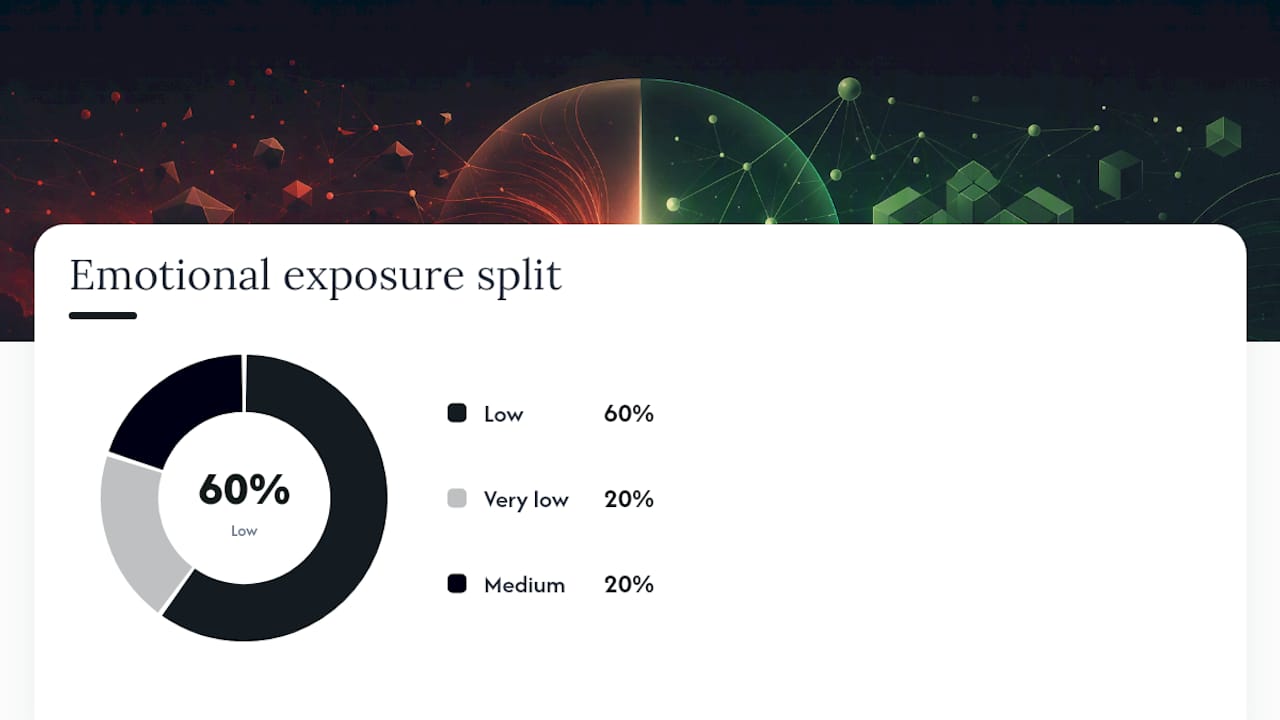
| Pre-commitment tool | How it reduces FOMO | Emotional exposure | Setup time |
|---|---|---|---|
| Investment Policy Statement | Replaces real-time decisions with pre-written rules | Low | 1–2 hours |
| Automated contributions (DCA) | Removes timing decisions for new money | Very low | 30 minutes |
| Limit orders only | Forces price discipline before entry | Low | Immediate |
| Separate funding account | Adds friction between impulse and capital | Medium | 1 hour |
| Two-strike circuit breaker | Stops session after two rule violations | Low | Immediate |
Pro Tip: Set your daily loss limit inside your brokerage platform as a hard stop, not just a mental note. TD Ameritrade, Webull, and Interactive Brokers all allow account-level alerts or restrictions. A rule you have to actively override is far stronger than one you only remember after the fact.
How to use a trade journal to externalize your thinking
Writing externalizes the decision. When the reason for a trade lives only in your head, your emotional brain can quietly rewrite it. On paper, it can’t.
A useful trade and FOMO journal captures these fields for every impulse, whether you act on it or not: date and time, ticker, what triggered the urge (social post, price alert, friend’s tip), your written entry rationale, your planned stop-loss and target, and the cooling-off outcome (did you wait? did you skip it?). Pre-trade checklists and cold-state rule writing prevent the real-time negotiation of criteria that turns late entries into poor risk/reward trades.
Run a weekly review using this checklist:
- Count how many FOMO impulses you logged.
- Count how many you avoided acting on.
- Compare P&L on planned trades vs. unplanned trades.
- Note any pattern in what triggered the impulses (time of day, specific platforms, market conditions).
- Adjust one rule or habit based on what you find.
Keep a “Trades I didn’t take” log alongside your regular journal. When a trade you skipped later goes up, hindsight bias will tell you that you obviously should have taken it. The log shows you the full picture: how many skipped trades went nowhere or reversed, which retrains your confidence in your process rather than in lucky outcomes.
Daily habits that lower FOMO pressure
Environment shapes behavior more reliably than motivation. A few specific changes reduce how often the FOMO trigger fires in the first place.
Turn off real-time price alerts except for your active positions. Limit live financial feeds to a scheduled window, say 30 minutes before market open for planning, and avoid them during the trading session itself. Before the market opens, write down the two or three setups you’re watching and the exact conditions that would make you act. Anything outside that list is off the table for the day.
The adrenaline test: when you feel the urge to buy something, ask yourself whether you can explain the investment thesis to a ten-year-old in two sentences. If you can’t, the idea is likely noise, not signal. This isn’t about simplicity for its own sake. It’s a fast check on whether you actually understand what you’re buying or whether you’re just reacting to price movement and social proof.
Replace social-media trading groups that celebrate gains with small accountability groups that share process, not outcomes. The difference in what gets normalized is significant.
When FOMO becomes a serious problem
Occasional FOMO impulses are normal. These signals suggest the pattern has become harmful:
- Consistent account drawdowns tied to unplanned trades
- Repeated violations of your own written rules
- Borrowing money or using margin to chase a move
- Compulsive checking of prices outside trading hours
- Emotional distress, anxiety, or mood swings tied to open positions
If you recognize more than one of these, stop trading for a defined period, at least two weeks. Document the behavior in your journal. Speak with a financial coach or a licensed financial advisor. The SEC’s investor education resources at Investor.gov are free, U.S.-focused, and specifically address behavioral traps like trend-chasing and influencer-driven decisions.
Copyable templates you can use right now
IPS checklist
- Target allocation bands (e.g., equities 50–70%, bonds 10–20%, crypto 0–15%)
- Forbidden actions: no market orders on gap-up opens, no buying after a 30%+ weekly run, no leverage
- Rebalancing cadence: quarterly, or when any allocation drifts more than 5% from target
- Maximum risk per trade: 1–2% of account equity
- High-volatility asset cap: no single speculative position larger than 5% of portfolio
48-hour wait script (paste into your notes app)
Trade entry and exit checklist
- Is this ticker on my pre-approved watchlist? Yes / No
- Does the setup match my written entry criteria? Yes / No
- Is my stop-loss level defined before entry? Yes / No
- Is my position size within my 1–2% risk limit? Yes / No
- Is the risk/reward ratio at least 1:2? Yes / No
If any answer is “No,” the trade does not get placed. For a beginner account under $10,000, keep position sizes small enough that a full stop-out on any single trade is a minor inconvenience, not a crisis. Adapt the allocation percentages in your IPS to match your actual account size and risk tolerance, not an idealized version of it.
What actually changes when you use these systems
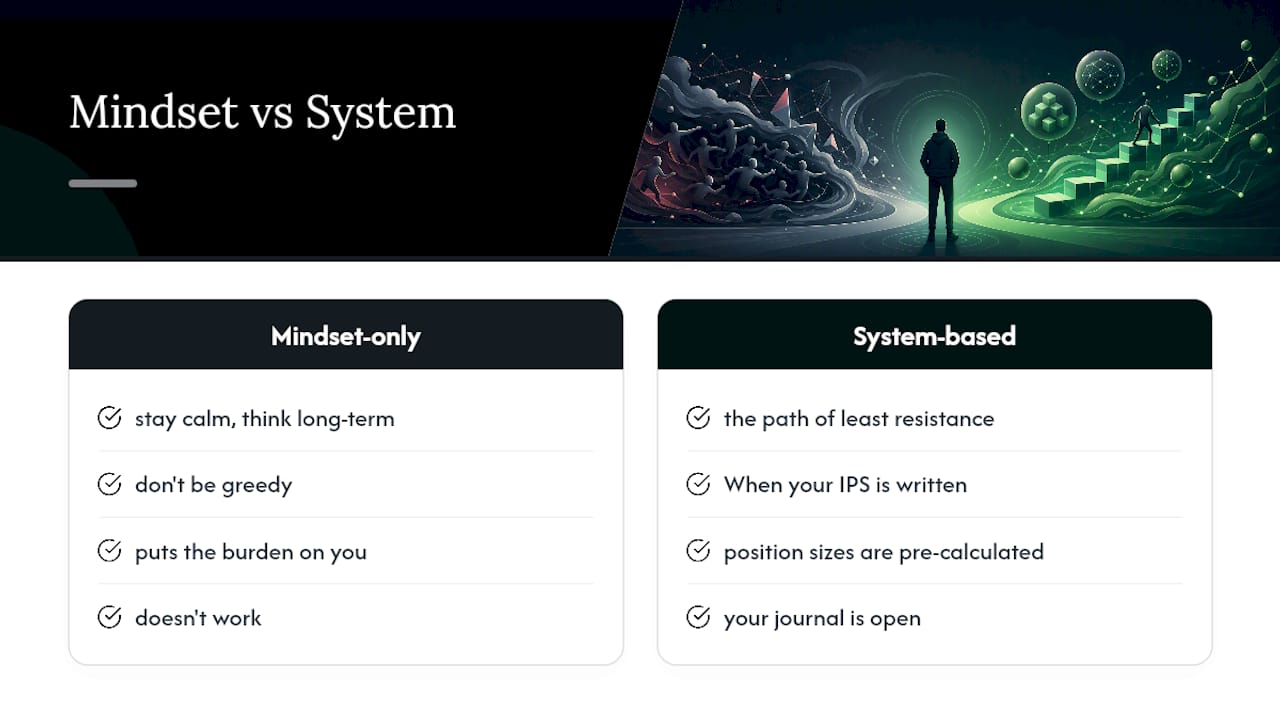
The conventional wisdom around overcoming trading fear focuses almost entirely on mindset: stay calm, think long-term, don’t be greedy. That framing puts the burden on you to out-feel the market every single session. It doesn’t work, because the market is specifically designed to produce urgency.
What actually works is making the disciplined choice the path of least resistance. When your IPS is written, your position sizes are pre-calculated, and your journal is open, the FOMO trade requires more effort than the planned trade. This friction helps prevent impulsive trades. Behavioral research consistently shows that FOMO often reflects unmet psychological needs, specifically autonomy, competence, and connection, and that building a process-based identity as a trader addresses those needs more durably than any single mindset shift. A missed trade you skipped because it wasn’t in your plan is not a failure. It is evidence that your system is working.
Profitomics makes the templates-first approach practical
Most beginner investors know they need a plan. The gap is having the actual documents: a pre-built IPS template, a trade journal with the right fields, a position-sizing spreadsheet that does the math for you.
Profitomics fills that gap with practical, instantly downloadable eBooks built specifically for beginners. The Stock Market Mastery guide includes entry and exit checklists, position-sizing frameworks, and swing-trading rules designed to replace impulsive decisions with a repeatable process. For readers dealing with FOMO in cryptocurrency specifically, the Crypto Profit System delivers a risk-first framework with allocation rules and cooling-off protocols tailored to crypto’s volatility. Both come with companion templates you can apply the same day. Browse the full library at Profitomics and download the bundle that fits where you are right now.
Sources
- Investor
- FOMO in Trading: How Fear of Missing Out Destroys Accounts | DayTradingToolkit
- FOMO in Trading: Why You Chase and How to Stop - Tradicted
This article is general information, not a substitute for advice from a qualified financial advisor. Consult a qualified financial professional about your own circumstances before acting on anything here.
Recommended
- Stock Market Mastery — Swing trading and long-term compounding strategies | Profitomics
- Make Money Online — Ebooks on Passive Income, Stocks & Crypto | Profitomics
- Crypto Profit System — A risk-first framework for building consistent crypto returns | Profitomics
- Side Hustle to Six Figures — Turn any skill or idea into a $100K+ income stream | Profitomics