Skill Monetization Plan: A 5-Step Path From Skill to First Sale

A skill monetization plan is a short written decision: which skill you will sell, to whom, in what format, at what price, and how you will know it works. Build it in five steps: find a problem people already pay to solve, test demand before you build, pick one model, price a small first offer, then adjust it from real buyer behavior. Skip the long business plan. A one-page plan you act on this week beats a polished one you never test.
This guide is for beginners and side hustlers: investors who want to turn market knowledge into income, car enthusiasts who know what a good flip looks like, and online entrepreneurs building a first digital product. It does not assume you have an audience, a website or any sales experience.
TL;DR
- Sell a result, not a skill. “I know cars” is a hobby; “I help first-time buyers avoid overpaying for a used car” is an offer.
- Test demand with real people and a small paid action before you spend weeks building anything.
- Services pay fastest. Templates, checklists and ebooks scale later, using what the first customers taught you.
- Price a first offer low enough to sell and high enough to be taken seriously, then change one variable at a time.
- Keep records from the first dollar: in the US, net self-employment earnings of $400 or more mean you file a return.
Table of Contents
- Step 1: Find the problem your skill solves
- Step 2: Test demand before you build anything
- Step 3: Choose one monetization model
- Step 4: Build and price a small first offer
- Step 5: Learn from results and make the plan repeatable
- A one-page skill monetization plan you can copy
- Perspective
- Put a proven structure to work
- FAQ
- Sources
Step 1: Find the problem your skill solves
A skill has no price until it is attached to a problem. The first job of your plan is to translate what you can do into what someone would pay to stop struggling with.
Start with an inventory. List tasks where you produced a measurable outcome: a car you bought, repaired and resold at a margin, a budget you cut, a trading journal that fixed your habit of panic-selling, a spreadsheet that saved a coworker hours. Seed & Society recommends separating vague responsibilities from concrete results, then favoring problems that are urgent, expensive or both. Add one more signal: what do people keep asking you for help with? Repeated requests are free market research.
Then run a quick filter on each candidate:
- Who has this problem? Name a type of person, not “everyone.”
- What do they do about it now? Workarounds, spreadsheets, forum threads and wasted money all show the problem is real.
- What does it cost them to do nothing? Lost money, lost time or repeated mistakes make a problem worth paying to fix.
- Have they ever paid for help? Existing spending is the strongest evidence that a budget exists.
Finish with one sentence: “I help [specific person] get [specific result] without [specific pain].” If you cannot fill in the blanks, you do not have an offer yet, only a skill.
Three examples
- The car enthusiast. “I know cars” becomes “I help beginners source, inspect and resell a used car for profit without buying a lemon.” The buyer, the result and the fear are all named.
- The new investor. “I like the stock market” becomes “I help beginners follow a written trading routine so emotions stop making their decisions.”
- The online side hustler. “I’m good with spreadsheets” becomes “I give freelancers a ready-made income-and-tax tracker so they stop losing receipts.”
Notice that none of these claims a guaranteed dollar outcome. Promise a process and a clear deliverable, not a payout you cannot control.
Step 2: Test demand before you build anything
The most expensive mistake in skill monetization is building a course, ebook or service package for a problem nobody was waiting to solve. Test first.
Harvard Innovation Labs frames customer discovery around three confirmations: the customer recognizes the problem and treats it as a priority, they are actively looking for a solution, and they have the budget to pay for one. Use those as your pass/fail criteria.
Talk to the right people
Pick one segment, such as “first-time used-car flippers” rather than “people who want money.” Typeform’s validation guide suggests recruiting from the places your audience already gathers: communities, associations and professional networks. Ask about their current behavior and past attempts, not whether your idea sounds good. Friends and family will compliment you. Strangers describing what they tried last month will tell you the truth.
Founder Decisions cites research by Abbie Griffin and John Hauser finding that 20 to 30 interviews within one segment surface 90% or more of customer needs. You do not need hundreds of conversations; you need a focused group and patience to notice repeated patterns.
Write your demand bet as a number
The same source recommends stating the bet in measurable form: at least X% of a named group will take a paid action at a stated price by a set date. For a solo beginner, it might read: “Of 30 first-time car buyers I contact, at least 3 will pay $15 for my inspection checklist within two weeks.” That sentence forces you to choose an audience, a price and a deadline, and it can be proven wrong, which is the point.
If you want a ready-made structure for this phase, our 7-day sprint to validate a product idea walks through it day by day. For hobby-sized ideas, validating a side hustle in 14 days shows the same logic on a small scale.

Judge behavior, not praise
A compliment costs nothing. A payment, a deposit, a signup with an email address or a booked call is commitment. Count those and ignore the rest.
Step 3: Choose one monetization model
Most skills can be sold in several formats. The mistake is trying all of them at once. Blastily’s overview lists the main routes: consulting and done-for-you services, coaching, workshops, online courses, templates and digital tools, paid communities, books, speaking, and licensing. It also notes the trade-off that matters most to beginners: services can bring revenue quickly, while digital products scale beyond your personal hours but take longer to build and usually need an audience.
| Model | What you sell | Speed to first income | Scales without your time? | Best when |
|---|---|---|---|---|
| Done-for-you service | Your hours and judgment | Fast | No | You need cash and case studies |
| Coaching or workshop | Guidance and accountability | Fast to medium | Limited | People need a person pushing them |
| Templates and checklists | A tool they use alone | Medium | Yes | Your process repeats the same way each time |
| Ebook or guide | A packaged method | Medium | Yes | You can teach the steps clearly |
| Course or membership | Structured learning or community | Slow | Yes | You already have an audience |
The sequence that works for most beginners
Blastily’s practical order runs from service first, to a productized service, to a group offer, to a digital product, and finally to leverage such as licensing or books. The reasoning is sound: early delivery produces income, testimonials and a clear view of what buyers actually ask. If you are weighing how to order your own offers, this marketing system for music educators shows how one niche stacks early income and course launches in sequence.
Why repeatable knowledge becomes a product
If you notice yourself giving the same answers, running the same checks or sending the same spreadsheet, you already have a product draft. Sense Central’s template method describes how repeated decisions, inputs, actions and outputs can be converted into worksheets, checklists, scorecards and decision trees that a buyer uses without you in the room. A car flipper’s inspection checklist and a trader’s pre-trade routine are exactly this kind of asset.
For ideas on what to package, see 60+ digital product ideas.
Step 4: Build and price a small first offer
Your first offer should be narrow, finishable in a few weeks, and easy to explain in one sentence. Before you recruit anyone, define the scope, the duration, the number of places, the price, how people pay and how you will collect feedback. A beta-testing guide from Content Fudge lists these as the things to settle first.
One offer, one customer
Resist the urge to list every skill you have. A buyer who sees ten services cannot tell what you are for. Choose one result for one type of buyer, for example “a pre-purchase inspection routine for first-time car flippers” instead of “automotive help.”
Pick a price you can defend
Price depends on the format. For service-based beginners, one source suggests a validation range of $300 to $1,500 and recommends offering three beta clients a discounted rate in exchange for feedback. That is one practitioner’s guideline, not a law, so treat it as a starting point and adjust to your market. For digital products, price sits much lower and the sale depends on clarity. Our piece on ebook pricing psychology explains how price shapes perceived value.
A useful reference point: Profitomics publishes its ebooks at $27 (Passive Income Blueprint), $29 (Side Hustle to Six Figures), $37 (Crypto Profit System), $44 (The Car Flipping Playbook) and $47 (Stock Market Mastery). Those are one-time prices for instant PDF downloads, which shows how a focused digital guide can be priced as an impulse-friendly purchase rather than a high-ticket commitment.

Find your first buyers where you already have trust
The early customers rarely come from ads. Content Fudge names personal networks, social posts, niche communities, free educational events and referrals as the usual first channels, with the reminder to follow each community’s rules about promotion. Build a short list of 50 people who might want the result or know someone who does, and note how you will contact each one. Match your ask to the stage: questions at the idea stage, a trial on one real task for a prototype, a paid beta once it works, and a payment link when the product is ready.
Deliver, then ask
When the first buyers receive the offer, ask for feedback while the experience is fresh. Ask what they used, what confused them and what they would have paid more for. Those answers write your next version.
Step 5: Learn from results and make the plan repeatable
A monetization plan is not finished at launch. It improves through small, deliberate tests.
Change one thing at a time
If you change the price, the headline and the audience in the same week, you will not know which one mattered. Pricing-experiment advice from Crofils recommends changing one variable for one client group over a defined period, tracking conversion and total spending, and combining the numbers with client comments. The same source warns that a single result can mislead, so record each test and look for trends before making big changes. Treating price as a continuing experiment is also the approach in this website pricing model guide.
Track a handful of numbers
For a digital product, keep an eye on:
- how many visitors turn into buyers
- how many buyers ask for a refund
- how many support questions each sale generates
- whether buyers finish the material
- whether anyone comes back for a second purchase
These are the signals Sense Central lists for judging whether a digital offer is clear and useful. A high number of support questions per sale usually means the instructions are unclear, not that buyers are careless.
Know when the offer is validated
A practical finish line comes from Thrive Side: the discovery stage is complete when five to ten well-matched buyers have purchased through repeatable channels, the promised outcome has been delivered consistently, and the first success metric has been observed and documented. Until then, you are still testing, and that is fine.
Keep your money records clean
Once money comes in, so does paperwork. The IRS says you must file a tax return if your net self-employment earnings reach $400 from gig work, even a side or temporary job, and that you must report all income even if no Form 1099 arrives. Keep a simple log of sales and expenses from day one. For personal tax questions, a licensed tax professional is the right person to confirm what applies to you.
A one-page skill monetization plan you can copy
Fill in each line in plain words. If a line takes more than two sentences, it is too vague.
- Skill and proof: what I can do and one result I have produced.
- Problem: what my buyer struggles with and what it costs them.
- Buyer: one specific group, and where they gather.
- Offer: one result, delivered in one format.
- Demand bet: at least X of Y named people will pay $Z by a date.
- Price and payment method: the amount and how I collect it.
- First 50 contacts: the list and the outreach plan.
- Success measures: conversion, refunds, support questions, completion.
- Next test: the one variable I will change next.
- Records: where I log income and expenses.
Perspective
Most people stall on skill monetization because they treat it as a branding exercise. They want a logo and a niche statement before anyone has paid them a dollar. We think the order should be reversed: pick one practical result, give people a clear process to reach it, and let the first sales tell you how to refine it.
That is how we approach every guide we publish. Whether the topic is flipping a car, building a first income stream or following a trading routine, a beginner needs steps, templates and checklists they can use the same day, not pages of theory. A good checklist does something a pep talk cannot: it removes the guesswork at the exact moment you are about to decide.
If you are choosing between building your own product from scratch and learning a working system first, learning the system is the faster way to understand what buyers value. Study how a tested method is structured, then bring your own experience to a narrow offer.
Kai
Put a proven structure to work
If your skill sits in one of the areas below, a ready-made system can shorten the learning curve before you build or sell anything. Side Hustle to Six Figures ($29) is built for people turning a skill into a side business. The Car Flipping Playbook ($44) gives aspiring flippers a source, inspect and resell routine for a first deal. Passive Income Blueprint ($27) is designed to help readers build multiple income streams within 14 days. Each comes as an instant PDF download with bonus materials for practical application.
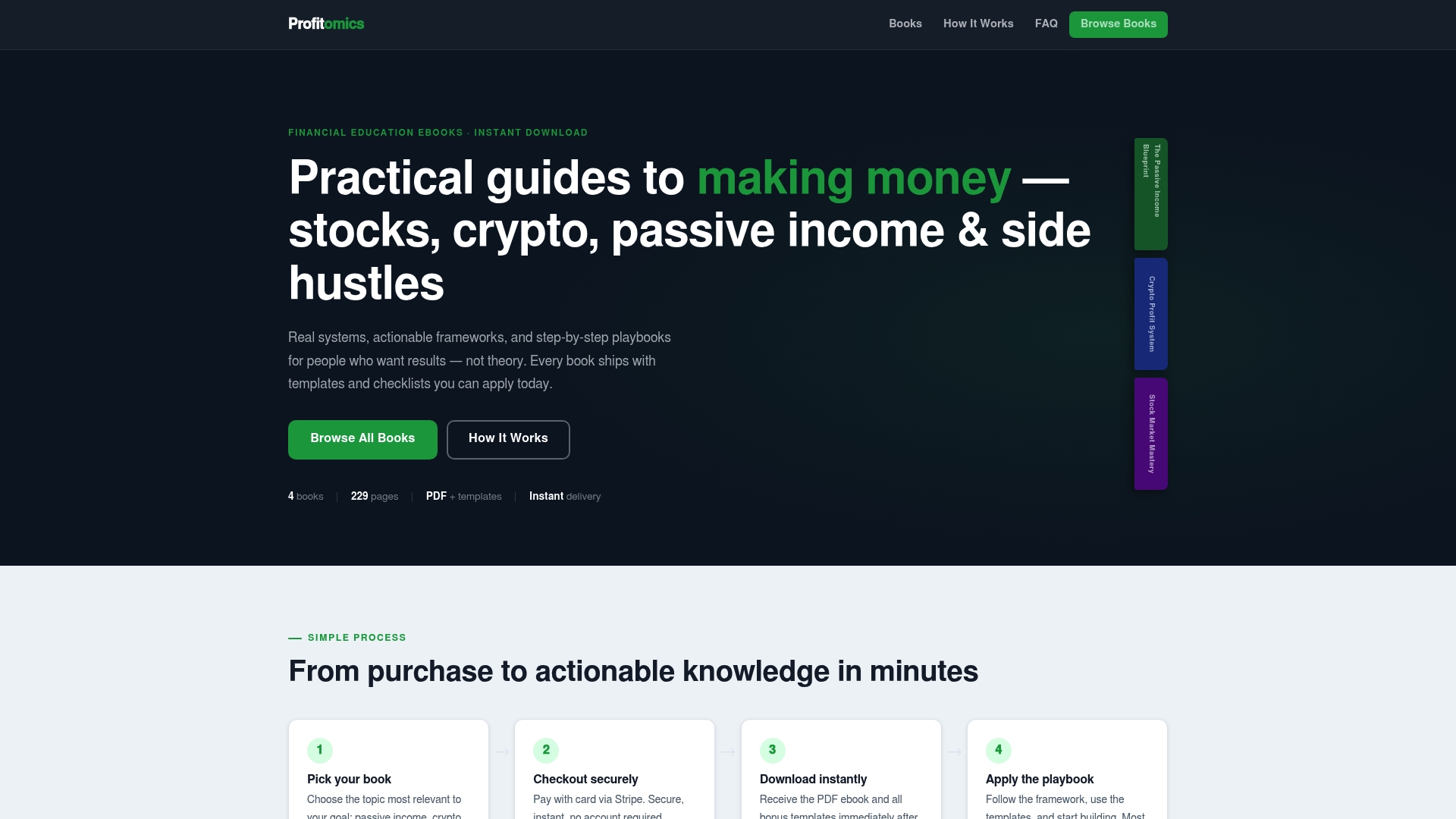
You can browse every title on the Profitomics ebook library, including Stock Market Mastery ($47) and Crypto Profit System ($37).
FAQ
How long does it take to monetize a skill?
It depends on the model. A service sold to people you already know can produce a first payment within weeks, because there is nothing to build. A digital product usually takes longer because you must create it and find buyers. Plan for a first test in weeks, and a repeatable result over months.
Do I need an audience before I start?
No. Start with your personal network, niche communities and a list of about 50 people who might want the result or know someone who does. An audience becomes more important later, when you move to digital products, courses or memberships that rely on steady traffic.
Should I sell a service or a digital product first?
A service usually gets you paid faster and shows you what buyers ask for. If your method already repeats the same way each time, a checklist, template or ebook can be a good first product, because you can sell it at a low price and learn from the first buyers quickly.
What is the best way to know if my idea will sell?
Ask for a small payment from a named group by a set date. Interviews help you shape the offer, but a payment, deposit or signup is the clearest proof. If a few people pay and finish what they bought, you have the start of a repeatable plan.
Do I owe taxes on side income?
In the US, you must report all income from selling your skills, even without a Form 1099. If your net self-employment earnings reach $400, you must file a return. Keep records of sales and expenses, and check with a licensed tax professional about your own situation.
Sources
- Seed & Society: How to Identify What People Would Actually Pay You For
- Harvard Innovation Labs: Validate Customer Demand
- Typeform: Market validation, how to test demand before you build
- Founder Decisions: How to validate demand before you build
- Blastily: How to Monetize Your Expertise
- Sense Central: How to Turn Client FAQs Into Paid Templates
- Content Fudge: The ultimate guide to beta testing your service
- jx-eph.com: From Idea to First Customer in 30 Days
- Crofils: Freelancer pricing experiments
- Thrive Side: The Discovery Stage
- IRS: Manage taxes for your gig work