Validate a Side Hustle in 14 Days With Low Content Books for Beginners

Low content books, in the sense that matters for building income fast, are short, action-first eBooks paired with templates, checklists, and spreadsheets that teach one specific money-making method at a time. Paired with a one-page lean plan and basic bookkeeping, they let a motivated beginner test a small income idea in about two weeks. The templates do the heavy lifting; you just fill them in and act.
TL;DR:
- Most low-content books include a step-by-step launch checklist, a pre-built spreadsheet, and fill-in worksheets to validate a money-making idea in about two weeks.
- These guides are designed for beginners with no finance background, focusing on actionable templates rather than theory or long reading.
- Validating an idea involves setting a simple price, running a low-cost test, and tracking key metrics like revenue, costs, and time spent each week.
- Income from side-hustles over $400 must be reported to the IRS, and keeping organized records in a separate account is essential for tax compliance.
- Verify income system sellers for legitimacy using official resources, avoid claims of guaranteed returns, and ask for real numbers before investing.
Table of Contents
- Who these eBooks are for and what’s inside
- Step-by-step workflow: build, validate, launch, monetize
- Templates and checklist examples you can copy today
- Taxes and recordkeeping every side-hustler must do
- How to vet offers and spot red flags
- Why micro, template-led learning actually works
- What each Profitomics eBook actually delivers
- FAQ
- Sources
Who these eBooks are for and what’s inside
These guides fit a specific reader: someone with little or no finance background who wants a concrete method, not a theory lecture. If you’ve read generic “financial freedom” content and still don’t know what to do Monday morning, this format is built for you. It assumes no prior trading, flipping, or investing experience and skips the padding that usually fills personal finance writing.
Open one of these eBooks and you should find the same basic kit every time:
- A step-by-step launch checklist you can follow in order, not a wall of theory.
- A revenue and expense spreadsheet pre-built with the categories you’ll actually use.
- A short launch script or outreach template for the first customer, buyer, or trade.
- Fill-in worksheets for the specific method, whether that’s a stock screen, a crypto workflow, or a car-flipping offer sheet.
A good one sets a 14-day validation window: enough time to run the checklist once, log real numbers in the spreadsheet, and know whether the method is worth repeating. Validation here means you completed the steps and have actual data, not a guess about whether it might work.
Step-by-step workflow: build, validate, launch, monetize
Treat this as a four-step sprint. Each step fits into a day or two, so you’re never stuck planning for weeks.
- Pick one narrow method and write a one-page plan. Choose a specific income method, such as flipping a single car category or running one options strategy, rather than “investing” broadly. The SBA’s lean business plan format fits this well: it’s designed to be completed in about an hour and forces you to state your customer, cost, and revenue assumptions on one page.
- Build the eBook skeleton and one to three templates. Each template needs a clear input field, a formula or decision rule, and an output you can act on the same day. A pricing template, for example, needs cost inputs, a margin rule, and a final price, nothing decorative.
- Validate with a low-cost test. A simple landing page, a small ad budget, or a pre-sale offer tells you whether real people will pay before you build anything bigger. Pair this with an implementation-intention worksheet: a short “if-then” prompt like “if it’s 9 a.m. Monday, then I post my first listing” that behavioral research links to higher follow-through than open-ended goals.
- Set a simple price, a refund policy, and two or three KPIs to track weekly. Revenue, cost, and time spent are usually enough to tell you if the method is worth scaling.
Pro Tip: Write your if-then prompts before you start, not after you stall.
If you want a structured way to turn a raw idea into a finished outline before you touch a template, our guide to building an eBook outline covers the sequencing in more detail.

Templates and checklist examples you can copy today
You don’t need software to start. A notebook, a spreadsheet, and these three formats will get you moving.
Launch checklist (7 items): define the method in one sentence, list three costs, set a price, write the outreach script, pick a sales channel, set a 14-day deadline, log the first result.
Monthly revenue and expense spreadsheet: use five columns, date, description, income, expense, and running balance. That’s enough to answer “am I making money” without building a full accounting system.
Implementation-intention worksheet: write three if-then statements tied to your checklist, such as “if I finish listing a car by Wednesday, then I send the ad to two marketplaces by Thursday.”
Short, action-first formats tend to build confidence and skill faster than dense, theory-heavy guides, according to research on financial education interventions. That’s the entire case for templates over textbooks: less reading, more doing, faster feedback.
Taxes and recordkeeping every side-hustler must do
Once money starts moving, the IRS doesn’t care how small the side hustle is. Anyone with $400 or more in net self-employment income has to report it, and that threshold catches most people running even a modest test, according to IRS guidance on gig work. All side-hustle income is taxable, whether it comes from flipping, freelancing, or trading.
Keep the bookkeeping boring and consistent:
- Open a separate business checking account so personal and side-hustle money never mix.
- Save every receipt, digital or paper, the day you get it.
- Track income and expenses weekly in a spreadsheet or a low-cost accounting app rather than reconstructing months later.
- Set aside a percentage of income for estimated taxes if you expect to owe more than a small amount.
- Learn where Schedule C and Schedule SE fit, and use free filing help through IRS Free File or a VITA site if your return gets complicated.
A partner resource on bookkeeping that survives tax season walks through setting up these habits before they become a scramble in April.
How to vet offers and spot red flags
Not every “proven system” is honest, and the warning signs repeat across scams. Watch for guaranteed returns, large upfront fees before you see any real material, and earnings claims with no evidence behind them. The FTC’s enforcement action against Click Profit shows exactly this pattern: false earnings claims and lifestyle marketing that cost consumers millions before regulators stepped in.
Before paying for any investing or income program, run through Investor, check whether the seller or program is registered, ask for sample templates before buying, confirm there’s a refund policy, and search for existing enforcement actions against the seller’s name.
Pro Tip: Ask directly, “Can you show me real numbers behind this claim?” A seller with nothing to hide will usually have an answer ready.
Why micro, template-led learning actually works
Templates work because they turn vague intentions into scheduled actions, the same mechanism behind implementation-intention research. Short, specific guides beat dense manuals for the same reason diets beat willpower: structure removes decisions you’d otherwise skip. That’s the thinking behind every Profitomics guide I’ve built.
— Kai
What each Profitomics eBook actually delivers
We built our eBooks around the same principle: skip the theory, hand you the templates, let you start today. Each purchase provides a PDF download with worksheets and spreadsheets included, without separate sign-up or waiting period.
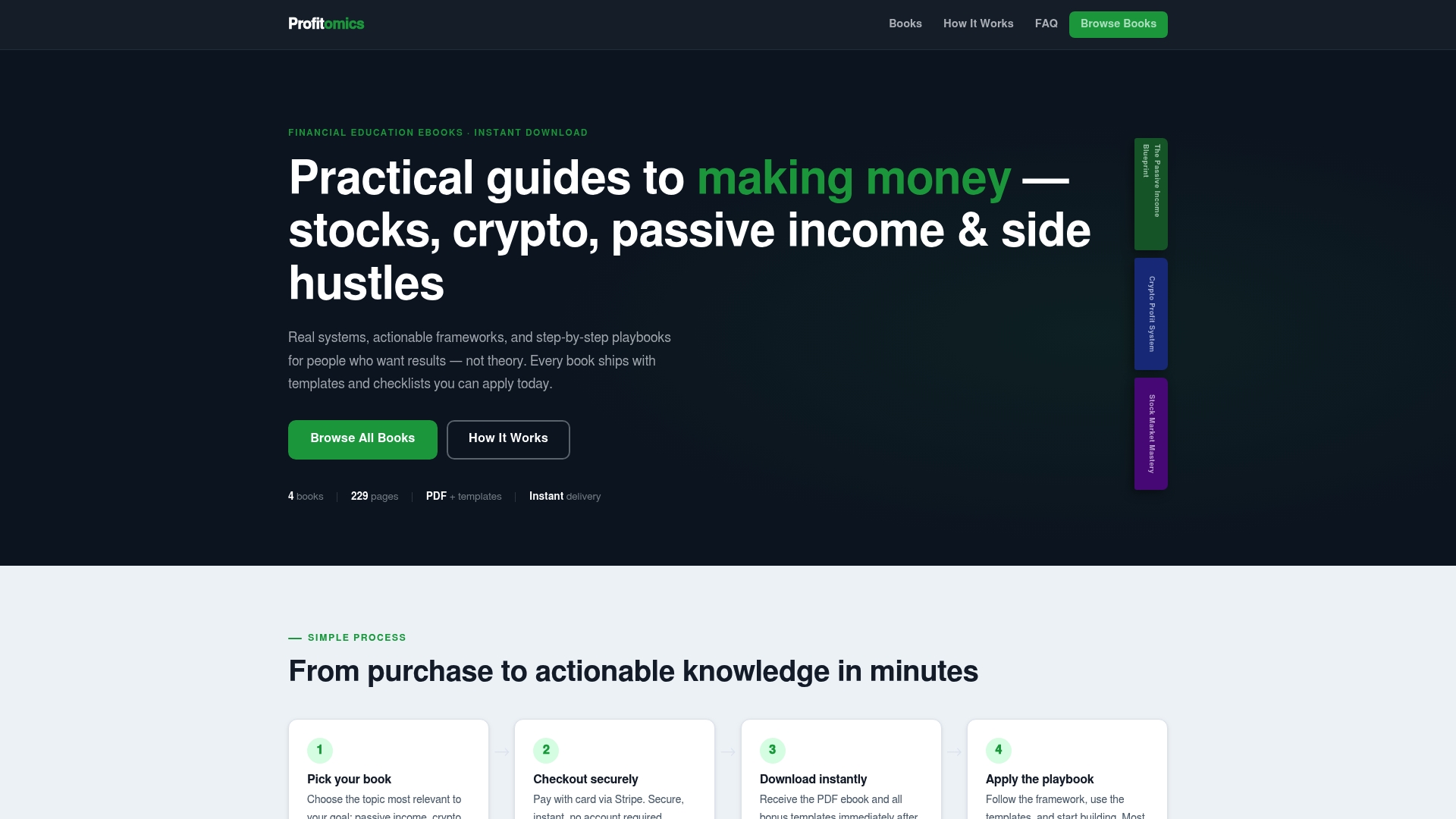
- Passive Income Blueprint ($27) for readers setting up multiple income streams with a step-by-step template set.
- Stock Market Mastery ($47) for investing templates and swing-trading and compounding worksheets.
- Crypto Profit System ($37) for a structured crypto workflow and tracking templates.
Browse the full catalog of guides, including Side Hustle to Six Figures, at Profitomics and pick the method that matches what you want to build first.
This article is general information, not a substitute for advice from a qualified financial advisor. Consult a qualified financial professional about your own circumstances before acting on anything here.

FAQ
What are low content books in the financial education sense?
Here, they’re short, action-first eBooks built around one income method, paired with templates, checklists, and spreadsheets you fill in rather than read. The goal is doing the work, not absorbing theory.
Do I have to report income from a small side hustle?
Yes. Anyone with $400 or more in net self-employment income must report it on a tax return, according to IRS gig work guidance, and that applies even to a small test project.
How do I know if an income-system seller is legitimate?
Check the Investor.gov five questions checklist, ask for sample templates before you pay, and search for the seller’s name alongside enforcement actions. Guaranteed returns and no evidence for earnings claims are the clearest warning signs.
What’s included when I buy a Profitomics eBook?
Each purchase includes the PDF guide plus companion templates, checklists, or spreadsheets specific to that method, delivered instantly after checkout. The Passive Income Blueprint, for example, includes a full set of templates for setting up multiple income streams.
How quickly can I validate a new income idea?
With a one-page lean plan and a focused checklist, many readers can run a first test and see real numbers within about 14 days. The SBA’s lean plan guidance supports building that plan in roughly an hour, which is what makes the fast timeline realistic.
Sources
- Manage taxes for your gig work | Internal Revenue Service
- Investor
- Plan your business | U.S. Small Business Administration
- FTC acts to stop Click Profit; business opportunity has cost consumers millions | FTC