How to Build an Ebook Outline That Actually Gets Written
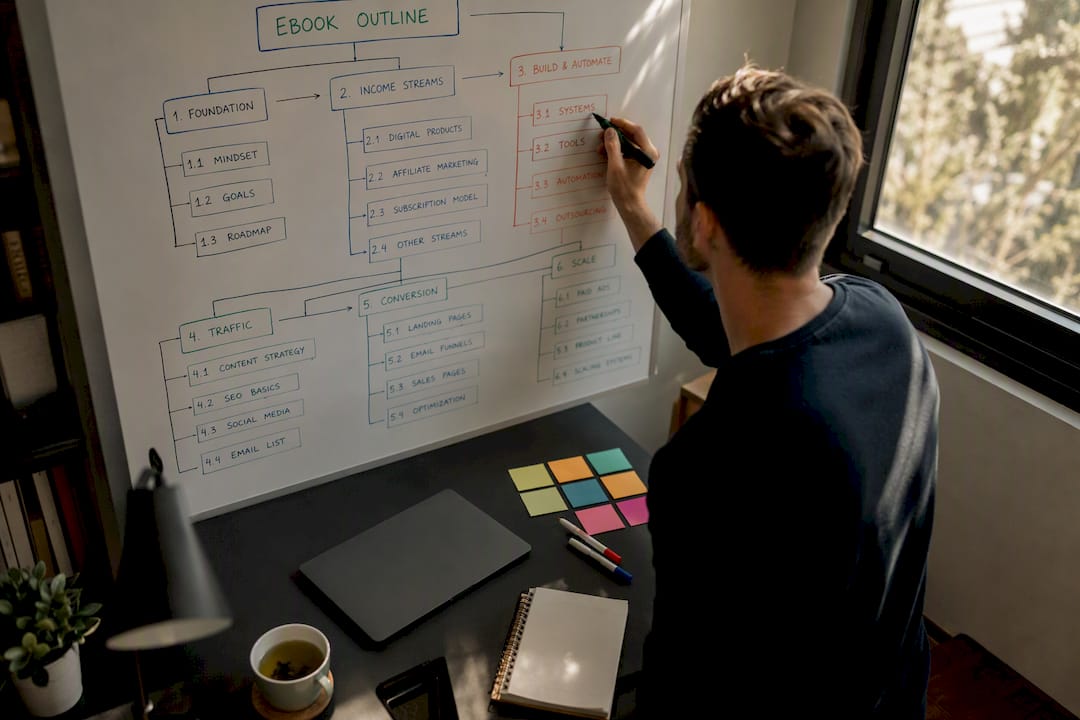
An ebook outline is a chapter map built around one reader promise: it tells you what the book delivers, in what order, and what the reader does with each chapter. The fastest way to get one is a one-page spine, a book promise plus six chapter promises, written in a single sitting.
Try this now:
- Write your book promise in one sentence (“This book helps [reader] achieve [result] by [method]”).
- List six chapter promises that each move the reader one step closer to that result.
- Give each chapter one task or payoff, something the reader does or produces before moving on.
That’s a draftable ebook outline in one session, or one solid AI prompt away.
Key Takeaways
A usable ebook outline is a one-page spine of chapter promises, each tied to a five-part rhythm and a tangible payoff, built and tested before drafting begins.
| Point | Details |
|---|---|
| Start with one promise | Write a single reader-promise sentence before listing any chapters. |
| Use the five-part rhythm | Orient, explain, show, apply, close, keeps every chapter finishable. |
| Attach a payoff to each chapter | A worksheet, checklist, or completed task proves reader progress. |
| Test before drafting | Run the one-sentence summary test and a small reader test to catch gaps. |
| Use templates to move faster | Profitomics ebooks build the spine and worksheets in from the start, so authors and readers skip the blank-page stage. |
Table of Contents
- How to Create an Ebook Outline Step by Step
- What Chapter Rhythm Keeps Readers Turning Pages?
- Copy This Ebook Outline Template
- Can AI Speed Up Your Ebook Outline?
- How Do You Know Your Outline Is Ready to Draft?
- What Are the Most Common Ebook Outline Mistakes?
- Why Application Points Make an Outline Worth Finishing
- Get a Head Start With Ready-Made Outline Templates
- Sources
How to Create an Ebook Outline Step by Step
Before you outline anything, pin down who you’re writing for and what single result they get from finishing the book. Vague promises produce vague chapters. “Helps you invest better” is not a promise. “Helps a first-time investor open a brokerage account and buy their first index fund in a weekend” is.
Once the promise is locked, build the spine:
- List the decisions a reader has to make, in order, to reach that result.
- Turn each decision point into a chapter promise, one sentence describing what that chapter resolves.
- Under each chapter, draft three to five subheadings that walk through the how.
- Attach one payoff to each chapter: a worksheet, a decision, a completed task.
- Set chapter count based on how many real decisions exist, not a target word count. Six chapters that each solve a problem beat twelve that pad the middle.
Pro Tip: Write every chapter promise before you write a single subheading. If you can’t summarize a chapter in one sentence, it’s not ready to outline yet, let alone draft.
What Chapter Rhythm Keeps Readers Turning Pages?
Chapters that meander lose readers by page three. A five-part rhythm, orient, explain, show, apply, close, fixes that because it forces every chapter toward a finish line instead of a slow fade.
- Orient: restate the chapter’s promise so the reader knows exactly what they’re about to get.
- Explain: teach the concept or method in plain terms, no filler.
- Show: give a concrete example, ideally a real number or a real scenario.
- Apply: hand the reader a task, worksheet, or decision to make right now.
- Close: state the payoff and preview what the next chapter unlocks.
Here’s the rhythm applied to a chapter on picking a brokerage: orient (“this chapter gets you a funded account”), explain (fee structures and account types), show (a comparison of two account types side by side), apply (a worksheet ranking three brokers against the reader’s own criteria), close (“you now have an account ready to fund; next, you’ll place your first trade”). This promise-payoff loop is what separates a finished ebook from an abandoned one.
Readers don’t abandon books because the writing is bad. They abandon books because a chapter never tells them what they’re supposed to walk away with.
Copy This Ebook Outline Template
A working table of contents needs a spine, not a random topic list. Here’s a six-to-nine chapter shape that moves a reader from zero to a completed result:
- Orientation: the promise, who this is for, what success looks like
- Foundation: the one concept everything else depends on
- First implementation: the smallest version of the method, done once
- Full implementation: the complete method, step by step
- Verification: how the reader checks their work is correct
- Troubleshooting: what goes wrong and how to fix it
- Scaling or next-level application
- Maintenance or ongoing habits
- Next steps and resources
Under each chapter, write: one chapter promise, three subheadings, and one reader task tied to that chapter’s payoff.
| Chapter promise | Teaching points | Reader action | Payoff |
|---|---|---|---|
| Reader picks the right account type | Fees, account types, tax treatment | Fill out a comparison worksheet | A funded account decision |
| Reader executes their first trade | Order types, timing, position size | Place one small practice trade | Confidence and a completed trade log |
| Reader builds a repeatable check | Red flags, review cadence | Complete a monthly review checklist | A system they’ll actually reuse |
Fill that map before you write a single paragraph of prose.
Can AI Speed Up Your Ebook Outline?
AI is genuinely fast at producing a starting table of contents and chapter summaries, but a raw AI output is a draft skeleton, not a finished spine. Use it to get past blank-page paralysis, then edit hard for your own examples and voice. AI outline generators tend to produce generic chapter promises that need sharpening before they’re usable.
Three prompts worth pasting into any AI writing tool:
- “Generate a nine-chapter table of contents for an ebook that helps [audience] achieve [result]. Give each chapter a one-sentence promise.”
- “Expand chapter [X] into three to five subheadings, plus one concrete example and one reader task.”
- “Write a checklist or worksheet that lets a reader apply the method taught in chapter [X].”
Pro Tip: Run every AI-generated chapter promise through the one-sentence summary test before you accept it. If the summary sounds interchangeable with three other chapters, the AI padded the outline.
How Do You Know Your Outline Is Ready to Draft?
Write a single sentence summarizing every chapter and subsection. If those sentences read as a clear, escalating sequence of decisions, the outline is ready. If two summaries sound interchangeable, merge those chapters.
Beyond that self-test, run these three checks:
- Ask two or three people in your target audience to read just the chapter promises. Do they know what they’d get from each chapter, and does the order make sense to them?
- Check for an early win. The reader should hit a small, real result by the end of chapter one or two, not chapter seven.
- Check pacing: tasks should escalate in difficulty, and every chapter needs a payoff a reader can point to and say “I did that.”
This reader test catches structural gaps a solo read-through almost always misses.
What Are the Most Common Ebook Outline Mistakes?
The most common failure is topic-stacking, grouping chapters by subject instead of by the decisions a reader actually needs to make. A chapter titled “Types of Investment Accounts” teaches nothing about what to do next; a chapter titled “Choose the Account That Fits Your Goal” does.
- Fix topic-stacking by rewriting each chapter title as a decision or outcome, not a category.
- If a section is interesting but not essential to the core promise, move it to an appendix or bonus download instead of bloating the chapter.
- Merge thin chapters that repeat the same teaching point, split overloaded ones that try to teach two skills at once, and convert dense explanation into a template or checklist wherever possible.
Why Application Points Make an Outline Worth Finishing
An outline built only around explanation produces a book people read once and forget. Plan the checklists, spreadsheets, and worksheets during the outline phase, not after the draft is done, so every chapter has something tangible attached to it.
- Chapter promise: “Reader identifies three passive income streams that fit their schedule” → spreadsheet: an income-stream comparison tool → reader task: fill in time and capital columns → payoff: a ranked shortlist.
- Chapter promise: “Reader builds a starter crypto portfolio” → spreadsheet: an allocation and risk tracker → reader task: input target percentages → payoff: a portfolio they can act on.
A chapter that ends in a completed worksheet proves the reader made progress. A chapter that just ends proves nothing.
Bundle these templates as downloadable companion files rather than static tables printed in the book. Readers reuse a spreadsheet; they rarely retype one.
A Quick Lesson From Building Actionable Ebooks
Every Profitomics ebook starts life as a one-page spine, and the ones that launch fastest are the ones where the chapter promises get rewritten two or three times before drafting begins. That habit, revisiting the outline every few chapters instead of only once at the start, has repeatedly cut draft time enough to move from outline to a finished, sellable ebook in about six weeks.
Get a Head Start With Ready-Made Outline Templates
Profitomics builds every ebook around the exact spine and chapter-rhythm method described above, so instead of starting your outline from a blank page, you get a proven structure already filled with worksheets and spreadsheets you can adapt. Each guide ships with the templates baked in, not bolted on afterward, which is the fastest way to see if the promise-payoff approach actually holds up for your own topic.
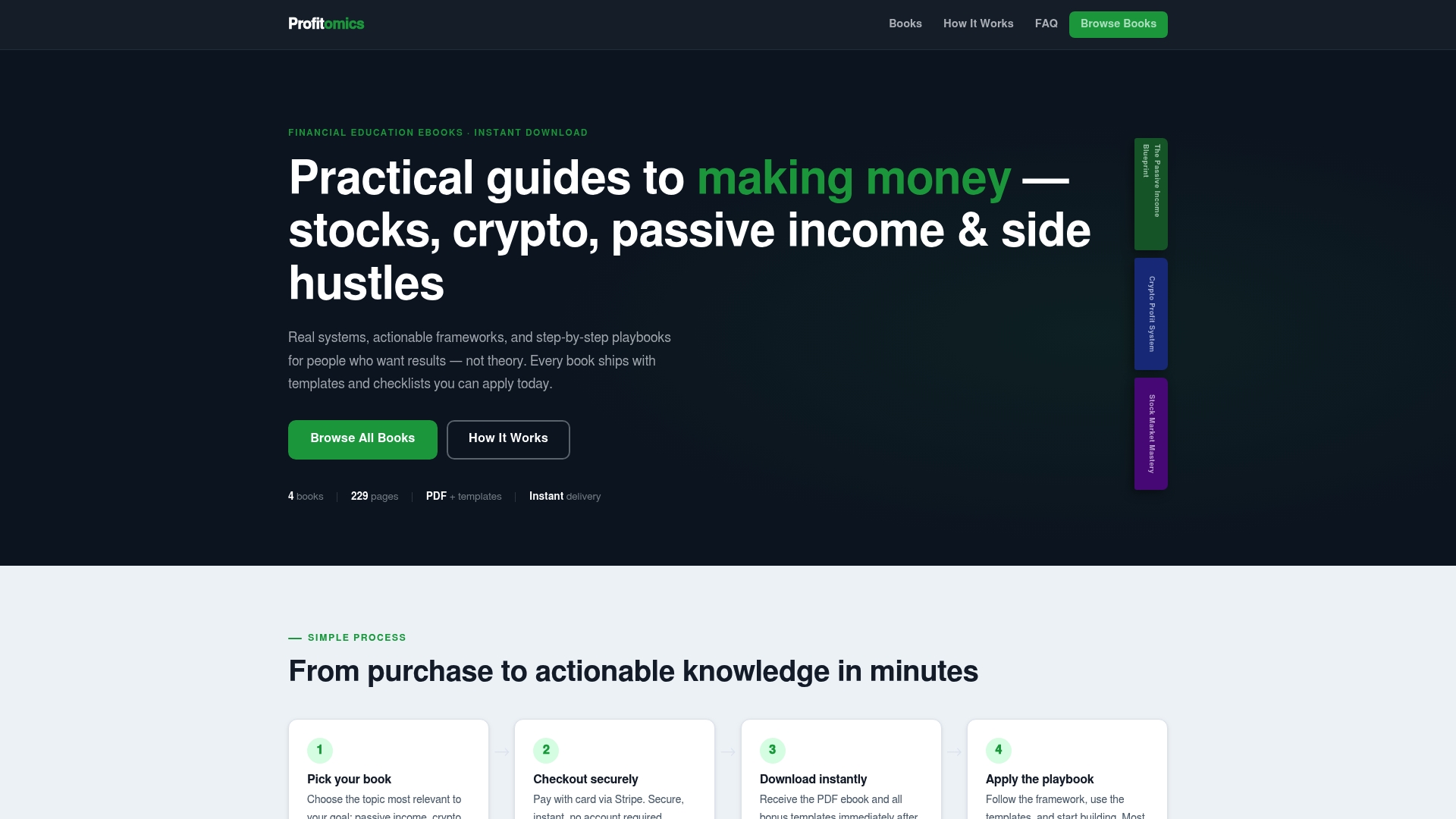
If you’re outlining a personal finance or side-income ebook, The Passive Income Blueprint shows the full chapter rhythm applied to real income streams, and Stock Market Mastery does the same for a more technical, trading-focused structure. Browse the full ebook catalog to see which template-driven structure fits your topic, and download one to study how a finished spine actually reads before you write your own.
Sources
- How To Write an Ebook: Writing and Publishing Tips (2026) - Shopify
- AI eBook Outline Generator - Brainstorm with AI Start for Free
- How to Outline an Ebook Readers Finish | Getly
- Template
FAQ
What Is a Book Outline Example?
A book outline example lists a book’s chapter promises in order, each broken into three to five subheadings and a reader task, such as the nine-chapter spine described above.
What Are the Four Types of Outlines?
Writers commonly use alphanumeric, full-sentence, decimal, and topic outlines; for ebooks, a full-sentence, promise-driven outline tends to translate most directly into finished chapters.
What Is an Outline for a Book Called?
It’s simply called a book outline or chapter outline, though nonfiction authors often refer to it as a content map or table of contents draft.
How Do I Design My Own Ebook?
Start with the outline and chapter rhythm, then apply consistent formatting, subheadings, and visual breaks for worksheets once the content structure is locked; Profitomics’ guides layer that design directly onto the spine so structure and layout get built together.
Should I Use AI to Write My Entire Outline?
Use AI to generate a first-pass table of contents or chapter summary, then rewrite the promises and add your own examples, since AI-generated outlines tend to read as generic until a human sharpens them.
Recommended
- Make Money Online — Ebooks on Passive Income, Stocks & Crypto | Profitomics
- The Passive Income Blueprint — Build income streams that pay you while you sleep | Profitomics
- Side Hustle to Six Figures — Turn any skill or idea into a $100K+ income stream | Profitomics
- Stock Market Mastery — Swing trading and long-term compounding strategies | Profitomics