7 Day Sprint to Validate a Product Idea for Solo Founders
Run a validation sprint lasting 3 to 14 days, aimed at one buyer segment and your single riskiest assumption, and only greenlight the idea if you get a real behavioral commitment: a paid preorder, a deposit, or a booked pilot signed off by an actual decision maker. Compliments don’t count. Before day one, write down your decision rule (what counts as pass, what counts as fail) so you can’t talk yourself into a win after the fact. The next move is simple: name your buyer, name the assumption that could kill the idea, and set the clock.
TL;DR:
- Validate your idea by running a short, targeted test with actual behavioral commitments from a specific buyer; vague interest or compliments do not count.
- Focus your interviews on past behavior and real experiences, aiming for 3 to 5 conversations to identify clear patterns before expanding the sample.
- Use simple landing pages, fake-door tests, or manual concierge experiments to measure real intent and commitment, not just interest or views.
- Set clear, pre-defined thresholds for success or failure based on the signal ladder, such as preorders, deposits, or repeat usage, before starting the sprint.
- Rely on existing competitor gaps and customer complaints to identify validated unmet needs, and avoid building further until a strong, measurable signal confirms demand.
Table of Contents
- How Do You Validate a Product Idea Step by Step?
- What Are the Best Methods to Test a Product Concept?
- Can Keyword Data Tell You if People Want Your Product?
- What Counts as a Pass or Fail Signal?
- Why Most Founders Misread Their Own Validation Results
- A 7-Day Validation Sprint You Can Copy This Week
- Which Tools Actually Speed Up a Validation Sprint?
- Analyzing Competitor Products to Find the Real Gap
- Should You Use Surveys Alongside Customer Interviews?
- How Do You Test Whether People Will Pay Your Price?
- Can Social Media and Online Communities Confirm Demand?
- When Should You Pivot Instead of Pushing Forward?
- What Legal Issues Should You Check Before Launching a Test?
- When Mixed Signals Mean Fix the Message, Not the Product
- Speed Up Your Validation Sprint With Ready-Made Templates
- Sources
- FAQ
How Do You Validate a Product Idea Step by Step?
Validating a product idea means proving, with evidence stronger than opinion, that a specific person will pay for a specific solution to a specific problem. That’s the standard industry definition behind what most guides call product idea validation, and it’s different from market research, which tells you about a category, not about whether your version of the answer gets bought.
Harvard Business School’s validation framework treats this as a five-part process: write your goals and hypotheses, size the market and your realistic share of it, check related search demand, talk to real target customers, and run a live test, whether that’s an alpha, a beta, or a small pilot. Here’s a tighter version built for someone validating solo or with a small team, with no engineering budget to burn.
- Apply the Rule of One. Pick one buyer (not a demographic, a specific role or situation), one painful job they’re trying to get done, and one promised outcome. Trying to validate for “small business owners” fails because the term covers a freelance photographer and a 40-person plumbing company, two people with nothing in common except a tax form.
- Write your hypotheses and list every assumption. You’re making claims about the market (this problem is common and painful), the message (this framing makes people say “yes, that’s exactly it”), the price (they’ll pay this much), and the channel (you can reach them here). Write each one down as a sentence you could be wrong about.
- Pick the cheapest test that actually answers your riskiest assumption. If you don’t know whether the problem is real, interview people. If you know the problem is real but don’t know if they’ll pay, build a landing page with a price on it. Don’t run a $2,000 pilot to answer a question five conversations could settle for free.
- Set a timebox and a pass/fail rule before you start. Decide in advance: “If fewer than 3 out of 15 qualified visitors put down a deposit within 7 days, this fails.” Write it down before you see any results. Nothing wrecks a validation sprint faster than deciding what counts as success after you’ve already seen the numbers.
HBS frames this whole exercise as a process of discovery, not a checkbox you tick once and move past. That framing matters because it gives you permission to revise a hypothesis mid-sprint instead of forcing your data to match your original pitch. If interview five contradicts interviews one through four, that’s information, not noise to be averaged away.
For anyone validating a digital product like an ebook, template pack, or course, the riskiest assumption is rarely “does this problem exist.” It’s usually whether people will actually pay for it, download it, and use it. A landing page with a sample chapter or worksheet, paired with a real checkout, tests that directly instead of guessing at it.
What Are the Best Methods to Test a Product Concept?
Five methods dominate early-stage validation, and each one produces a different quality of evidence. Interviews are cheap and fast but easy to get wrong. Landing pages and fake-door tests measure real intent without you building anything. Concierge service and paid pilots force people to commit money or time, which is where the truth usually lives. Prototypes come last, and only once cheaper tests have narrowed what’s worth building.
Customer interviews: getting past polite answers
Stanford’s early customer research framework recommends structuring interviews around six areas: the segment you’re talking to, their unmet needs, what they currently use to solve the problem, how they’d actually buy something new, who makes that decision, and what would stop them from adopting it. Skip the pitch. Ask about their last actual experience with the problem, not their opinion of your solution.
On volume, the same research is specific: 3 to 5 interviews start revealing patterns, and 15 to 20 approach saturation, the point where new conversations stop surfacing new information. If you’ve run 10 interviews and the answers still don’t converge into a coherent pattern, the fix isn’t more interviews. It’s narrowing the segment, because you’re probably talking to three different buyers wearing one persona’s clothing.
For each conversation, record it in a structured evidence table rather than trusting your memory of “that went well.” Capture:
- Interviewee’s role, company size, or life situation
- Their exact words describing the problem (not your paraphrase)
- When they last dealt with this issue, and how
- What workaround they currently use, and what it costs them in time or money
- Whether they control the budget or need someone else’s sign-off
- What they agreed to do next, if anything
Pro Tip: Ask “when did this last happen to you?” instead of “would you use something like this?” Past behavior is evidence. Hypothetical enthusiasm is a guess dressed up as data.
Landing pages and fake-door tests
A fake-door test puts a real offer in front of real traffic without the product existing yet. Build one page: a clear headline naming the outcome, a short explanation of who it’s for, and a single call to action, either “join the waitlist” or, better, “preorder now.” Send traffic from wherever your buyer actually spends time, whether that’s a subreddit, a LinkedIn post, a small ad budget, or an email list. A minimal funnel built from ready templates can go live in an afternoon, which matters because speed is the whole point of this test.
The signal you want isn’t page views. It’s the conversion from qualified visitor to committed action, ideally a card on file, not just an email address.
Concierge tests and paid pilots
This is where weak signals turn into strong ones. A concierge test means you deliver the outcome manually, by hand, for a handful of customers, before you’ve automated anything. A paid pilot means a real customer pays real money for a limited-scope version of what you’re planning to build. Both force a decision that an interview never can, because interviews and surveys are weak evidence when the respondent has no purchasing authority or nothing at stake. Someone who says “I’d definitely use that” in a Zoom call and someone who wires you $200 are answering two different questions.
Prototypes: scope down, not up
Once you’ve narrowed the assumption worth testing, build the smallest possible version that fulfills the core promise, nothing more. Lightweight concept tests, like five-second first-impression tests, branching-path click tests, or simple opinion-scale surveys, are useful for checking whether people understand your concept and prefer it over alternatives. But comprehension isn’t commitment. Pair any concept test with a behavioral or payment test before you treat the results as validation.
The signal ladder: what each test actually proves
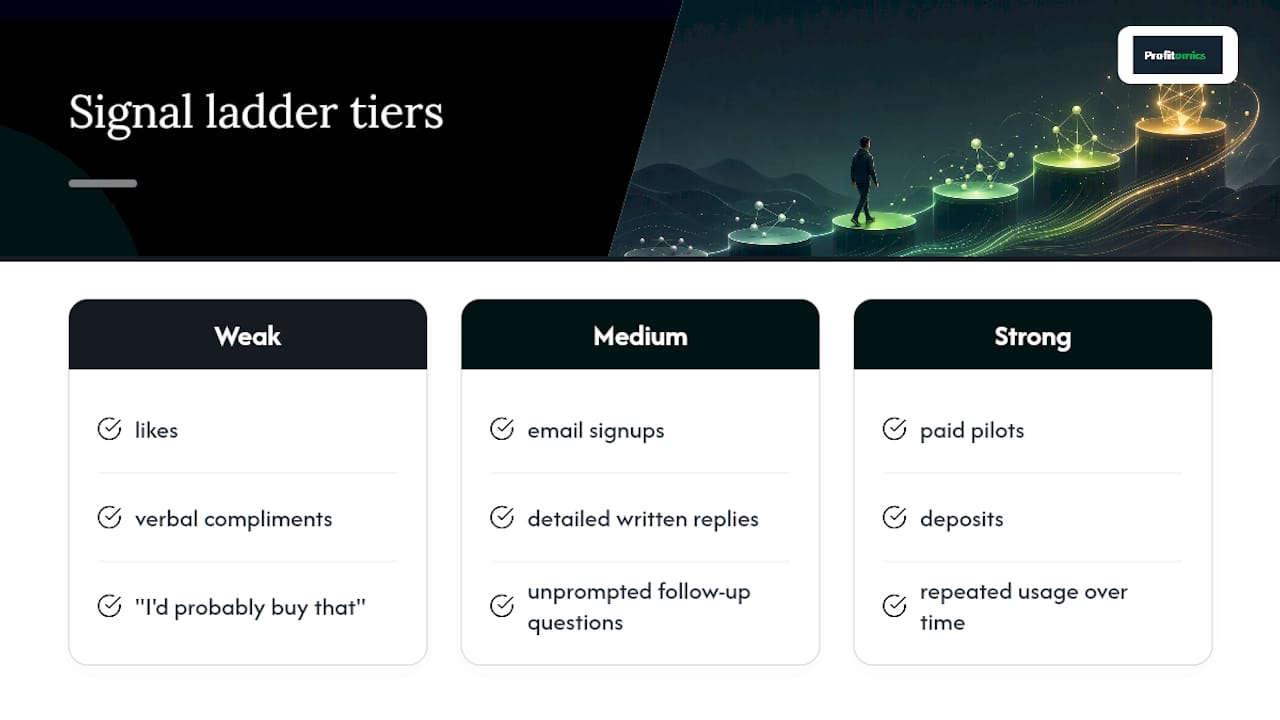
Not all positive feedback carries equal weight. Practitioner frameworks for validation organize evidence into three tiers: weak signals (likes, verbal compliments, “I’d probably buy that”), medium signals (email signups, detailed written replies, people asking follow-up questions unprompted), and strong signals (paid pilots, deposits, and repeated usage over time). Treat anything below “strong” as directional, not decisive.
Can Keyword Data Tell You if People Want Your Product?
Keyword data tells you whether people are searching for a solution to a problem, which is useful directional evidence, not proof anyone will buy what you build. Google’s Keyword Planner generates keyword ideas alongside forecasts for clicks and impressions, but those forecasts are explicitly conditional: they shift based on your bid, budget, ad quality, targeted location, and recent account performance. Google itself is clear that this is not a promise of results, and treating it as proof of demand is a mistake founders make constantly.
Rising search volume for a problem phrase (“how to track freelance invoices manually,” say) tells you people are actively looking for a fix right now, which beats guessing. Low cost-per-click on a commercial-intent term often signals low competition for buyer attention, not necessarily low demand, so don’t read it as a red flag on its own.
What to actually track before and during your sprint:
- Search volume trend for the exact problem phrase your buyer would type, not your product category
- Whether the keywords showing volume are intent-based (“buy,” “template,” “software for”) versus purely informational (“what is”)
- Estimated cost-per-click as a rough proxy for how expensive customer acquisition might get
- Month-over-month movement, since a term climbing steadily beats one that spiked once and flattened
Use keyword data to decide where to point your landing page traffic and which problem phrasing to test in your headline. Never use it as the finish line. It tells you people are searching. It says nothing about whether they’ll pay you.
What Counts as a Pass or Fail Signal?
Vague enthusiasm kills more validation sprints than outright rejection does, because founders don’t know how to grade what they’re seeing. Set your thresholds before you launch, using the signal ladder as your grading scale.
| Test | Weak signal (fail) | Medium signal (proceed carefully) | Strong signal (pass) |
|---|---|---|---|
| Interviews | Compliments, “sounds interesting” | Detailed problem description, unprompted follow-up questions | Interviewee describes an active workaround and asks how to buy |
| Landing page | Page views with no conversions | Email signups above your target rate | Preorders or deposits collected |
| Concierge test | One-time favor for a friend | Repeat request from someone outside your network | Payment plus a second request without prompting |
| Paid pilot | Free trial with no renewal interest | Verbal commitment to renew | Signed renewal or expanded scope |
For a landing page test, a reasonable starting threshold is something like 3 to 5% of qualified visitors converting to a waitlist signup, and a smaller fraction, even 1%, converting to an actual preorder. For a preorder-based test, a common practitioner rule is requiring a minimum number of paid preorders (not just interest) within your timebox, say 10 paid preorders in 14 days, before committing further resources.
Qualify your respondents before counting them. A visitor who bounced in from an unrelated forum post isn’t a data point about your buyer. Someone who lacks the budget or authority to actually purchase doesn’t count as a “no,” either. They were never eligible to say “yes” in the first place, so their response tells you nothing.
Why Most Founders Misread Their Own Validation Results
Confirmation bias is the single biggest threat to a validation sprint, and it’s rarely intentional. Founders ask leading questions, hear a polite “that sounds useful” and log it as validation, then build for months on a foundation of good manners. Stanford’s research is blunt about this: prioritize evidence of recent, actual behavior over hypothetical answers, because people are bad at predicting their own future purchasing decisions and good at being agreeable in a conversation.
The second common failure is sampling the wrong people. Friends, family, and your existing network want you to succeed, which makes them terrible validators. Before you count anyone’s feedback, confirm they actually fit your buyer definition and control their own budget. A founder’s cousin who works in an unrelated field isn’t a data point. Neither is a warm LinkedIn contact who has no purchasing authority at their company.
A structured evidence table fixes both problems by forcing you to record specifics instead of vibes: the interviewee’s exact problem language, when it last occurred, what workaround they use today, what that workaround costs them, whether they control budget, and what they committed to doing next. When you review ten rows of that table side by side, a pattern of polite non-commitment becomes obvious in a way it never is in the moment.
- Never count “I’d probably use that” as evidence; count what they did next
- Exclude anyone who can’t personally authorize a purchase from your sample
- Log the exact words people use for their problem, not your interpretation of it
Pro Tip: If you can’t fill in the “next commitment” column for most of your interviews, you don’t have validation. You have a series of pleasant conversations.
A 7-Day Validation Sprint You Can Copy This Week
This sprint compresses HBS’s five-part validation process and Stanford’s interview guidance into a schedule a solo founder can run without hiring anyone.
- Day 0: Set the frame. Write down your one buyer, their one painful job, your promised outcome, and the single riskiest assumption standing between you and a sale. Write your pass/fail decision rule now, before you talk to anyone.
- Days 1 to 3: Run targeted interviews. Aim for 5 to 10 conversations with people who genuinely fit your buyer profile. Ask about past behavior, not hypotheticals, and log every conversation in your evidence table.
- Days 4 to 6: Run a behavioral test. Depending on what days 1 to 3 revealed, either launch a landing page with a preorder button or run a manual concierge test for two or three willing participants.
- Day 7: Compare results against your pre-set thresholds and decide. Pass, and you scope the smallest real build. Fail, and you revisit the buyer or the message before touching another test.
Each stage has a template that removes the blank-page problem:
- Day 0 to 3: an interview script with the six Stanford-derived question areas already written out, plus an evidence table with columns pre-built
- Day 4 to 6: landing page copy structured for one clear outcome and one call to action, and a preorder flow that captures payment, not just an email
- Day 7: a scorecard mapping your actual results against the signal ladder, so the decision doesn’t come down to how you’re feeling that morning
If your riskiest assumption is really about the delivery format, whether people will complete and actually use a template or worksheet, proven steps for validating and selling templates walk through exactly that kind of preorder-first test.
Which Tools Actually Speed Up a Validation Sprint?
You need five tool categories for a sprint like this, and none of them require a developer. Keyword research tools (Google’s Keyword Planner, or similar free alternatives) tell you what people are searching for right now. Landing page builders let you ship a test page in hours instead of days. Prototype and concept-sharing tools, like Maze, let you run quick comprehension checks before you build anything real. Payment and preorder processors turn “I’m interested” into a transaction you can measure. Scheduling and call-recording tools make interview logistics painless so you actually run the five to ten conversations you planned.
Pick tools based on your riskiest assumption, not on what’s trendy. If you’re testing whether people understand your pitch, a fast, low-fidelity concept test beats a polished prototype. If you’re testing whether they’ll pay, skip the prototype entirely and go straight to a preorder page.
Before day one of any sprint, prepare these three assets:
- An interview script built around past behavior, not hypothetical opinions
- Landing page copy with one headline, one outcome promise, and one call to action
- A preorder or deposit flow that actually processes a payment, not just an email capture
Security-sensitive products carry an extra layer here: if your concept involves handling customer data or payments early, look at how structured security testing processes set measurable pass/fail thresholds, the same discipline that makes a validation sprint trustworthy instead of wishful.
Analyzing Competitor Products to Find the Real Gap
Every competitor already running in your space is a free validation signal, if you read them correctly. Their existence proves the market has enough demand to support at least one business. What matters is finding the gap they’re leaving open: a customer segment they ignore, a price point nobody’s hit, or a job-to-be-done their marketing doesn’t mention but their one-star reviews complain about constantly.
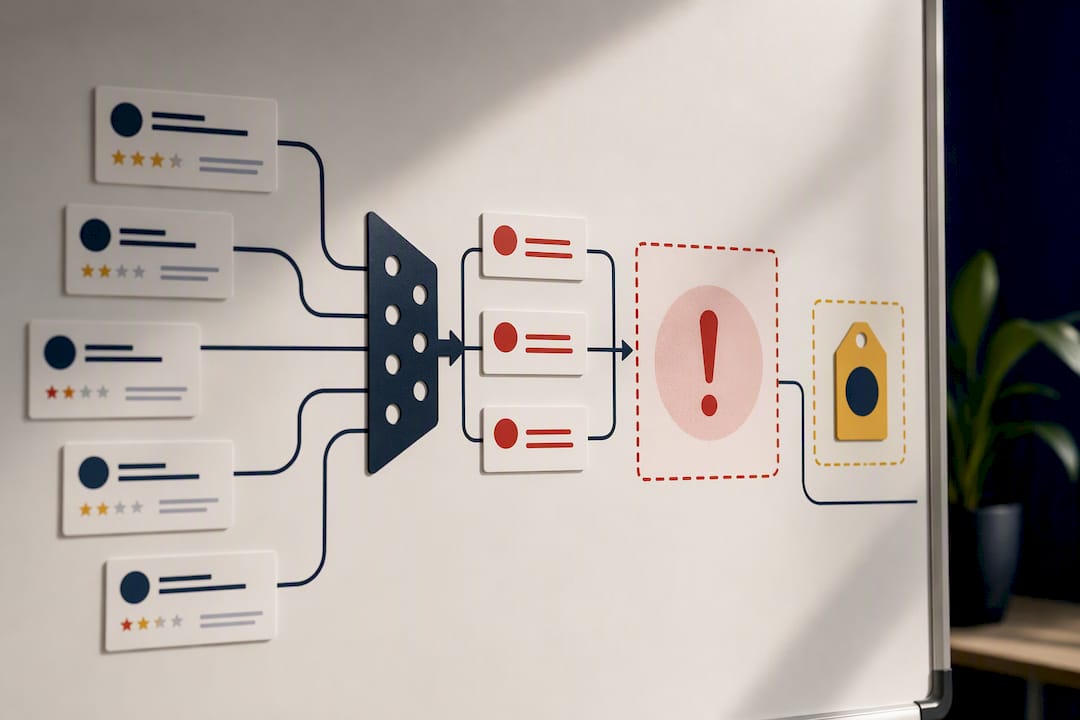
Read competitor reviews specifically for complaints, not compliments. A pattern of “support never responds” or “I wanted X but it only does Y” is a validated unmet need someone is already paying to tolerate. That’s stronger evidence than a cold interview, because these are real paying customers describing a real gap in a real product.
Check their pricing pages, not just their homepages. A competitor charging significantly more than what your interviews suggest people expect to pay tells you either the market tolerates higher prices than you assumed, or they’re serving a different, higher-budget segment entirely. Both are useful.
Don’t mistake “a competitor exists” for “the market is validated for exactly what I’m building.” The gap is the opportunity, not the category. If three competitors already serve your exact buyer with your exact promise, your riskiest assumption shifts from “does anyone want this” to “why would they switch to me,” and your validation sprint needs to test that instead.
Should You Use Surveys Alongside Customer Interviews?
Surveys scale where interviews can’t, letting you check whether a pattern from five interviews holds across 200 respondents. Use them second, never first. A survey built before you’ve done any interviews tends to ask the wrong questions, because you don’t yet know which questions actually matter to your buyer.
Once you’ve run your initial interviews and spotted a pattern, a short quantitative survey can test how widely that pattern holds. Keep it to five or six questions maximum, and lean on multiple choice and rating scales over open text, since open text data is hard to analyze at scale and tempts you into cherry-picking the answers that flatter your idea.
Ask about frequency and recency of the problem, not hypothetical interest in your solution. “How many times in the last month did you deal with X?” produces usable data. “Would you be interested in a tool that solves X?” produces the same polite false positives that plague interviews, just with a bigger sample size attached.
Survey respondents face the same qualification problem interview subjects do. A hundred responses from people outside your buyer definition is a hundred data points about nothing. Screen respondents with one or two qualifying questions at the start, and discard anyone who doesn’t pass before you look at the rest of their answers.
Surveys are a confirmation tool for patterns you’ve already spotted, not a discovery tool for finding them. Treat medium-strength survey data (a strong stated preference across a big sample) as one more rung between weak interview compliments and a strong behavioral commitment like a preorder.
How Do You Test Whether People Will Pay Your Price?
The only reliable way to test a price is to put an actual number in front of a real potential buyer and see what they do, not what they say about it in the abstract. Asking “would you pay $50 for this?” in an interview produces almost pure noise, since people routinely overstate their willingness to pay when there’s no money actually leaving their account.
Run pricing as a live experiment instead. Put a specific price on your landing page or preorder flow and measure conversion at that price. If you have the traffic for it, test two prices on two versions of the same page and compare conversion rates directly, rather than asking people to guess their own reaction to a hypothetical number.
Pay attention to where people drop off in the checkout flow, not just whether they complete it. Someone who clicks “buy” and abandons at the payment screen is telling you something different from someone who never clicks “buy” at all. The first suggests price sensitivity or checkout friction. The second suggests the offer itself didn’t land.
Anchor your price test against what competitors already charge, if any exist, rather than pricing in a vacuum. A price far below the market can actually depress conversion, since buyers sometimes read “too cheap” as “not serious,” particularly for anything positioned as a professional tool or an income-generating resource.
Treat a completed purchase at your test price as a strong signal on the ladder. Treat “I’d pay for that” in a conversation as barely a signal at all, the same weight you’d give a compliment.
Can Social Media and Online Communities Confirm Demand?
Online communities, subreddits, niche Facebook groups, Discord servers, and industry forums surface demand signals faster and cheaper than almost any formal test, because people in these spaces are already discussing their problems in their own words, unprompted by your questions.
Search for your problem phrase inside relevant communities before you post anything. A recurring complaint thread, one that gets revived every few months by different people, is a strong indicator the problem is persistent rather than a one-off frustration. Note the exact language people use; it’s often better headline copy than anything you’d write yourself.
Posting your own concept for feedback works, but treat the response the same way you’d treat an interview: upvotes and comments saying “I need this” are weak signals. A comment asking “when can I buy this” or “here’s my email, tell me when it launches” is medium to strong, depending on whether they follow through when you actually reach out.
Community feedback carries a real bias risk, since the loudest voices in any forum tend to be power users or edge cases, not your average buyer. A niche subreddit obsessed with a topic isn’t representative of how a mainstream buyer thinks about the same problem, so weight enthusiastic community response accordingly, especially if your actual buyer doesn’t spend much time in forums at all.
Use these spaces for two things: finding the exact words your buyer uses to describe their pain, and recruiting interview subjects who fit your profile. Don’t use raw engagement numbers as your primary validation metric.
When Should You Pivot Instead of Pushing Forward?
Mixed signals are the hardest results to act on, harder than a clean pass or a clean fail, because they tempt you to keep testing indefinitely instead of deciding. Set a rule in advance: if you’ve run two full cycles of your sprint and still can’t get a clean signal, the problem usually isn’t your product. It’s your buyer definition or your message.
A pivot in this context rarely means abandoning the idea entirely. More often it means narrowing the buyer (from “freelancers” to “freelance graphic designers billing hourly”), reframing the promised outcome (from “save time” to “get paid two weeks faster”), or testing a different price point before you touch the actual offer. Each of those is a cheap, fast test compared to rebuilding the product.
Persevere when you’re seeing consistent medium-to-strong signals from a narrow, well-defined segment, even if the total addressable market feels small. A validated niche beats an unvalidated mass market every time, because you can expand a working formula, but you can’t fix a formula that never worked in the first place.
Kill the idea, at least in its current form, when repeated cycles across different messages and different buyer definitions all land on weak signals. That’s a different outcome from “I haven’t found the right angle yet,” and the evidence table you’ve been keeping is what tells you which situation you’re actually in. Don’t let sunk time in the sprint itself become a reason to keep testing past the point your own decision rules told you to stop.
What Legal Issues Should You Check Before Launching a Test?
Even a lightweight validation test can create real legal exposure, so a few checks belong on your day-0 list alongside your hypotheses. If your product idea overlaps with an existing patent, trademark, or copyrighted material, a landing page or preorder test that uses a competitor’s branding, imagery, or proprietary process language can create liability before you’ve made a single sale.
Search the U.S. Patent and Trademark Office database for your product name and category before you commit to branding for a landing page test. A name collision discovered after you’ve built an audience around it is expensive to fix. This costs nothing and takes twenty minutes.
If your validation test involves collecting customer data, emails, payment details, or survey responses, you’re subject to data handling expectations even at the test stage. A simple, honest privacy notice on any page collecting personal information protects both you and your test subjects, and most landing page and payment tools include this by default.
Be careful with claims in your test copy, particularly for anything touching health, finance, or income. A landing page promising specific financial results without a factual basis isn’t just an ethics problem, it can trigger regulatory scrutiny from bodies like the FTC. Keep test copy honest about what the product does rather than what you hope it will eventually do.
If your concierge test or paid pilot involves a written agreement, even an informal one, put the basic terms in writing: what’s delivered, by when, and for how much. It protects you and it signals seriousness to the buyer, which tends to improve the quality of the commitment you’re measuring.
When Mixed Signals Mean Fix the Message, Not the Product
The instinct after a messy validation sprint is to start building, on the theory that a real product will finally convince skeptics. That instinct is usually wrong. When your signals are mixed, weak interview enthusiasm paired with a flat landing page conversion, the fix is almost never more features. It’s a narrower buyer or a sharper promise.
Prioritize in this order: buyer, message, price, channel, delivery. Most founders default to fixing delivery first, meaning they build more, faster, hoping volume of effort substitutes for clarity of aim. That’s backward. A confused buyer definition poisons every test that follows it, because you can’t tell if a weak signal means “wrong product” or “wrong person asking.”
If your interviews produced inconsistent patterns past ten conversations, that’s not a sign you need more data. It’s a sign your segment is too broad, and narrowing it is a faster fix than running interview number fifteen. The same logic applies to a landing page that gets traffic but no conversions: check whether the headline promise matches what your interviews actually revealed as painful, before you assume the whole concept is dead.
Templates earn their keep here because they remove the friction that makes founders skip iteration. Rewriting a landing page from scratch feels like a day’s work; adjusting a headline on a page you already built from a template is twenty minutes. That speed difference is what actually determines whether someone runs two validation cycles or gives up after one.
— Kai
Speed Up Your Validation Sprint With Ready-Made Templates
Some digital financial education providers build ebooks to address the blank page bottleneck that kills most validation sprints: offering worksheets structured around the questions that matter to save preparation time.
The Side Hustle to Six Figures ebook, priced at $29 as a one-time purchase, includes step-by-step checklists built for exactly this kind of test: launching a digital offer, validating it with real buyers, and moving from idea to a working preorder flow without hiring anyone. If your riskiest assumption centers on income potential from stocks or crypto rather than a digital product, the Passive Income Blueprint at $27 offers the same template-first approach, with checklists built for launching and testing a passive income stream fast rather than studying it indefinitely.
Every template maps to a day in your sprint: a pre-built worksheet for day 0, a checklist for structuring your days 1 to 3 interviews, and a ready preorder framework for testing your days 4 to 6 landing page. Grab the guide that matches your riskiest assumption and start day 0 today.
Sources
For readers who want the primary research behind this guide, Harvard Business School’s market validation framework lays out the five-step process referenced throughout. Stanford’s early customer research guide covers interview structure and saturation in more depth than any single section here can. For keyword forecasting mechanics, Google Ads’ Keyword Planner documentation explains exactly what those forecasts are conditional on. Maze’s concept testing guide is worth a look for anyone running prototype or comprehension tests. And for a practitioner’s take on the signal ladder itself, see this guide to validating a product idea.
- 5 Steps to Validate Your Business Idea | HBS Online
- Early Customer Research
- About Keyword Planner forecasts - Google Ads Help
- Maze concept testing guide
- How to validate a product idea (practitioner guide)
FAQ
How Can I Validate My Idea Without Building It First?
Run a landing page or fake-door test with a real call to action, ideally a preorder button, and send qualified traffic to it before writing a line of product code. If people commit money or a deposit, you’ve validated demand without building anything beyond a single page.
What Are the Five Steps to Validate a Business Idea?
HBS’s five-step framework covers writing your goals and hypotheses, assessing market size and your realistic share, researching related search demand, interviewing target customers, and running a live test like a pilot or beta. Each step feeds the next, and skipping the hypothesis step is the most common shortcut that backfires.
What Questions Should I Ask to Validate a Business Idea?
Ask about the person’s most recent experience with the problem, what workaround they currently use, what that workaround costs them, and who controls the budget for a solution. Stanford’s research recommends past-behavior questions over hypothetical ones, since people are far more accurate describing what they’ve already done than predicting what they’d do.
What Does It Mean to Validate a Product?
Validating a product means confirming, with behavioral evidence rather than opinion, that a specific buyer will take a real action, paying, committing a deposit, or repeatedly using it, in response to your specific offer. A “yes” in conversation doesn’t count; a completed purchase or signed pilot does.
How Long Should a Validation Sprint Take?
Most early-stage validation sprints run 3 to 14 days, long enough to run 5 to 10 interviews and one behavioral test, short enough to force a decision instead of endless research. If a single cycle doesn’t produce a clear signal, run a second cycle with a narrower buyer rather than extending the same test indefinitely.