Ebook Pricing Psychology: How Price Shapes Perceived Value

A buyer sees your ebook’s price before they read a single page, and they use it to guess what is inside. A very low price can read as thin. A confident price can read as serious. The best way to price an ebook is to set it by the value the reader gets, check it against the books they will compare it with, and then test it with real sales data.
This guide covers how readers read prices, which tactics work and where they stop working, what ranges look like in the US, when free makes sense, and how to run a price test.
TL;DR
- Readers treat price as a quality signal. Fileflare’s pricing guide describes a $9 ebook as reading “probably thin” and a $49 one as reading “the author took this seriously.”
- Charm endings (.99) and round prices send different messages. Use .99 where buyers compare prices side by side, and round numbers where you want to signal premium.
- Anchor to the books your reader will compare you with. Your price feels fair or expensive relative to that set, not in isolation.
- Platform royalty bands shape your price. On Amazon KDP, the 70% option now covers $2.99 to $12.99.
- Change one thing at a time, give each price enough visitors, and judge it by revenue per visitor and refunds, not by unit sales alone.
Table of Contents
- Why price works as a signal before the reader opens the book
- Charm pricing versus round numbers
- Anchoring: your price is judged against a set
- What US price ranges look like
- Match the price to the job the ebook does
- Know your platform’s royalty bands
- When free is the right price
- Choose a price in five steps
- How to test and adjust your price
- Our perspective
- See how we price our own ebooks
- FAQ
- Sources
Why price works as a signal before the reader opens the book
An ebook has no weight, no cover stock and no shelf presence. The only physical cue a buyer gets is the number. That is why pricing digital products is, in the words of Fileflare’s Beka Rice, a psychology problem dressed up as a math problem. A download has no inventory, no cost of goods and no shipping, so cost does not set your price. What the buyer believes the product is worth does.
Two effects follow from that.
Price reads as quality. Barnes & Noble Press notes that readers often associate higher prices with higher quality. A reader choosing between two similar guides, with nothing else to go on, often assumes the cheaper one has less in it.
Price filters your audience. Fileflare also points out that higher prices tend to attract more committed, lower-maintenance buyers, while lower prices bring more buyers but a higher share of refund requests and one-star reviews. A price is not only a number on a checkout page. It decides who shows up.
There is a counterweight. Digital goods carry a built-in expectation of being cheap. A TeleRead report from 2011 quotes an analyst saying customers see everything digital as cheaper than the physical version, and that a huge spread between low and high ebook prices weakens pricing power. The takeaway is not to price low. It is to give the buyer a reason your price makes sense: a clear promise, a visible table of contents, and materials they can use.

Charm pricing versus round numbers
The two classic tactics send opposite messages.
| Tactic | Example | What it signals | Where it fits |
|---|---|---|---|
| Charm ending | $26.99 | Approachable, a good deal | Comparison screens, promotions, bundles |
| Round number | $27 | Confident, premium, simple | Single product pages, expert guides |
| Low-ending signal | $0.99 | Impulse buy or sale | Short pieces, launches |
Barnes & Noble Press says prices ending in .99 feel more approachable, while round numbers like $5 or $10 signal premium content. BookSpace reports studies showing 8 to 25% higher conversion with .99 endings on books, and also warns that a $0.99 price can signal low value at its regular price.
The often-cited academic result is a catalog experiment by Anderson and Simester in 2003, in which a $39 item outsold the same item at $34. An analysis of charm pricing for direct-to-consumer brands puts the average lift at roughly 24%, and also notes that the effect nearly vanishes on an isolated product page where the buyer already knows the price. Charm endings work best where numbers sit next to each other: collection pages, sale tags and tier tables.
So the practical rule is simple. If your ebook sits alone on its own sales page and you want to look like an expert resource, a round price is a sound choice. If it sits in a lineup or a bundle table, a charm ending has more room to do its job.
Anchoring: your price is judged against a set
Nobody decides whether a price is fair in a vacuum. They compare. BookSpace gives the example of thriller ebooks that usually sell for $4.99: pricing yours at $3.99 feels like a deal, while $7.99 feels expensive regardless of quality.
That gives you three ways to use anchors.
- Anchor to the category. Know what your reader compares you with. Kindlepreneur warns that you cannot price an ebook at $15.99 and expect perceived value to do the rest when other books in the genre sit near $5.99. The cover, the length and the page presentation have to support the price you ask.
- Anchor with tiers. The same DTC analysis says a good, better, best layout with a decoy tier can shift the mix toward your target option by roughly 10 to 30 percentage points. A single guide, a guide plus templates, and a full bundle give the reader a frame.
- Anchor with the outcome. A reader weighing $27 against a car flip, a side income or a dollar-cost-averaging plan is comparing the price to what the book helps them do, not to other PDFs.
What US price ranges look like
Ranges depend heavily on the kind of book. Barnes & Noble Press lists these common indie points: free for series openers, $0.99 for short pieces or promotions, $2.99 for new indie authors, $4.99 for full-length novels, $5 to $9.99 for premium content or specialized nonfiction, and $10 or more for niche audiences, box sets or bundles.
For business and professional titles, the numbers run higher. Inkfluence AI pulled the top 100 paid ebooks on Apple Books US and found median prices of $11.99 for Business & Finance and $12.99 for Professional & Technical, against $7.99 for romance and $3.99 for cookbooks.
The lesson: a how-to guide that comes with working files is not competing with a $2.99 novel. If your ebook includes spreadsheets, checklists and templates, it belongs in a different band, and your price should reflect that.
Older data points the same direction on volume. A 2013 Smashwords survey found that a $0.99 book sold about 3.9 times as many units as a book over $10, and $2.99 was the most popular paid price. That was a fiction-heavy retail marketplace, and it measured units, not revenue. A guide sold directly from your own site plays by different rules, because you also control the page, the promise and the audience.

Match the price to the job the ebook does
A useful way to price is to sort your ebook by the outcome it delivers:
- Reference or short primer. A narrow answer to a narrow question. Lower prices fit, and charm endings are fine.
- Skill-based guide with tools. Step-by-step instructions plus templates. Mid-range prices fit, because the reader can apply it the same day.
- System or playbook. A complete process for a result such as a first deal, a first investment plan or a first online income stream. Higher prices fit, as long as the page makes the outcome concrete.
Write down the value in the reader’s terms first. If a checklist keeps a beginner from one costly mistake, the question is no longer whether the PDF is worth $5. It is whether the outcome is worth the price. Price from that question and then make sure the page proves it.
Know your platform’s royalty bands
If you sell through a retailer, the price you pick also decides your cut. This is a place where psychology and math collide.
On Amazon KDP, you choose between a 35% and a 70% royalty, and list price requirements depend on the marketplace and royalty option. Until this year the 70% band ended at $9.99. According to Built&Written, Amazon raised that ceiling to $12.99 on July 7, 2026, its first increase since 2007. The change is opt-in, so an ebook priced between $10 and $12.99 stays at 35% until you switch the option in your Rights & Pricing settings.
A worked example from BestWriting’s royalty guide: for a 1 MB text ebook at $9.99, the 70% option pays $6.89 against $3.50 at 35%. At $12.99, it pays $8.99 against $4.55.
Other stores differ. Kindlepreneur’s comparison of platform royalties lists Barnes & Noble at 65% for $2.99 to $9.99, and Apple Books and Google Play at 70% across the board. Check each platform’s current terms before you lock in a price.
Selling direct avoids these bands, but you still pay payment processing and any platform fees. If you sell through a storefront or a webinar and course platform, work out your price after fees so the number you see is the number you keep.
When free is the right price
Free is a tactic, not a verdict on your book. Barnes & Noble Press describes three uses: a series starter, a promotion to build visibility and reviews, or a lead magnet that grows a mailing list.
It works when something is waiting on the other side. A free first book has a second one to sell, and a free guide has a paid product behind it. As one author-marketing piece puts it, being free is not enough on its own; you need undeniable proof the book is worth more than $0. Derek Haines makes a similar point: with a single title and nothing else to promote, a free offer has little direct financial benefit.
A simple test: if you cannot name the paid product a free reader would buy next, keep the price above zero.
Choose a price in five steps
- Define the buyer’s outcome. One sentence: what can they do after reading that they could not do before?
- Collect the comparison set. List five to ten products your buyer would consider, including courses and templates, not just ebooks.
- Pick a band. Place your ebook relative to that set. Premium positioning needs a page that earns it.
- Choose the ending. Round for a confident standalone page, .99 where prices sit side by side.
- Add a frame. A bundle or a second tier gives the reader something to measure against.
How to test and adjust your price
Barnes & Noble Press recommends that you test prices and track which points convert best. Here is a practical way to do it.
Track four numbers per price.
- Visitors to the sales page
- Conversion rate (orders divided by visitors)
- Revenue per visitor (conversion rate times price)
- Refund rate and the tone of reviews or support emails
Revenue per visitor is the number that decides. A price that converts at 4% at $19 earns $0.76 per visitor. A price that converts at 2.5% at $37 earns $0.925. Fewer buyers, more money, and often better-fit customers.
Change one variable at a time. If you alter the price, the headline and the cover together, you will not know which one moved the result.
Run each price long enough. A handful of orders is noise. Keep each price live across a full week or more of similar traffic, and avoid comparing a holiday weekend with a quiet Tuesday.
Run the price against the same traffic source. Email subscribers and cold social visitors behave differently, so mixing them clouds the comparison.
Read the refund signal. Fileflare’s observation that low prices bring more refunds and harsher reviews is a reason to watch refunds as closely as sales. If a price cut raises orders but also raises refunds, the cut may not have helped.
Move in clear steps. Try a visible jump, such as $27 to $37, rather than a one-dollar nudge that buyers will not notice.
Our perspective
We build our ebooks for people who want to act, not just read: beginners who want a first investment plan, a first side hustle or a first car deal. That shapes how we think about price.
A guide that comes with templates, checklists and spreadsheets is a toolkit, and we price it like one. Our current range runs from $27 for the Passive Income Blueprint to $47 for Stock Market Mastery, with each title priced to the job it helps the reader do. We want the number to say what the book is: a practical system, not a throwaway PDF.
Our advice to other creators is to stop asking what the cheapest believable price is. Ask what the reader’s result is worth, and make your page prove it with a clear promise, a visible structure and tools the buyer can use that day.
Kai
See how we price our own ebooks
If you want a working example of value-based pricing for action-oriented guides, look at our range. The Passive Income Blueprint is $27 one-off, Side Hustle to Six Figures is $29, Crypto Profit System is $37, The Car Flipping Playbook is $44, and Stock Market Mastery is $47. Each one is delivered instantly as a PDF with companion materials.
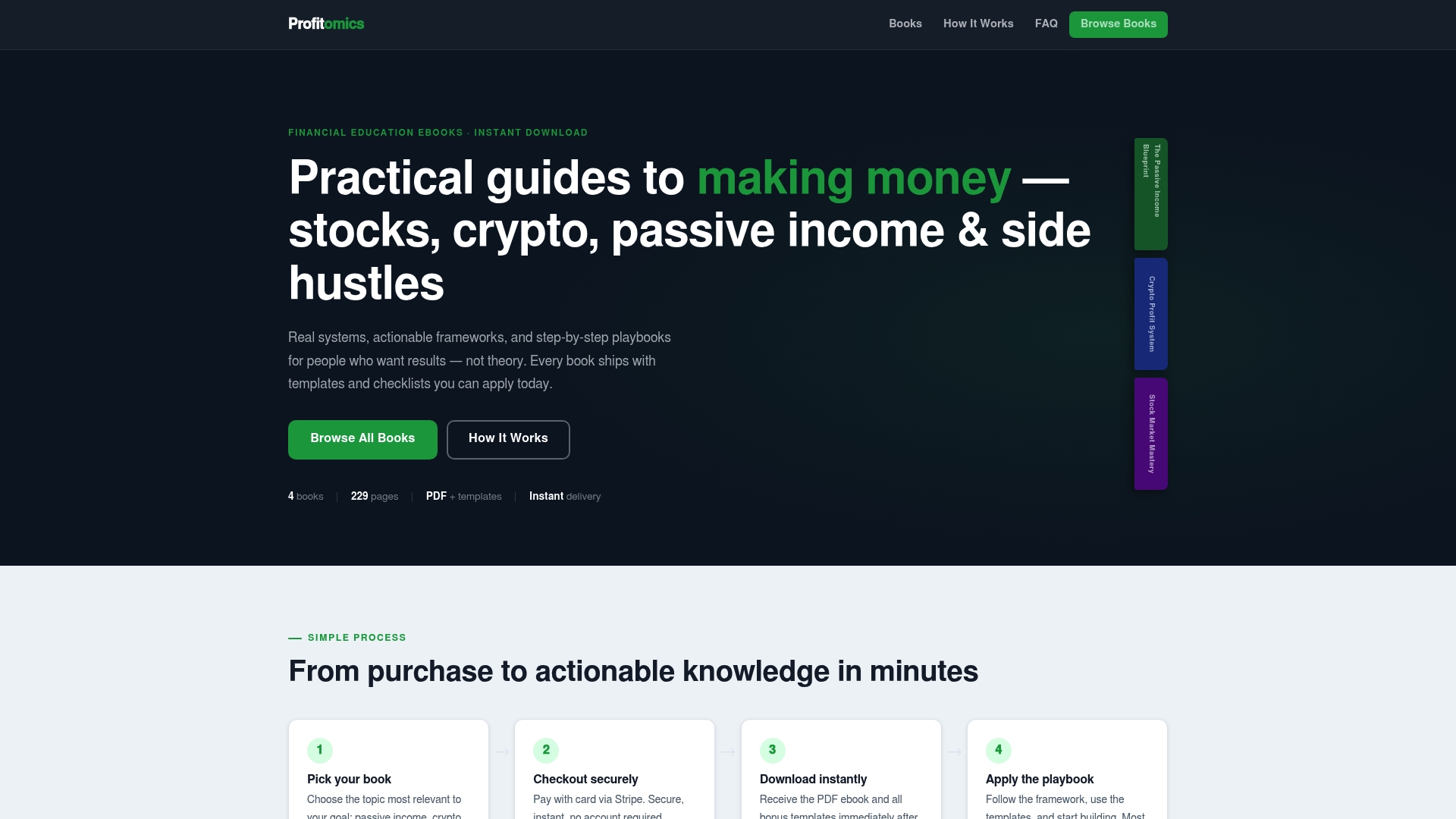
If you are building your own digital product, our guide to digital product ideas to sell is a good next step. If you plan to sell templates, see how to sell Notion templates in the US. You can also browse the full range on the Profitomics home page.
FAQ
How much should I charge for an ebook?
Start from the buyer’s outcome and the products they will compare you with. For specialized nonfiction, common US price points start around $5 to $9.99 and go higher for niche audiences and bundles, according to Barnes & Noble Press. A guide with templates and tools can reasonably sit above that band if the page shows what the buyer gets.
Does ending a price in .99 really increase sales?
It often helps, mainly where buyers compare prices on one screen. One DTC analysis reports an average lift near 24%, and notes the effect fades on a standalone product page. Test it on your own page rather than assuming it.
Is a cheaper ebook always easier to sell?
No. Lower prices bring more buyers, but Fileflare notes they also bring a higher share of refund requests and one-star reviews. A price that signals care can attract more committed readers. Judge a price by revenue per visitor and refunds, not by orders alone.
Should my first ebook be free?
Only if a paid product follows. Free helps a series starter or a lead magnet, but with one title and nothing to sell next, it brings little direct income, as Just Publishing Advice explains.
Sources
- How to Price Your eBooks for Maximum Sales, Barnes & Noble Press
- Price digital products without leaving money on the table, Fileflare
- E-book pricing hinges on customer perception of value, TeleRead
- How to Price Your Self-Published Book, BookSpace
- Psychological Pricing for DTC: Charm Pricing, Anchoring
- Pricing Ebooks: How to Choose Your Price, Kindlepreneur
- How to Price an Ebook (2026), Inkfluence AI
- New Smashwords Survey Helps Authors Sell More, Smashwords
- Price Your Book, Amazon KDP
- Amazon KDP Royalty Changes 2026, Built&Written
- KDP Royalties Guide (2026), BestWriting
- Webinar Pricing for Creators: 5 Steps to Price After Fees
- How to Boost Sales With Permafree Books, Author Media
- Should You Offer Your First Ebook For Free?, Just Publishing Advice