Sales Funnel for Ebooks: Build One Step by Step

An ebook sales funnel is the path a stranger walks from first hearing about your book to paying for it, and then to a second purchase. The simplest working version has five parts: a free lead magnet, a landing page, a short email sequence, a checkout with one add-on, and a delivery page that points to what comes next. You can build all five with a handful of tools and one afternoon of planning per stage.
This guide walks through each stage in order, with real examples, the numbers worth tracking, and the U.S. rules that apply if your ebook is about investing or making money.
TL;DR
- A funnel narrows many interested people into a few buyers: attention, a free offer, an email sequence, a sale, then an upsell or next product.
- Start with a free chapter or a closely related free guide as the lead magnet, then send the buyer to one focused sales page.
- Keep checkout simple: one price, one clear promise, an optional order bump, and instant delivery with a start-here message.
- Track traffic to page, page to email, email to sale and cart completion, and change one thing at a time.
- If your ebook is about money or investing, every earnings claim needs evidence. Avoid guarantees and cherry-picked results.
Table of Contents
- What an ebook sales funnel actually is
- Step 1: Pick one reader and one promise
- Step 2: Build a lead magnet that previews the book
- Step 3: Write a landing page that sells one thing
- Step 4: Turn subscribers into buyers with email
- Step 5: Set up checkout and delivery
- Step 6: Measure each handoff and test one change at a time
- Money and investing ebooks: the rules that apply
- Perspective
- A funnel you can copy, built around a $27 ebook
- Where our ebooks fit
- FAQ
- Sources
What an ebook sales funnel actually is
A sales funnel is the journey from a prospective buyer’s awareness of an ebook to purchase, narrowing from many potential customers to paying ones. The shape matters because each stage loses people. Ten thousand visitors might become 500 email subscribers, and 500 subscribers might become 25 buyers. You improve revenue by widening the top, tightening each handoff, or raising what each buyer is worth.
For a single ebook, you do not need a complex map. Think of four jobs:
- Get attention from the right reader.
- Capture an email address in exchange for something useful.
- Make the offer on a page and in a few emails.
- Deliver and extend: give instant access, then suggest the next step.
Software vendors have settled on a similar pattern for book offers. ClickFunnels’ own documentation describes a book funnel as a two-step order page, an optional order bump, a one-time upsell and a confirmation page. You can copy that skeleton in any tool, or without a funnel builder at all.
If you want a ready-made starting point, our guide on launching a working sales funnel in one week covers the template approach in more detail.
Step 1: Pick one reader and one promise
Before any page or email, write one sentence: “This ebook helps [specific person] do [specific thing] without [specific obstacle].” Funnels fail most often because the promise is fuzzy and the traffic is wrong, not because the buttons are the wrong color.
A few examples of tight promises:
- A checklist-driven guide for someone buying and reselling a first used car.
- A starter framework for a new investor who panics when the market drops.
- A set of templates for a person turning a skill into a side business.
Each one names a reader and a result that the book can reasonably support. That sentence then drives your lead magnet, your headline, your ad copy and your email subject lines. If a piece of the funnel does not serve it, cut it.
Price belongs in this step too, because it shapes everything downstream. Low-priced ebooks need volume and a smooth checkout. Higher-priced ones need more proof and more nurturing. Our piece on ebook pricing psychology explains how price shapes perceived value.
Step 2: Build a lead magnet that previews the book
A lead magnet is a free downloadable document exchanged for an email address. Kit’s guide recommends making it closely related and specific to the paid ebook, and suggests a free chapter or a related free ebook as the format.
The key word is related. A generic “10 tips” PDF attracts people who like free things. A lead magnet that solves the first small problem of your book attracts people who will want the rest of the solution.
Good matches between magnet and paid ebook:
| Paid ebook topic | Lead magnet that fits |
|---|---|
| Car flipping | One-page inspection checklist for a first used-car purchase |
| Stock investing | A worksheet for writing down your rules before you buy |
| Side business | A skills-to-offer worksheet |
| Passive income | A one-page comparison grid for income ideas |
We go deeper on formats in our post on lead magnet ideas that build a list of buyers.
Where people enter the funnel
You do not need one channel. Kit’s case study of a recipe publisher selling ebooks describes website pop-ups, Instagram with Manychat automation, blog posts and direct landing-page traffic as entry points. The lesson is that every entry point leads to the same offer and the same email sequence. Pick one or two channels, send them all to the same place, and measure them separately.
Paid ads are another entry. A Publishers Weekly case study from 2023 describes Facebook ads sending readers to a landing page that used social proof, reasons the book suits the reader, and bonuses. The same piece shows an ebook used as the first step into a higher-priced program.
Step 3: Write a landing page that sells one thing
The landing page has one job and one call to action. Kit’s guidance says a sales page needs an attention-grabbing headline, relevant visuals, clear forms and calls to action, and benefit-focused paragraphs or bullets.
A structure that works for most ebooks:
- Headline that states the reader and the result.
- Short subhead with what is inside and how fast they can use it.
- Benefit bullets, each tied to a problem the reader recognizes.
- What you get: the PDF, spreadsheets, templates, checklists.
- Proof: genuine reviews, sample pages, or a preview chapter.
- Price and one button.
- Access terms: instant download, what format, how to get help.
Small wording changes can matter. In a 2013 Unbounce case study, changing one bullet to address a time barrier was reported to lift free-ebook downloads by 18.59%. That is a single, older result from one page, so use it as a prompt to test your own bullets, not as a promise.
Order matters as well. A MarketingExperiments test on an ebook retailer found that moving the product description higher on the page produced a 78% relative increase in conversion. Put the explanation of what the book does where visitors see it first.
We break the page down element by element in what to include on an ebook sales page.
Step 4: Turn subscribers into buyers with email
Most subscribers will not buy on day one. A short sequence gives them time to trust you.
The recipe publisher in Kit’s case study placed new subscribers in a three- to five-email sequence with topic-specific content, and a thank-you-page prompt invited them to browse the ebooks. Kit’s guide also says automation can be triggered by downloading a lead magnet or showing interest through an announcement page.
A simple five-email sequence for an ebook:
| Timing | Purpose | |
|---|---|---|
| 1 | Immediately | Deliver the lead magnet and say what to do with it first |
| 2 | Day 2 | Ask how the free chapter went and link to the full ebook with a short benefit summary |
| 3 | Day 4 | Teach one useful idea from the book, with a worked example |
| 4 | Day 6 | Answer the top objection (time, experience, “will this fit me?”) |
| 5 | Day 8 | Restate the offer and give a clear next step |
The Day 2 follow-up follows Kit’s suggestion to send a note a couple of days after a free-chapter download, asking for feedback and linking to the full ebook.
Write each email to do one job and end with one link. Our post with paste-ready welcome email examples shows 3 to 5 email layouts you can adapt.
When your pages get traffic but few sign-ups, the problem is often the page, not the email. Practical advice on converting website visitors to leads applies to ebook landing pages as much as to any other site.
Step 5: Set up checkout and delivery
A reader who clicks “buy” has decided. Your job is to not lose them.
Kartra’s digital-products guide says checkout should show the product name, price, payment terms, contents, billing type, refund or access terms, confirmation and next step. For a one-time ebook, that means one clear price, one clear list of what is in the download, and no surprises.

Order bump and upsell
Two add-ons are standard in book funnels:
- Order bump: a small checkbox offer on the checkout page, such as a spreadsheet pack or a checklist bundle.
- One-time upsell: a single offer shown right after purchase, such as a related ebook or a higher-value program.
The Publishers Weekly case study describes a $9.99 offer with PDF and ePub files, an audiobook and bonus content, followed by a 60%-off upsell against a $497 normal price. That was a coaching-style business with a high-ticket product behind the book. If you sell only ebooks, the natural upsell is the next ebook in the same topic. If you do run coaching or courses, connecting an ebook purchase to coaching software for higher-value offers is one way to organize the follow-on service.
Delivery that works the first time
Delivery is part of the funnel, because the first minutes after payment set up refunds, reviews and repeat sales. Kartra recommends a workflow with a thank-you page, confirmation email, access instructions, a download or login link, start-here guidance, a support contact and access terms.
The Publishers Weekly case study went further, using a thank-you-page video explaining access, a bonus-call offer and testimonials. A short “start here” note in the confirmation email is the cheapest version of this and works for any size of store.
If you run a WordPress site, ScribeCount’s guide notes that WooCommerce supports native downloadable products, ePub and PDF uploads, download limits and expiry, and automatic emailed download links. That is enough for a simple ebook store without a dedicated funnel tool.
Choosing tools
Stripe’s ecommerce guide recommends checking payment-method coverage, checkout customization, accelerated checkout, payment-failure recovery, mobile behavior, documentation, integrations and test orders before you pick a platform. The practical version: place a test order on your phone, with a card that gets declined, before you spend a dollar on traffic.
Step 6: Measure each handoff and test one change at a time
A funnel is only as good as its weakest step, and you can only find that step by measuring each one. Track these four ratios:
| Stage | What to measure | What a low number suggests |
|---|---|---|
| Traffic to landing page | Click-through rate on ads, posts or pop-ups | Wrong audience or weak promise |
| Landing page to email | Sign-up rate | Lead magnet or headline mismatch |
| Email to sales page | Click rate on offer emails | Subject lines or offer timing |
| Sales page to paid order | Checkout completion | Price, trust or checkout friction |
Change one element at a time, so you know what caused any difference. Checkout is a good place to test. In a case study from 2Checkout, Epubor reported a 19.62% improvement in cart conversion after testing an inline cart against a hosted checkout and changing the preselected payment method. Again, that is one company’s result, so treat it as a test idea.
On the ad side, be careful with headline return figures. The Publishers Weekly seller reported a 2,400% return on ad spend on a first test, driven by a higher-priced program behind the book, while the ads were still being refined toward break-even acquisition. The lesson is to measure the whole path, including what buyers do after the ebook.
Money and investing ebooks: the rules that apply
If your ebook is about investing, trading or income, your funnel copy is advertising, and U.S. rules apply to it. The key points from a January 2026 compliance presentation for financial publishers: advertising must be truthful, non-deceptive and substantiated, and earnings claims need evidence and context.
What that means in practice:
- Do not guarantee results. Selective wins and promised outcomes are the classic problem.
- Do not imply every reader will do as well as your best example. An FTC stock-trading settlement reported by the National Law Review required operators to support earnings claims with written evidence that results were typical and to avoid claims that ignored experience, capital or time.
- Be honest about what comes after the book. A Ninth Circuit opinion held that misleading statements about earning potential and coaching availability in a book-led upsell program could violate the FTC Act and the Telemarketing Sales Rule.
- Make recurring charges easy to cancel if any part of the funnel leads to a subscription.
A safe habit: describe what the reader will do with the book (the steps, templates and checklists) rather than what they will earn. If you quote a result, say who achieved it, over what period and with what starting point. For specific legal questions about your own offers, talk to an attorney who handles advertising law.
Perspective
We build our ebooks around one idea: a reader should be able to do something useful the same day they download. That is also how we think about funnels. The funnel is not a trick to move people along. It is a series of small, honest steps that each give the reader something they can use.
In our experience, the strongest funnels for ebooks are short. One free resource that previews the method, one clear page, a few emails that teach, and a checkout that delivers instantly. Our guides come with templates, checklists and worksheets for exactly this reason: when the buyer gets a working tool, not just theory, they trust the next thing you suggest.
For money topics, we think the discipline is also the advantage. Describe the process, show the steps, and let the reader judge the fit. That approach is easier to defend, easier to repeat and kinder to beginners who are still learning what is realistic.
Kai
A funnel you can copy, built around a $27 ebook
Here is the whole path, so you can see the pieces working together. We use a passive-income starter guide as the example product.
- Lead magnet: a one-page worksheet comparing income ideas by time, startup cost and skill needed.
- Landing page: headline names the reader (a beginner with no audience yet) and the outcome (a clear first step), with the worksheet as the free offer.
- Emails 1 to 5: deliver the worksheet, follow up on how it went, teach one idea, answer the “is this for me?” objection, then present the ebook.
- Sales page: benefits, contents, sample pages, price, one button.
- Checkout: the $27 ebook, with an optional spreadsheet bundle as the order bump.
- Delivery: instant download, a start-here email, and a support address.
- Next step: a single suggestion for a related guide.
None of those steps needs special software. A form tool, an email service and a checkout that can deliver files will do. Once it runs, review the four ratios above every couple of weeks and change the weakest step.
Where our ebooks fit
If you are learning to build your own income streams, our Passive Income Blueprint is a $27 one-time purchase, delivered instantly as a PDF with companion materials. It is designed to give beginners a step-by-step framework with templates and checklists they can use right away.
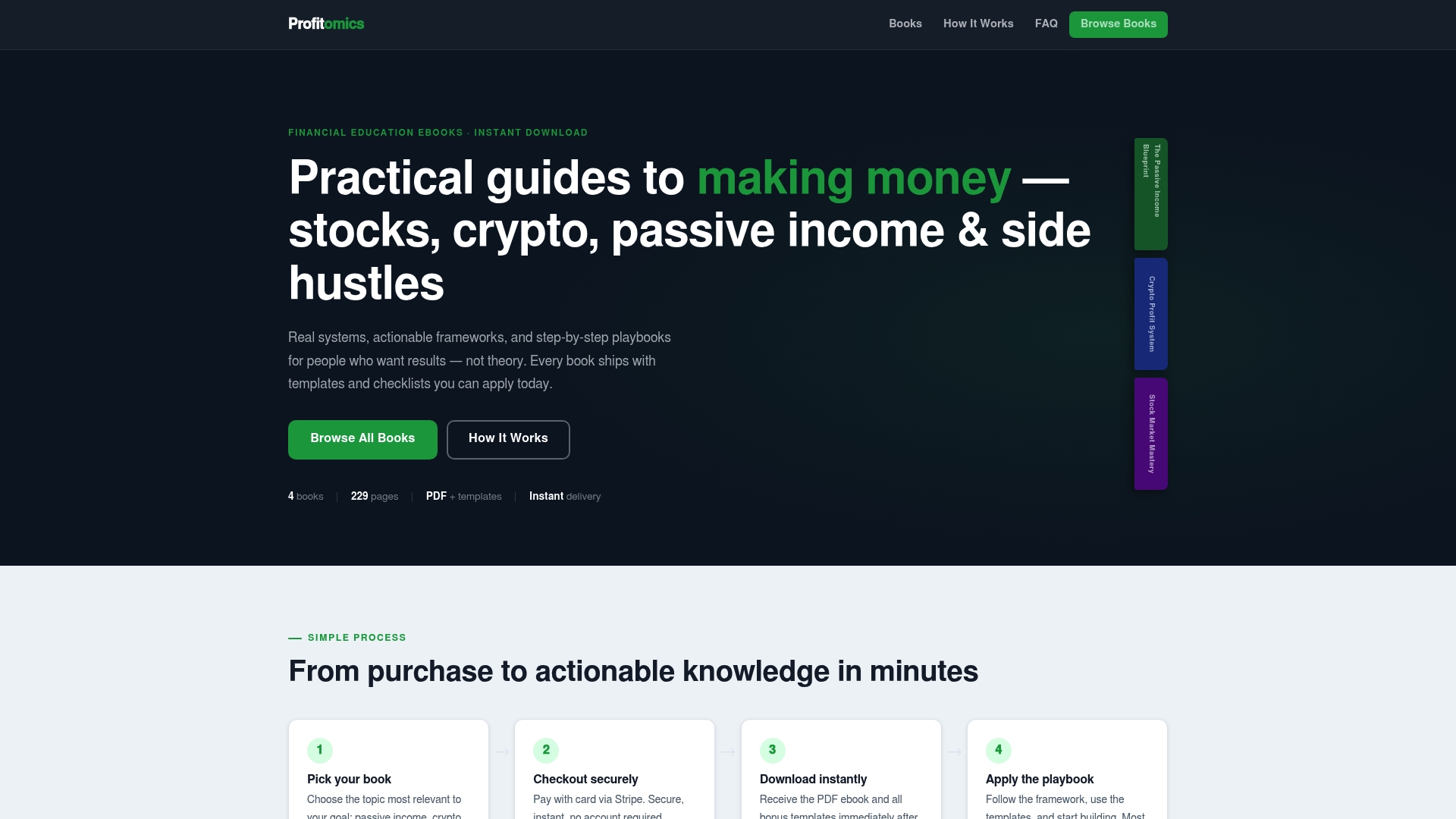
We also offer Side Hustle to Six Figures for $29, Crypto Profit System for $37, The Car Flipping Playbook for $44 and Stock Market Mastery for $47. You can see the full range on the Profitomics home page.
FAQ
How many steps does an ebook sales funnel need?
Five is enough for most sellers: a lead magnet, a landing page, an email sequence, a checkout and a delivery page. You can add an order bump and a one-time upsell once the core path converts. Adding steps before the basics work only gives you more places to lose buyers.
Do I need ClickFunnels or another funnel builder?
No. A funnel builder bundles pages, checkout and upsells in one place, which is convenient. But a landing page, an email service and a checkout that delivers files can do the same job. If you sell on WordPress, WooCommerce supports downloadable products with emailed links.
What is a good lead magnet for an ebook?
A free chapter, a checklist or a worksheet that solves the first small problem your ebook covers. It should be closely related to the paid book, so the people who download it are the people who would buy. Generic freebies fill your list with readers who never buy.
How long should my email sequence be?
Three to five emails is a common starting point. Deliver the freebie in the first, teach something useful in the middle, and present the ebook with a clear next step. Review open and click rates after a few weeks and trim or extend from there.
Can I promise income results in my funnel copy?
Avoid promises. U.S. advertising must be truthful and substantiated, and earnings claims need evidence and context. Describe what the reader will do and learn, and if you cite a result, say who achieved it and under what conditions. For your own offers, an advertising attorney can review the copy.
Sources
- How to Create a Sales Funnel for Your Ebook
- How to Create a Book Funnel (ClickFunnels support)
- Turning a Book into Paying Clients (Publishers Weekly)
- Ebook marketing strategies (Kit)
- The Real Food Dietitians ebook case study (Kit)
- Small Changes That Have a Big Impact (Unbounce)
- A/B Testing: Product page testing (MarketingExperiments)
- How to Sell Digital Products Online (Kartra)
- WooCommerce for Authors (ScribeCount)
- How To Choose Between Ecommerce Platforms (Stripe)
- Epubor case study (2Checkout)
- Legal Compliance for Financial Publishers and Trading Educators
- FTC Settles with Online Stock Trading Platform (National Law Review)
- Ninth Circuit opinion (GovInfo)