Ebook Sales Page: What to Include and How to Build One

An ebook sales page is a single page with one job: persuading a visitor to buy your ebook. It shows the promise, who the book is for, what is inside, proof, the price and one clear button. Everything else on your site is a distraction from that. Below is what goes on the page, the order that works, how to keep the copy honest, and a checklist for the launch.
TL;DR
- A sales page sells one ebook to one type of reader. A free-ebook landing page trades a download for an email address. Don’t mix the two goals.
- Lead with a specific promise, then show the cover, the contents, proof, the price, a guarantee (only if you really offer one), an FAQ and a final button.
- Every claim needs evidence. The FTC expects ad claims to be truthful and backed up before the ad runs, and income claims get extra scrutiny.
- Treat launch as three phases: before (page, checkout, delivery test), during (traffic and follow-up), after (fixes and reviews).
Table of Contents
- What an ebook sales page is (and what it is not)
- The order of an ebook sales page, section by section
- Writing persuasive copy without misleading claims
- What good ebook sales pages have in common
- An ebook launch checklist
- See how we apply this on our own pages
- FAQ
- Sources
What an ebook sales page is (and what it is not)
The Publishing E-Books For Dummies excerpt from O’Reilly defines a sales page as a web page whose role is to sell an ebook. It may also be called a landing page or sales letter, and it works like a brochure that is always available. The same chapter, written by Ali Luke, treats it as a persuasive tool, not a plain book listing.
The confusion starts with the phrase “landing page.” AWeber explains that an ebook landing page can either sell the book or give it away, while a lead-capture page swaps a free resource for contact details. The offer and the goal decide which one you have. AWeber’s advice is that a page should have one goal and one primary action.
Here is how the two differ in practice:
| Ebook sales page | Free ebook landing page | |
|---|---|---|
| Goal | A purchase | An email address |
| Main button | Buy now or Get the book | Download |
| Persuasion needed | High: price, proof, guarantee | Lower: a short form and a clear benefit |
| Typical content | Contents, excerpt, FAQ, price | Cover, three bullets, form |
BookFunnel’s help center draws the same line for promotions: a newsletter promo needs a free download and a page that collects emails, while a sales promo offers no free download and sends readers to the book’s description and the stores.
A sales page is also not your home page. Shopify’s guide notes that a regular webpage carries more links, media and navigation, while an ebook landing page is built around one purpose or product. Cut the menu, the footer maze and the unrelated offers. If you run on WordPress and want a dedicated page without the theme’s clutter, WordPress landing page development is one route to a focused layout with a single path to checkout.
The order of an ebook sales page, section by section
No single order is mandatory, but the guides that publish a structure converge on the same logic: promise, fit, substance, proof, offer, objections, action. LanderKit’s worked example suggests a hero promise, audience fit, annotated contents, excerpt, social proof, offer, guarantee, FAQ and final call to action. Use that as a skeleton.
1. The headline and subheadline
Say what the reader gets and for whom. “Learn to flip your first car for profit” beats “The ultimate guide.” Vague headlines make the visitor work, and visitors don’t. Shopify’s editors describe this as cognitive ease: the visitor should grasp the value without hunting for it.
A useful test: cover everything but the headline and ask a stranger what the book is about. If they can’t say, rewrite.

2. The cover and what they receive
Show the cover image, the format (PDF, for example) and anything bundled with it, such as spreadsheets, templates or checklists. Say how delivery works. If the download arrives instantly after checkout, say so near the button, because it removes a common hesitation.
3. Who it is for, and who it is not for
Name the reader in a sentence or a short list: a beginner with no experience, a side hustler with five hours a week, a first-time investor. Naming who should skip the book builds trust and cuts refund requests. It also lets the right reader think “this is me.”
4. An annotated table of contents
A bare list of chapter titles tells a visitor little. Add one line under each chapter about what the reader will be able to do afterward. LanderKit recommends this because it turns an abstract promise into something concrete that the reader can picture using.
Compare:
- Weak: “Chapter 3: Inspection.”
- Stronger: “Chapter 3: Inspect a car in 20 minutes using the included checklist, so you know what to walk away from.”
5. An excerpt or a look inside
A sample page, a checklist screenshot or a free chapter shows quality in a way adjectives can’t. For books with worksheets and templates, show one filled-in example. Jodi Brandon Editorial lists a look inside among the standard components of a book sales page, alongside cover art, description, reviews, author information and purchase links.
6. Proof
Proof means real reviews, real customer results you can document, or the author’s real background. Unbounce’s ebook page guidance recommends credible social proof and one clear call to action. If you have no reviews yet, say less. A thin page with true statements converts better over time than a loud one that gets questioned. Section three below covers the rules on testimonials.
7. The offer, price and guarantee
State the price plainly, in dollars, with what is included. Don’t invent a “regular price” you never charged. If you offer a guarantee, spell out its terms, since conditions and limits must be clearly disclosed. If you don’t offer one, skip the section rather than implying one.
8. The FAQ and the final button
Use the FAQ for objections: Is this for beginners? What format is it? Do I need special software? When do I get it? Then repeat the main button. The final call to action should use the same wording as the first, so the visitor never wonders whether it is a different step.
Writing persuasive copy without misleading claims
This matters more in some niches than others. If your ebook touches money, investing or income, regulators look hard at the copy.
The Federal Trade Commission’s small business advertising FAQ says ad claims must be truthful, non-deceptive and backed by a reasonable basis of objective evidence before the ad runs. That covers ebooks. Practical translation:
- Don’t promise outcomes you can’t document. “Build multiple income streams” describes a method. “Earn $5,000 a month” is a claim you must be able to prove for typical buyers.
- Be careful with testimonials. The FTC’s Rules of the Road say testimonials must reflect typical experiences unless the ad clearly and conspicuously says otherwise. A single buyer’s best month is not a typical result.
- Disclose connections. If a reviewer got a free copy, was paid or works with you, that connection must be clearly disclosed when readers wouldn’t expect it. The same document covers this.
- Disclose guarantee limits. Time windows and conditions belong in plain view, not in fine print.
- Keep urgency real. LanderKit’s advice is to use urgency only when it is genuine, because manufactured countdowns damage trust.
For finance and trading topics, the FTC has acted before. In an investment software case, its consent order barred unsubstantiated earnings, income, profit or return claims and required a disclosure that trading involves high risks. The case is old and concerned software, but the principle is the one to follow: if you can’t substantiate a number, don’t print it, and state the risk where the reader decides. If you are unsure about a specific claim, ask an attorney who handles advertising law before the page goes live.
What good ebook sales pages have in common
Public roundups of ebook pages are mostly built around free downloads, so check whether an example sells or collects emails before you copy it. Still, the same traits show up in the better ones:
- One action. BookFunnel’s Universal Book Link is a deliberately minimal example: cover, tagline and description, then a route to the store where the reader buys. It lists over 30 stores, yet the page itself stays simple.
- A benefit in the first line. Unbounce’s examples lead with what the reader gains, not the book’s title.
- Short forms or none. For free ebooks, Flodesk’s best-practice roundup notes that gated pages typically ask only for a name and an email address. A paid page asks for even less before checkout: the payment form is the form.
- Concrete contents. Pages that show chapters, samples or templates give visitors something to evaluate.
When you look at examples, ask three questions. What is this page asking me to do? What did it show me to earn that? What would I cut? That last question is the useful one, because most weak pages fail by adding, not by omitting.
What we think a sales page owes the reader
We build ebooks for people who want to act, not just read: templates, checklists and worksheets that make the first step obvious. We think a sales page should work the same way. It should show the buyer what they will do in the first hour after the download, not just describe a transformation.
That is why we lean on annotated contents and screenshots of the real worksheets. Our guides are designed to cut theory and give step-by-step instructions that beginners can apply without prior experience, and the page should make that visible before anyone pays.
We also keep the claims modest. A method is something we can describe. A guaranteed result is something nobody can promise, and readers can tell the difference.
Kai
An ebook launch checklist
A launch is easier when you treat it as three phases. The items below are our working checklist, not a regulatory standard.
Before launch
- Finish the book and test the file on a phone, a tablet and a laptop.
- Build the sales page in the order above and read it as a stranger would.
- Have someone outside the project check every claim against what you can prove.
- Run a real test purchase end to end: checkout, payment confirmation, download link and any bonus files.
- Write the welcome email the buyer will receive. Our post with welcome email examples has paste-ready sequences.
- Decide on your list-building offer. If you want a free taster to feed the page, see these lead magnet ideas.
- Add support contact details and a refund policy that matches what the page says.
During launch
- Send the page to your list first, since those readers already know you.
- Point every campaign to the sales page, not your home page.
- Answer questions fast, and add recurring ones to the FAQ.
- Watch the basics: visitors, clicks on the buy button, completed checkouts. If many click but few buy, the price or the offer section needs work. If few click, the headline does.
- If you plan a funnel around the book, our guide on launching a sales funnel in a week explains the pieces.
After launch
- Ask buyers for honest reviews and keep a record of where each came from.
- Update the page with real quotes only, within the testimonial rules above.
- Fix the weakest section first, based on the numbers.
- Plan the next product. Our list of digital product ideas is a good place to look, and if your book isn’t written yet, start with this guide to an ebook outline you will actually finish.
See how we apply this on our own pages
We sell practical ebooks with templates and checklists, delivered instantly as a PDF with companion bonus materials. Our pages follow the structure in this article: a clear promise, a look at what is inside, and one button.
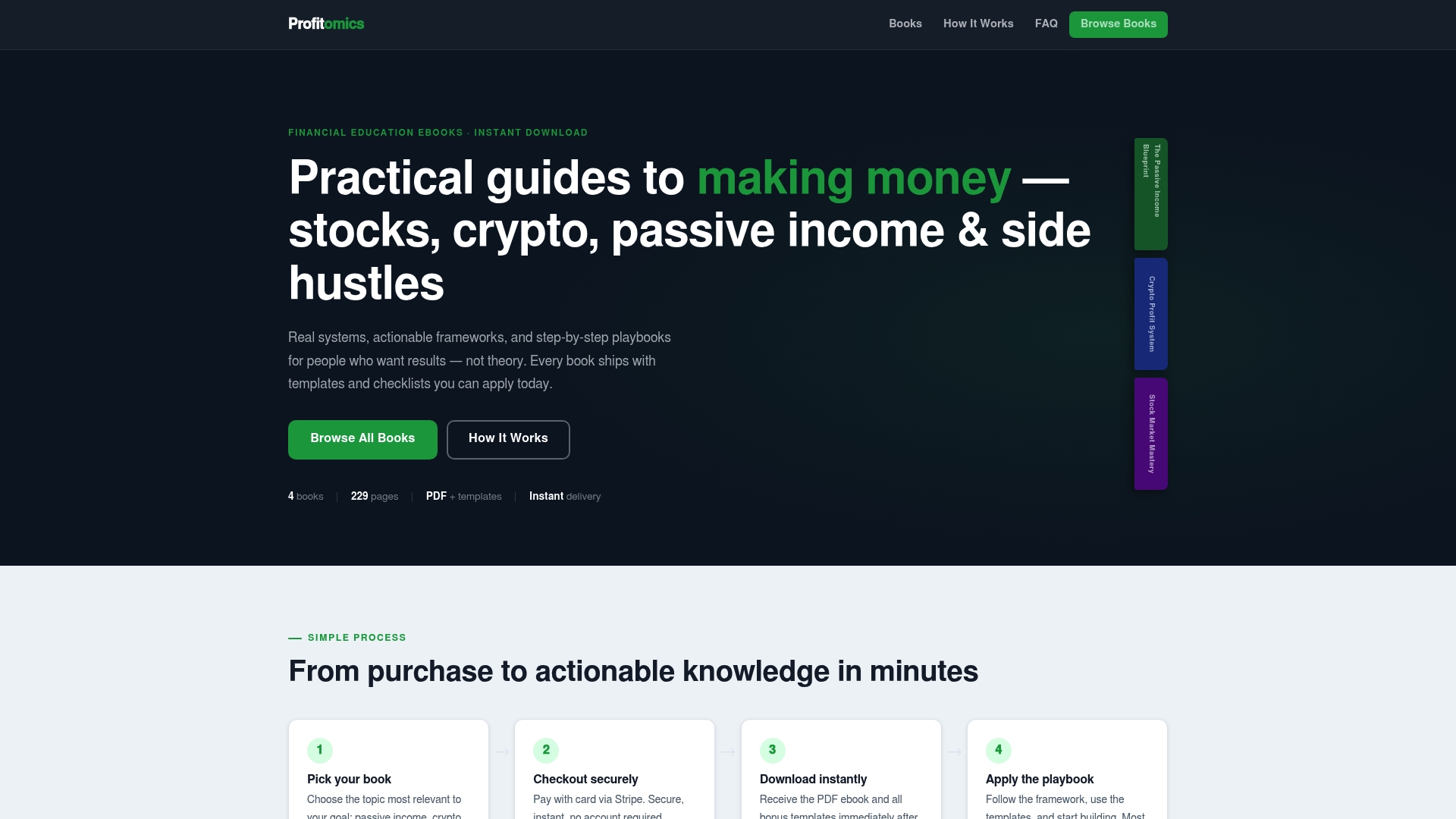
If you want to see it in action, start with the Passive Income Blueprint at 27 USD one-off. Looking for another topic? Side Hustle to Six Figures is 29 USD, the Crypto Profit System is 37 USD, The Car Flipping Playbook is 44 USD and Stock Market Mastery is 47 USD. You can browse them all on Profitomics.
FAQ
What is the difference between an ebook sales page and a landing page?
A sales page is a type of landing page whose goal is a purchase. “Landing page” is the broader term, and it also covers pages that give an ebook away in exchange for an email address. What decides the design is the goal: buying calls for proof, price and objections, while a free download calls for a short form and a clear benefit.
How long should an ebook sales page be?
As long as it takes to answer the questions a buyer has at that price, and no longer. A 10 USD ebook needs less persuasion than a 47 USD one with templates. Include the sections above, keep each short, and cut anything that doesn’t help someone decide.
Can I use testimonials and income results on my page?
Only if they are real and fairly represent what typical buyers experience, or the page clearly explains otherwise. The FTC also requires clear disclosure of connections such as free copies or payment. For income or investing claims, you need evidence for the number before you publish it.
Do I need a guarantee?
No. If you offer one, state its terms and limits plainly. Don’t imply a guarantee you don’t provide, and make sure the checkout and your support policy match the page.
What should I build first: the page or the book?
Finish the outline first, then draft the page’s headline and contents. Writing the page early exposes a vague promise while it is still cheap to fix. Final copy and screenshots come after the book is done.
Sources
- Chapter 10: Crafting an Effective Sales Page, Publishing E-Books For Dummies (O’Reilly)
- 14 Types of Landing Pages (AWeber)
- Before You Join a Promo (BookFunnel Author Knowledge Base)
- Universal Book Links (BookFunnel Author Knowledge Base)
- How to Create an Ebook Landing Page (Shopify)
- Ebook sales page: structure and worked example (LanderKit)
- Your Book Sales Page (Jodi Brandon Editorial)
- 10 genius ebook landing pages (Unbounce)
- Ebook Landing Page Best Practices & Examples (Flodesk)
- Advertising FAQ’s: A Guide for Small Business (FTC)
- Advertising and Marketing on the Internet: Rules of the Road (FTC)
- Investment Software Vendors Settle FTC Charges (FTC)