One Session Crypto Risk Management for Retail Traders: Six Pillar Checks
Follow risk-first rules: size every position to your stop, risk 1%–2% of your account per trade, use hard stops instead of mental ones, split custody between hot and cold wallets, and cap total portfolio heat around a low single-digit percentage. Two tools do most of the work: a position sizing formula and Average True Range (ATR) based stop placement. Templates built around this system are available from a financial education provider authored by Kai.
TL;DR:
- Position sizing should limit risk to 1-2% per trade by calculating trade size based on stop distance and account balance.
- Stops should be placed using ATR multiples to reflect actual volatility, avoiding round-number levels that attract liquidity clustering.
- Keeping 10-20% of holdings on exchange and the rest in cold storage minimizes custodial risks, with multisig and offline backups for larger amounts.
- Regularly review portfolio heat, diversify across asset types and strategies, and run scenario stress tests to prepare for market crashes and systemic events.
- Using templates and checklists, such as the Crypto Profit System, helps implement disciplined risk management routines without building tools under pressure.
Table of Contents
- What Is Crypto Risk Management, and Why Do You Need a System?
- A Practical Six-Pillar Crypto Risk Framework for Due Diligence
- Trading and Allocation Controls: Position Sizing, Stop-Losses, and Portfolio Heat
- Security, Custody, and Operational Best Practices
- Why Regulation and Market Structure Change Your Risk Exposure
- Your Checklist and Templates to Apply These Rules Today
- Hedging Strategies in Crypto Risk Management
- Stress Testing and Scenario Analysis for Crypto Portfolios
- Risk Measurement Metrics Specific to Crypto
- Why Diversification Across Crypto Assets and Strategies Matters
- The Impact of Market Volatility and How to Manage It
- Tools and Software for Crypto Risk Management
- Author Perspective: Why a Risk-First Approach Beats Speculation
- How Profitomics Can Help: The Crypto Profit System and Ready-Made Templates
- Sources
- FAQ
What Is Crypto Risk Management, and Why Do You Need a System?
Crypto risk management is the discipline of identifying what can go wrong with a token, trade, or exchange before it costs you money, then sizing your exposure so no single event wipes out your account. It borrows from traditional cryptocurrency risk assessment used by hedge funds and institutional desks, but retail traders need a version that fits a laptop and a weekend, not a compliance department.
Six categories of risk show up again and again in crypto, and most losses trace back to ignoring one of them.
- Market and volatility risk: sudden gaps, flash crashes, and liquidation cascades that can move a token 20% in minutes.
- Liquidity risk: thin order books that cause slippage, meaning your fill price is far worse than your intended entry.
- Counterparty risk: exchange insolvency or frozen withdrawals, the kind that turned FTX into a case study overnight.
- Security and custody risk: lost private keys, phishing, and smart contract exploits that drain wallets in seconds.
- Technical and operational risk: bugs in a protocol’s code, failed upgrades, or bridge exploits.
- Regulatory risk: enforcement actions or delisting decisions that can gut liquidity for a token almost instantly. Reuters reported how a regulatory ban pushed Chinese investors toward bitcoin rather than away from it, proof that policy shifts can redirect capital flows in ways that catch traders off guard.
A Practical Six-Pillar Crypto Risk Framework for Due Diligence
Before you allocate real money to a token or platform, run it through a structured check. EY’s token due diligence framework organizes digital asset risk into six pillars, and you can apply a scaled-down version of it in about twenty minutes per asset.
- Reputational and strategic: Who founded the project, and do they have a track record worth trusting?
- Technical: Is the code open source, has it shipped consistently, and does the team have a credible upgrade path?
- Financial and tokenomics: How is supply distributed, who controls the treasury, and are there hidden unlock schedules?
- Legal and compliance: Has the project registered anywhere, and does it face active regulatory scrutiny?
- Cybersecurity: Has the smart contract been audited by a recognized firm, and were the findings addressed?
- Auditability and ownership: Can you verify on chain who holds admin keys and whether multisig controls exist?
Deloitte’s guidance on digital asset risk assessment makes a similar point: treat this as a prioritization exercise, not a checkbox. Red flags worth walking away from include an anonymous team with no audit history, a treasury controlled by a single wallet, and tokenomics that funnel most supply to insiders with short lockups.
Trading and Allocation Controls: Position Sizing, Stop-Losses, and Portfolio Heat
Most blown-up accounts didn’t fail because of a bad thesis. They failed because the position was too big for the stop. The fix is a position sizing formula that ties trade size directly to risk tolerance:
Position Size = (Account Balance × Risk %) ÷ (Entry Price − Stop Price)
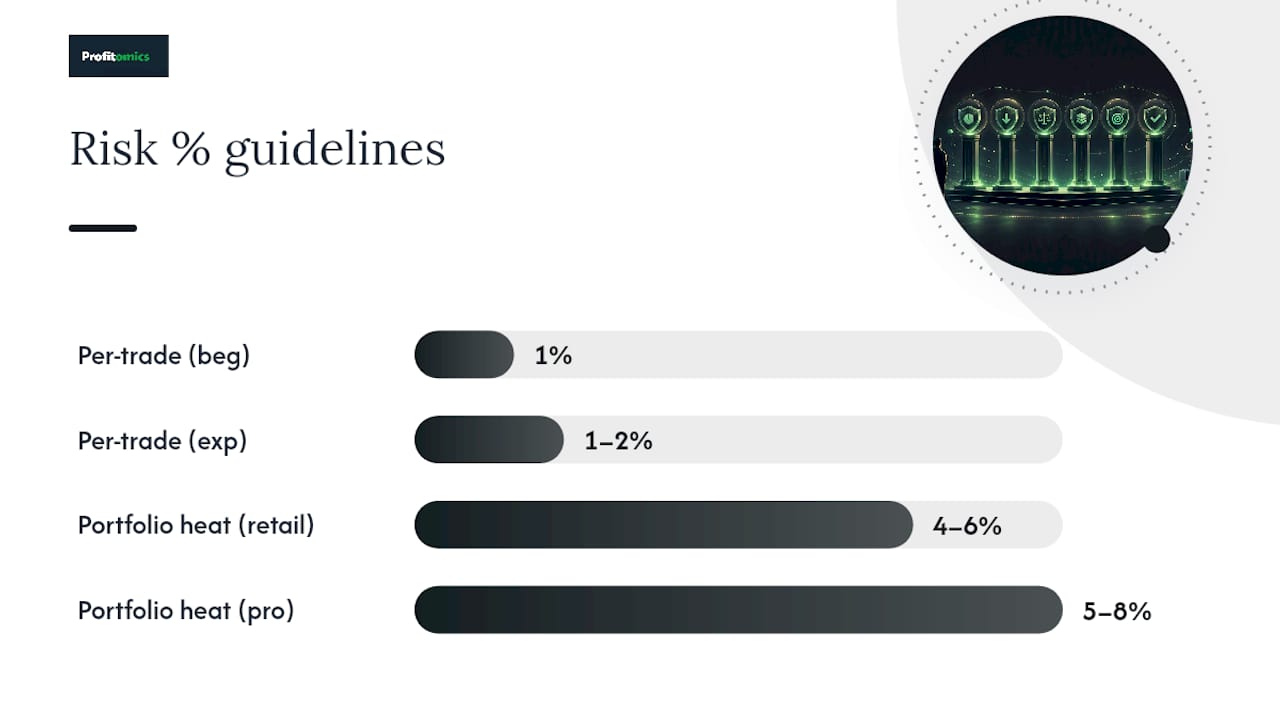
If you have a $10,000 account and you’re willing to risk 1% ($100) on a trade, and your entry-to-stop distance is $50, your position size caps at 2 units. TradeAlgo’s guidance recommends 1% per trade for beginners and 1%–2% for experienced traders. Push much past that and a losing streak of five or six trades, which happens even with a solid strategy, starts eating meaningfully into your capital.
- Calculate your stop distance first, then size the position, never the reverse.
- Place stops using ATR, typically 1.5 to 2 times the Average True Range, so your stop reflects actual volatility instead of an arbitrary percentage.
- Avoid round-number stops like an even $60,000 on bitcoin. Liquidity clusters there, and market makers hunt those levels.
- Use stop-market orders in fast-moving conditions. IG’s risk guidance notes that stop-market orders execute more reliably during gaps than stop-limit orders, though guaranteed stops (where available) carry a premium in exchange for a locked exit price.
- Cap portfolio heat, the sum of dollar risk across all open trades, at roughly 4%–6% for retail accounts, closer to 5%–8% for professional books.
- Set a daily or weekly hard loss limit and step away from the screen when you hit it. A common recovery rule: after a limit is triggered, cut position sizes in half until you’ve had two profitable sessions.
Pro Tip: Write your stop and position size on paper before you enter the trade, not after. If you can’t calculate both numbers before clicking buy, you’re not ready to click buy.
For a deeper walkthrough of order types, Profitomics has a companion piece on risk management trading rules worth bookmarking.
Security, Custody, and Operational Best Practices
Trading rules protect your capital from the market. Custody rules protect it from everything else. A sensible split for active traders: keep 10%–20% of holdings on an exchange as working capital, and move the rest to cold storage. Investors with a longer time horizon can push that even further toward cold storage, since they don’t need instant liquidity.
- Use a hardware wallet for anything you’re not actively trading.
- Set up multisig for larger holdings so no single device or key compromise drains the wallet.
- Back up your seed phrase offline, split across two physical locations, never as a photo on your phone.
- Vet every browser extension and dApp before connecting a wallet. Malicious contracts request approvals, not just transactions.
- Withdraw a small test amount first whenever you send funds to a new address or wallet type.
If you suspect a compromise: revoke token approvals immediately using a revocation tool, move remaining funds to a fresh wallet, contact the exchange’s support if funds are held there, and write down a timeline while details are fresh. That documentation matters if you need to file a report later.
Pro Tip: Set a recurring calendar reminder to review and revoke old wallet approvals every 90 days. Most people never do this, and it’s the single easiest attack surface to close.
Profitomics walks through the full setup in its hot and cold wallet checklist.
Why Regulation and Market Structure Change Your Risk Exposure
Enforcement actions and listing decisions can reshape liquidity overnight. A single delisting announcement can turn a liquid token illiquid within hours, and a major exchange freezing withdrawals can trap capital for weeks. Regulatory shifts don’t always cut in the direction you’d expect either, as the surge into bitcoin during a domestic ban in China showed.
Keep a short watchlist: pending SEC or OCC guidance affecting stablecoins or custody standards, delisting notices from major exchanges, and any signs of exchange instability like withdrawal delays or unusual fee changes. None of this requires daily monitoring, just a weekly scan before you add new exposure.
Your Checklist and Templates to Apply These Rules Today
Turning rules into habits means running the same checklist every time, not improvising.
Before every trade:
- Write your entry thesis in one sentence.
- Set your stop using ATR, not a guess.
- Calculate position size from the stop distance.
- Check current portfolio heat before adding the new risk.
Custody checklist, reviewed monthly:
- Confirm your hot and cold split still matches your trading activity.
- Verify hardware wallet firmware is current.
- Test that your seed backup is still legible and accessible.
Run a weekly portfolio review and a monthly token audit using the six-pillar prompts above. Profitomics builds these into ready-to-use spreadsheets, and Kai’s posts on copy trading risk caps and stop-loss testing go deeper into each piece if you want to drill down further.
Hedging Strategies in Crypto Risk Management
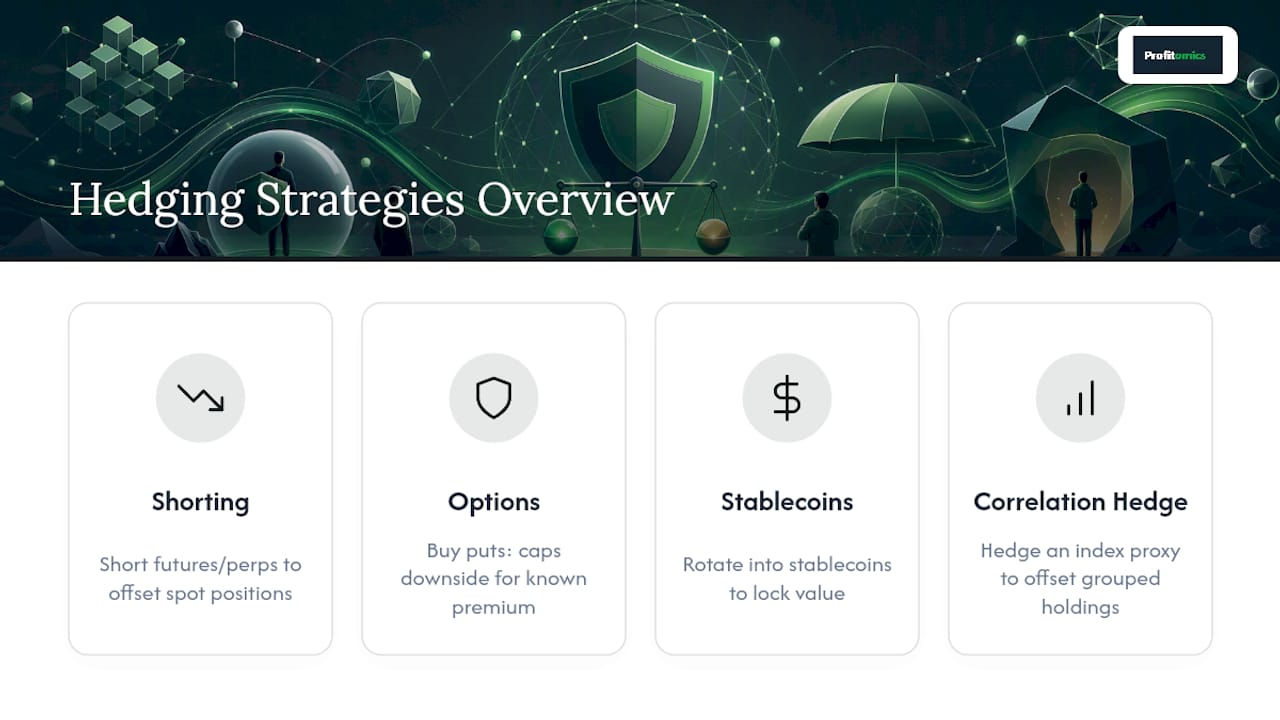
Hedging doesn’t eliminate risk. It trades one risk for a smaller, more predictable one. The most accessible hedge for retail traders is shorting a correlated asset, either through a futures contract or a perpetual swap, to offset a spot position you don’t want to sell for tax or conviction reasons.
Options are the more precise tool. Buying a put on bitcoin or ether caps your downside at a known cost, the premium, while leaving upside open. The tradeoff is that premiums spike during high volatility, exactly when you’re most likely to want protection, so hedging tends to be cheapest when you need it least.
Stablecoins serve as a simpler, lower-friction hedge. Rotating a portion of a portfolio into a stablecoin during periods of macro uncertainty or ahead of major regulatory announcements locks in value without triggering a full exit from the asset class. Many active traders treat stablecoin balances as dry powder: capital parked defensively but ready to redeploy the moment a setup appears, rather than money sitting idle out of fear.
Correlation hedging works at the portfolio level. If your holdings are concentrated in assets that move together, like most large-cap tokens during a broad market selloff, a single hedge on a major index proxy can offset multiple positions at once rather than requiring one hedge per asset. The cost is basis risk: your hedge won’t move in perfect lockstep with your actual holdings, so it reduces but doesn’t erase the drawdown.
Stress Testing and Scenario Analysis for Crypto Portfolios
Stress testing means asking a blunt question before the market asks it for you: what happens to my portfolio if bitcoin drops 30% in a week? Run three scenarios at minimum. A moderate correction (15%–20% drawdown), a severe crash (40%–50%, roughly what happened in past cycle bottoms), and a liquidity event where you can’t exit a position at all for 48 hours because an exchange halts withdrawals.
For each scenario, calculate your portfolio’s dollar loss, check whether any leveraged positions would face liquidation, and confirm whether your stop orders would actually execute at reasonable prices given historical slippage during similar events. This last part matters more than most traders realize. A stop that looks safe on a calm chart can fail badly during a cascade, because everyone else’s stop triggers at the same price level simultaneously.
Scenario analysis also means testing correlation breakdowns. Assets that normally move independently sometimes crash together during systemic stress, which is exactly when diversification benefits disappear and portfolio heat calculations need revisiting. Running this exercise quarterly, not just after a crash has already happened, is what separates a rules-based trader from someone who’s reacting.
Risk Measurement Metrics Specific to Crypto
Traditional finance leans on Value at Risk (VaR), a statistical estimate of the maximum expected loss over a given period at a given confidence level. Crypto’s volatility and fat-tailed price moves make standard VaR models less reliable than in equities, since crypto crashes tend to be sharper and more frequent than a normal distribution predicts. Still, a rough VaR calculation gives you a baseline number to sanity check against your portfolio heat cap.
Realized and implied volatility are more directly useful day to day. Realized volatility, calculated from historical price swings, tells you how turbulent an asset has actually been. Implied volatility, derived from options pricing where available, tells you what the market expects going forward. When implied volatility spikes well above realized volatility, it’s often a signal that traders are pricing in an event, an upgrade, a regulatory decision, an unlock, that hasn’t happened yet.
Maximum drawdown, the largest peak-to-trough decline over a period, is the metric that matters most for gut-check purposes. Track it alongside your portfolio heat and treat a drawdown that exceeds your personal tolerance as a signal to cut size, not double down.
Why Diversification Across Crypto Assets and Strategies Matters
Diversification in crypto isn’t just holding ten different tokens. Most altcoins move in tight correlation with bitcoin during major market swings, so holding twenty large-cap tokens can offer less real diversification than it looks like on paper. Genuine diversification comes from spreading exposure across asset types, layer-one tokens, stablecoins, and selectively, tokenized real-world assets, and across strategies, some capital in active trading, some in longer-term holding, some parked in yield-generating stablecoin positions.
Strategy diversification matters as much as asset diversification. A trader who only runs momentum breakout setups gets hurt badly in choppy, range-bound markets. Mixing in a mean-reversion approach or a longer-term accumulation strategy for a portion of capital smooths the equity curve even when any single method is having a rough month.
The practical takeaway: cap any single token, including bitcoin, at a percentage of your portfolio you’d be comfortable losing entirely, and treat stablecoin allocation as a strategy in its own right rather than an afterthought sitting between trades.
The Impact of Market Volatility and How to Manage It
Crypto volatility isn’t a bug, it’s structural. Thinner order books than equities, a 24/7 trading cycle with no circuit breakers, and a retail-heavy participant base combine to produce price swings that would be considered extreme events in traditional markets but happen routinely here.
Managing it starts with accepting that you can’t predict volatility spikes, only prepare for them. That means sizing positions for the volatility you’re likely to see, not the volatility you hope to see. ATR-based stops already build this in, since they widen automatically during turbulent periods and tighten during calm ones. It also means resisting the urge to increase size after a winning streak, since winning streaks often precede the exact conditions, overconfidence plus stretched valuations, that produce the sharpest reversals.
The other lever is time horizon. Volatility that looks terrifying on a five-minute chart often looks like normal noise on a weekly chart. If it does force a decision, the position was too large to begin with.
Tools and Software for Crypto Risk Management
You don’t need institutional infrastructure to run this system well, but a few categories of tools make it easier. Portfolio trackers that aggregate holdings across exchanges and wallets give you a single view of total exposure, which is essential for calculating portfolio heat accurately when positions are spread across multiple platforms.
Charting platforms with built-in ATR indicators let you calculate stop distances without manual math, and most major exchanges now include ATR as a standard overlay. On-chain analytics tools help with the technical and auditability pillars of due diligence, letting you check treasury wallet activity, token unlock schedules, and contract admin permissions directly rather than trusting a project’s marketing.
For the custody side, hardware wallet companion apps and multisig coordination tools handle the operational half of the equation. None of these tools do the thinking for you. They speed up the calculations and checks that the framework above already tells you to run, which is the actual point. A spreadsheet with the position sizing formula built in, paired with a disciplined checklist, outperforms an expensive dashboard used inconsistently.
Author Perspective: Why a Risk-First Approach Beats Speculation
Survival is the whole game. This approach builds around risk-first rules because consistent compounding, not one lucky trade, is what actually builds wealth over years. Templates speed up implementation by removing the excuse to skip the math when a trade looks exciting. The rules work precisely because they don’t care how confident you feel.
— Kai
How Profitomics Can Help: The Crypto Profit System and Ready-Made Templates
Everything in this guide, the position sizing formula, ATR-based stops, portfolio heat caps, custody splits, works better with templates you don’t have to build from scratch under pressure. That’s the gap the Crypto Profit System closes.

The Crypto Profit System is a one-time $37 ebook from Profitomics with step-by-step routines, checklists, and spreadsheets built specifically around the kind of rules covered here: sizing trades to a stop, capping portfolio heat, and running the six-pillar due diligence check before you buy into a new token. Instead of rebuilding a position sizing spreadsheet or a custody checklist from memory every time the market gets volatile, you plug your numbers into a system that’s already structured for it. If you’d rather build a broader income base alongside your trading, the Passive Income Blueprint covers complementary strategies. Head to the Crypto Profit System page and get instant access to start applying the checklist on your next trade.
Sources
This framework draws on due diligence models from EY and Deloitte, plus practitioner guidance from TradeAlgo and IG.
- Token due diligence: a structured approach to digital asset risk — EY
- Digital asset risk assessment — Deloitte
- Crypto risk management: Position sizing, stop losses — TradeAlgo
- How to set smart crypto stop losses: ATR method + position sizing — CryptoTradeSignals
FAQ
What Is the Safest Percentage to Risk Per Crypto Trade?
Most guides recommend risking 1% of your account per trade for beginners and 1%–2% for experienced traders, calculated using the position sizing formula. This keeps a string of losing trades from meaningfully damaging your capital.
How Do I Set a Stop-Loss That Won’t Get Triggered by Normal Noise?
Base your stop on Average True Range rather than a fixed percentage, typically placing it 1.5 to 2 times the ATR below your entry for a long position. Avoid round numbers, since liquidity often clusters there and gets swept during minor pullbacks.
What Is Portfolio Heat and How Do I Calculate It?
Portfolio heat is the sum of dollar risk across every open trade at once, not just one position’s risk.
Should I Keep My Crypto on an Exchange or in Cold Storage?
This limits your exposure if the exchange faces a withdrawal freeze or insolvency event.
Does Profitomics Offer a Product for Crypto Risk Management Specifically?
Yes, the Crypto Profit System is a $37 one-time ebook with templates and checklists built around position sizing, stop placement, and portfolio heat rules. It’s designed to help you apply the exact framework covered in this guide without building your own spreadsheets from scratch.