Turn Books Into Systems: 3 Stage Plan for Best Personal Finance Books

The most effective way to learn personal finance is a short, three-stage reading sequence: one book on mindset, one on practical systems, and one on investing, each worked with a template or exercise instead of just read. This order targets key obstacles many readers face: motivation, daily money management, and long-term investing. Below, you’ll find how to pick titles for your specific sticking point and how to turn each one into action.
TL;DR:
- Focus on books that directly address your specific financial problem, such as overspending, debt, or investing, rather than popular titles alone.
- Use the four filters—problem match, actionable exercises, relevant and current expertise, and preferred format—before selecting a book to ensure it fits your learning style and goals.
- Follow the three-stage reading sequence: start with a mindset book, then practical systems, and finally an investing guide, allowing time for implementation between stages.
- Pair a mindset book with an action-oriented manual and actively implement tasks within 48 hours, tracking progress through templates like budgets and account checklists.
- When choosing your next book, answer what decision you’re avoiding, whether you need motivation or mechanics, and how much time you have, emphasizing application over just reading.
Table of Contents
- What to look for in a personal finance book
- The three-stage reading framework: mindset, systems, investing
- Reading paths by goal: pick the one that matches your situation
- How to work a finance book instead of just reading it
- How to pick your next book in under five minutes
- Paperback, audiobook, or eBook: why format matters
- Reading order and how to pair books
- Why books alone rarely close the gap between knowing and doing
- How Profitomics turns book lessons into finished systems
- FAQ
- Sources
What to look for in a personal finance book
Most readers pick a book because it’s famous, not because it fits their actual problem. That’s backward. Financial editors recommend choosing books based on your specific sticking point, whether that’s motivation, account setup, technical investing concepts, or behavioral blind spots, rather than chasing whatever tops a bestseller list, according to personal finance book guidance. Before you buy or borrow anything, name the problem you’re trying to solve. “I don’t know where my money goes” needs a different book than “I have debt and no plan” or “I have savings but no idea how to invest it.”
Once you know your sticking point, run every candidate book through four filters.
Does it match your actual problem, not just a popular topic. A bestseller about real estate investing won’t help if your real issue is overspending on subscriptions. Match the book to the task in front of you.
Does it include exercises, templates, or worksheets you can act on. Books that just explain concepts leave you informed but unchanged. Look for calculators, fill-in budget sheets, or step-by-step account-opening instructions.
Is the author’s expertise relevant and the material current. A book written before low-cost index funds and modern robo-advisors existed may still have good psychology lessons but outdated investing mechanics. Check the publication or revision date, especially for anything touching tax rules, account types, or investment products.
Does the format match how you actually learn. Some people absorb financial psychology best through audiobooks during a commute. Others need a physical workbook they can write in while building a budget. Pick the format you’ll actually finish, not the one that looks best on a shelf.
Editorial roundups often sort picks by “best for” categories, such as best for budgeting, best for investing, or best for financial psychology, which gives readers a faster way to narrow choices than scanning a flat top-ten list, according to CNBC Select’s roundup. That category-first approach is worth copying even if you’re building your own reading list from scratch: sort candidate titles by the problem they solve, then pick one per category instead of five books that all cover the same ground.
Author credentials matter, but not in the way most readers assume. A certified financial planner writing about budgeting basics is not automatically better than a journalist who interviewed hundreds of households about spending habits. What matters more is whether the author shows their reasoning and sources their numbers, rather than asserting rules with no explanation. Books that cite specific studies, name real account types, or walk through worked examples tend to hold up better than ones built entirely on personal anecdote.
Revision dates deserve a second look, especially for anything mentioning specific interest rates, contribution limits, or tax brackets. A book published a decade ago may still nail the psychology of saving but misstate a current contribution limit. When a topic is time-sensitive, cross-check the number against a current primary source rather than trusting the page in front of you.
Pro Tip: Before buying a book, read its table of contents and one random middle chapter. If the chapter has no exercise, template, or worked example, the whole book probably doesn’t either.
Format availability also shapes how useful a book turns out to be. A workbook-style title you can mark up does more for action-oriented readers than the same content in audiobook form, where you can’t fill in a template while listening. We’ll cover format trade-offs in more detail further down, but it’s worth deciding your format preference before you start your reading list rather than after.

The three-stage reading framework: mindset, systems, investing
Reading one book cover to cover and hoping something sticks rarely changes behavior. A structured sequence works better because each stage builds on the last: mindset removes the psychological friction, systems give you daily tools, and investing gives you a plan for money you don’t need right away.
Stage one: mindset. Start here even if you’re eager to jump straight to investing. A mindset book’s job is to clarify what you actually value money for and reduce the emotional resistance to changing habits. Most readers underestimate how much their spending is driven by identity and comparison rather than math, and a good mindset book names that pattern directly instead of lecturing about willpower.
Stage two: practical systems. This is where you get the daily tools: a budgeting method, a debt payoff order, automation steps for savings and bills, and templates for tracking where money actually goes. A systems book should leave you with something concrete to build the same week you finish it, not just a philosophy.
Stage three: investing. Once your spending and saving habits are stable, an investing primer should cover account types (retirement accounts, taxable brokerage accounts), basic asset allocation, and why low-cost index funds are widely favored over picking individual stocks. The Bogleheads’ Guide to Investing is a commonly cited model for what this stage should deliver: it covers saving habits, asset allocation, tax-advantaged accounts, and the behavioral traps that derail new investors, all without requiring a finance degree to follow. For readers who want a second investing primer with a simplicity-first approach, publisher descriptions of The Simple Path to Wealth frame it as an outcome-focused roadmap built around index-fund strategies, which makes it a reasonable alternate or companion to the Bogleheads material.
Here’s a workable schedule for moving through all three stages, which might span several weeks, allowing time to read, apply, and stabilize new habits before proceeding to the next stage.

Experts recommend pairing a mindset-focused book with an action-oriented manual to cover both motivation and practical steps, according to personal finance editors, and that pairing is really the backbone of this whole framework: motivation without a system fades, and a system without motivation never gets started.
If 12 weeks feels long, compress it. The minimum workable version is four weeks: one week per book plus two weeks to implement the systems stage before moving to investing. What matters is that you don’t read all three books back to back without pausing to apply anything, which is the single most common reason reading lists fail to change behavior.
Reading paths by goal: pick the one that matches your situation
Different financial situations call for different starting points. Instead of one universal list, match your path to your actual goal.
- Absolute beginners should start with a mindset or foundational primer that explains core vocabulary (assets, liabilities, compound interest) in plain language before anything technical. Your first practical task: write down every account you currently have and its balance, which becomes the baseline for every later exercise.
- Debt payoff and cash-flow repair calls for a systems book with an explicit payoff method (avalanche or snowball) and a worksheet for listing balances, rates, and minimum payments. Your first task: list every debt by interest rate and pick a payoff order before reading past chapter three.
- Budgeting and ongoing cash management benefits from a book built around a repeatable monthly process rather than a one-time overhaul. Your first task: track every dollar spent for one week using whatever template the book provides, even a simple spreadsheet.
- Beginner to intermediate investing should lean on an accessible primer that explains account types and index-fund basics before touching individual stock picking. ‘Broke Millennial Takes on Investing’ is frequently recommended as a bridge book for readers who need the most basic, step-by-step explanations of investing concepts and account types, according to The Penny Hoarder, making it a reasonable entry point before moving to denser material like the Bogleheads guide.
- Money psychology and behavior change fits readers who’ve tried budgeting apps and spreadsheets before but keep reverting to old habits. This path works best as a supplement alongside the systems stage rather than a replacement for it, since psychology alone rarely produces a working budget.
Visual, illustrated formats can shortcut the beginner path for readers who find traditional financial writing dense. Napkin Finance markets a skimmable, illustrated approach to concepts like credit scores and investing basics, which can lower the barrier to entry for someone who has avoided financial reading altogether. That kind of bite-sized format works well as a first exposure, then hands off to a denser systems or investing book once the basic vocabulary feels familiar.
Whichever path you choose, resist the urge to read every book in every category. One book per stage, applied, beats five books skimmed. If you finish a path and still feel stuck, that’s a sign to revisit the application step, not to add another book to the pile.
How to work a finance book instead of just reading it
Reading a personal finance book passively rarely changes anything. The readers who see results treat the book as a workbook, not a story, using three techniques that convert information into habits.
Active notes. Instead of highlighting, write a one-sentence action next to any concept that applies to your situation. “Pay off highest interest rate first” becomes “call credit card company Tuesday to confirm my actual rate.”
Immediate implementation tasks. Pick one action from each chapter to complete within 48 hours of reading it, even something small like opening a high-yield savings account. Momentum matters more than perfection here.
30-day experiments. Choose one lesson per book and test it for a full month with a measurable outcome. Most readers get disproportionate value by pairing a mindset book with an action book that includes a 30-day experiment forcing real implementation, rather than reading passively and hoping the ideas stick on their own.
A few templates make this structure easier to repeat across multiple books:
- Budget sheet: A simple income-minus-expenses tracker, updated weekly, that flags overspending categories before the month ends.
- Account-open checklist: A step-by-step list for opening a retirement account, high-yield savings account, or brokerage account, including documents needed and account minimums.
- Experiment log: A one-page tracker for your 30-day test: what you’re measuring, your starting number, and your result at day 30.
Pro Tip: Keep every template from every book in one folder, physical or digital. Comparing your savings rate sheet from book one against your net worth snapshot from book three shows progress a single book never will.
Three metrics are worth tracking no matter which path you’re on: your savings rate (percentage of income saved each month), your emergency fund balance relative to your monthly expenses, and a simple net worth snapshot (assets minus debts, recalculated monthly). These numbers don’t require a finance degree to calculate, and checking them monthly turns abstract reading into a visible trend line.
Measurement matters because it’s the only way to know whether a book’s advice actually fits your situation. A budgeting method that works beautifully for someone else might leave you tracking expenses you don’t care about or ignoring the one category actually draining your account. Thirty days of real data tells you that faster than another chapter would.
How to pick your next book in under five minutes
You don’t need a long research process to choose your next read. Answer three questions, then act.
- What’s actually stopping me right now? Not “what should I learn” but “what decision am I avoiding or stuck on this week.” Match the answer to a reading path above.
- Do I need motivation or mechanics? If you know what to do but haven’t started, pick a mindset book. If you don’t know what to do, pick a systems or investing book.
- How much time do I actually have? A dense investing primer needs more focused attention than a short, illustrated overview. Pick the format you’ll finish, not the one with the best reputation.
If your sticking point is debt, look for a book with an explicit payoff worksheet. If it’s investing anxiety, look for a primer that explains account types before touching market strategy. If it’s chronic overspending, look for a systems book with a weekly tracking habit built in, not just a one-time budget overhaul.
Cost shouldn’t be a barrier. Most public libraries carry current personal finance titles in print, audiobook, and eBook formats at no cost, and many audiobook platforms offer trial periods that cover a full book for free. Used copies of older editions are often fine for mindset and psychology books, though investing and tax-related titles are worth buying current.
Watch for red flags before committing time to any title: heavy promotion of a single paid product inside the book itself, no cited sources for specific numbers or claims, and promises of guaranteed or unusually fast returns. These patterns suggest marketing dressed up as education rather than a genuinely useful guide.
Paperback, audiobook, or eBook: why format matters
Format isn’t a minor detail. It determines whether you’ll actually finish the book and whether you’ll do the exercises inside it. CNBC Select’s roundup of top picks notes audiobook availability as a real buyer consideration, not an afterthought, alongside “best for” categories like budgeting or investing, according to CNBC Select.
Audiobooks work well for mindset and psychology books you’ll absorb passively during a commute or workout, but they make it hard to pause and fill in a worksheet. Paperbacks and workbook editions suit systems and investing books where you need to write numbers down, flip back to a chart, or mark up a budget template. eBooks split the difference: searchable and portable, though templates sometimes work better printed or copied into your own spreadsheet rather than filled in on a screen.
Availability details like exact edition, ISBN, and format options are worth checking before buying, since publisher and retailer listings such as Bookshop’s title pages show which formats are actually in print for a given book. If your library’s app only carries the audiobook version of a title you wanted as a workbook, that’s worth knowing before you commit a slot in your reading schedule to it.
Reading order and how to pair books
The order from earlier, mindset, then systems, then investing, holds for most readers, but pairing books within that order can tighten the sequence. A short, illustrated primer paired with a denser systems book covers both quick orientation and deep mechanics without requiring two heavy reads back to back.
For the investing stage specifically, pairing a beginner-friendly bridge book with a more comprehensive primer works better than jumping straight into dense material. Read the bridge book first for vocabulary and basic account concepts, then move to a fuller primer like the Bogleheads guide once terms like asset allocation and tax-advantaged accounts feel familiar rather than foreign.
Avoid reading two books from the same stage back to back. Two systems books in a row often repeat the same budgeting advice in different language, which feels like progress but isn’t. Two investing books in a row risks conflicting guidance on stock picking versus index investing before you’ve applied either one. If you want a second opinion on a stage, read it after you’ve implemented the first book’s advice for a few weeks, not before.
For readers who want a structured walkthrough of the investing stage specifically, our step-by-step plan for new investors covers account setup in more detail than a single chapter can.
Why books alone rarely close the gap between knowing and doing
Here’s the uncomfortable truth about personal finance books: most of them are better at explaining what to do than at making you actually do it. A 300-page book can walk you through exactly how compound interest works and still leave you without a funded retirement account six months later, because reading comprehension and behavior change are different skills.
The reading-industrial complex around personal finance rewards books that are smooth to read and pleasant to finish, not necessarily books that change outcomes. A chapter that makes you feel motivated for twenty minutes isn’t the same as a chapter that gets you to open an account. That’s not a knock on the authors. It’s a structural limit of the format: a book can hand you a template, but it can’t sit next to you while you fill it out.
What readers consistently underestimate is how much the application step costs in time and friction, not knowledge. Most people who fail to build a budget don’t fail because they misunderstood the 50/30/20 rule. They fail because setting up the actual tracking system, choosing categories, linking accounts, building the habit of checking it weekly, takes real hours that the book itself doesn’t hand you. The information gap closes in a weekend of reading. The execution gap can take months.
That gap is exactly where a reading plan either earns its keep or quietly fails. Treating a book’s exercises as optional is the single biggest reason good advice doesn’t translate into a better bank balance.
— Kai
How Profitomics turns book lessons into finished systems
Everything in this article points toward the same conclusion: books are strongest at explaining principles and weakest at forcing the setup work that makes those principles stick. That gap is exactly where our eBooks start.
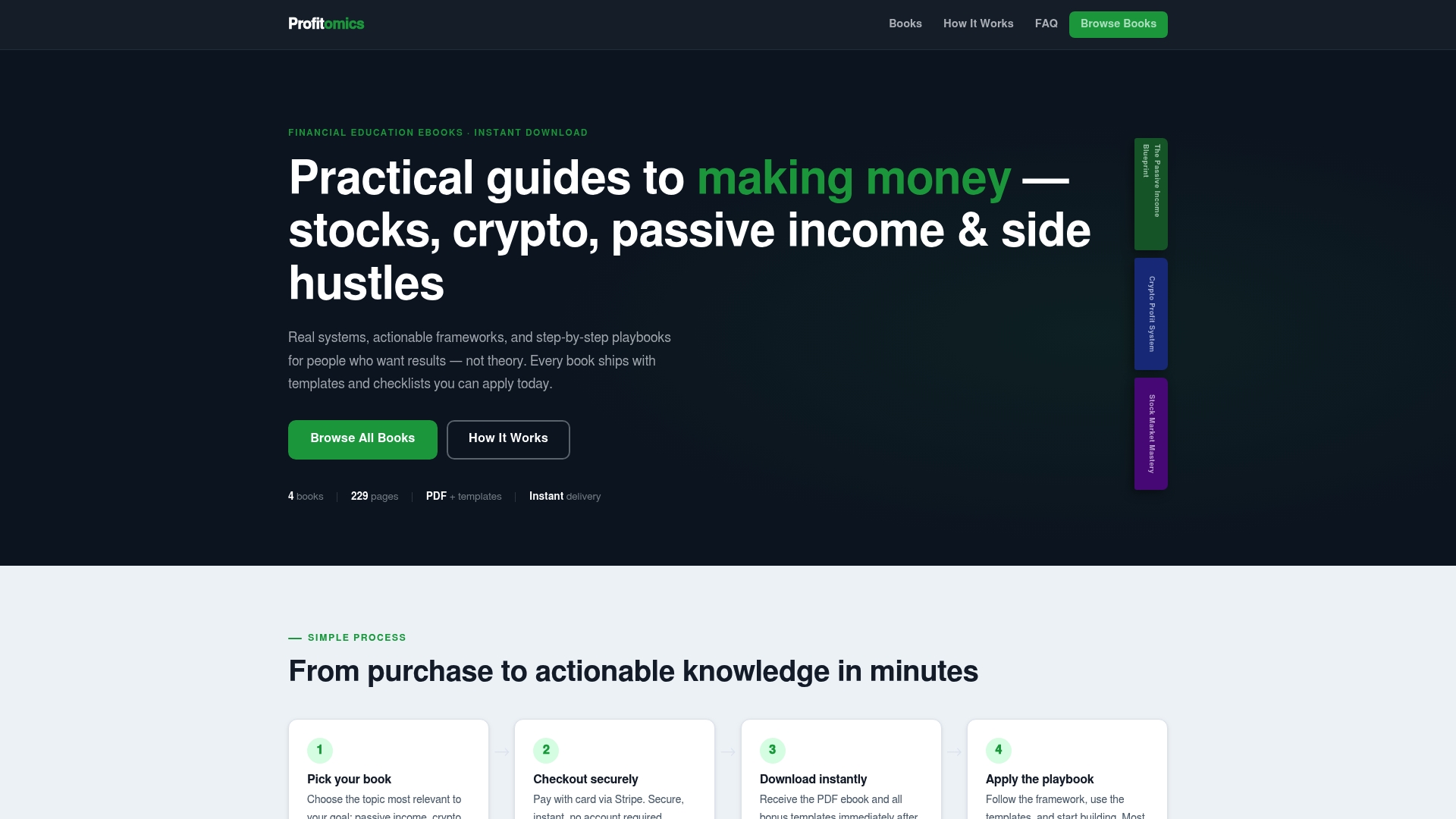
Instead of another chapter of theory, each Profitomics guide hands you the templates, checklists, and step sequences already built, so you skip the hours most readers spend assembling their own spreadsheet from scratch after finishing a book. We built these guides for people who finished a mindset or systems book, understood the principles, and then stalled on the setup work. Every guide is delivered instantly as a PDF with companion templates, so there’s no gap between deciding to act and having the tools in hand.
- Passive Income Blueprint maps to readers who finished the investing stage and want a structured path to building multiple income streams beyond a single brokerage account.
- Stock Market Mastery pairs naturally with an investing primer for readers who want templates for account setup and ongoing portfolio tracking rather than building their own from a blank spreadsheet.
- Side Hustle to Six Figures fits readers whose sticking point is income generation rather than traditional investing, with checklists built for starting a side project without a business background.
- The Car Flipping Playbook suits readers drawn to a specific, hands-on income project with a defined process rather than open-ended entrepreneurship.
If you’ve just finished your three-stage reading sequence and want the setup work already done for you, our Stock Market Mastery guide or the broader Profitomics catalog are reasonable next stops, each built to turn what you just read into a system you can run this week.
This article is general information, not a substitute for advice from a qualified financial advisor. Consult a qualified financial professional about your own circumstances before acting on anything here.
FAQ
What is the best personal finance book ever written?
There’s no single universally agreed “best” book, since the right choice depends on whether you need mindset, budgeting systems, or investing knowledge. A widely recommended investing primer is the Bogleheads’ Guide to Investing, which covers saving, asset allocation, and behavioral traps for readers at the investing stage.
What are the top five finance books?
Rather than a fixed top five, editorial roundups typically group recommended titles by category: mindset, budgeting, investing, debt payoff, and financial psychology, letting readers pick the category that matches their current sticking point, according to CNBC Select. Choosing one strong book per category tends to work better than chasing a single ranked list.
What five books does Warren Buffett recommend?
There isn’t a confirmed, sourced list of exactly five books tied to a specific recommendation; definitions and lists attributed to public figures vary widely across the internet and aren’t verifiable here. For a reliable investing primer instead, the Bogleheads’ Guide to Investing is a commonly cited, well-documented starting point.
What is the 7% rule in finance?
If you’ve seen it referenced for withdrawal rates or return assumptions, check the original source’s exact wording before applying it to your own plan.
How do I choose between reading a book and using a template-based guide?
Books are strongest for understanding the reasoning behind a financial decision, while template-based guides save the setup time of turning that reasoning into a working system. Many readers use both: a book like the Bogleheads’ Guide to Investing for the concepts, then a structured guide for the account-opening and tracking steps.
Sources
- The Penny Hoarder — Best personal finance books
- CNBC Select — Best personal finance books of 2026
- Bogleheads — Bogleheads’ Guide To Investing
- Napkin Finance — book page
- Simon & Schuster — The Simple Path to Wealth