Self Directed Traders: A $27 Self Study Alternative to PiranhaProfits

If you want actionable, template-driven trading education you can use right away, Profitomics eBooks are a solid alternative to PiranhaProfits, especially for beginners on a budget. If you need live coaching, trade signals, or ongoing mentor feedback, a coaching program or subscription platform will likely serve you better. The right pick depends on your learning style, your schedule, and how much you want to spend before you place a real trade.
TL;DR:
- Profitomics eBooks are ideal for budget-conscious beginners seeking quick, template-driven tools without live feedback or ongoing support.
- Self-study guides provide immediate application through checklists and spreadsheets but lack personalized coaching or real-time alerts.
- Refund policies and sample content visibility before purchase are crucial indicators of product confidence and long-term value.
- Trade alerts and real-time signals are typically available only through subscription platforms, not one-time ebooks, affecting how traders receive prompt market updates.
- Matching the course format to your trading style, market, and risk appetite is more important than the brand reputation when choosing educational materials.
Table of Contents
- Comparing alternative course formats to PiranhaProfits
- What to check before you buy a trading program
- What Profitomics offers and who it fits best
- How customer reviews and satisfaction typically break down
- Comparing refund policies across program types
- Platform technology and everyday usability
- Trade alerts and real-time signal access
- Matching a program to your trading style and market
- Why the format matters more than the brand name
- Getting started with Profitomics after you buy
- Sources worth checking before you decide
- FAQ
Comparing alternative course formats to PiranhaProfits
Trading education splits into five broad formats, and each one solves a different problem. Knowing which one fits your habits matters more than any single brand name.
Ebooks and self-study guides give you a fixed price, instant access, and a set curriculum you work through at your own pace. You get templates, checklists, and worked examples, but no live feedback when you get stuck.
Structured paid courses add video lessons, quizzes, and sometimes a private forum. They cost more than a single ebook and often run as a multi-week program rather than a one-time purchase.
Coaching and mentorship puts a person in your corner who reviews your trades and answers questions in real time. It is the most expensive route and the one that depends most on the individual coach’s skill and availability.
Subscription platforms bundle trade alerts, market commentary, and sometimes a community feed for a recurring fee. You are paying for ongoing signals rather than a one-time skill transfer, so the value depends on whether you keep renewing.

Community and copy-trading groups let you follow other traders’ moves, often through a shared chat or a copy-trading feature on a broker platform. Feedback is fast and social, but accountability is loose and the quality of the group leader varies widely.
Here is how those formats stack up on the things buyers actually care about:
- Speed to apply: ebooks and self-study courses win here since you can start using a template the same day you buy it.
- Feedback quality: coaching and mentorship offer the most direct feedback, while ebooks offer none.
- Accountability: subscription platforms and communities build in some social pressure to keep learning, but self-study formats rely entirely on you.
- Total cost: one-time ebooks are the cheapest entry point, followed by paid courses, then subscriptions, with coaching typically the most expensive over a full year.
Match the format to the buyer profile:
- A complete beginner with limited time usually does best starting with a self-study ebook that includes templates and checklists.
- A part-time trader who wants to fit lessons around a job benefits from an on-demand paid course they can pause and resume.
- An active trader chasing faster feedback loops often gets more value from coaching or a subscription with real-time alerts.
- A risk-averse investor who wants to move slowly should prioritize a format with a clear refund policy and sample content over speed or hype.
Pro Tip: Before paying for any format, ask whether you can preview a sample lesson or chapter first. A seller confident in their material will let you see it.
What to check before you buy a trading program
A trading education purchase is easy to regret if you skip the basics. Run through this checklist before handing over your card details.
- Look for sample lessons or a preview chapter so you know the writing style and depth before committing.
- Check for a named author or team with a described background rather than an anonymous storefront.
- Confirm there is a refund policy and read its exact terms, including the window and any conditions.
- Verify the product includes usable templates, spreadsheets, or checklists rather than just narrative text.
- Ask whether you get access to a community or ongoing updates, or whether the purchase is a one-time, static product.
Pricing signals tell you a lot on their own. A one-time ebook priced under $50 is a low-risk way to test a topic. A subscription charges you every month whether you trade or not, so the math only works if you actually use the signals. Coaching fees vary the most and often depend on the bootcamp or program’s length. If you are weighing a self-paced course against live coaching, this comparison of course and coaching formats breaks down when each model tends to pay off.
Watch for these red flags:
- Promises of a guaranteed income figure with no explanation of the risk involved.
- No sample content available anywhere, forcing you to buy blind.
- No mention of risk management, stop-losses, or position sizing in the curriculum description.
Before buying, ask the seller directly: what is in the refund window, is there a sample lesson, and does the course cover risk management explicitly.
What Profitomics offers and who it fits best
Profitomics builds its ebooks around templates and checklists rather than long theory sections, which suits readers who want to act quickly. The Passive Income Blueprint lays out a step-based system for building income streams, the Crypto Profit System documents a risk-first framework for crypto strategy, and Stock Market Mastery focuses on swing trading and long-term compounding with practical worksheets.
Each guide includes:
- Ready-to-use templates and spreadsheets instead of abstract advice.
- Checklists that walk you through setup step by step.
- Sample frameworks drawn from case-tested systems rather than generic tips.
The Crypto Profit System takes a risk-first stance, and Profitomics’ companion blog post on capping copy-trading risk at 20 to 25 percent reflects that same caution applied to following other traders’ positions.
The Passive Income Blueprint is presented as a system for building multiple income streams within a short timeframe.
This format suits self-starters, budget-conscious beginners, and fast implementers who would rather test a system than sit through video modules. If you want to check the fit quickly, read the included checklist first, then run the numbers through a paper-trading spreadsheet for a few weeks before committing real capital. Profitomics’ blog post on paper trading for beginners walks through exactly that kind of test-first workflow.
How customer reviews and satisfaction typically break down
Reviews of trading education products tend to cluster around three themes: whether the material matched the sales page, whether the buyer could apply it immediately, and whether support existed after purchase. Self-study ebooks generally score well on the first two points and weaker on the third, since there is no coach checking in.
Coaching and mentorship programs often draw stronger satisfaction scores when the mentor is responsive, but ratings drop sharply when a buyer feels ignored after paying. Subscription platforms live and die on whether the alerts actually perform, so satisfaction tends to swing month to month rather than staying steady.
When you read reviews for any program, separate complaints about the format itself (too much theory, not enough examples) from complaints about outcomes (a losing trade). A losing trade is not proof a course failed, but a missing refund or unanswered support ticket usually is. Look for repeated mentions of specific templates or lessons rather than vague five-star praise, since specific feedback is harder to fake and easier to verify against a sample chapter.
Comparing refund policies across program types
Refund terms vary more than almost any other feature in trading education, and they say a lot about how confident a seller is in their own material. A one-time ebook purchase typically comes with a defined refund window measured in days, giving you a short period to request your money back if the content does not match expectations.
Subscription platforms usually let you cancel future billing but rarely refund the current month, so canceling early in a cycle matters if you decide the alerts are not worth it. Coaching programs are the least standardized: some offer a partial refund if you drop out early, others offer none once the first session happens.
Before buying anything, read the refund policy in full rather than assuming a standard window applies. A program that hides its refund terms behind a support ticket, or requires you to explain why you want out, is a weaker bet than one that states its terms plainly on the sales page.
Platform technology and everyday usability
Ebooks and downloadable guides are the simplest to use since there is no login, no app, and no dashboard to learn. You get a PDF and any companion spreadsheets, and you can read or reference them on any device without a subscription to maintain.
Subscription platforms and community apps ask more of you technically. You typically need to check a dashboard or chat feed regularly to catch alerts as they happen, and missing a login for a few days can mean missing several trade calls entirely. Coaching programs sit in between, often relying on a video call platform and a shared document or spreadsheet rather than dedicated software.
If you are not interested in learning a new platform on top of learning to trade, a self-contained ebook with built-in templates removes that extra layer of friction. If real-time alerts matter more to you than simplicity, expect to spend time getting comfortable with whatever app or dashboard the subscription uses.
Trade alerts and real-time signal access
Real-time trade alerts are a feature of subscription platforms and some copy-trading communities, not of self-study ebooks. If a course or guide promises live signals bundled into a one-time purchase, that is worth double-checking, since ongoing alerts usually require ongoing infrastructure and therefore a recurring fee.
Ebook-based education instead teaches you the decision framework so you can generate your own trade ideas rather than waiting on someone else’s call. That trade-off suits a learner who wants to build independent judgment, while a trader who wants speed and does not mind following someone else’s timing may prefer a signals subscription.
Profitomics’ guides fall into the framework-and-template category rather than the live-alert category. The Crypto Profit System’s risk-first approach and the accompanying advice on capping copy-trading risk are built to help you evaluate signals you encounter elsewhere, not to replace them with a proprietary feed.
Matching a program to your trading style and market
Not every course fits every market. A guide built around swing trading and compounding, like Stock Market Mastery, is aimed at readers holding positions over days or weeks rather than scalping intraday moves. A crypto-focused guide built on a risk-first framework assumes a market that moves faster and swings harder than most equities, so its risk caps and position-sizing advice are tuned accordingly.

Before buying, check whether a program’s examples come from the market you actually plan to trade. A course built entirely around stock charts will not translate cleanly to crypto volatility, and a crypto-first guide’s risk assumptions may be too aggressive for a slower-moving stock portfolio.
Also consider your intended holding period. Day traders need material that addresses fast decision-making and tight stop-losses, while swing traders and long-term investors benefit more from compounding strategies and portfolio-level thinking. Profitomics splits this by product line, keeping crypto risk guidance separate from the swing-trading and compounding focus in Stock Market Mastery, so you can pick the guide that matches your actual market instead of a one-size-fits-all curriculum.
Why the format matters more than the brand name
Most guides to picking trading education fixate on comparing brand against brand, which misses the real decision: what format matches how you actually learn and how much risk you can absorb while you are still figuring things out. A flashy sales page tells you nothing about whether you will finish the material or apply it.
The advice that gets underrated is the cheapest to follow: read the refund policy before the curriculum, and demand a sample lesson before you demand a discount. A program that will not show you a page of real content is telling you something, regardless of how polished its marketing looks.
If you take one thing from this comparison, prioritize risk management content over promised returns. A course that spends real space on position sizing and stop-losses is more likely to keep you in the game long enough to actually improve, and that matters more than any single strategy it teaches.
Format fit and refund clarity matter more than brand reputation when you are choosing trading education.
— Kai
Getting started with Profitomics after you buy
Profitomics works best for readers who want to move from reading to doing within days, not weeks. Each guide is built to be opened once and used immediately, without waiting on a cohort start date or a coach’s calendar.
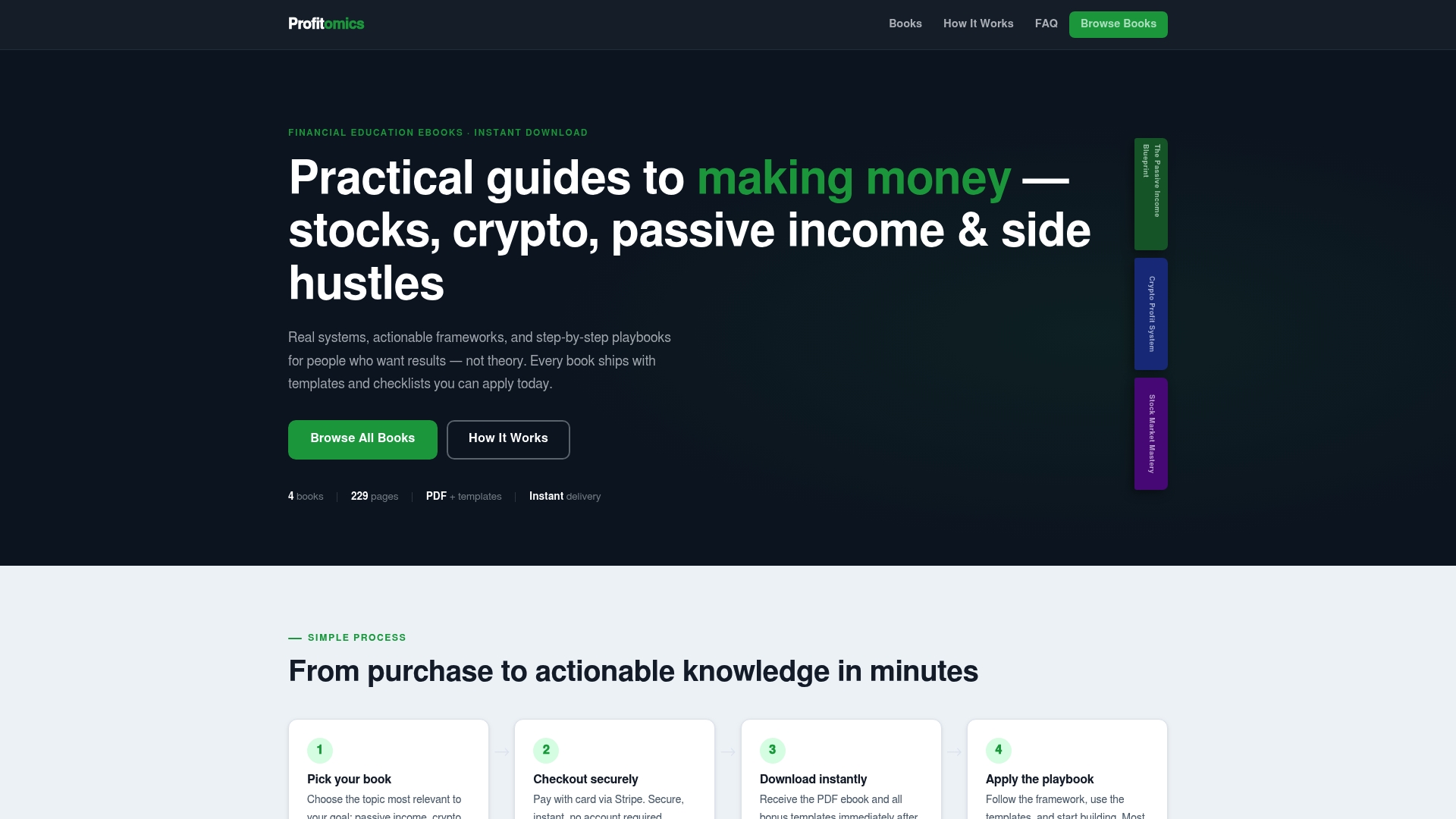
Start with the product that matches your target market. The Passive Income Blueprint is priced at $27 one-time and focuses on building multiple income streams. The Crypto Profit System runs $37 one-time and centers on a risk-first crypto framework. The Stock Market Mastery guide is $47 one-time and covers swing trading and compounding.
After purchase, take these three steps before risking real money:
- Read through the included checklist once, end to end, before touching a live account.
- Run a short paper-trade plan using the provided spreadsheet to see how the framework behaves.
- Set a firm risk limit for yourself, using the guide’s risk-first guidance as your starting point.
Browse the full ebook lineup if you are not sure which title fits your goals best.
Sources worth checking before you decide
These pages let you preview the material referenced above and confirm what each guide actually includes before you buy.
- Crypto Profit System: product page detailing the risk-first crypto framework.
- Stock Market Mastery: product page covering swing trading and compounding strategies.
- Paper trading for beginners: a practical start-up plan for testing any trading system before going live.
- Risk-first crypto copy trading: guidance on capping copy-trading risk.
- Profitomics blog: the hub for further reading on risk management and trading behavior.
FAQ
What is PiranhaProfits’ outlook for 2026?
Profitomics does not track or report on PiranhaProfits’ program updates or forecasts, so no specific future outlook can be confirmed here. If you are evaluating PiranhaProfits directly, check its own current program pages for the latest details.
Can you realistically make $200 a day in day trading?
Day trading results depend heavily on account size, market conditions, and individual skill, so no fixed daily figure applies to every trader. Any guide or platform promising a specific daily dollar amount without explaining the underlying risk should be treated with caution.
What is considered the top trading app?
There is no single trading app that ranks as the definitive best choice, since the right one depends on your market, your budget, and whether you need real-time alerts or just execution. Compare apps on fees, supported markets, and usability rather than searching for one universal answer.
Is it possible to earn $1,000 a day from trading?
Trading income varies enormously by capital, strategy, and market volatility, so a fixed daily figure like this cannot be guaranteed by any course or platform. Treat any program that promises a specific daily return as a red flag rather than a credibility signal.
Are Profitomics eBooks a good fit for complete beginners?
Profitomics eBooks are built around templates, checklists, and step-based systems, which tends to suit beginners who want to start applying a framework right away rather than sit through lengthy theory. Readers who prefer live feedback or ongoing mentorship may want to pair a self-study guide with a coaching option instead.