Start Dollar Cost Averaging in 15 Minutes for Individual Investors
Dollar-cost averaging means putting a fixed dollar amount into an investment on a set schedule, no matter what the price is doing that day. It’s built for steady savers who want to invest through 401(k)s, IRAs, or brokerage accounts without trying to time the market. The trade-off: in a market that keeps climbing, spreading out your cash usually earns less than investing it all upfront.
TL;DR:
- Dollar-cost averaging is most effective for consistent investing habits, especially in volatile markets, because it reduces emotional decision-making and panic selling.
- For lump-sum windfalls, investing immediately generally outperforms phased investing, unless it causes anxiety that prevents timely deployment of funds.
- Frequent small purchases can incur transaction fees and lead to cash drag, which may offset the benefits of lowering your average purchase cost.
- Automated contributions into broad-market ETFs or index funds with minimal fees are ideal for implementing a disciplined DCA strategy.
- DCA works best when paired with ongoing income sources and combined with annual rebalancing to maintain your target allocation over time.
Table of Contents
- How Dollar-Cost Averaging Works
- Why Dollar-Cost Averaging Works for Most Investors
- Where Dollar-Cost Averaging Falls Short
- DCA vs. Lump Sum: Which Should You Use?
- How to Set Up Dollar-Cost Averaging the Right Way
- A Worked Example: Calculating Your Average Cost
- Who’s Behind This Guide
- Where Dollar-Cost Averaging Fits in a Real Portfolio
- Put Your Dollar-Cost Averaging Plan on Paper
- Sources
- FAQ
How Dollar-Cost Averaging Works
The mechanic is simple: you invest the same dollar amount every period instead of buying a fixed number of shares. That single difference changes everything about your average cost.

When the price drops, your fixed dollar amount buys more shares. When the price rises, it buys fewer. Over several purchases, this inverse relationship tends to pull your average cost per share below the simple average of the prices you paid, a mechanic Investopedia breaks down with side-by-side price and share examples. Investor defines dollar cost averaging exactly this way: fixed-dollar purchases at regular intervals, regardless of the asset’s current price.
Most people are already doing this without thinking about it:
- 401(k) payroll deductions: a set percentage of every paycheck buys fund shares automatically.
- IRA auto-contributions: monthly transfers from a checking account into index funds.
- Dividend reinvestment plans (DRIPs): dividends buy more shares the moment they land, whatever the price is.
- Recurring brokerage buys: a scheduled $200 purchase into an ETF every payday.
In a tax-advantaged account like a 401(k) or IRA, this happens with no tax friction along the way. In a taxable brokerage account, each purchase creates its own cost basis and holding period, which matters later when you sell.
Why Dollar-Cost Averaging Works for Most Investors
DCA’s biggest advantage isn’t mathematical, it’s behavioral. You remove the temptation to guess whether now is a good time to buy, which is the decision that trips up most new investors.
That structure pays off in a few concrete ways:
- Removes the emotional guesswork of deciding whether prices are “too high” or “too low.”
- Can lower your average cost per share during volatile stretches, since you buy more shares when prices dip.
- Builds a habit that survives market noise, the same habit that makes 401(k) contributions work.
- Fits naturally into automatic payroll deductions you’re probably already using.
Behavioral finance research backs this up directly. FINRA notes that reducing regret and preventing panic selling are the main reasons advisors recommend DCA to newer investors, separate from any math about returns.
Pro Tip: If your employer’s 401(k) already deducts a percentage from every paycheck, you’re running a dollar-cost averaging strategy right now. Extending it to a taxable brokerage account is just applying the same habit to your next investing goal.
Where Dollar-Cost Averaging Falls Short
DCA isn’t free of downsides, and pretending otherwise sets you up for disappointment.
- Opportunity cost: if the market trends upward while you’re phasing in cash, you earn less than if you had invested it all at once.
- Cash drag: money sitting on the sidelines waiting for its turn to invest isn’t compounding.
- Fee erosion: frequent small purchases can rack up transaction costs that quietly cancel out any pricing advantage, a concern Wikipedia’s overview of the strategy flags directly.
- No downside protection: DCA smooths your entry price, but it does nothing to shield you from a genuinely bad investment or a prolonged bear market.
Investor.gov is blunt about this: dollar-cost averaging doesn’t assure a profit or protect against loss in a declining market, and it only works if you actually have the ability to keep contributing through rough stretches.
DCA vs. Lump Sum: Which Should You Use?
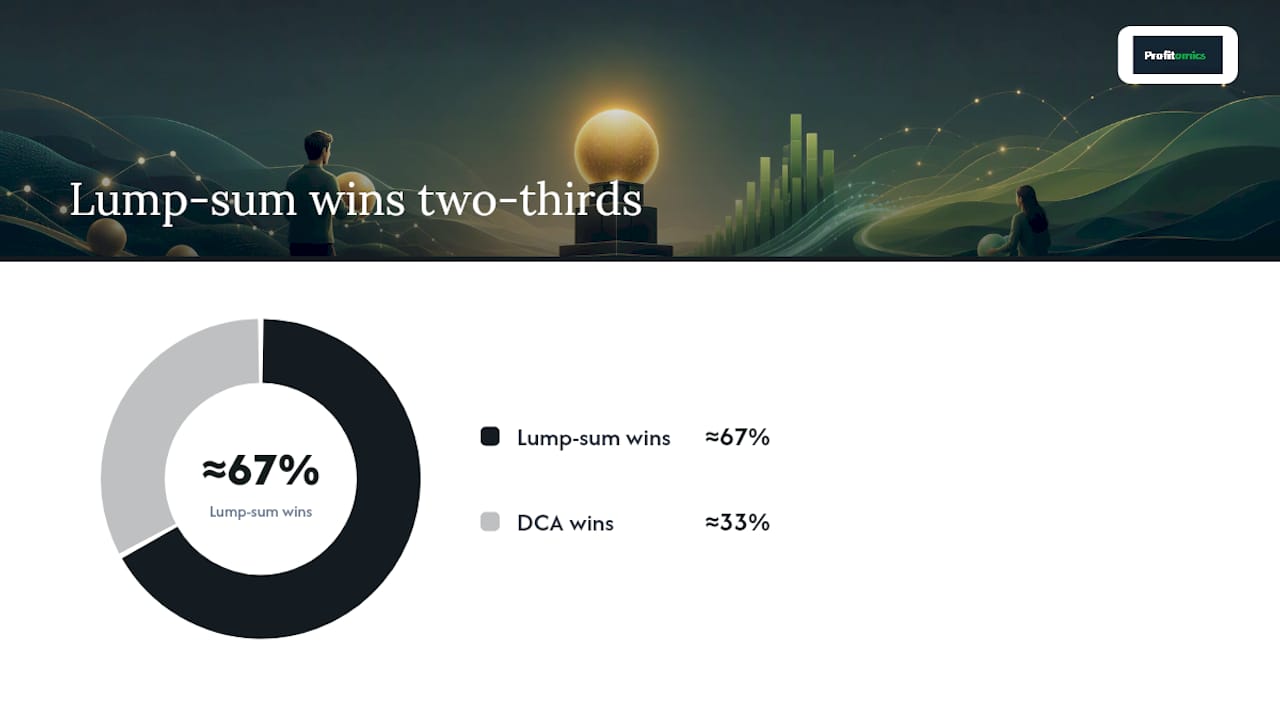
Here’s the uncomfortable truth most DCA advocates skip: if you’re sitting on a lump sum and the market generally trends up over time, investing it all immediately tends to beat spreading it out. Modeling based on historical U.S. equity returns finds lump-sum investing outperforms phased investing roughly two-thirds of the time, simply because more money spends more time in the market.
That doesn’t make DCA the wrong choice, it just narrows down when it’s the right one. Use this rough framework:
- You just received a windfall (bonus, inheritance, sale proceeds): lump-sum historically wins on average, but DCA over 3 to 6 months is a reasonable compromise if the size of the number makes you anxious enough that you’d otherwise delay investing entirely.
- You’re investing from ongoing income (paycheck, side income): there’s no lump sum to compare against, so DCA is the only real option, and it’s already the default in most retirement accounts.
- You’re risk-averse or new to investing: DCA’s behavioral value, avoiding the regret of buying right before a drop, can outweigh its statistical disadvantage.
- Markets feel expensive or volatile: phasing in a large amount smooths your entry price even if it costs you some expected return.
How to Set Up Dollar-Cost Averaging the Right Way
Getting started takes about fifteen minutes once you’ve made a few decisions.
- Pick your cadence. Per-paycheck contributions align with cash flow and require zero extra thought. Monthly is simpler to track. Weekly increases your number of purchases, and your fee exposure, without meaningfully improving your average cost.
- Set your dollar amount based on your budget and goal, not on what feels exciting. Consistency matters more than size.
- Choose your vehicle. Broad-market ETFs or index funds are the standard choice for most investors running a long-term DCA strategy, since they avoid the concentration risk of picking individual stocks.
- Minimize per-trade costs. Use a commission-free broker and fractional shares so small, frequent purchases don’t get eaten by fees, a point worth understanding before you start investing with fractional shares.
- Park uninvested cash somewhere productive, like a high-yield savings account, rather than letting it sit at 0% while it waits for its next scheduled purchase.
- Review annually. Rebalance if your allocation has drifted, but resist adjusting your DCA schedule based on short-term price swings.
Pro Tip: Automate the transfer, not just the investment. If you have to manually click “buy” every month, you’ll eventually skip a month during a downturn, which is exactly the moment DCA is supposed to protect you from.
A Worked Example: Calculating Your Average Cost
Suppose you invest $200 every month into an ETF for six months, and the price fluctuates along the way.
Total invested: $1,200. Total shares: 28.08. Average cost per share: $42.74, which is lower than the simple average of the six prices ($43.33) because more dollars landed on the two cheapest months.
Run the same $1,200 through a scenario where prices only climb, and lump-sum investing on month one would have outperformed this schedule. The math flips depending on the price path, which is exactly why Investopedia’s worked examples are worth studying against your own numbers. A spreadsheet that generates purchase quantities and running totals from a list of prices makes this instantly reproducible.
Who’s Behind This Guide
This guide is written by Kai, a practical investing educator focused on turning strategy into steps you can actually execute this week, not theory you file away.
Profitomics builds that execution layer directly:
- Ebooks that translate strategies like DCA into checklists rather than lectures.
- Spreadsheet templates for modeling your own DCA schedule against real price data.
- Beginner resources like a step-by-step plan to start investing for readers building their first routine.
Where Dollar-Cost Averaging Fits in a Real Portfolio
I favor DCA for anything funded by ongoing income and lump-sum for windfalls, unless the amount is large enough to cause real anxiety. The habit matters more than the math for most people. Pair it with an annual rebalance, and DCA stops being a debate and becomes a background process.
— Kai
Put Your Dollar-Cost Averaging Plan on Paper
Reading about DCA and actually running it are two different skills, and the gap between them is usually a missing spreadsheet, not missing motivation. Profitomics ebooks are built to close that gap: step-by-step checklists, sample DCA schedules, and reusable templates instead of another theory-heavy course.
If you’re just getting your footing with individual stocks, Stock Market Mastery walks through swing trading and long-term compounding strategies with templates you plug your own numbers into. Curious about applying the same DCA discipline to digital assets? The Crypto Profit System frames a risk-first approach to crypto DCA strategy, useful if you’re weighing DCA vs. buying the dip on volatile assets. And if your goal is broader than one asset class, the Passive Income Blueprint bundles systematic investing templates with other income-building frameworks. Pick the ebook that matches where you’re starting, download it instantly, and start plugging your own numbers into the worksheet the same day. Browse the full lineup at Profitomics.
Sources
- Investor
- Dollar-Cost Averaging (DCA): What It Is, How It Works, and Example — Investopedia
- The Benefits and Limitations of Dollar-Cost Averaging | FINRA
- Dollar cost averaging — Wikipedia
FAQ
Does Dollar-Cost Averaging Really Work?
It works as a discipline and risk-management tool, smoothing your entry price and removing timing decisions, but it doesn’t guarantee a profit or beat lump-sum investing in a rising market.
What Does Warren Buffett Say About Dollar-Cost Averaging?
Buffett has generally favored investing available cash promptly in quality businesses rather than phasing it in, consistent with the lump-sum advantage seen in historical market modeling, though his approach centers on selecting businesses, not on timing mechanics.
What if I Invested $10,000 in the S&P 500 20 Years Ago?
The outcome depends entirely on the exact entry and exit dates and reinvested dividends, so there’s no single universal number. Modeling your own scenario with a spreadsheet template that accepts historical prices is more useful than any single quoted figure.
Is It Better to DCA Daily or Weekly?
Weekly or monthly cadences are more common than daily, since more frequent purchases raise your transaction count and fee exposure without meaningfully improving your average cost. Monthly, tied to your paycheck, is usually the simplest and most sustainable choice.