Low Single Digits: How Beginners Should Allocate Crypto and Stocks

For most beginners, stocks belong at the center of a portfolio, with crypto held back as a small, speculative extra — never the main event. The right split depends on your time horizon, how much loss you can stomach without panic selling, and what you’re actually saving for. If retirement is the goal, stocks and ETFs should do almost all the work. If you just want exposure to something new with money you can afford to lose, a small crypto slice is fine.
TL;DR:
- Beginners should keep stocks as the main portfolio component, with crypto limited to a small, high-risk satellite if they can tolerate volatility.
- Crypto markets operate 24/7 with high daily swings and less regulation, increasing risks of emotional trading and total loss without insurance protections.
- Investing in stocks requires understanding company fundamentals, while crypto value depends on adoption, scarcity, and network belief, making each suitable for different risk profiles.
- Establishing proper habits, such as dollar-cost averaging, secure custody, and diligent record-keeping, is more crucial than choosing the perfect investment initially.
- Crypto may only make sense for long-term, fully funded emergency savers with genuine curiosity, not for short-term goals like house down payments.
Table of Contents
- Crypto vs Stocks for Beginners: What Are Stocks?
- Crypto vs Stocks for Beginners: What Is Cryptocurrency?
- What Are the Real Differences Between Stocks and Crypto?
- How Should Beginners Split Stocks and Crypto in a Portfolio?
- How Do You Actually Get Started With Stocks and Crypto?
- What Mistakes Cause the Most Damage for New Investors?
- A Simple Framework for Getting Started
- When Does Crypto Actually Make Sense for a Beginner?
- Ready-Made Templates for Stocks and Crypto
- Sources
- FAQ
Crypto vs Stocks for Beginners: What Are Stocks?
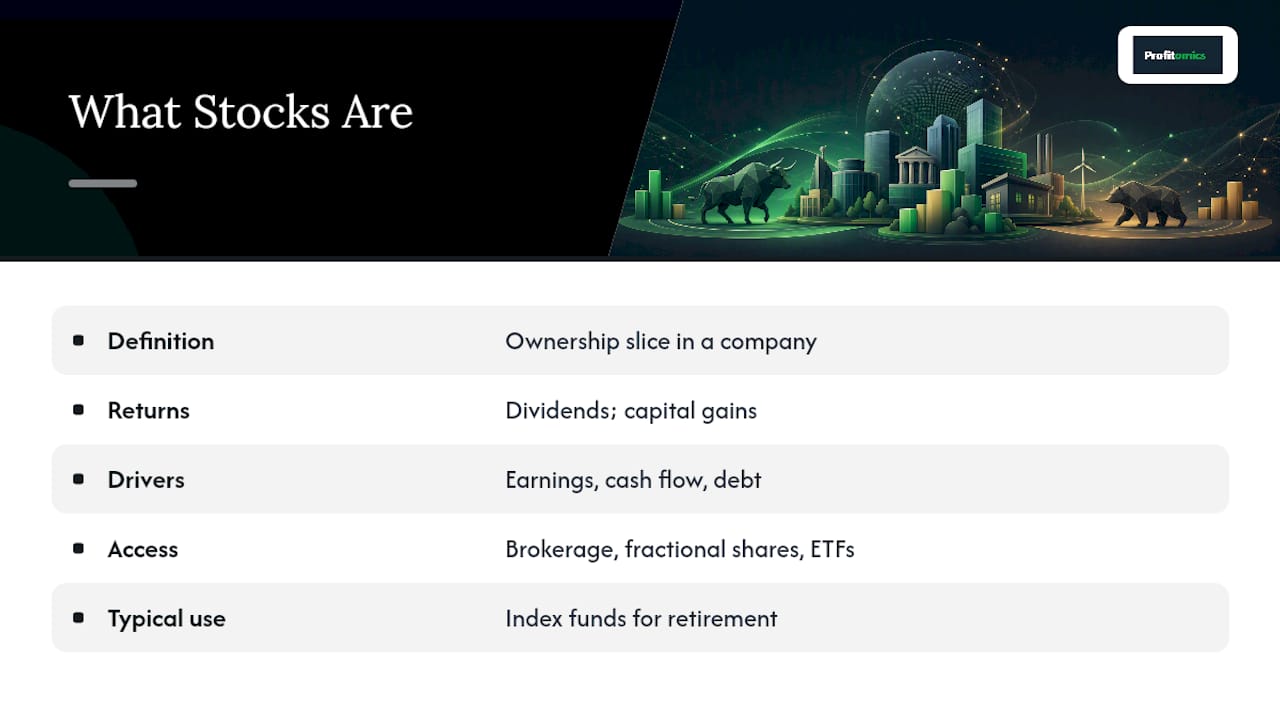
A stock is a slice of ownership in a real company, which is a key concept explained in Cap Rate Explained: A Beginner’s Guide for Investors. Buy one share of an airline or a coffee chain, and you legally own a tiny fraction of its equipment, brand, and future profits. Returns come from two places: dividends, which are cash payouts some companies distribute quarterly, and capital gains, the difference between what you paid and what the stock is worth when you sell.
Company fundamentals drive the price over time. Earnings growth, cash flow, debt levels, and competitive position all feed into what a stock is worth. That is the anchor crypto lacks. You can open a beginner brokerage account, buy fractional shares for a few dollars, or put money into a diversified ETF that holds hundreds of companies at once. Investor is a solid starting point if you want the mechanics without the jargon. Most people building retirement savings lean on index funds precisely because they don’t require picking individual winners.
Crypto vs Stocks for Beginners: What Is Cryptocurrency?
A cryptocurrency is a digital asset that lives on a blockchain, a shared public ledger that records who owns what. Unlike a stock, owning Bitcoin or Ethereum does not give you a claim on a company’s earnings or assets. There’s no CEO, no quarterly earnings call, no balance sheet to analyze.
Value instead comes from network adoption, how many people and businesses actually use the token, plus tokenomics: the supply schedule, scarcity, and any utility the token has, like staking rewards. Smart contracts let certain tokens generate yield through staking, which functions a bit like a dividend but carries very different risk. For a first purchase, stick to major, liquid coins like Bitcoin or Ethereum through a regulated exchange, or consider a spot crypto ETF inside a normal brokerage account if you’d rather skip wallets entirely.
What Are the Real Differences Between Stocks and Crypto?
The comparison boils down to six things that actually change how you should behave as an investor, not abstract philosophy.
- Ownership and value drivers. Stocks are backed by real earnings and assets; crypto is backed by adoption, scarcity, and belief in the network.
- Volatility. Crypto routinely swings 10% to 20% in a single day. A diversified stock ETF rarely moves that much in a month.
- Trading hours. The NYSE runs Monday through Friday, 9:30 AM to 4:00 PM ET. Crypto markets trade 24 hours a day, 365 days a year, including holidays and 3 AM on a Sunday.
- Regulation. Stocks trade inside a mature system overseen by the SEC and FINRA, with brokerage protections like SIPC covering certain account types. Crypto regulation is still catching up, and Congress continues debating new crypto legislation, which means the rules you buy under today could shift.
- Custody. Your broker holds your stocks in an account with established safeguards. Crypto held on an exchange depends on that exchange’s security; crypto in a self-custody wallet depends entirely on you protecting a private key or seed phrase, with no institution to call if you lose it.
- Taxes. Both are taxable, but the IRS treats crypto transactions as events that trigger reporting far more often than stock trading does, including trades between two different coins.
The 24/7 nature of crypto markets deserves its own callout: there is no closing bell. Stock investors get overnight and weekend breaks that naturally slow down impulsive decisions. Crypto never pauses, which is exactly why FINRA warns that crypto’s volatility, combined with round-the-clock access, makes emotional trading far easier to fall into. And when it comes to protections, the FDIC has been direct: most crypto holdings carry no FDIC or SIPC-equivalent insurance, so a hacked exchange or a lost password can mean a total loss with no safety net.
How Should Beginners Split Stocks and Crypto in a Portfolio?
Think of your portfolio in two layers: a core and a satellite. The core is the boring, dependable part, mostly broad stock ETFs, that’s built to compound quietly over decades. The satellite is a smaller, higher-risk slice you can afford to lose without changing your life, and that’s where crypto fits.
- Beginners with a long horizon (10+ years) and a fully funded emergency fund can reasonably size a crypto satellite in the low single digits of their total portfolio.
- Beginners still building an emergency fund, or investing money they’ll need within a few years, should skip crypto for now and put everything toward stocks and cash savings.
- If watching a 30% drop overnight would make you panic sell everything, that’s a sign your risk tolerance doesn’t match crypto yet, regardless of your account balance.
Pro Tip: Before you buy a single dollar of crypto, ask yourself if you’d be fine never touching that money again. If the answer is no, that money belongs in your core, not your satellite.
How Do You Actually Get Started With Stocks and Crypto?
Getting started is less about picking the perfect asset and more about setting up the right habits before you put real money in.
- Open the right accounts. A standard brokerage account covers stocks and ETFs. If you’re adding crypto, use a reputable, regulated exchange rather than an obscure platform you found through a social media ad.
- Use dollar-cost averaging. Investing a fixed amount on a regular schedule, weekly or monthly, smooths out the effect of buying at a bad moment. Fractional shares mean you can start with $20 in a stock ETF instead of waiting until you can afford a full share.
- Lock down security basics. Turn on two-factor authentication everywhere. Decide whether you want your crypto on the exchange (easier, but the exchange controls it) or in a hardware wallet you control (safer from exchange failure, but you’re now responsible for your seed phrase). Never enter that seed phrase on a website someone emailed or messaged you.
- Keep records as you go. Every crypto trade, and every stock sale, needs to be tracked for tax season. A simple spreadsheet at the time of the trade saves hours of reconstruction later.
- Practice before it counts. If you’re nervous about timing or mechanics, paper trading lets you test decisions with fake money before risking real capital.
Pro Tip: Set up your dollar-cost averaging as an automatic transfer the same day you get paid. The version of you that has to manually click “buy” every month will eventually skip it.
If you want the account-opening and fractional-share mechanics spelled out step by step, Profitomics has a beginner investing plan and a guide to fractional shares that walk through both.
What Mistakes Cause the Most Damage for New Investors?
Two different kinds of risk hit beginners, and they need different fixes. Market risk is the normal ups and downs of an asset’s price. Platform and custody risk is losing access to your money because of a hack, a lost password, or a broker failure, entirely separate from whether the asset itself performed well.
The behavioral mistakes tend to repeat across every new investor cohort:
- Overtrading because watching a chart feels productive.
- Using leverage or margin before understanding how it multiplies losses, not just gains.
- Buying into a coin or stock purely because it’s trending, then panic selling when it drops.
- Ignoring taxes until filing season and scrambling to reconstruct a year of trades.
The fixes are unglamorous but effective: diversify instead of concentrating in one bet, decide your exit point before you buy rather than after a loss, keep crypto in secure custody you actually understand, and log every taxable event the day it happens. None of this requires special skill. It requires doing it consistently, which is the part almost everyone skips.
A Simple Framework for Getting Started
The order matters more than the exact numbers: set a clear goal, fully fund an emergency cushion, then build your core with stock ETFs before considering any crypto satellite. Review the whole thing every few months rather than every few days.

Templates and checklists can help organize each step as a worksheet instead of a vague intention. Treat any example allocation as an illustration of the process, not a promise of results.
When Does Crypto Actually Make Sense for a Beginner?
A reader with a fully funded emergency fund, a decade or more before they’ll need the money, and genuine curiosity about the technology is a reasonable candidate for a small crypto satellite. Someone saving for a house down payment in two years is not, and no amount of enthusiasm changes that math. If you want a repeatable process instead of guesswork, the checklists and templates built around this framework are worth working through step by step.
— Kai
Ready-Made Templates for Stocks and Crypto
The frameworks in this article work better with the paperwork already done for you. The Stock Market Mastery ebook breaks down swing trading and long-term compounding into templates you can fill in the same day you buy your first ETF share. If you’re leaning toward a crypto satellite, the Crypto Profit System walks through a risk-first framework for sizing positions and managing exposure, instead of chasing whatever coin is trending that week.

Both come with checklists and spreadsheets built for instant use, not theory you have to translate into action yourself. If you’d rather practice the mechanics first, A paper trading guide is available for testing your approach with zero capital at risk. Preview the Stock Market Mastery checklist or the Crypto Profit System framework and decide which one matches where you actually are right now.
This article is general information, not a substitute for advice from a qualified financial advisor. Consult a qualified financial professional about your own circumstances before acting on anything here.
Sources
- FDIC — Crypto fact sheet
- U.S. Securities and Exchange Commission (SEC)
- IRS — Topic No. 409 Virtual Currencies
FAQ
Is It Better to Invest in Stocks or Crypto?
For most beginners, stocks are the better starting point because they’re backed by company fundamentals and operate inside an established regulatory system. Crypto can be added later as a small satellite once you have a stable core and understand the volatility involved.
Is $100 Enough to Start Investing in Crypto?
Yes. Most regulated exchanges and brokerages allow fractional purchases, so you can buy a portion of Bitcoin or a fractional share of a stock ETF without needing to buy a whole unit.
What Has Warren Buffett Said About Crypto?
Buffett has been publicly skeptical of Bitcoin and crypto for years, arguing it doesn’t produce anything and has no intrinsic value the way a business does. His preference has consistently stayed with owning shares of productive companies over speculative assets.
What If I Had Put $1,000 Into Bitcoin Five Years Ago?
Bitcoin’s price has moved through several dramatic cycles over any five-year stretch, including sharp rallies and steep crashes, so the outcome depends heavily on the exact entry and exit dates. That swing is the clearest illustration of why crypto belongs in the satellite portion of a portfolio, not the core, for a beginner who can’t predict timing.
Do I Need a Brokerage Account for Both Stocks and Crypto?
You need a standard brokerage account for stocks and ETFs, and either that same brokerage (if it offers crypto or spot crypto ETFs) or a separate regulated exchange for direct crypto ownership.