Best Ecommerce Books for 2026: What to Read and When

The best ecommerce books are the ones that match the problem you have this month. If you are picking a first product, start with a dropshipping guide such as The Ultimate Guide to Dropshipping. If your store exists but your message is weak, read Building a StoryBrand. If sales come in but cash never stays, read Profit First. Below you will find the books worth your time, what each teaches, and a simple way to choose. For broader reading, digital marketing ebooks can fill in the traffic and promotion side.
TL;DR
- Read one practical guide for your model (dropshipping, Shopify store, retail) and one book on a single weak spot, such as messaging or cash.
- The Ultimate Guide to Dropshipping is the most consistently recommended starting point for dropshippers.
- The Personal MBA and Profit First cover the business fundamentals that ecommerce guides skip.
- Reading alone does not build a store. Pick the book you will act on this week.
- Our own ebooks, including Side Hustle to Six Figures, are for readers who want templates and checklists, not theory.
Table of Contents
- How to choose an ecommerce book
- Best ecommerce books at a glance
- Best books for dropshipping beginners
- Best books for starting and growing a store
- Best books on the business side of online selling
- What about the 80/20 rule?
- Our perspective
- Where Profitomics fits
- A simple reading plan
- FAQ
- Sources
How to choose an ecommerce book
Most lists ranking for this topic hand you twenty titles and no order. That is how people end up with a stack of unread books. Shopify’s roundup makes the useful point: choose based on your current challenge, because some books suit beginners while others go deep on branding, growth marketing or logistics.
Andrew Youderian, founder of eComFuel, describes his own approach as just-in-time reading: he picks topics he is curious about or will implement in his business. That is a good filter. Ask three questions before you buy:
- Where am I? No store yet, a store with no sales, or a store that sells but does not profit.
- What will I do in the next seven days? If the book does not change that answer, it is the wrong book for now.
- Which format do I need? A narrative like The Everything Store inspires. A step-by-step guide gets you moving. A framework book changes how you decide.
A beginner-oriented shortlist from USA Drop (July 2026) suggests pairing one dropshipping guide with books on product testing, customer research, traffic channels, ad copy, persuasion, store messaging, cash control, retention and delegation. In practice that means one how-to book plus one specialist book, not a library.
Best ecommerce books at a glance
| Book | Best for | What it teaches |
|---|---|---|
| The Ultimate Guide to Dropshipping (Mark Hayes, Andrew Youderian) | Beginners starting a dropshipping store | Validating product ideas, retargeting, SEO, fixing supplier mistakes |
| Product Research 101 | Choosing what to sell | Best-selling products, market trends, profitable niches |
| The Wolf of Ecom | New or early-stage founders | Practical strategy for building a store |
| The Personal MBA (Josh Kaufman) | Anyone running an online business | Marketing, sales, negotiation, operations and systems as mental models |
| Building a StoryBrand (Donald Miller) | Stores with weak messaging | Clarifying your message so customers listen |
| Profit First (Mike Michalowicz) | Sellers with revenue but thin cash | Allocating bank accounts so profit is taken first |
| Zero to One (Peter Thiel) | Founders building a distinct brand | Creating unique value instead of copying |
| Anything, Anywhere (Matthew Bertulli) | Retail startups and established retailers | Digital road maps, channels, staffing, customer-journey data |
| The Everything Store (Brad Stone) | Inspiration and context | The story of Amazon and Jeff Bezos |
Best books for dropshipping beginners
The Ultimate Guide to Dropshipping
Volusion’s review of the best dropshipping books named this title by Mark Hayes and Andrew Youderian its top pick, highlighting product-idea validation, social-media retargeting, SEO campaigns and what to do when a supplier makes a fulfillment mistake. BrandsGateway also lists it as a beginner guide covering the model, finding products, setting up a business and online marketing. Note that the Volusion review dates from 2019, so confirm the edition you are buying and treat platform-specific tactics as a starting point.
Product Research 101 and other niche guides
The same BrandsGateway roundup describes Product Research 101 as a book about identifying best-selling products, product ideas, market trends and profitable niches. It also lists DropShip Institute for high-ticket products, Shopify Ecommerce for launching a Shopify store and 500 Social Media Marketing Tips for social strategy. If product selection is your bottleneck, a narrow book like this beats a general one.
Short step-by-step guides
Shorter self-published guides exist too. One example is Ezeanaka’s 92-page dropshipping paperback from 2019, whose listing says it covers the model, setup and funding, fulfillment, three sales channels, product and niche research, supplier vetting, inventory, fraud, chargebacks, pricing and seven scaling strategies. Short books are quick to finish, but they are also quick to date, so check the publication year before you rely on any ad or platform advice.
Print on demand
Print on demand shares most of the dropshipping playbook: you do not hold inventory, a partner fulfills each order and your edge is niche selection and design. Read a general dropshipping guide for the mechanics, then spend your effort on audience research and product testing, which the USA Drop shortlist above treats as core topics.
Best books for starting and growing a store
The Wolf of Ecom
Shopify’s list names The Wolf of Ecom as a practical strategy book for new or early-stage founders. It sits in the hands-on category rather than the theory one.
Anything, Anywhere
Matthew Bertulli’s book, published October 24, 2017, is described by Scribe Media as a step-by-step playbook for retail startups and established B2B and B2C retailers. It covers digital road maps, technology and staffing, online channels, goals, channel separation and customer-journey data. It suits a store that is growing into multiple channels more than a first-timer.
Ecommerce fundamentals
If you want strategy basics, Ebusiness: A Beginner’s Guide by Toby Velte and Robert Elsenpeter covers e-commerce strategy, including securing transactions and managing quality of service. It dates from 2000, so read it for foundations, not for current tactics. For a more current starting point, see our own guide to starting an ecommerce brand style fundamentals: product selection, suppliers and a clear first offer.
Best books on the business side of online selling
Building a StoryBrand
Donald Miller’s 2017 book, subtitled Clarify Your Message So Customers Will Listen, is a frequent pick for store owners whose product pages do not convert. Its list price is $24.99 for the illustrated hardcover (ISBN-13 9780718033323). Prices change, so check a current retailer.
Profit First
Mike Michalowicz’s method is simple: Sales minus Profit equals Expenses, applied through bank-account allocation. The Apple Books listing shows a $10.99 ebook, 224 pages, from Penguin Publishing Group. There is also an ecommerce-specific edition, Profit First for Ecommerce Sellers by Cyndi Thomason, but the research here covers the original, so confirm the edition you want.
The Personal MBA
Josh Kaufman’s book breaks entrepreneurship, marketing, sales, negotiation, operations and systems design into mental models. It is not about ecommerce specifically, which is the point: it fills the business gaps a niche guide leaves.
Zero to One
Peter Thiel and Blake Masters argue that entrepreneurs should create unique value rather than improve what already exists. For ecommerce, that is a warning against selling the same item as every other store with a different logo.
The Everything Store
Brad Stone’s account of Amazon and Jeff Bezos is a narrative, not a manual. Read it for context on how the marketplace you sell on was built, not for steps.
What about the 80/20 rule?
Readers often ask what the 80/20 rule means in ecommerce. Feedvisor explains that a small share of products or customers usually produces most revenue, while the exact ratio varies. Its advice: segment products by sales volume and profitability, put resources behind the top performers and reassess periodically. No single book owns this idea. Profit First and The Personal MBA both push the same habit of measuring before you spend.

Our perspective
We sell ebooks, so we have a bias, and we will say it plainly: books do not build stores, actions do. The pattern we see among beginners is collecting. They read five books, make no first sale, and conclude they need a sixth.

Our approach at Profitomics is the opposite. We strip out theory and give readers frameworks, templates, checklists and worksheets they can use the same day. That is why we would tell you to read a classic like The Personal MBA for thinking and a hands-on guide for doing, and to set a deadline for the first action before you open the first page.
One rule we use: after each chapter, write down one thing you will do within 48 hours. If you cannot, skip ahead to a chapter you can act on.
— Kai
Where Profitomics fits
We do not publish a dropshipping title, and we would not pretend otherwise. Our books are for readers who want to turn a skill or idea into income and want a system to follow.
Side Hustle to Six Figures costs $29 one time and is built to help you turn any skill or idea into an income stream, which suits a future store owner who has not yet decided what to sell. Passive Income Blueprint is $27 one time and covers building multiple income streams. Both arrive instantly as a PDF with companion materials.
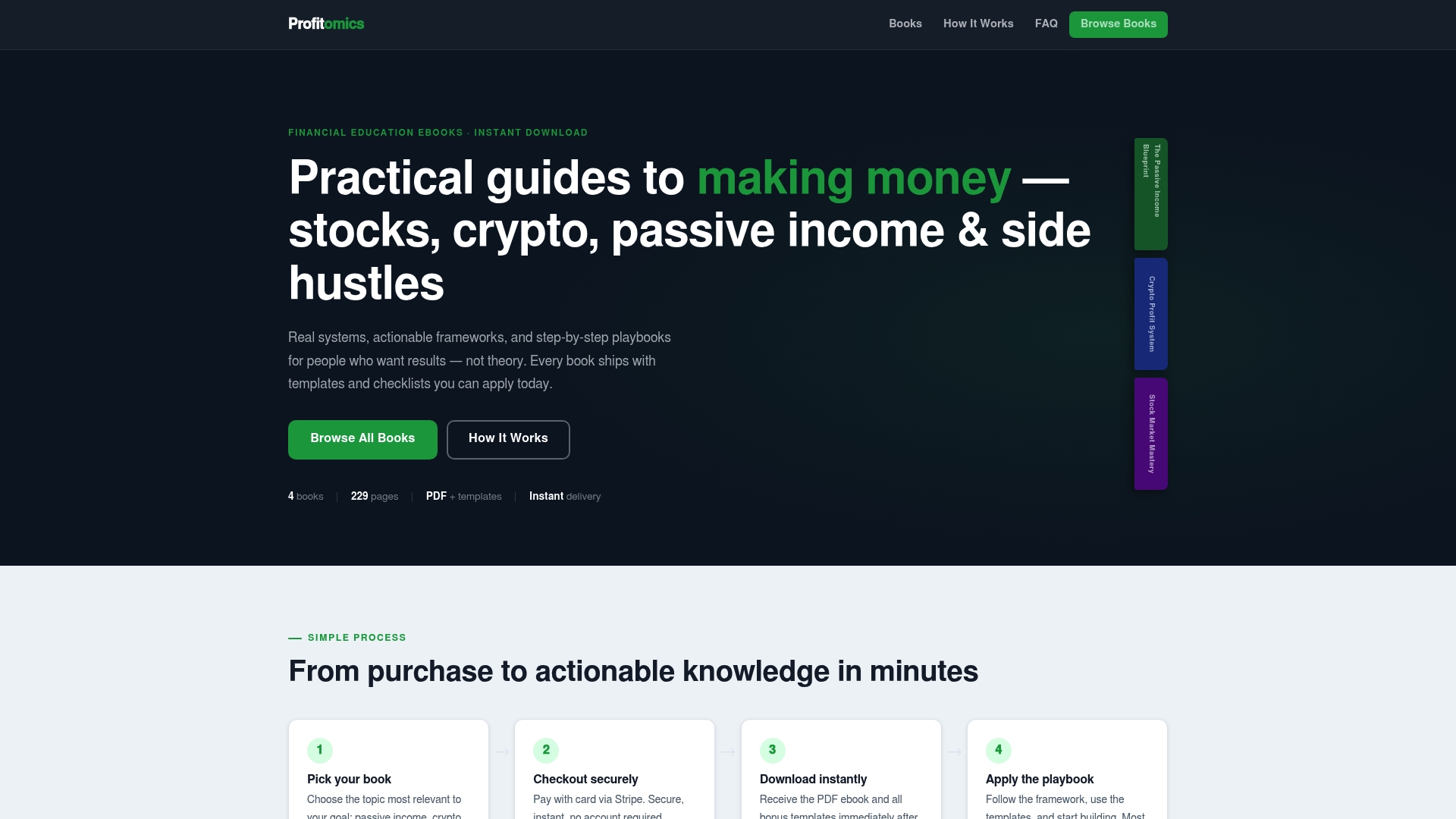
If you are still weighing formats, our guide to the best ecommerce courses compares books with structured courses, and our list of digital product ideas can help you pick what to sell. Browse everything on Profitomics.
A simple reading plan
- Week 1: Read one practical guide for your model. For dropshipping, start with The Ultimate Guide to Dropshipping. Pick a niche and a handful of product ideas.
- Week 2: Add a product research or customer research book. Test before you build.
- Week 3 and after: Read one fix-it book when a real problem appears: StoryBrand for weak messaging, Profit First when revenue does not become cash.
- Later: Read Zero to One or The Everything Store when you have time to think about the long game.
New to making money online at all? Our side hustle ideas for beginners under $50 is a cheap way to test the habit before you commit to inventory or ad spend.
FAQ
What are the top books on ecommerce?
For most readers the shortlist is The Ultimate Guide to Dropshipping, The Personal MBA, Building a StoryBrand and Profit First. Add The Wolf of Ecom if you want a hands-on strategy title. The Everything Store is good background but not a how-to.
What is the best book for dropshipping beginners?
The Ultimate Guide to Dropshipping by Mark Hayes and Andrew Youderian is the most commonly recommended starting point. It covers product validation, marketing and supplier problems. Pair it with a product research book if you are unsure what to sell.
Do I need an ecommerce book, or is a course better?
A book is cheaper and faster to scan, and a course adds structure and feedback. Choose based on how you learn and how much you will actually finish. We compare both in our guide to ecommerce courses.
Are older ecommerce books still worth reading?
Yes for fundamentals such as strategy, messaging and cash management, which change slowly. No for ad platforms, app stores and tool tutorials, which date within a couple of years. Check the publication year and treat tactics as ideas to verify.
Sources
- Shopify: Best Ecommerce Books
- USA Drop: Best Dropshipping Books for Beginners
- Andrew Youderian interview, The CEO Library
- Volusion: The 5 Best Dropshipping Books
- BrandsGateway: Best Dropshipping Books
- eBay listing: Dropshipping step-by-step guide
- Scribe Media: Anything, Anywhere
- ACM: Ebusiness, A Beginner’s Guide
- CheapestTextbooks: Building a StoryBrand
- Apple Books: Profit First
- Feedvisor: Ruling Revenue with the 80/20 Rule
- Tianxia: The Everything Store (Taiwan edition)