Affiliate Program Setup: 8 Steps to Launch Yours in 2026

To set up an affiliate program, work out what you can afford to pay per sale, choose where the program will run, write the rules, recruit a few partners who already reach your buyers, and track every sale back to the partner who sent it. For a small digital-product seller, the order matters more than the software: margin first, tools second, recruiting last. This guide walks through each step with the numbers and the rules you need, plus a checklist you can work from.
It is written for people building income on their own: side hustlers, online entrepreneurs with an ebook or course, and anyone turning a skill into a product. If you sell a digital product and want other people to sell it for you, this is your path.
TL;DR
- Set your commission from your margin, not from what competitors advertise. The commission has to fit inside what is left after refunds and payment fees.
- Run a simple in-house program with a tracking plugin or tool while you have a handful of partners. Networks add reach but also cost real money.
- Write the terms before you recruit: commission, attribution window, payout schedule, refund handling and disclosure requirements.
- U.S. affiliates must disclose their commission relationship. You, as the merchant, are expected to set that expectation and watch what partners post.
- Check the numbers by partner every month: clicks, conversion rate, refunds and cost of sale.
Table of Contents
- What an affiliate program actually is
- Step 1: Start with your margin and your goal
- Step 2: Choose what partners will promote
- Step 3: Decide where the program will run
- What setup costs
- Step 4: Set commissions, attribution and payout terms
- Step 5: Write your terms and your disclosure rules
- Step 6: Recruit partners who already reach your buyers
- Step 7: Track results and review them monthly
- Step 8: Launch checklist
- Our perspective
- Build the product your program will promote
- FAQ
- Sources
What an affiliate program actually is
An affiliate program is a performance-based deal. Partners promote your product through their own channels, and you pay a commission only when a tracked referral produces a sale or another action you agreed on. Mailchimp describes the mechanics: each affiliate gets a custom link to your purchase page, and when a customer clicks it and buys, the sale is credited to that partner.
Three terms carry the whole arrangement. The offer is what the partner promotes. The payout model is how they are paid. The attribution window is how long after a click a purchase still counts for that partner. Coinis’s definition puts all three in the brand’s hands, while the partner brings the traffic.
That is why setup is mostly decision-making. The software only records what you decided.
Step 1: Start with your margin and your goal
Before you open any tool, do the arithmetic. The commission must fit inside the product’s contribution margin after refunds and processing fees. Coinis gives a blunt example: a 30% commission on a product with a 25% margin loses money on every sale.
For a digital product, the margin is usually high because there is no shipping and no inventory. That is the reason digital products suit affiliate programs well. Here is a worked example with a $27 ebook:
| Line | Amount |
|---|---|
| Sale price | $27.00 |
| 30% commission | $8.10 |
| Payment processing (example: 3% plus $0.30) | about $1.11 |
| Refund allowance (example: 5% of sales) | about $1.35 |
| What is left for you | about $16.44 |
The processing and refund figures are placeholders: replace them with your own checkout fees and your own refund rate. The point is the method. Every line is subtracted before you decide whether a rate is sustainable.
Then set a measurable goal. Useful ones include extra revenue, new leads or email subscribers, and average order value by partner. Pick one or two. “More sales” is not a goal you can check in three months.

Step 2: Choose what partners will promote
Pick the product that has proven demand and gives a buyer a reason to choose you over an alternative. If you only have one product, promote that one. If you have a range, start with the one buyers already finish and talk about.
Partners promote what converts. A clear, specific product with a landing page that explains who it is for is easier to recommend than a vague one. If you are still deciding what to sell, the 60+ digital product ideas list is a practical place to narrow it down, and affiliate niche research shows how to check whether a market has real demand before you build for it.
A product page that turns visitors into buyers matters more than the commission rate. A partner who sends 500 clicks to a page that does not convert earns nothing and will not come back. Build the path first: a sales funnel for ebooks covers it step by step.
Step 3: Decide where the program will run
You have two routes. You can run your own program, or you can join an affiliate network. The U.S. Chamber of Commerce’s April 2026 guide summarizes the trade: running your own costs less and gives more control but takes more work, while networks give you an existing pool of affiliates and a fast start, at a high cost.
For a first program with one to ten partners, running your own is the usual fit. You already know the people you want to work with, so paying for access to a marketplace of strangers buys you little. Many online checkout tools and shopping carts include an affiliate feature. Systeme.io, for example, lets you configure its built-in affiliate program under account settings, including a minimum payout amount.
Whichever route you pick, ask four questions of any tool:
- Does it assign each partner a unique link and record the sale automatically?
- Can you set the commission, the attribution window and the payout threshold yourself?
- Does it handle refunds, so a refunded sale does not pay out?
- Can partners see their own clicks and earnings?
Partners also tend to promote through video, so it helps to know how video marketing works for a business when you brief them on what you would like to see.
What setup costs
Costs vary a lot by route, and the largest line is almost always the commissions themselves. The figures below are published ranges for different tools, each with the year of the source. Prices change, so confirm them on each provider’s page.
| Route | Published cost | Source |
|---|---|---|
| Shopping-cart plugin | No software fee beyond commissions | Siege Media, 2026 |
| Everflow tracking platform | Starts around $500 | Siege Media, 2026 |
| Full network launch | Budget closer to $5,000 | Siege Media, 2026 |
| impact.com | Starter from $30/month, Essentials from $500/month, Pro from $2,500/month, plus a 2.5% fee on partner-driven transactions | CompareSharp, 2026 |
| PartnerStack | Launch tier from $1,000/month, paid annually | CompareSharp, 2026 |
Notice what dominates. AffiliateRail’s analysis of 358 public program pages found a median commission of 25%, with 20% the most common rate. On a program doing $10,000 a month, a $2,500 commission payout is 94% to 98% of the total cost, against $49 for software. So the question “how much will this cost?” is really “how much will I pay per sale?” Software is the small part.
Step 4: Set commissions, attribution and payout terms
Now decide the rate. The Chamber’s guide advises calculating profit margins first and notes that many programs pay between 5% and 25% depending on industry, with tiered rates as an option. Digital products can pay more than physical goods because they carry no unit cost, which is why digital-product programs often sit higher in that range. The AffiliateRail median of 25% is a sensible reference point once your own margin check from Step 1 allows it.
Choose a payout model:
- Percentage of the sale: the most common, and easy for partners to understand.
- Fixed fee per sale: simple for a single-price product.
- Pay per lead: useful if the goal is email subscribers rather than purchases.
- Recurring commission: only for subscription products.
Semrush lists these models side by side. Impact.com adds that the contract should define the conversion event, the payout amount and the timing, which is the part most beginners leave vague.
Then fix the attribution window. Shopify explains that a tracked visit can be credited if a qualifying purchase happens within the program’s window. A longer window is more generous to partners. A shorter one protects you from paying for a purchase the buyer would have made anyway. Pick a number, write it down, and apply it to everyone.
Payouts are where small programs stumble. SendOwl’s guide for digital products points out that payment-method fees can reduce what an affiliate receives, so decide who absorbs them and state it plainly. Choose a minimum payout, a monthly schedule, and a holding period long enough for refunds to clear. Then pay on the date you promised, even when the amounts are small.
Step 5: Write your terms and your disclosure rules
Put the terms in writing before the first partner joins. A short affiliate agreement should cover the commission and attribution window, the payout schedule and minimum, how refunds and chargebacks are handled, what promotion methods are not allowed, and the disclosure requirement. The Chamber’s guide advises writing promotion and branding rules into the program terms and telling potential affiliates that they must disclose their relationship with you.
The U.S. disclosure rule
This is the part you cannot skip. The Federal Trade Commission (FTC) requires that a connection between an endorser and a seller be disclosed when it could affect how people weigh the endorsement. For affiliates, that means a commission. The FTC’s own guidance says an affiliate should disclose the relationship in videos and near the links, and that disclosures belong in whatever language the endorsement is made in. In some cases, such as a link embedded in a product review, a single disclosure can be enough.
The federal regulation behind this is the Endorsement Guides, 16 CFR Part 255, which state that reviews by affiliates should clearly disclose compensation when that knowledge could change how much weight consumers give them. The FTC also finalized its Consumer Reviews and Testimonials Rule in August 2024, which targets fake reviews, including AI-generated ones, as summarized by a law firm that advises influencers.
In practice, put three lines in your agreement and your welcome email:
- Partners must say they earn a commission, in plain words, close to the link.
- Partners may not post fake reviews or invent results, including income claims you cannot support.
- You will check partner content and can remove anyone who breaks these rules.
This is general information, not legal advice. If your program pays partners at scale or promotes anything about money, health or income results, have a lawyer review your agreement.
Step 6: Recruit partners who already reach your buyers
A small program lives or dies on a few people. Coinis reports that the top 5% of partners drive 80% of revenue, so your time goes to finding and supporting that group rather than signing hundreds of inactive accounts.
Start with people whose audience already matches your buyers:
- Your existing customers who have finished the product and say good things about it.
- Newsletter writers, bloggers, YouTubers and podcasters in your niche.
- Peers who sell a complementary product and share your kind of reader.
Approve partners by looking at their actual content: does it fit your product, is the audience real, and do they already disclose sponsored links? Reject the rest politely. Then give approved partners what they need to promote well: your link, a short description of who the product is for, a few images, sample copy, and the disclosure wording you want. A partner with ready assets promotes sooner and more accurately.
Send one personal message to each partner in the first week and another after their first sale. Small programs keep partners through attention, not through dashboards.
Step 7: Track results and review them monthly
Check the numbers by partner once a month. The Chamber’s guide recommends tracking clicks, conversion rate and cost of sale to see who is valuable and whether the program is profitable. Shopify’s guide adds returns by affiliate, and checks for self-referrals, coupon leakage and compliance with disclosure and claims rules.
A simple monthly review looks like this:
| Metric | Question it answers |
|---|---|
| Clicks | Is the partner sending traffic? |
| Conversion rate | Does that traffic buy? |
| Refund rate | Are the buyers happy with what they got? |
| Cost of sale | Is the commission still inside your margin? |
| Disclosure check | Is the partner following your rules? |
If a partner has strong clicks and weak conversion, the fix is usually your landing page or the match between their audience and your offer. If conversion is strong and clicks are low, send them more assets or a better offer. If refunds spike, look at what they are promising.
Step 8: Launch checklist
Work through this list in order before you announce the program:
- Margin calculated, with fees and refunds subtracted.
- One or two measurable goals written down.
- Product page tested and converting for non-affiliate traffic.
- Tool chosen: unique links, refund handling, partner dashboard.
- Commission, attribution window, payout minimum and schedule fixed.
- Agreement written, including disclosure and claims rules.
- Welcome email and promotional assets ready.
- First three to five partners approved personally.
- Test purchase made through a partner link to confirm the sale is credited.
- Monthly review date on your calendar.
Our perspective
Most affiliate programs that stall do not fail on software. They fail because the founder never worked out the numbers or never built a product page that sells without help. A partner can only amplify what already works.
That is how we build our own guides at Profitomics: practical steps, templates, checklists and worksheets that a beginner can use right away, with the theory trimmed out. The same approach fits affiliate setup. Do the margin sum on a sheet. Write the terms down. Work through a checklist. Review the numbers on a schedule.
If you are building income from a digital product, a structured system beats improvising each decision. The people who get a program running are the ones who treat it as a set of small, finished tasks.
Kai
Build the product your program will promote
An affiliate program multiplies a product that already sells. If you are still shaping your first income stream, our Passive Income Blueprint is a $27 one-time ebook, delivered instantly as a PDF with companion bonus materials, designed to help you build several income streams in a structured way. Side Hustle to Six Figures is $29 one-time and is aimed at people converting skills into income.
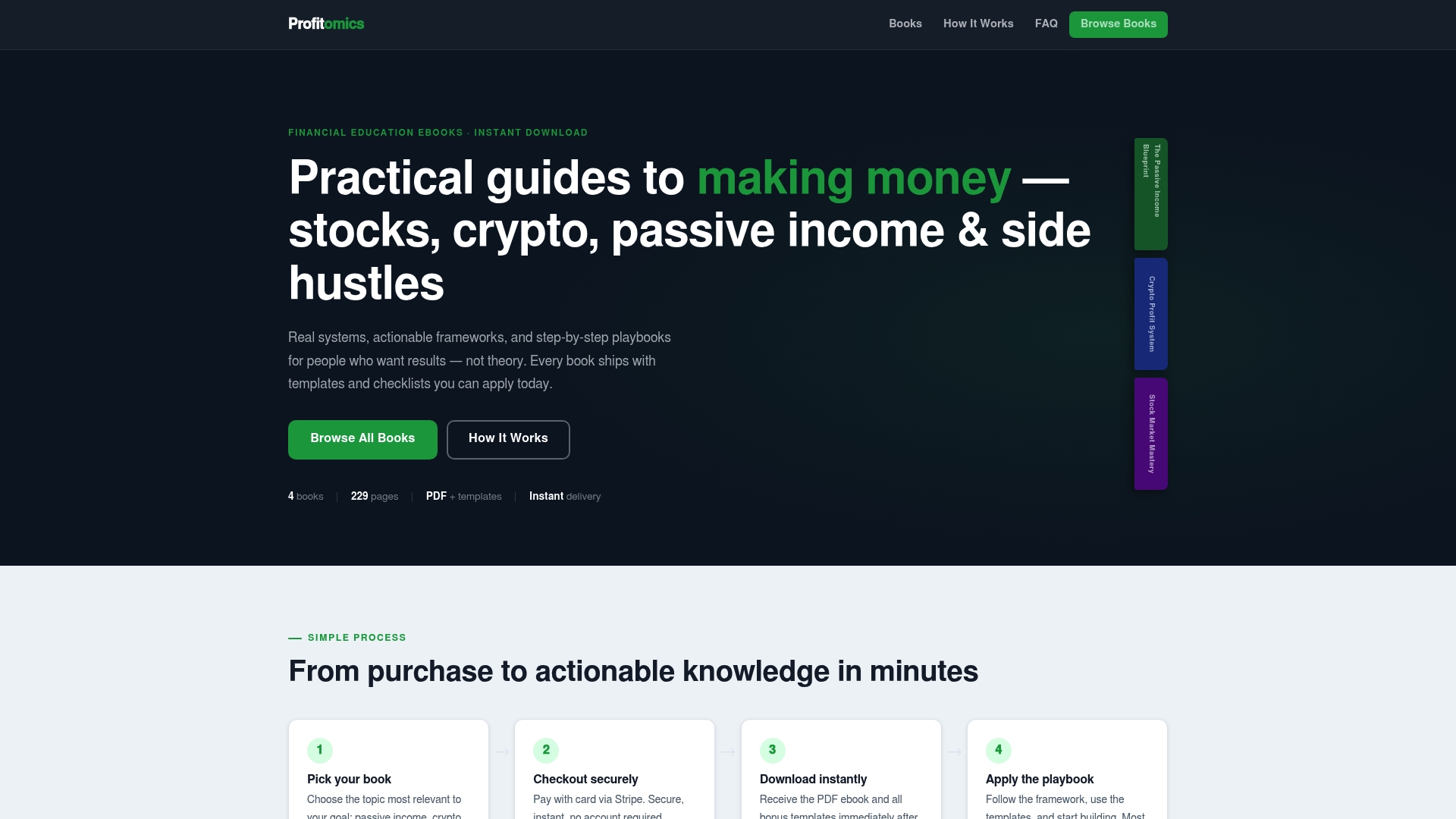
Both come with step-by-step frameworks and templates, so you can move from reading to doing. Browse the full range on the Profitomics site.
FAQ
How much does it cost to set up an affiliate program?
A simple program built on a shopping-cart plugin can carry no software fee beyond commissions, while a full network launch should be budgeted closer to $5,000. Commissions are usually the largest cost by far. Work out your margin first, then pick the cheapest tool that tracks sales and handles refunds.
Should I run my own program or join a network?
For a handful of partners you already know, your own program is usually enough and costs less. A network makes more sense when you need access to a large pool of affiliates and can absorb the fees. Start small and move to a network only when demand for partners outgrows what you can recruit yourself.
What commission should I offer?
Start from your margin after fees and refunds. Many programs pay between 5% and 25%, and AffiliateRail’s review of 358 programs found 25% as the median and 20% as the most common. Digital products can often pay at the upper end because they have no unit cost.
Do affiliates have to disclose that they earn commissions?
Yes, in the U.S. The FTC says the affiliate relationship should be disclosed clearly, near the links and in videos. Include the requirement in your agreement and check partner content now and then.
Sources
- How to Create a Successful Affiliate Marketing Program, U.S. Chamber of Commerce
- What is Affiliate Marketing? Mailchimp
- Affiliate Program: Definition, Models & Examples, Coinis
- How to create and configure your own affiliate program, Systeme.io
- How Much Does an Affiliate Marketing Program Cost in 2026? Siege Media
- impact.com vs PartnerStack, CompareSharp
- How much does an affiliate program cost in 2026? AffiliateRail
- How Do Affiliate Programs Work? Semrush
- What is an affiliate marketing program, impact.com
- Affiliate Marketing: How It Works in 2026, Shopify
- How to set up an affiliate program for your digital products, SendOwl
- FTC’s Endorsement Guides: What People Are Asking
- 16 CFR Part 255 (CFR 2025), GovInfo
- FTC Rules for Influencers, The Social Media Law Firm
- How To Start an Affiliate Program, Shopify UK
- Video Marketing for Business, Tatem Web Design