Mutual Funds vs. ETFs: Which One Is Right for You?

For taxable accounts and low-cost index exposure, ETFs usually win. For automated, dollar-based investing or workplace retirement plans, mutual funds often make more sense. Both are pooled investment vehicles registered with the SEC that give you diversification and professional management in a single purchase. The core difference comes down to how they trade, how they’re taxed, and how you plan to invest.
Here’s what separates them at a glance:
- Trading and pricing: ETFs trade intraday on stock exchanges like a stock; mutual funds price once per business day at net asset value (NAV)
- Fees and costs: Both charge expense ratios, but ETFs may also carry bid-ask spreads; mutual funds sometimes add sales loads
- Tax efficiency: ETFs typically generate fewer capital gains distributions thanks to in-kind redemption mechanics
- Transparency: Many ETFs disclose holdings daily; most mutual funds report monthly or quarterly
- Minimums and liquidity: Mutual funds often require a minimum investment amount; ETFs can be bought for the price of one share (or less with fractional shares)
- Management style: Both can be active or passive; specialty ETFs often have no mutual-fund equivalent
Key Takeaways
ETFs generally win on tax efficiency and cost in taxable accounts, but mutual funds remain the better fit for automated contributions, workplace retirement plans, and dollar-cost averaging strategies.
| Point | Details |
|---|---|
| Account type drives the decision | In 401(k)s and IRAs, tax efficiency differences between ETFs and mutual funds are negligible; focus on expense ratios instead. |
| ETFs suit taxable lump-sum investing | In-kind redemption mechanics reduce capital gains distributions, making ETFs more tax-efficient for taxable accounts. |
| Mutual funds support automation | Automatic dollar-amount contributions are easier to set up with mutual funds at most brokers and fund companies. |
| Read the prospectus for real costs | The fund prospectus discloses expense ratios, after-tax returns, and share-class minimums required by SEC rules. |
| Profitomics provides implementation templates | Stock Market Mastery and The Passive Income Blueprint include allocation templates and checklists for both ETF and mutual fund strategies. |
Table of Contents
- How mutual funds and ETFs are more alike than you think
- Mutual funds vs. ETFs: a dimension-by-dimension comparison
- How to decide which one fits your situation
- How to buy and hold ETFs and mutual funds
- What the research actually shows about cost and tax differences
- The vehicle matters less than you think
- What Profitomics offers investors ready to act on this decision
- Sources
How mutual funds and ETFs are more alike than you think
Both vehicles are open-end pooled funds registered under the Investment Company Act of 1940 and subject to SEC oversight. That shared legal foundation means both must file a fund prospectus and summary prospectus, disclose their expense ratio in SEC filings, and report NAV regularly. Whether you’re buying a Vanguard index fund or a T. Rowe Price actively managed fund, the structural protections are the same.
The similarities run deeper than regulation:
- Both provide instant diversification across dozens or hundreds of securities in a single purchase
- Both can pursue active or passive (index) strategies
- Both distribute dividends and capital gains to shareholders
- Both are tracked and rated by third-party data providers like Morningstar, which publishes fee comparisons and star ratings across thousands of funds
- Neither is a bank deposit. Charles Schwab, Vanguard, and other major brokers make this clear in their disclosures: fund assets are not FDIC insured
The practical implication is that choosing between the two is not about safety or diversification. It’s about cost structure, tax treatment, and how you actually invest.
Mutual funds vs. ETFs: a dimension-by-dimension comparison
The differences that actually change investor outcomes fall into seven categories. Here’s how they stack up:
| Dimension | ETFs | Mutual Funds |
|---|---|---|
| Trading and pricing | Intraday on exchanges at market price; can trade at a premium or discount to NAV | Once per day at end-of-day NAV; no premium/discount risk |
| Fees and transaction costs | Expense ratio plus bid-ask spread; most major brokers now offer commission-free trades | Expense ratio; may include front-end or back-end sales loads; some share classes carry 12b-1 fees |
| Tax efficiency | In-kind creation/redemption limits capital gains distributions; generally more tax-efficient | Can distribute capital gains to all shareholders when the manager sells holdings or investors redeem |
| Holdings transparency | Most ETFs disclose full holdings daily | Most mutual funds disclose monthly or quarterly, sometimes with a 60-day lag |
| Minimum investment | Price of one share (or fractional share at many brokers); no dollar minimum | Often $1,000 for retail share classes; institutional share classes may require $1 million or more |
| Management style and availability | Broad index and active options; many specialty and thematic ETFs have no mutual-fund equivalent | Broad index and active options; some active strategies only available as mutual funds |
| Best use cases | Taxable accounts, lump-sum investing, intraday execution, tax-loss harvesting | Automated contributions, workplace 401(k)s, dollar-cost averaging, advisor-managed accounts |
A note on bid-ask spread: When you buy an ETF, you pay the ask price and sell at the bid. The gap between them is the spread, and it’s a real cost that doesn’t appear in the expense ratio. For liquid, large ETFs tracking major indexes, spreads are typically a few cents. For thinly traded specialty ETFs, the spread can meaningfully erode returns. Always check the spread relative to the fund’s indicative NAV before placing a market order.
Morningstar’s analysis confirms that ETFs often carry lower average fees and greater tax efficiency, but notes that the practical advantage depends on fund strategy and investor behavior.
FINRA’s investor guidance makes one point worth repeating: in tax-advantaged accounts like IRAs and 401(k)s, the tax efficiency difference between ETFs and mutual funds is essentially irrelevant. Capital gains distributions inside a retirement account don’t trigger a tax event. That changes the calculus considerably.
Pro Tip: To measure the true cost of ownership, add the expense ratio, the average bid-ask spread (available on your broker’s ETF detail page or on Morningstar), and any load or platform fee. That total is what you actually pay per year, not just the expense ratio.
How to decide which one fits your situation

The right vehicle depends on four questions: What kind of account are you using? How do you plan to contribute? How sensitive are you to taxes? Do you need intraday trading?
Work through this checklist:
- Account type first. In a 401(k) or 403(b), you’re usually limited to the fund menu your plan offers, which is typically mutual funds. In a taxable brokerage account or IRA, you have full flexibility.
- Contribution style. Do you invest a fixed dollar amount on a schedule (dollar-cost averaging)? Mutual funds handle this natively. Many brokers support automatic dollar-amount purchases of mutual funds down to the penny. ETF automation is improving but still less consistent across platforms.
- Tax sensitivity. In a taxable account, ETF structure usually produces fewer surprise capital gains distributions. If you’re in a high tax bracket and investing outside a retirement account, that matters.
- Intraday execution. If you want to react to market moves during the day, use limit orders, or employ stop-loss orders, ETFs are the only option. Mutual funds execute once at 4 PM Eastern, regardless of when you submit the order.
- Minimum investment. If you’re starting with a small amount, an ETF’s single-share minimum (or fractional shares at brokers like Charles Schwab or Vanguard) may be more accessible than a mutual fund’s $1,000 minimum.
Investor profiles and recommended vehicles:
- New saver using monthly dollar-cost averaging: Index mutual fund. Set up automatic purchases and forget it. Vanguard’s comparison specifically notes that automatic investment plans are a common advantage of mutual funds.
- Taxable investor with a lump sum in a high tax bracket: Index ETF. Lower expense ratios and in-kind redemption mechanics reduce the odds of an unexpected capital gains bill.
- Retirement plan participant (401k/403b): Whatever the plan menu offers, which is almost always mutual funds. Tax efficiency is irrelevant inside the account.
- Active trader needing intraday execution: ETF, no question. Limit orders, stop-losses, and options strategies all require exchange-traded instruments.
- Small-dollar investor using fractional shares: ETF at a broker offering fractional shares, or a mutual fund with a low minimum. Either works; compare expense ratios.
Edge cases where the usual recommendation flips:
- Advisor-managed or institutional accounts may access institutional share classes of mutual funds with expense ratios lower than comparable ETFs
- Some brokers offer no-transaction-fee mutual funds that eliminate the cost advantage of ETFs entirely
- Certain active strategies (some fixed-income, alternatives, and multi-asset funds) are only available as mutual funds with no ETF equivalent
- Specialty and thematic ETFs (sector-specific, leveraged, inverse) often have no mutual-fund equivalent, making ETFs the only option for those exposures
How to buy and hold ETFs and mutual funds
Buying an ETF:
- Find the ticker symbol and pull up the fund’s detail page on your broker or Morningstar
- Check the bid-ask spread and compare it to the fund’s indicative NAV (sometimes labeled iNAV or IOPV) to confirm you’re not buying at a large premium
- Use a limit order during normal market hours rather than a market order, especially for less liquid ETFs
- Decide on share quantity or, if your broker supports it, a dollar amount using fractional shares
- Set dividend reinvestment preferences. Most brokers reinvest at market price, not NAV, so the reinvestment price will vary slightly
Buying a mutual fund:
- Confirm the share class (retail vs. institutional vs. advisor) and its minimum investment requirement
- Check for front-end loads (charged at purchase) or back-end loads (charged at redemption) and whether breakpoints reduce the load at higher investment amounts. Fidelity’s explainer covers these mechanics clearly
- Set up automatic purchases if you want to dollar-cost average. Most fund companies and brokers support this at the fund level
- Confirm dividend reinvestment is set to reinvest at NAV, which is the standard for mutual funds
Account-level decisions:
- In taxable accounts, prioritize tax-efficient ETFs or index mutual funds with low turnover. Avoid high-turnover active mutual funds in taxable accounts unless you’re comfortable with potential capital gains distributions
- In IRAs and 401(k)s, use whichever vehicle has the lower expense ratio and best fits your contribution style. The tax efficiency gap closes to near zero inside these accounts, per FINRA’s guidance
- Track after-tax returns using the prospectus’s after-tax return disclosures (required by SEC rules) and your broker’s year-end tax reports. For taxable accounts, after-tax return is the number that actually matters
Pro Tip: Keep records of every purchase date and price for ETFs in taxable accounts. Specific-lot identification (rather than FIFO) lets you choose which shares to sell for tax-loss harvesting, which can meaningfully reduce your annual tax bill.
What the research actually shows about cost and tax differences
Morningstar’s analysis is the most cited source on this question, and its conclusion is more nuanced than the headline suggests. ETFs are more tax-efficient and cheaper on average, but “on average” hides a lot. Bryan Armour of Morningstar has noted that disciplined long-term behavior matters more than daily transparency for most investors. Chasing the vehicle with the slightly lower expense ratio while trading frequently or panic-selling during a correction will cost far more than any structural fee advantage.
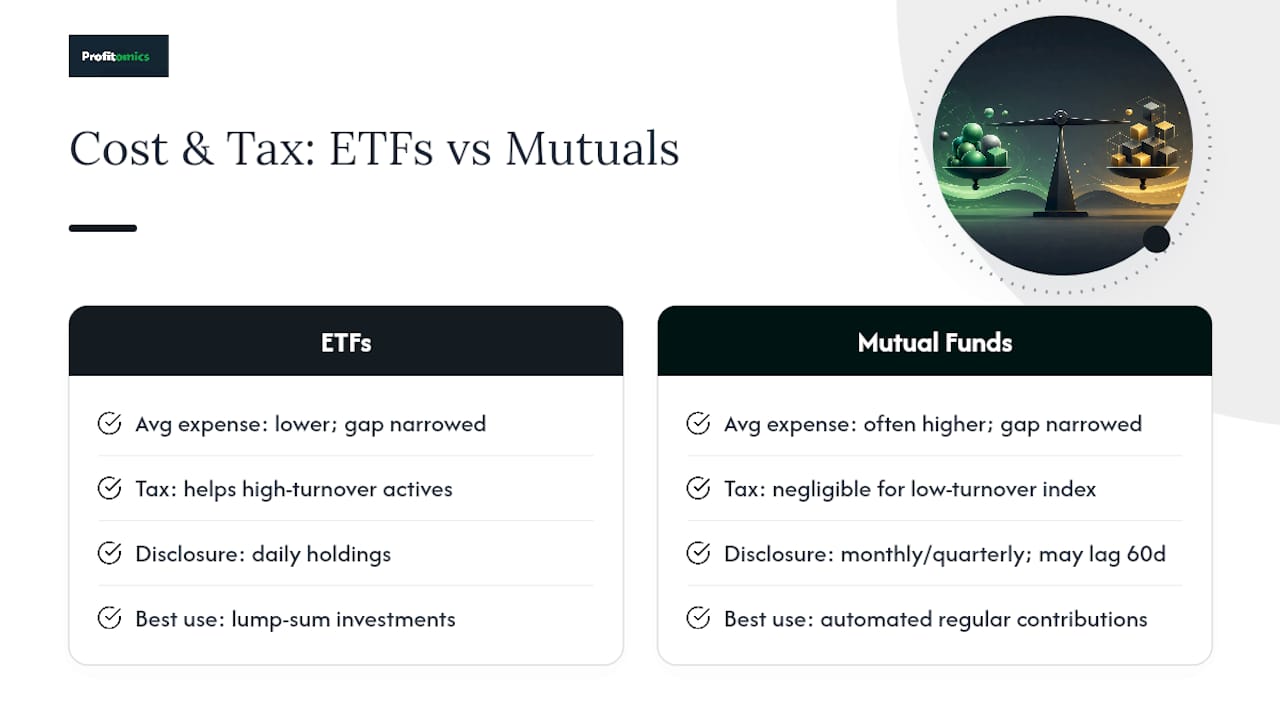
The tax efficiency advantage of ETFs is clearest for two types of strategies: high-turnover actively managed U.S. equity funds, and funds in categories where managers frequently sell holdings to meet redemptions. For low-turnover index strategies tracking the S&P 500 or total market, the tax difference between an ETF and a comparable index mutual fund is often negligible. VanEck’s analysis confirms this pattern: the benefit shrinks for low-turnover index funds and many bond strategies, and is most pronounced for actively managed or high-turnover equity strategies.
Statistic callout: The ICI 2025 Factbook tracks long-run fee trends across both vehicles and shows that average expense ratios for both ETFs and mutual funds have declined significantly over the past two decades, driven by index fund competition. The gap between the two has narrowed, making fund selection and tax placement more important than the vehicle itself.
Navy Federal’s guidance on combining vehicles makes practical sense: use index mutual funds for automated regular contributions and ETFs for lump-sum investments. That hybrid approach captures the automation convenience of mutual funds and the tax efficiency of ETFs where it matters most.
CNBC’s coverage of transparency differences is worth noting: many ETFs disclose holdings daily, while most mutual funds report monthly or quarterly, sometimes with a 60-day lag for certain managed products. For most long-term investors, this difference is academic. For investors who want to monitor factor exposures or avoid holding a specific company, daily ETF disclosure is a genuine advantage.
Pro Tip: For taxable accounts, look up the fund’s after-tax returns in its prospectus or on Morningstar before investing. The prospectus must disclose this figure by SEC rule.
The vehicle matters less than you think
Most of the mutual funds vs. ETFs debate is really a debate about costs, taxes, and behavior. The structure is secondary.
Here’s what gets underweighted in most comparisons: the investor who picks the “wrong” vehicle but invests consistently, keeps costs low, and stays the course will almost always outperform the investor who picks the “right” vehicle but trades frequently, chases performance, or holds cash waiting for the perfect entry point. Morningstar’s research on investor returns versus fund returns consistently shows a gap caused by poor timing decisions, not poor fund selection.
The practical rule is simple. In taxable accounts, prioritize tax efficiency first: that usually means ETFs for lump-sum investing and low-turnover index mutual funds for automated contributions. In retirement accounts, ignore the tax efficiency argument entirely and focus on expense ratios and automation. If your 401(k) offers a low-cost index mutual fund, that’s your answer regardless of what ETFs are doing in the market.
One more thing that rarely gets said: the fund prospectus is not just a legal document. It tells you the expense ratio, the after-tax return history, the distribution schedule, and the share-class minimums. Reading it takes 10 minutes and will tell you more about a fund’s real cost than any comparison article.
What Profitomics offers investors ready to act on this decision
Knowing which vehicle to choose is step one. Building the actual allocation, setting up automatic contributions, and managing tax events across accounts is where most investors stall.

Profitomics’ Stock Market Mastery guide gives you the step-by-step portfolio templates and order checklists that translate this comparison into a real investment plan, covering both ETF execution and long-term compounding strategies. For investors focused on automated income-building, The Passive Income Blueprint includes contribution templates and portfolio checklists built around mutual fund and ETF allocations. Both guides are delivered instantly as PDFs with companion spreadsheets. If you’re ready to move from comparison to implementation, start at Profitomics and download the guide that fits your strategy.
Sources
These primary sources are worth bookmarking if you’re doing deeper research on either vehicle:
- SEC guide to mutual funds
- ETFs vs. Mutual Funds: The Benefits That Really Matter | Morningstar
- ETFs vs. mutual funds: Key differences for investors | FINRA
- ETFs vs. Mutual Funds: Which To Choose - Vanguard
- Mutual fund or ETF? | Fidelity
This article is general information, not a substitute for advice from a qualified financial advisor. Consult a qualified financial professional about your own circumstances before acting on anything here.
Recommended
- Make Money Online — Ebooks on Passive Income, Stocks & Crypto | Profitomics
- Stock Market Mastery — Swing trading and long-term compounding strategies | Profitomics
- The Passive Income Blueprint — Build income streams that pay you while you sleep | Profitomics
- Crypto Profit System — A risk-first framework for building consistent crypto returns | Profitomics