Index Funds vs Stocks: Which One Belongs in Your Portfolio?

For most investors, a low-cost index fund should be the core of your portfolio, with individual stocks used as a smaller, deliberate supplement. That’s the direct answer to index funds vs stocks: funds first, stocks second, not the other way around.
The reasoning is straightforward. Index funds hand you instant diversification, rock-bottom fees, and almost no maintenance. Stocks can outperform, but they demand real time, real skill, and a stomach for volatility most people don’t have during a bad quarter. A blended approach, often called core and satellite, works well for the majority of readers weighing this decision.
- Index funds: the default core, offering low fees and broad diversification
- Individual stocks: a smaller allocation for those willing to research and monitor positions
- Blended portfolio: most investors blend the two in some proportion
Key Takeaways
A diversified index-fund core paired with a small, disciplined stock allocation gives most investors the best combination of low risk, low fees, and real upside.
| Point | Details |
|---|---|
| Index funds as the default core | Broad diversification and low expense ratios make them the lower-effort, lower-risk foundation. |
| Stocks require real skill and time | Concentrated positions demand ongoing research and a written thesis before you buy. |
| Odds favor indexing long-term | Most active managers underperform benchmarks over 20-year periods, per SPIVA-style analysis. |
| ETFs often beat mutual funds on taxes | In-kind redemptions reduce forced capital gains distributions in taxable accounts. |
| Combine both with core-and-satellite | A 70% to 90% index core with a 10% to 30% stock satellite fits many risk profiles. |
| Profitomics offers structured tools | Stock Market Mastery and The Passive Income Blueprint provide checklists for each sleeve of the plan. |
This article is general information, not a substitute for advice from a qualified financial advisor. Consult a qualified financial professional about your own circumstances before acting on anything here.
Table of Contents
- What Is an Index Fund and How Does It Work?
- What Does It Mean to Own an Individual Stock?
- Index Funds vs Stocks: Comparing Risk, Cost, and Taxes
- How Do You Decide Between Index Funds and Stocks?
- How to Build a Core-and-Satellite Portfolio
- Common Misconceptions About Index Funds and Stocks
- How Market Conditions Change the Calculus
- Learn Disciplined Stock Selection With Profitomics
- Sources
- FAQ
What Is an Index Fund and How Does It Work?
An index fund is a pooled investment that tracks a market benchmark, like the S&P 500 or the Nasdaq 100, instead of trying to beat it. You get two flavors: ETFs, which trade throughout the day like a stock, and index mutual funds, which price once daily at net asset value after the market closes. Functionally, ETFs and index mutual funds tracking the same benchmark deliver nearly identical returns; the real differences show up in trading mechanics and taxes, not performance.
The diversification math is what makes index funds compelling. A single fund can hold dozens to thousands of underlying securities, which means one company’s bad earnings call or bankruptcy filing barely dents your return. Own an S&P 500 index fund and a single failing company is one one-five-hundredth of your exposure, not your entire position.
Fees matter more than most new investors assume. Over 20 or 30 years, that fee gap compounds into a meaningfully larger ending balance, since every dollar not paid in fees stays invested and keeps growing.
What Does It Mean to Own an Individual Stock?
Buying a share of stock means buying a slice of one company, full stop. There’s no built-in diversification cushion.
Trying to build stock-picking into something resembling index-fund diversification takes real effort. Reaching even a baseline level of diversification with individual holdings typically requires 20 to 30 or more separate positions, each researched, monitored, and rebalanced over time. That’s a part-time job for most people, not a weekend project.
Picking stocks well requires reading balance sheets, tracking earnings calls, following sector trends, and knowing when a price drop reflects a real problem versus market noise. This is an active, skill-based pursuit, in contrast to the largely hands-off nature of passive index investing.
That said, stocks have a real place. If you have strong conviction about a company you understand deeply, individual shares let you express that view directly, something a broad index can’t do. Stocks also give you more control over tax-loss harvesting, since you decide exactly which lots to sell and when, rather than relying on a fund manager’s decisions.
Index Funds vs Stocks: Comparing Risk, Cost, and Taxes
Line the two approaches up side by side and the trade-offs get clearer fast.
- Risk: A single stock carries catastrophic risk (a company can go to zero); an index fund spreads that risk across an entire market segment.
- Returns: Index funds match the market, no more, no less. Stocks offer a shot at beating the market, but the odds are stacked against most attempts.
- Fees: Index funds charge a small annual expense ratio. Stocks carry no ongoing fund fee, but trading costs and the temptation to trade frequently can erode returns just as effectively.
- Taxes: ETFs generally have an edge over mutual funds thanks to in-kind redemptions that limit forced capital gains distributions; individual stocks give you full control over when you realize a gain or loss.
- Liquidity: ETFs and stocks both trade intraday with fractional-share options at most brokers; index mutual funds settle once daily at NAV.
- Effort: Index funds ask almost nothing of you after purchase. Stocks demand ongoing attention and a plan for managing your own emotions.
The performance gap is the part most people underestimate. Most actively managed funds fail to beat their benchmark over 20-year stretches, and that same difficulty applies to individual stock pickers trying to consistently outguess the market. It’s not that skilled stock-picking is impossible. It’s that doing it well, repeatedly, over decades, is rarer than the finance industry likes to admit.
On the tax side, the mechanics genuinely differ. ETFs can save meaningfully on annual tax drag compared with mutual funds holding the same index, because their in-kind creation and redemption process avoids triggering capital gains inside the fund.
Pro Tip: If you’re choosing between an ETF and an index mutual fund tracking the identical benchmark, default to the ETF in a taxable brokerage account. Save the mutual fund version for tax-advantaged accounts like a 401(k), where the tax-efficiency gap doesn’t matter.
How Do You Decide Between Index Funds and Stocks?
Run through a short checklist before you commit money either way:
- How many hours a week can you realistically spend researching companies?
- What’s your time horizon: five years, twenty years, or something in between?
- Can you watch a position drop 30% without panic-selling?
- Do you already have an emergency fund and maxed-out tax-advantaged accounts?
- Are you drawn to a specific company because of real research, or because it’s been going up?
Your answers point toward an allocation. A few common starting points:
- Conservative: 90% index funds, 10% individual stocks (or skip stocks entirely)
- Moderate: 80% index funds, 20% individual stocks
- Aggressive: 65% to 70% index funds, 30% to 35% individual stocks
Before adding any single stock position, ask whether you’d still buy it today at the current price, not just whether you’re glad you bought it earlier. Chasing recent winners is one of the most common ways new investors turn a satellite allocation into a core mistake.
How to Build a Core-and-Satellite Portfolio
Core and satellite investing means most of your money sits in broad index funds, while a smaller slice goes toward individual stocks you’ve chosen deliberately.
- Set your target percentages in writing before you buy anything.
- Rebalance once or twice a year, trimming winners back to your target weight rather than letting one stock take over the portfolio.
- Write a one-sentence thesis for every stock you buy, and revisit it when the price moves sharply in either direction.
- Set a rule for when you’ll sell, whether that’s a stop-loss percentage or simply “the original thesis no longer holds.”
Where you hold each piece matters too. Placing higher-turnover or actively traded holdings in tax-advantaged accounts when possible reduces the tax drag from frequent buying and selling, leaving your taxable account for the buy-and-hold index core.
Pro Tip: Treat every individual stock purchase as a small, tracked experiment. Log your entry price, your thesis, and your exit reasoning. After a year or two of entries, you’ll have real evidence of whether you’re actually developing an edge or just getting lucky.
How Profitomics Helps You Put This Into Practice
Turning this framework into action is easier with structured tools. Stock Market Mastery walks through disciplined stock analysis with checklists and tracking templates built for the satellite sleeve of a portfolio. Pair it with an index-fund checklist to lock down your core allocation first, then use the stock-picking templates to test ideas on paper before committing real money.
Common Misconceptions About Index Funds and Stocks
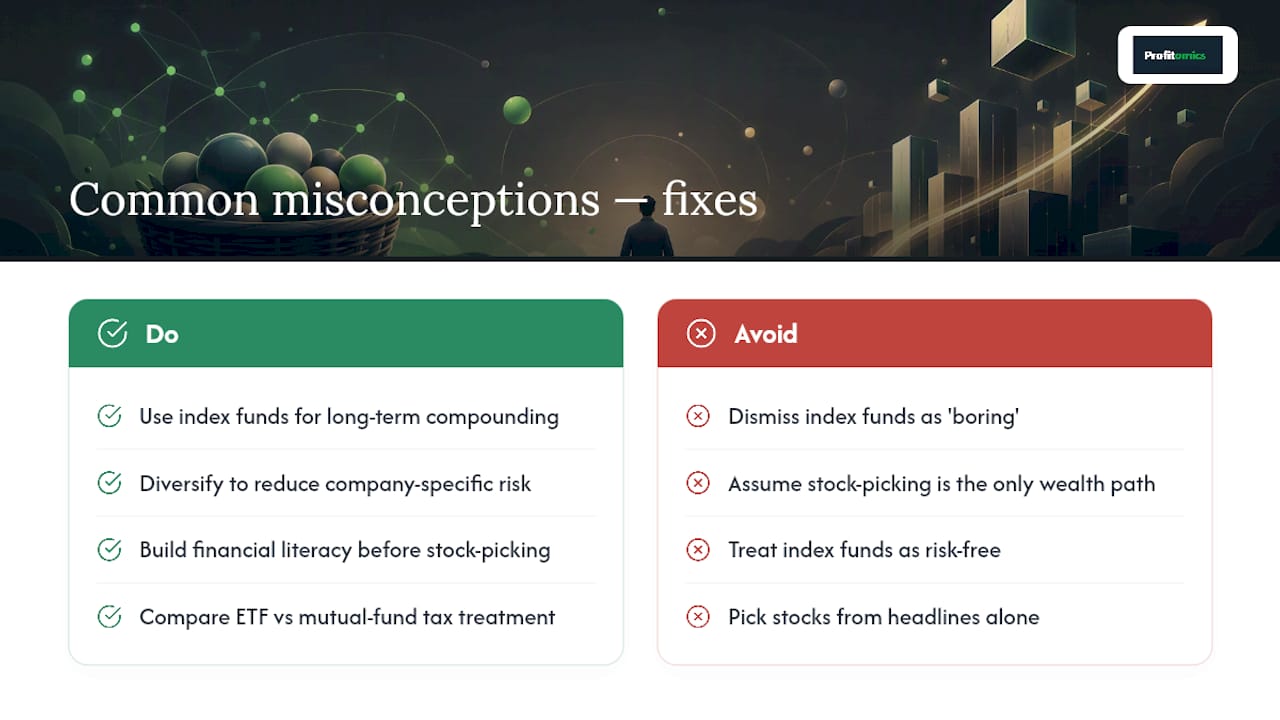
The biggest myth is that index funds are “boring” and therefore inferior. Boring, in this context, means fewer decisions, lower fees, and returns that quietly compound for decades without demanding your attention. That’s a feature, not a flaw.
Another common misconception: that picking individual stocks is the only path to building real wealth. Plenty of long-term wealth has been built entirely through diversified funds held for decades, with contributions added consistently along the way.
Some investors also assume index funds are risk-free because they’re diversified. They’re not. An S&P 500 index fund still drops sharply during broad market downturns; diversification protects you from single-company disasters, not from the market itself falling.
There’s also a persistent belief that stock-picking requires no more skill than reading headlines. In reality, distinguishing a temporary setback from a permanent problem takes financial literacy most casual investors haven’t built, which is exactly why most active managers, who do this professionally, still underperform their benchmarks over long periods.
Finally, some assume ETFs and index mutual funds are totally interchangeable. They’re close, but not identical. The tax treatment differs enough in a taxable account that the choice between them is worth making deliberately rather than defaulting to whichever one your brokerage shows first.
How Market Conditions Change the Calculus
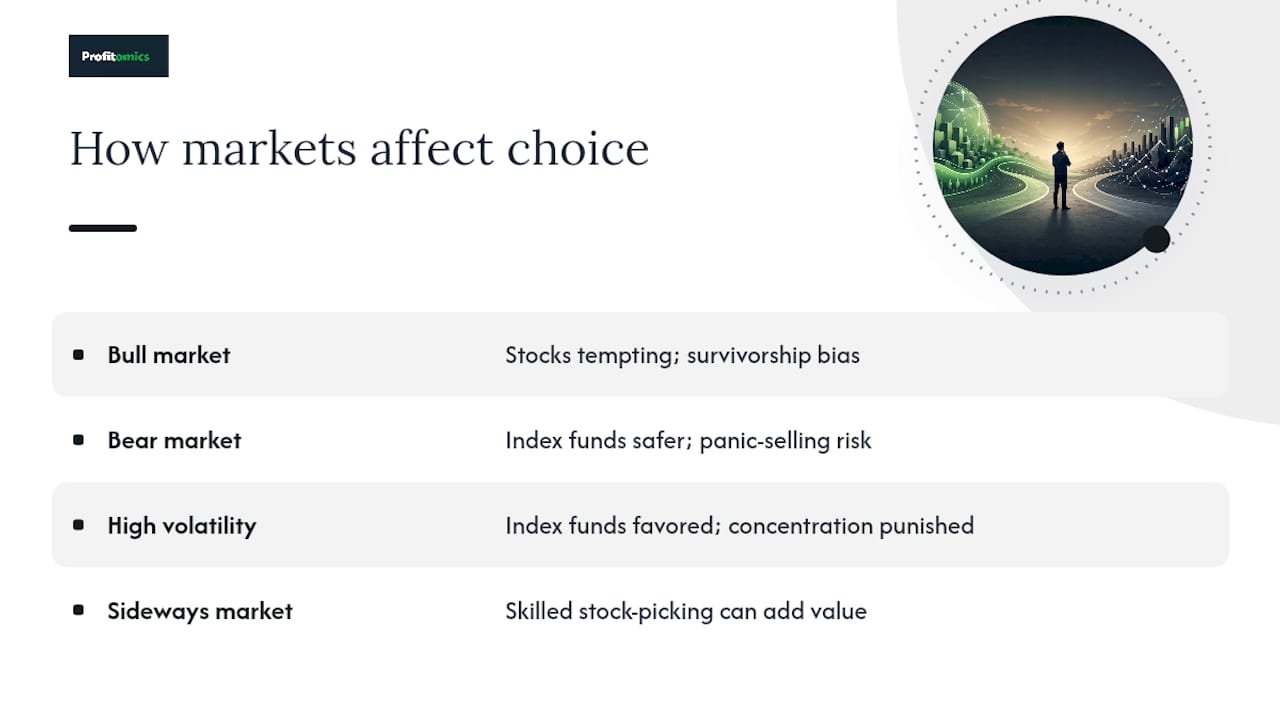
During bull markets, individual stocks can feel like the obviously better choice, especially the ones that are already climbing. That feeling is survivorship bias at work. You notice the stocks that went up and forget the ones that didn’t, which skews your sense of how often stock-picking actually pays off.
Bear markets test the opposite instinct. A concentrated stock position in a struggling company can be risky. This is where the behavioral risk of stock ownership shows up most clearly: panic-selling a beaten-down individual stock near its bottom is a far more common and costly mistake than riding out a broad index decline.
High-volatility, high-uncertainty periods, like sharp interest rate moves or sector-specific shocks, tend to punish concentrated positions hardest, since a company with a fragile balance sheet has less room to absorb bad news than a fund spread across hundreds of companies. Sideways or range-bound markets are arguably where skilled stock-picking has the most room to add value, since index funds simply track a benchmark that isn’t going anywhere, while a well-chosen individual stock might still find catalysts for growth.
The practical takeaway: don’t let current market conditions talk you into abandoning your allocation plan. A core-and-satellite structure is built precisely so market swings hit your satellite sleeve harder than your core.
Author perspective: when index funds win and when stocks earn their spot
My default is index funds for the core, every time. Stocks earn a spot only when I can afford to lose the position without changing my plans, and only after I’ve written down why I’m buying. Most losses I’ve seen investors take come from skipping that second step entirely.
— Kai
Learn Disciplined Stock Selection With Profitomics
Building the index-fund core of your portfolio is the easy part. Learning to run a disciplined satellite sleeve without letting emotion drive your trades is where most self-taught investors struggle.
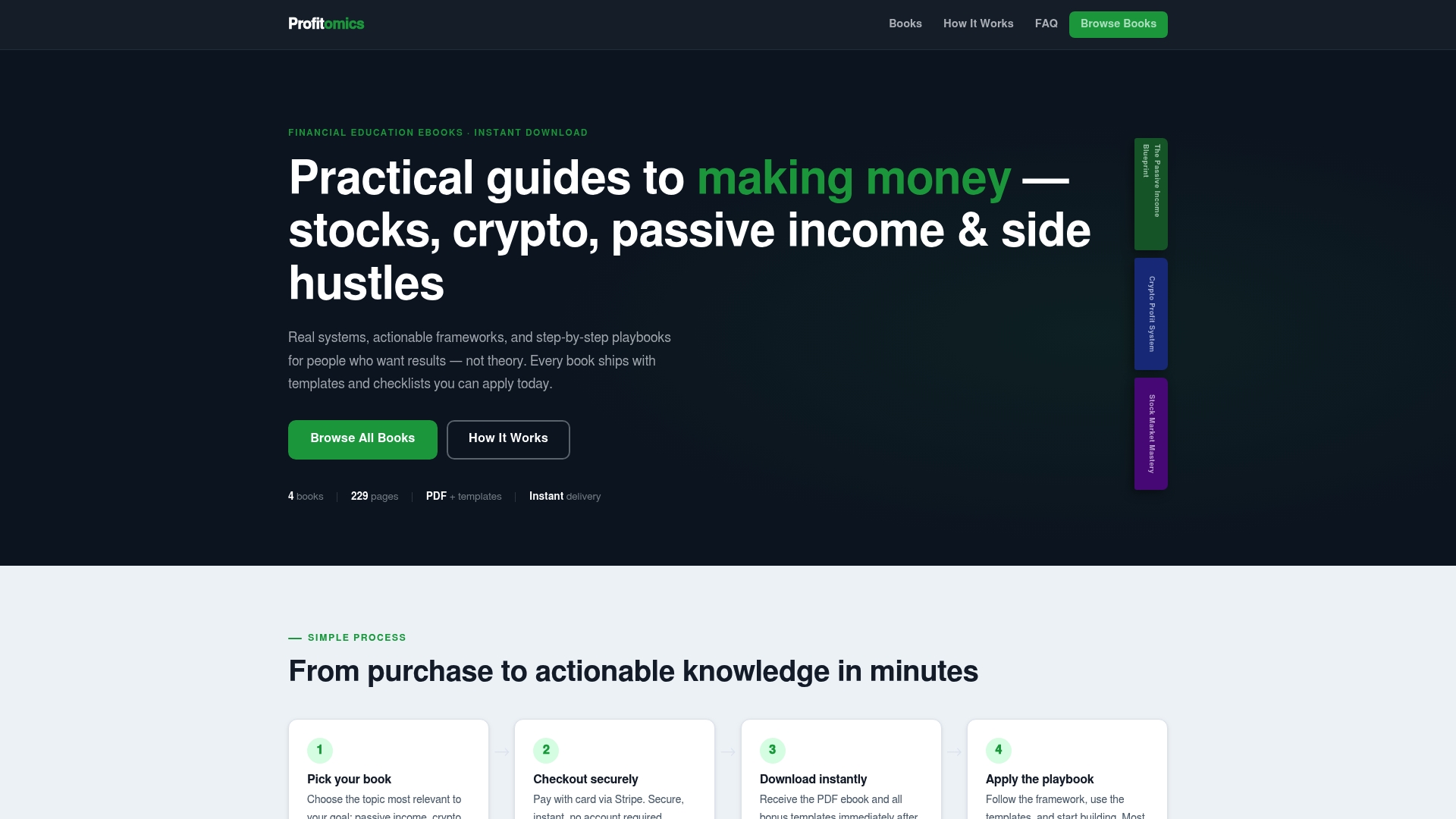
Profitomics built Stock Market Mastery specifically for that gap: a step-by-step ebook with templates and checklists for analyzing individual companies, sizing positions, and tracking whether your picks are actually beating the market or just riding a good year. If your priority is the core itself, The Passive Income Blueprint focuses on setting up reliable, low-maintenance income streams that complement a fund-based foundation. Both are instant PDF downloads with companion spreadsheets, so you can start applying the framework the same day you buy it. Visit Profitomics to see the full catalog and pick the resource that matches where you are right now.
Sources
- What is an index fund? | Vanguard
- What is passive investing? | Fidelity
- Index Funds Vs Etfs Vs Individual Stocks — What Actually Performs Better | Calculatorian
- Taxing index funds, mutual funds, ETFs and paths to reform | Brookings
FAQ
What Did Warren Buffett Say About Index Funds?
Buffett has repeatedly recommended low-cost S&P 500 index funds for most investors, arguing that few professional managers consistently beat the market after fees, a stance echoed by SPIVA-style research showing most active funds underperform over long periods.
What if I Invested $1,000 in the S&P 500 Ten Years Ago?
The exact return depends on the specific ten-year window and dividend reinvestment, but broad S&P 500 index funds have historically grown long-term investments significantly over rolling ten-year periods, though past performance never guarantees future results.
What Are the Big Three Index Fund Providers?
Vanguard, Fidelity, and BlackRock (through its iShares ETF lineup) are widely recognized as the largest providers of low-cost index funds and ETFs in the United States.
What Is the Downside of an Index Fund?
Index funds can’t outperform their benchmark, so you’re guaranteed to match the market rather than beat it, and they still fall in value during broad market downturns despite offering diversification against single-company risk.
Should I Choose Index Funds or Individual Stocks First?
Start with index funds to build a diversified core, then consider adding individual stocks only once you have the time, research process, and emotional discipline to treat stock-picking as a smaller, deliberate satellite allocation.